
One of the biggest mistakes traders make is celebrating the wrong numbers.
Ask a new trader about their performance, and they’ll often tell you their win rate.
“I win 75% of my trades.”
It sounds impressive.
Then you discover their average losing trade is three times larger than their average winner.
Despite winning most of the time, the account is steadily shrinking.
On the other hand, I’ve worked with traders whose win rates barely reached 45%, yet they consistently passed funded account evaluations and generated steady monthly returns.
The difference wasn’t luck.
It was understanding what a win rate actually measures and, more importantly, what it doesn’t.
Professional traders don’t track win rate to impress themselves.
They track it to improve decision-making.
Win rate is not a scorecard.
It’s a diagnostic tool.
When combined with expectancy, risk-to-reward, market conditions, and execution quality, it becomes one of the most valuable performance metrics in your trading business.
This guide explains how to track your forex trading win rate like a professional, how to interpret it correctly, and how to use it to refine your strategy instead of feeding your emotions.
What Is a Trading Win Rate?
Your trading win rate is the percentage of trades that close in profit over a given sample.
The calculation is simple.
Win Rate = Winning Trades ÷ Total Trades × 100
If you take 100 trades and 58 finish as winners, your win rate is 58%.
That number alone tells you very little.
It doesn’t reveal:
How much did you make?
How much did you lose?
Whether your strategy has positive expectancy.
Whether your execution was consistent.
Professional traders never evaluate win rate in isolation.
It is one piece of a much larger performance puzzle.
Why Traders Misunderstand Win Rate
Most traders assume a higher win rate automatically means better trading.
Research from the CFA Institute consistently shows that investors tend to focus on easily understood metrics while overlooking more meaningful measures of long-term performance.
Behavioral finance research by psychologist Daniel Kahneman also explains why people naturally seek frequent positive outcomes, even when those outcomes reduce overall profitability.
This bias appears constantly in trading.
Many traders sacrifice larger profits to maintain a higher percentage of winning trades.
Professional traders think differently.
They optimize expectancy.
Not appearances.
Why Win Rate Without Risk-to-Reward Is Meaningless
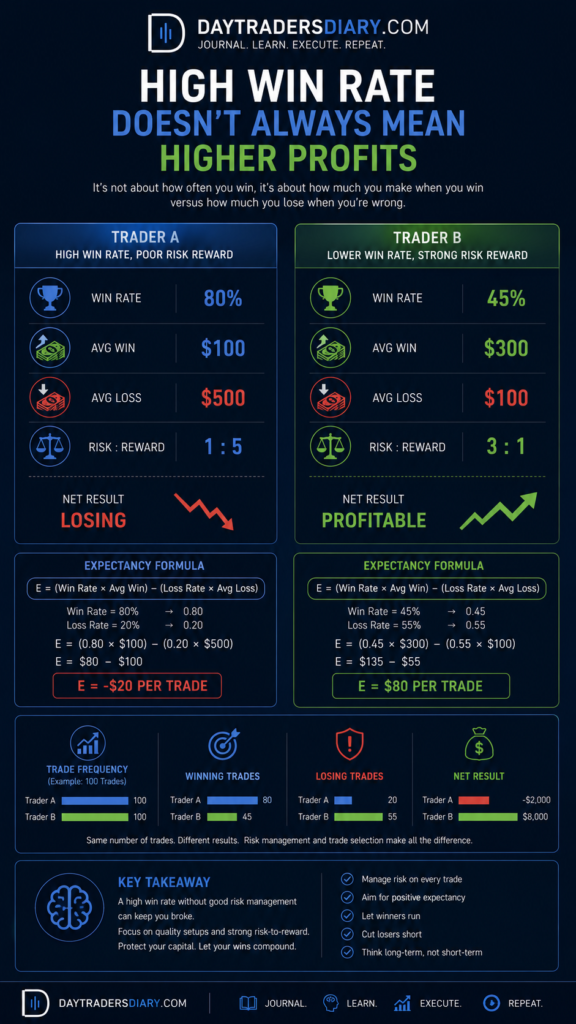
Let us consider two merchants.
Trader A is right 80% of the time.
$100 for each winning trade.
Each lost trade costs $500.
Trader B wins 45% of the trades.
Each profitable trade pays you $300.
Every losing trade loses $100.
Most beginners choose Trader A.
Professional traders immediately recognize that Trader B has the stronger business model.
The lesson is simple.
A high win rate cannot compensate for poor risk management.
This concept connects directly with our article on What Is a Trading Edge and How to Build One, where positive expectancy matters far more than isolated statistics.
The Metrics Professionals Track Alongside Win Rate
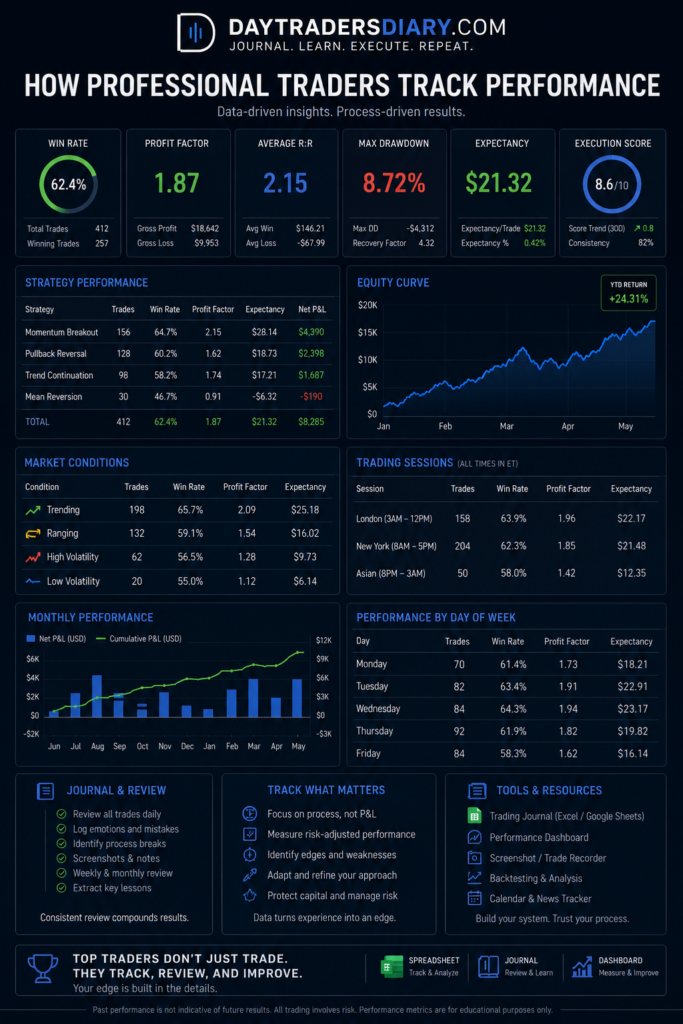
Win rate only becomes useful when viewed with supporting data.
Experienced traders monitor several additional statistics every week and month.
Average reward-to-risk ratio.
Average winning trade.
Average losing trade.
Maximum drawdown.
Profit factor.
Expected value.
Performance by market condition.
Performance by trading session.
These numbers explain why your win rate changes.
The percentage itself rarely provides the answer.
Track Win Rate by Strategy, Not Just Overall Performance
One mistake many traders make is combining every trade into a single statistic.
Imagine you trade:
Breakout strategies.
Range reversals.
News events.
If your overall win rate is 54%, what does that actually tell you?
Very little.
Professional traders separate every strategy.
For example:
Trend pullbacks may produce a 67% win rate.
Breakouts may generate only 39%.
Range trades may achieve 72%.
Now the data becomes actionable.
Instead of changing everything, you know exactly which strategy deserves improvement.
Track Win Rate by Market Conditions
Markets constantly change.
Your performance changes with them.
A professional journal records whether trades occurred during:
Strong trends.
Sideways markets.
High volatility.
Low volatility.
Major news sessions.
Quiet sessions.
You may discover something surprising.
Your strategy performs exceptionally well during trending markets but struggles badly during consolidation.
If you’ve read our guide on How to Trade Flat Markets, you’ll understand why recognizing different market environments often matters more than changing strategies.
The edge isn’t always the strategy.
Sometimes it’s knowing when to use it.
Track Execution Quality Separately
Not every losing trade is a mistake.
Not every winning trade is well executed.
Professional traders score execution independently of the outcome.
For example:
Did the setup meet every rule?
Was the entry disciplined?
Was position sizing correct?
Was the stop placed according to plan?
Did emotions influence the trade?
Imagine two losing trades.
One followed every rule.
The other resulted from chasing price.
The financial outcome looks identical.
The learning opportunity is completely different.
Execution quality often predicts future profitability better than today’s P&L.
Use Rolling Samples Instead of Daily Statistics
One profitable day means nothing.
Neither does one losing day.
Professional traders evaluate rolling samples.
Twenty trades.
Fifty trades.
One hundred trades.
This approach reduces emotional reactions to short-term variance.
It also aligns with probabilistic thinking.
A strategy with a genuine edge should reveal itself over meaningful sample sizes.
Not individual trades.
This concept is explored further in our article on What Is a Probabilistic Trading Model.
How to Build a Win Rate Tracking System
A professional tracking system does not need expensive software.
The important factor is consistency.
Each trade should include:
Date.
Market.
Strategy.
Market condition.
Entry reason.
Exit reason.
Risk percentage.
Reward-to-risk achieved.
Execution score.
Profit or loss.
Comments.
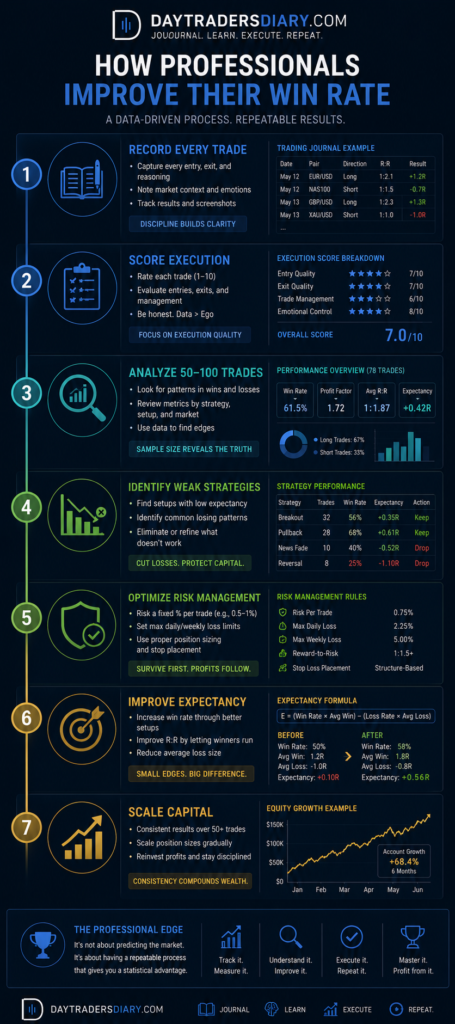
After fifty or one hundred trades, patterns begin emerging naturally.
Those patterns often reveal improvements impossible to notice from memory alone.
Risk Management Makes Win Rate Useful
Win rate has value only when supported by consistent risk management.
Imagine increasing risk after every winning streak.
Your statistics become distorted.
Performance becomes difficult to evaluate.
Professional traders risk a consistent percentage of capital regardless of recent outcomes.
This is where many traders make avoidable mistakes.
Using the Position Size Calculator ensures every trade carries consistent risk regardless of stop-loss distance or market volatility.
Without standardized position sizing, the win rate becomes much harder to interpret.
Your Journal Is More Valuable Than Your Win Rate
The best traders don’t obsess over percentages.
They study decisions.
Every trade should answer questions such as:
Why did I take this trade?
Did I follow my plan?
What market conditions existed?
Would I take this setup again?
Over time, your journal becomes a detailed performance database.
You stop relying on memory.
You start relying on evidence.
The Trade Journal Template makes this process simple by organizing trades into measurable categories that highlight strengths, weaknesses, and recurring behavioral patterns.
Eventually, your journal becomes your greatest competitive advantage.
When Your Win Rate Drops
A declining win rate does not automatically mean your strategy has stopped working.
Several possibilities exist.
Market conditions may have changed.
Execution quality may have declined.
Risk management may have become inconsistent.
Your sample size may still be too small.
Professional traders investigate before making changes.
They compare recent performance with historical data.
Only then do they decide whether adjustments are necessary.
Changing strategies too quickly often destroys profitable systems.
Scaling a Proven Process
Once your trading statistics demonstrate consistent performance over several months, another question naturally appears.
How can you apply that consistency to more capital?
This is one reason experienced traders explore proprietary trading firms such as The5ers, FTMO, and FundedNext.
Evaluation programs are designed to identify traders who consistently execute profitable processes rather than those who occasionally produce spectacular returns.
Your trading journal, win rate statistics, expectancy, and disciplined risk management all become evidence that your edge is repeatable.
If your data constantly proves your trading performance, a The5ers assessment account can be a reasonable next step to grow your trading business without having to invest a lot more of your own money.
Final Thoughts
Professional traders don’t chase a higher win rate.
They chase better decisions.
Ironically, improving decision quality often improves win rate naturally.
This week, don’t ask yourself how many trades you won.
Ask yourself why you won them.
Track your results by strategy.
Track them by market condition.
Track your execution.
Review your journal.
Those habits reveal opportunities that a simple percentage never will.
For your next read, explore our guide on What Is the Daily Routine of Successful Day Traders to learn how consistent preparation leads to more consistent trading statistics.
Frequently Asked Questions
What is a good win rate in forex trading?
There is no ideal win rate. Many profitable forex traders operate with win rates between 40% and 60% because they maintain strong risk-to-reward ratios and positive expectancy.
How do I calculate my trading win rate?
Divide the number of winning trades by your total number of trades, then multiply by 100. For example, 55 winning trades out of 100 equals a 55% win rate.
Is win rate more important than risk-to-reward?
No. Risk-to-reward and expectancy are generally more important. A lower win rate can still produce consistent profits if average winners are significantly larger than average losers.
How many trades should I track before evaluating my win rate?
Most experienced traders recommend evaluating at least 50 to 100 trades before concluding strategy performance.
Should I track the win rate for each strategy separately?
Yes. Tracking each strategy individually helps identify which setups consistently produce positive results and which require improvement or removal.
What is the best way to improve my win rate?
Select your setups better, trade only when the market is favorable, follow objective entry rules, maintain disciplined risk management, and examine your trading notebook often to find repeating mistakes.