
Ask a struggling trader if they keep a journal, and many will proudly answer, “Yes.”
Then you look inside it.
Date.
Entry price.
Exit price.
Profit.
Loss.
That’s not a trading journal.
That’s a trade history.
A real trading journal doesn’t just record what happened. It explains why it happened.
It reveals patterns you cannot see while you’re trading. It exposes emotional mistakes that charts never will. Most importantly, it turns every trade, whether profitable or not, into useful data.
After years of reviewing traders who consistently passed funded account evaluations and those who repeatedly failed, one habit appeared almost every time.
The profitable traders weren’t necessarily taking better trades.
They were learning faster.
And they were learning faster because they had a journal that actually worked.
This guide will show you how to establish an effective trading log, what information professional traders save, and how a simple trading journal can become one of the most valuable tools in your trading business.
Why Most Trading Journals Fail
Many traders begin journaling with gusto.
After two weeks they stop.
How come?
They produce journals that are too labor intensive and too little insight.
If those statistics never inform future judgments, recording dozens of statistics after every trade quickly becomes laborious.
A useful trading journal answers one simple question:
“What can I improve tomorrow?”
Everything else is secondary.
Research Shows Why Journaling Improves Performance
Research published in the CFA Institute consistently highlights the importance of structured performance evaluation in improving investment decision-making.
Similarly, psychologist Anders Ericsson, whose research on deliberate practice altered the way professionals develop skill, showed that ongoing feedback and thorough review produce faster increases than mere repetition.
Behavioral finance research also shows that memory is remarkably unreliable.
Most traders remember their biggest winners.
They remember painful losses.
They rarely remember the hundreds of average trades that actually define long-term performance.
Your journal eliminates that bias.
It replaces memory with evidence.
A Trading Journal Is Not About Profit
This may sound surprising.
Profit is not the primary purpose of a trading journal.
Improvement is.
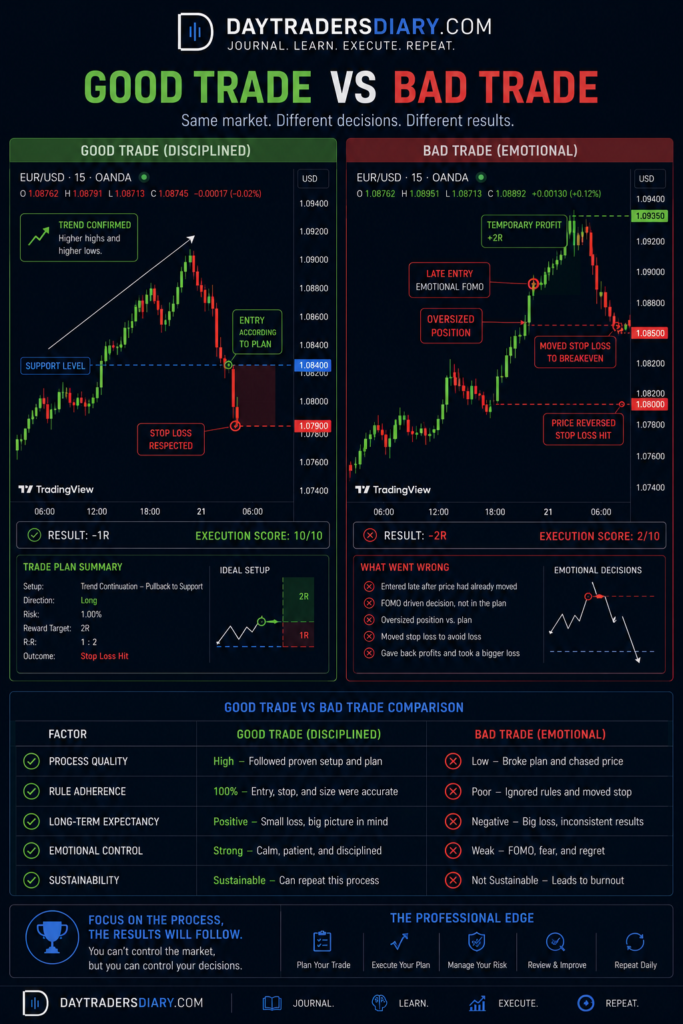
Picture two traders.
Trader A makes $500, breaching all the rules.
Trader B follows every rule flawlessly and loses $150.
Who had the best day?
Trader A is usually by most newcomers.
Trader B is selected by professional traders.
Because process creates consistency.
Consistency creates profitability.
A good journal measures decision quality before financial outcomes.
What an Effective Trading Journal Should Include
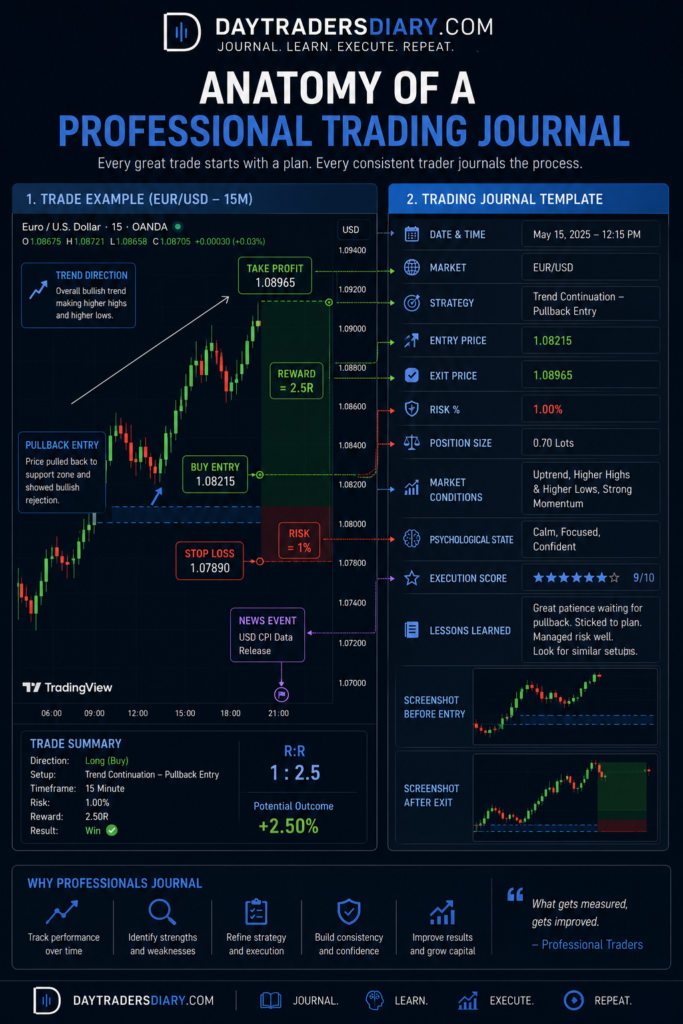
The best journals remain simple enough to complete every day while collecting enough information to improve performance.
Each trade should have:
Date and hour.
Traded market.
Used strategy.
Entry and exit price.
Risk %.
Reward to risk realized.
Market circumstances .
Admission reason.
Reason for leaving.
Before entering screenshot.
Screenshot after exit.
Execution score.
Psychological state.
Lessons learned.
Notice what is missing.
There is no unnecessary complexity.
Every field exists because it helps improve future decisions.
Record Market Conditions, Not Just Trades
One of the biggest improvements traders can make is documenting the environment surrounding every trade.
Ask yourself:
Was the market trending?
Was it ranging?
Was volatility high?
Was major economic news approaching?
This information often explains performance far better than the setup itself.
For example, your breakout strategy may produce excellent results during trending conditions but struggle during consolidation.
If you’ve already read our guide on How to Trade Flat Markets, you’ll understand why identifying market conditions often matters more than identifying chart patterns.
The market environment frequently determines whether your edge appears.
Score Your Execution
One error I see over and over again is to evaluate deals only by profit and loss.
Then execution score.
For instance this:
Did I obey all the rules?
Did I wait patiently.
Was my position size right?
Did I move my stop?
Did emotions influence my decisions?
Imagine losing two trades.
The first followed your plan perfectly.
The second resulted from chasing momentum after missing the initial entry.
Both lost money.
It’s just one thing to fix.
Execution scoring differentiates bad luck from bad trading.
Screenshots Often Reveal More Than Statistics
Experienced traders know charts tell stories that numbers cannot.
Every journal entry should include:
The chart before entry.
The chart after exit.
Several weeks later, reviewing these screenshots often reveals recurring habits.
Perhaps you consistently enter too early.
Your exits leave substantial profits unrealized.
Your best trades all occur after pullbacks rather than breakouts.
These observations become obvious visually.
Numbers alone rarely show them.
Review Weekly, Not Just Daily
Daily journaling creates data.
Weekly assessment drives improvement.
At the conclusion of each week, look at the patterns, not the individual trades.
Questions that are worth asking include:
Which arrangement worked best?
What were the most beneficial market conditions?
Which mistakes occurred repeatedly?
Did I overtrade?
Did I follow my risk plan?
The goal is to identify trends in your behavior.
Small recurring mistakes often create the biggest performance problems.
Track Process Before Performance
Professional traders focus on leading indicators.
Retail traders focus on lagging indicators.
Leading indicators include:
Rule adherence.
Preparation quality.
Risk consistency.
Execution discipline.
Journal completion.
Lagging indicators include:
Weekly profit.
Monthly profit.
The first group eventually influences the second.
Focusing exclusively on profits usually leads to emotional decision-making.
This idea connects closely with our article on What Is the Daily Routine of Successful Day Traders, where preparation matters more than prediction.
Use Your Journal to Measure Your Trading Edge
Your journal eventually becomes much more than a record of trades.
It becomes evidence of your edge.
Over time, you’ll discover:
Which strategy has the highest win rate?
Which market session suits you best?
Which setups produce the highest expectancy?
Which mistakes cost the most money?
This transforms your journal into a decision-making tool rather than a historical archive.
If you’ve read our article on What Is a Trading Edge and How to Build One, you’ll recognize that measurable data is what separates genuine edges from random success.
Risk Management Should Be Part of Every Journal Entry
Many traders record profits but ignore risk.
That makes performance difficult to evaluate.
Every trade should include:
Percentage of account risked.
Position size.
Stop-loss distance.
Reward-to-risk ratio.
This is where many traders make avoidable mistakes.
Using the Position Size Calculator ensures every trade begins with consistent risk rather than emotional position sizing.
Once risk becomes standardized, journal data becomes significantly more valuable.
Comparisons become meaningful.
Patterns become easier to identify.
Common Journaling Mistakes
Most ineffective journals fail for predictable reasons.
The trader only records winning trades.
Keeps up? The journal is too difficult.
Reviews don’t happen.
The emotional notes are left out.
Market conditions are not reported.
The lessons are never implemented.
A journal only creates value when it changes future behavior.
Otherwise, it becomes little more than bookkeeping.
Turning a Simple Trading Journal Into a Performance System
Your journal should gradually evolve.
The first month focuses on consistency.
The next few months focus on identifying recurring strengths and weaknesses.
Eventually, your journal becomes the foundation for every improvement you make.
Instead of asking:
“How do I become a better trader?”
You’ll begin asking:
“Which one habit is reducing my performance?”
That question has measurable answers.
Your journal provides them.
Scaling a Proven Process
One overlooked benefit of maintaining a detailed journal is that it prepares traders for larger opportunities.
Proprietary trading firms don’t simply reward profitable traders.
They reward disciplined traders.
Firms such as The5ers, FTMO, and FundedNext evaluate consistency, risk management, and execution just as carefully as profitability.
A trader who has a six-month notebook trail has something most candidates don’t have.
Proof.
Proof that the edge is reproducible.
Evidence of methodical decision making.
Proof that discipline outlasts streaks of winning and losing.
If your journal reveals a regularly lucrative procedure, then a The5ers evaluation account can be a reasonable next step to developing your trading business without the need to increase your personal capital significantly.
Final Thoughts
Your trading journal should become your coach.
Not your accountant.
The goal isn’t collecting data.
The goal is to uncover patterns that improve future performance.
This week, don’t focus on making your journal bigger.
Focus on making it more useful.
After every trade, write one sentence answering this question:
“What is the single biggest lesson this trade taught me?”
Over the course of one hundred trades, those lessons often become the foundation of lasting consistency.
For your next read, explore our guide on How to Track Your Win Rate Like a Pro to learn how to turn your journal into meaningful performance statistics.
Frequently Asked Questions
What is a trading journal?
A trading journal is a structured record of your trades, market conditions, decision-making process, emotions, and performance used to improve future trading decisions.
What should I include in a trading journal?
Include entry and exit details, strategy, market conditions, screenshots, risk percentage, reward-to-risk ratio, emotional state, execution quality, and lessons learned.
Why is a trading journal important?
A trading journal helps identify recurring mistakes, improve discipline, validate strategies, and build a repeatable trading edge based on evidence rather than memory.
Can a simple trading journal be effective?
Yes. A simple journal that is completed consistently is often more valuable than a complex journal that becomes too time-consuming to maintain.
How often should I review my trading journal?
Review trades daily for immediate feedback and conduct a detailed weekly or monthly review to identify patterns and long-term performance trends.
Does journaling improve trading profitability?
Journaling doesn’t directly boost earnings but it does improve decision-making, execution and discipline, which frequently leads to improved long-term trading performance.