
Most traders do not blow accounts because they cannot find setups.
They blow accounts because they size trades emotionally.
A trader can spend months studying price action, indicators, market structure, and trading psychology. But one oversized position during a volatile session can erase weeks of disciplined work.
Almost every experienced trader has lived through this at some point.
You take one trade that “looks too good to miss.”
Maybe confidence is high after a winning streak.
Maybe frustration is building after losses.
Maybe the setup feels obvious.
So you increase size slightly.
Then the market does what it always does eventually:
It moves against you.
Suddenly a normal losing trade becomes emotionally painful.
The problem was never the setup itself.
It was the risk exposure attached to it.
This is where position sizing changes everything.
Professional traders understand something many developing traders overlook:
Your survival in trading depends less on predicting markets perfectly and more on controlling how much damage one mistake can do.
That is exactly what a position size calculator helps solve.
This guide breaks down what a position size calculator actually is, how experienced traders use it in real market conditions, why most retail traders misuse risk sizing, and how proper position sizing quietly becomes the foundation behind long-term consistency.
What Is a Position Size Calculator?
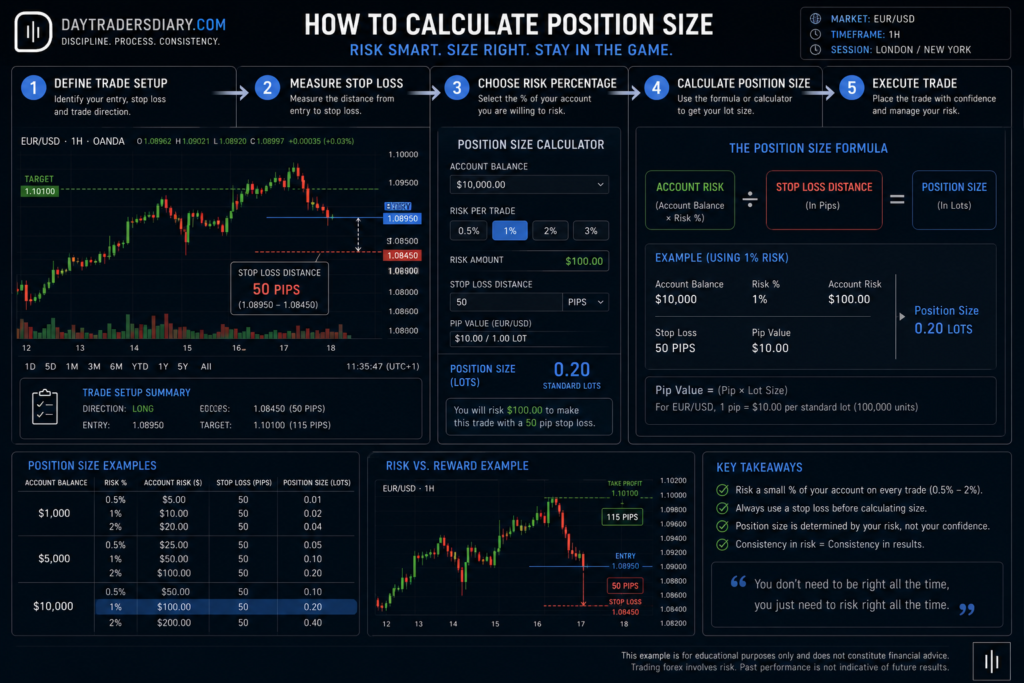
A position size calculator is a tool traders use to determine how much capital to risk on a trade based on account size, stop loss distance, and risk percentage.
Instead of guessing lot size emotionally, the calculator creates consistency mathematically.
It answers in simple words a key question:
“About how big should this trade be?”
Sounds straightforward yet it totally affects the trading behaviour.
Because traders typically make selections without organised sizing, emotionally:
They increase size after wins.
Reduce size after losses.
Oversize “high-confidence” trades.
Force recovery trades emotionally.
A position size calculator removes much of that inconsistency.
It creates structure before emotion has a chance to interfere.
Why Most Traders Misunderstand Risk
A lot of traders think risk management simply means using stop losses.
That is only part of the equation.
Position size matters just as much.
For example:
Two traders can use the exact same 20-pip stop loss on EUR/USD.
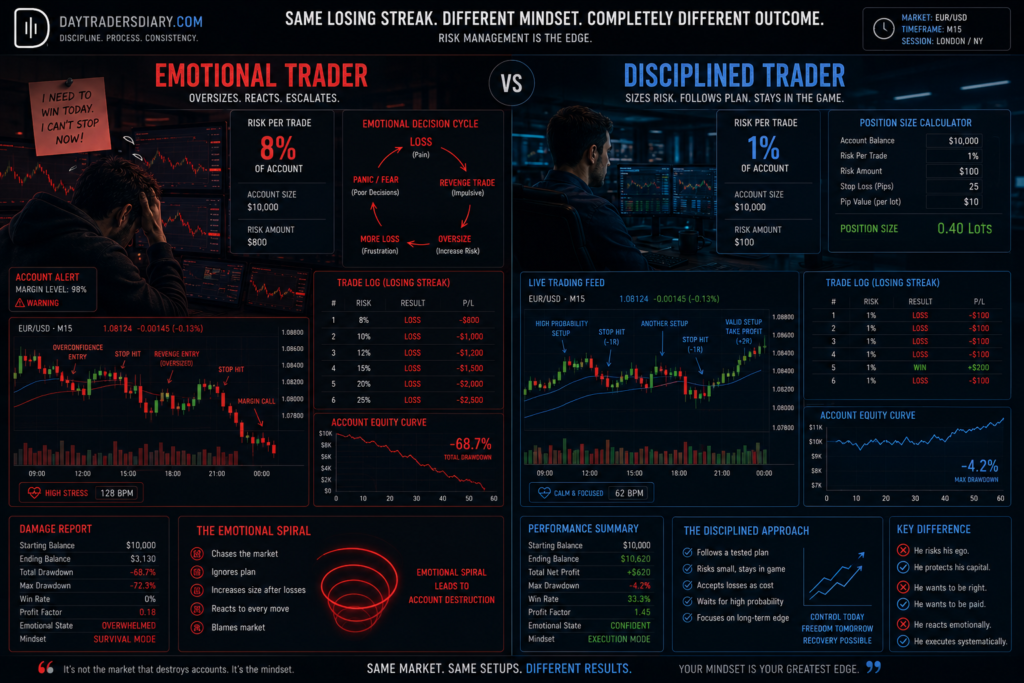
But if one trader risks 0.5% and the other risks 8% of the account, they are playing completely different psychological games.
One loss feels manageable.
The other feels catastrophic.
Research from the CFA Institute consistently highlights how emotional stress increases significantly when financial exposure exceeds a trader’s psychological tolerance.
Meanwhile, educational research from CME Group Education regularly emphasizes that risk consistency is one of the core foundations behind long-term survival in leveraged markets.
This is why experienced traders care deeply about sizing consistency.
Not because they fear losing.
Because they know that the better the execution, the better the emotional stability.
Why Traders Start Ignoring Position Sizing
Most traders respect risk rules at the beginning.
Then we start to feel things.
A few more wins and confidence is high.
A few loses later and frustration mounts.
Then the traders start to think:
“That’s a lot more solid.
“I can just make it a little bigger.”
“I can recover faster this way.”
That is usually where accounts begin becoming unstable.
One oversized trade creates emotional volatility.
Emotional volatility creates impulsive decisions.
Impulsive decisions damage consistency.
Professional traders understand that long-term performance is often less about finding better entries and more about avoiding emotional exposure mistakes.
The Real Purpose of a Position Size Calculator
Most traders think a position size calculator exists to protect money.
It does.
But psychologically, it protects something even more important:
Decision quality.
When traders know risk is controlled before entering a trade, they usually:
Cleaner race.
Trades hold more easy.
Don’t panic and rush decisions.
Don’t be so disrespectful of stop-losses.
That emotional stability is incredibly important.
For trading mistakes do not happen when we are in a peaceful state of mind.
They happen when fear and pressure take over.
How Professional Traders Actually Use Position Sizing
Experienced traders usually start every trade with one question:
“How much am I willing to lose if this setup fails?”
NOTE:
“How much can I make?”
That adjustment in thinking is what separates professional thinking from emotional gambling.
A typical structured sizing procedure consists of:
Account balance.
Risk per trade percentage.
Stoploss distance.
Trade quality.
For example:
A trader with a $10,000 account risking 1% knows the maximum acceptable loss is $100.
Once the stop loss distance is defined, the position size calculator determines the appropriate lot size automatically.
Simple process.
Huge psychological impact.
Because the trader now approaches the market with predefined risk instead of emotional improvisation.
Why Smaller Position Sizes Often Improve Performance
This is one of the hardest lessons traders learn.
Emotional noise from oversized postures.
Good traders do stupid things when the exposure becomes psychologically painful.
You begin to watch every candle with feeling.
Little dips are scary.
Normal pullbacks feel catastrophic.
Eventually the trader stops managing the trade objectively.
They start reacting emotionally.
Ironically, many traders perform far better after reducing size because calmer execution improves overall consistency.
That realization usually comes after painful drawdowns.
Why Volatility Should Influence Position Size
One mistake many traders make is using identical lot sizes across completely different market conditions.
That becomes dangerous quickly.
A 15-pip stop during quiet Asian session conditions behaves very differently from a 15-pip stop during Non-Farm Payroll volatility.
Professional traders adapt position sizing based on:
Volatility in the session.
Economic Events List
Liquidity situation.
Pair behaviour.
NASDAQ Market Research research consistently documents meaningful shifts in volatility regimes driven by the macroeconomic environment and institutional activity.
This is something that experienced traders respect.
They recognise that aggressive scaling when the market is not stable can often build up excessive emotional pressure.
Why Position Sizing Matters More Than Win Rate
Many traders obsess over strategy accuracy.
But win rate alone means very little without proper risk sizing.
A trader winning 40% of trades with controlled losses and strong reward-to-risk can outperform someone winning 70% while taking oversized emotional losses.
This is one of the biggest mindset shifts in trading.
Risk control often matters more than prediction accuracy.
That idea connects directly with many related DayTradersDiary.com articles discussing trading psychology, drawdown management, and long-term consistency.
How Position Sizing Impacts Trading Psychology
Position sizing is more than math.
It’s managing emotions.
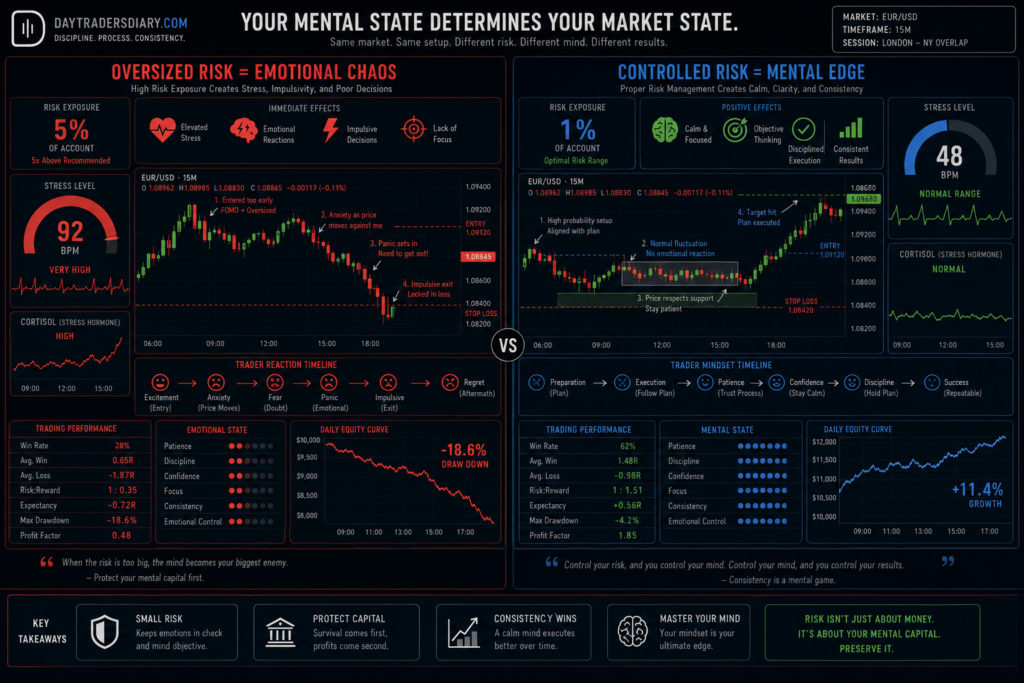
If the exposure is too much:
Fear increases.
Patience is no more.
Decrease in quality of execution.
If exposure is controlled:
The trader thinks logistics.
Traded on facts.
Usually takes losses.
No emotional rollercoaster rides.
That’s why expert traders are generally emotionally calm when the markets are volatile.
They know their risk before they even get into the trade.
That preparation changes everything psychologically.
Why Journaling Position Size Decisions Matters
Many traders only journal entries and exits.
They absolutely ignore hazardous behaviour.
That’s a big error.
In a well-organised journal, one will often see important patterns:
Overshooting after winning runs.
Aggressive recovery deals with losses.
Less discipline on days of crazy.
Emotional size increases during “high-confidence” setups.
Without tracking these patterns, traders keep repeating them unconsciously.
Using a structured Trade Journal Template helps traders review:
Emotional behaviour.
Selection of exposure.
Discipline of execution.
As time passes, traders start to figure out if their bad performance is due to flaws with their approach or errors in sizing.
It is a really big difference.
Why Serious Traders Use Evaluation Accounts Carefully
One reason funded trader programs fail many traders is not strategy quality.
It is position sizing discipline.
Firms like The5ers, FTMO, and TradeThePool heavily reward traders who can manage exposure consistently under pressure.
Most traders who fail evaluations do not fail because they lack technical knowledge.
They fail because they oversize emotionally.
That is why serious traders spend so much time refining risk consistency before scaling capital.
A The5ers assessment account could be a reasonable next step for disciplined traders wanting to grow beyond the limits of their own capital as it promotes controlled execution and competent risk management instead of uncontrolled aggression.
The Real Edge Behind Position Sizing
Most traders search endlessly for better indicators, faster entries, or more profitable setups.
But many of the traders who survive long term are simply better at controlling damage.
That’s the uncomfortable truth.
A position size calculator is more than a mathematical tool.
It’s emotional armor.”
It prevents one moment of impulse from turning into a disaster.
Take a hard look at your recent trades this week.
How many losses grew more than they had to because size was an emotional, not a mathematical, consideration?
That answer frequently tells you more about the long-term trading prospects than the approach itself.
For your next read, see related DayTradersDiary.com articles on risk management, psychology of trading and recovery from drawdown. Those topics are closely related to long term survival and consistency.
FAQs
What is a position size calculator in forex trading?
Position size calculators are tools that help traders determine the proper transaction size depending on their account balance, stop loss distance and risk percentage.
Why is position sizing important in trading?
Position sizing limits risk exposure, maintains emotional stability and allows traders to achieve long term consistency.
How much should traders risk per trade?
Most skilled traders would risk somewhere between 0.5% and 2% on any one trade based on their approach, the volatility and their account size.
Why do traders struggle with position sizing?
Emotions often cause traders to oversize after winning streaks or increase risk while trying to recover losses quickly.
Does position sizing affect trading psychology?
Yes. Large positions amplify fear, stress and rash decisions, while controlled sizing enhances emotional stability.
Why do funded trader programs focus heavily on risk management?
Programs like The5ers and FTMO reward traders who can manage exposure consistently and avoid emotional overleveraging.