
Every trader has experienced it.
You find a strategy that looks incredible in screenshots or on social media. You follow every rule for a week, only to watch it produce inconsistent results. Then another strategy catches your attention. You switch again. Months later, you’ve accumulated dozens of indicators, countless chart templates, and very little confidence.
The problem usually isn’t the strategy.
The problem is that most traders never develop a genuine trading edge.
An edge isn’t a secret indicator, an AI signal, or a magic chart pattern that predicts the next move. It is a measurable advantage that produces positive results over a large sample of trades. More importantly, it’s something you can execute consistently even when markets become difficult.
Surprisingly, professional traders spend little time searching for great entries. They spend the majority of their time testing concepts, perfecting execution, managing risk and eliminating variables that affect consistency.
In this article you’ll learn: – What is a trading edge truly is? – How to establish a trading edge in forex and day trading – Why backtesting is more important than prediction – How serious traders turn minor statistical advantages into long term profitability.
What Is a Trading Edge?
A trading edge is any repeatable advantage that gives you positive expectancy over a large number of trades.
Notice the emphasis on “repeatable.”
Anyone can catch one exceptional trade.
An edge means you can repeatedly identify situations where the probabilities are slightly in your favor while controlling downside risk.
Many traders confuse profitable trades with having an edge.
They’re not the same thing.
A trader may double an account in one month through aggressive risk-taking. Another trader may quietly earn steady returns with disciplined execution over several years.
Only one of those traders actually has an edge.
An edge is made up of numerous factors:
Market selection
Quality of Entry
Exit plan
Risk management program
Consistent execution
Psychological discipline
None of these variables alone creates profit.
They establish a repeatable process.
Research Shows Why Most Traders Never Find an Edge
Data from the CFA Institute consistently shows that successful market participants rely on systematic decision-making rather than intuition. Likewise, research published by CME Group shows that disciplined risk management has a greater impact on long-term performance than attempting to forecast every price movement.
The famed work of psychologist Daniel Kahneman also explains why traders often confuse recent outcomes for skill. Humans are pattern-seeking animals by nature, even when there are no patterns to be found. Get a few winners in a row and many traders think they have found the Holy Grail when they are only in the regular zone of statistical fluctuation.
For active traders, the lesson is clear.
A trading edge cannot be judged after ten trades.
It must survive hundreds.
That is why professional traders trust data more than confidence.
The Biggest Misconception About Trading Edges
Many traders believe an edge means predicting market direction.
It doesn’t.
Markets are uncertain by nature.
Your edge exists because certain market conditions historically produce slightly better outcomes than others.
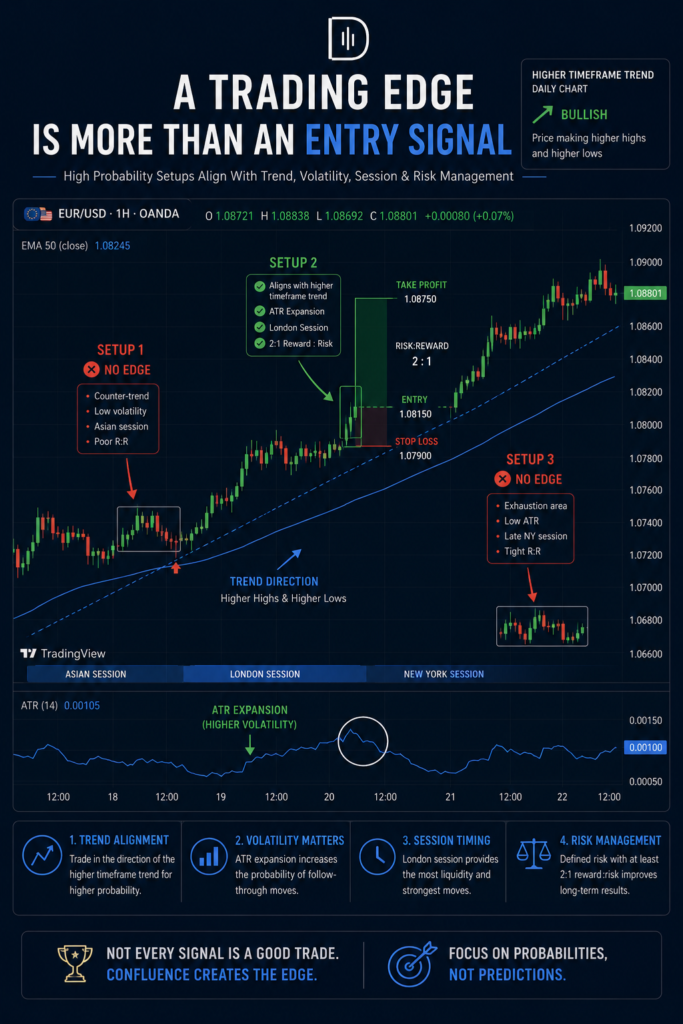
Imagine two breakout setups.
The first occurs during the London session, with rising volatility, strong higher-timeframe momentum, and increasing volume.
The second appears during a quiet holiday session with declining volatility.
Both charts may look identical.
Their probabilities are not.
Professional traders don’t simply trade patterns.
They trade context.
That context is often the real edge.
How to Build a Trading Edge
Building an edge starts with narrowing your focus.
Most traders try to trade every market, every timeframe, and every strategy.
Professionals become specialists.
Perhaps you only trade EUR/USD during the London session.
Perhaps you focus exclusively on Nasdaq pullbacks after major economic releases.
The narrower your focus, the easier it becomes to collect meaningful data.
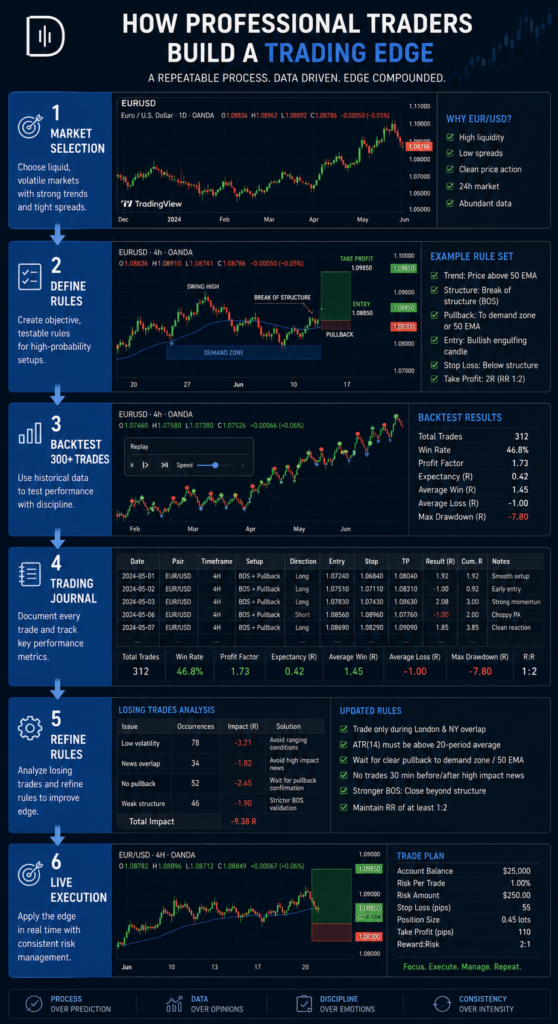
Once you’ve defined your market, establish objective rules.
Your entry should never depend on feeling confident.
Instead, define conditions that can be repeated exactly.
For example:
Price aligns with the higher timeframe trend.
ATR confirms above-average volatility.
Risk-to-reward is at least 2:1.
Major economic news has already passed.
These conditions don’t guarantee a winning trade.
They simply increase the probability that your historical edge will appear again.
Trading Edge Backtesting Is Where Confidence Is Built
Many traders backtest only to prove their strategy works.
Professional traders backtest to discover why it fails.
That distinction is vital.
When you look at historical charts, don’t only count winning trades.
Analyze losing trades closely.
Ask questions such as:
What market conditions prompted the failure?
Was the loss concentrated at low-volatility sessions?
The entries in too soon?
Did they leave before things got rolling?
The replies typically show gains that indicators will never show.
Backtesting should also measure:
Winning percentage
Average reward/risk
Maximum drawdown
Average holding time
Performance by session
Performance by weekday
Performance during news events
Over time, your strategy becomes less dependent on opinion and more dependent on evidence.
The Difference Between Strategy and Edge
A strategy tells you when to enter.
An edge explains why that strategy continues to make money.
For example, two traders may use the same moving average crossover.
Trader A follows every signal.
Trader B only trades signals that align with higher timeframe structure, rising volatility, and institutional trading sessions.
Both use the same strategy.
Only one has improved the underlying probability.
That’s the difference between copying a system and building an edge.
Your Edge Must Match Your Personality
One overlooked aspect of trading is compatibility.
An edge that works brilliantly for another trader may fail for you.
Scalping demands rapid decision-making and constant attention.
Swing trading requires patience and the ability to hold positions overnight.
News trading demands emotional stability under extreme volatility.
If your personality conflicts with your strategy, discipline becomes impossible.
The strongest trading edge is often the one you can execute consistently without forcing yourself to become someone you’re not.
If you’ve read our guide on Trading Psychology, you’ll recognize that self-awareness often contributes more to profitability than adding another indicator.
Protecting Your Edge Through Risk Management
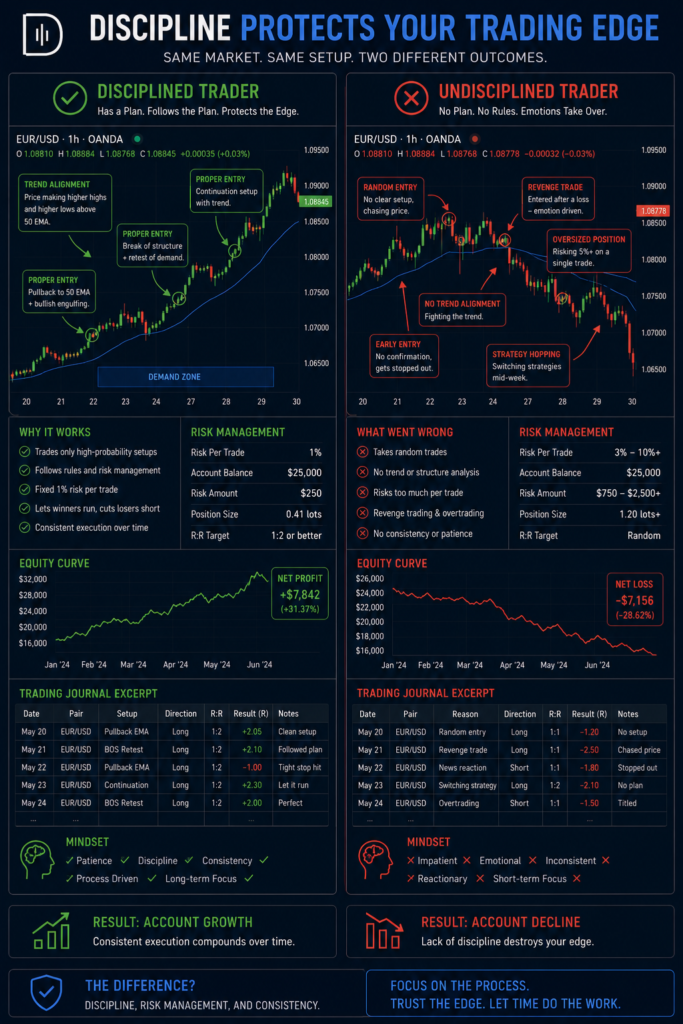
Even the best trading edge becomes useless if risk management is inconsistent.
Imagine a strategy with a strong positive expectancy.
One oversized losing trade can erase weeks of disciplined execution.
Professional traders think differently.
Every position carries predefined risk before the trade begins.
Position size adjusts based on the stop-loss distance rather than on emotional confidence.
This is where many traders make avoidable mistakes.
Using the Position Size Calculator removes guesswork and ensures every trade fits within your overall risk framework.
Your edge survives because your account survives.
Measuring Whether Your Edge Is Improving
An edge should evolve with data.
Every month, review your trades, not your profits.
Look for recurring patterns.
Perhaps breakout trades perform significantly better after major economic releases.
Maybe afternoon trades consistently underperform.
Maybe your best trades occur only on Tuesdays through Thursdays.
Small observations create meaningful improvements.
The Trade Journal Template lets you systematically track these details instead of relying on memory.
Eventually, your journal becomes a roadmap for refinement.
Professional traders don’t simply record trades.
They record decisions.
When a Trading Edge Stops Working
Every edge has periods of underperformance.
Markets change.
Volatility changes.
Changes in institutional behavior.
Liquidity circumstances are seasonal.
The answer isn’t to just abandon your strategy.
Rather, compare present performance to historical data.
If current drawdowns remain within historical expectations, continue executing.
If market conditions have fundamentally changed, begin testing adjustments before making major changes.
Patience often protects traders from destroying perfectly profitable systems.
Scaling a Proven Trading Edge
Once you’ve demonstrated consistent profitability over a meaningful sample of trades, the next limitation often becomes available capital.
A trader earning 5% monthly on a $3,000 account faces different opportunities than someone applying the same edge to a six-figure account.
This is why many disciplined traders explore proprietary trading firms.
Evaluation programs from firms like The5ers, FTMO, and FundedNext allow traders to demonstrate consistency before accessing significantly larger capital allocations.
The goal isn’t quick funding.
It’s proving your edge under structured risk parameters.
If your backtesting, live execution, and journal all point toward a repeatable advantage, a The5ers evaluation account can become a logical next step for growing your trading business without committing substantially more personal capital.
Common Mistakes That Destroy a Trading Edge
Most trading edges aren’t lost because markets have changed.
They’re lost because traders change.
A profitable process gradually disappears when traders:
Take trades outside their rules.
Increase position size after winning streaks.
Reduce position size after normal losses.
Switch strategies before collecting enough data.
Ignore changing market conditions.
The edge rarely disappears overnight.
Discipline usually does.
Final Thoughts
A trading edge isn’t something you discover once.
It’s something you build, measure, protect, and refine.
Every profitable trader eventually realizes that success comes from small advantages repeated consistently rather than dramatic predictions.
The market doesn’t reward perfect forecasts.
It rewards disciplined execution backed by evidence.
This week, challenge yourself to improve one variable instead of changing your entire strategy.
Test one filter.
Review one hundred historical trades.
Refine one execution habit.
Those incremental improvements often become the foundation of a lasting trading edge.
For your next read, explore our guide on What Is a Probabilistic Trading Model to understand how statistical thinking strengthens every trading edge.
Frequently Asked Questions
What is a trading edge?
A trading edge is a repeatable edge that gives a positive anticipation for a trader over many trades through consistent execution, good risk management and favorable market conditions.
How do I build a trading edge in forex?
Focus on one market and set up at a time, use objective trading criteria, backtest thoroughly, be consistent with your risk management and use trade journaling to fine-tune your technique.
Why is backtesting important for building a trading edge?
Backtesting can be used by traders to confirm whether a strategy has historically favorable expectation, to find weak points, enhance execution and create confidence based on facts, not feelings.
Can indicators alone create a trading edge?
No. Indicators are tools, not edges. A true edge comes from combining market context, risk management, execution discipline, and statistical validation.
How long does it take to develop a trading edge?
There is no fixed timeline. Most traders need hundreds of backtested trades and several months of live execution before determining whether an edge is genuinely repeatable.
Can a trading edge stop working?
Yes . Market conditions change. Good traders regularly measure their performance, compare it to past results and make changes based on evidence rather than abandoning their plan after a short losing streak.