
Most traders do not lose small accounts because they picked the wrong strategy.
They lose them because the pressure of trading a small account slowly changes their behavior.
At first, the strategy generally sounds fair.
A trader deposits a few hundred dollars and convinces himself they will stay disciplined, risk small, and build steadily. Then reality strikes in. A 2% gain feels pointless. A losing trade suddenly feels bigger than it should. The temptation to enhance leverage starts seeping in because delayed progress seems emotionally distressing.
That is where small accounts become dangerous.
Not because they are impossible to grow.
Because they expose impatience faster than larger accounts do.
Almost every experienced trader has gone through this phase at some point. The charts are not the real challenge in the beginning. The real challenge is learning how to think long term while staring at short-term results every day.
After years of watching traders go through this cycle, one thing becomes obvious:
Small accounts usually fail because of emotional decisions, not lack of market knowledge.
This guide is built around the mistakes traders rarely talk about openly. The goal is not to sell the fantasy of turning a tiny account into instant wealth. The goal is to explain how traders actually survive long enough to become consistently profitable.
Because once consistency appears, scaling becomes much easier.
Why Small Accounts Feel Harder Than They Should
Trading a small account creates a completely different emotional environment.
The smaller the account, the more traders feel pressure to speed things up.
CFA Institute research on behavioral finance shows that financial pressure leads to emotional decision-making, causing traders to take more risks when seeking to recover losses or to speed up gains.
Another study from MIT Sloan School of Management found that traders under performance pressure become more reactive to recent outcomes instead of focusing on long-term probabilities. In real trading, this is exactly why many small-account traders suddenly abandon their plan after two losses or double their position size after a winning streak.
Meanwhile, data released by NASDAQ Market Research continues to reveal just how transaction fees, spread expansion and slippage affect active day traders more than many realize, especially on smaller accounts, where margins for error are already thin.
What all of this means in practical terms is simple:
Small accounts are not just technically challenging.
They are emotionally exhausting.
That is why many traders who look disciplined on demo accounts struggle the moment real money gets involved.
The Biggest Mistake Small-Account Traders Make
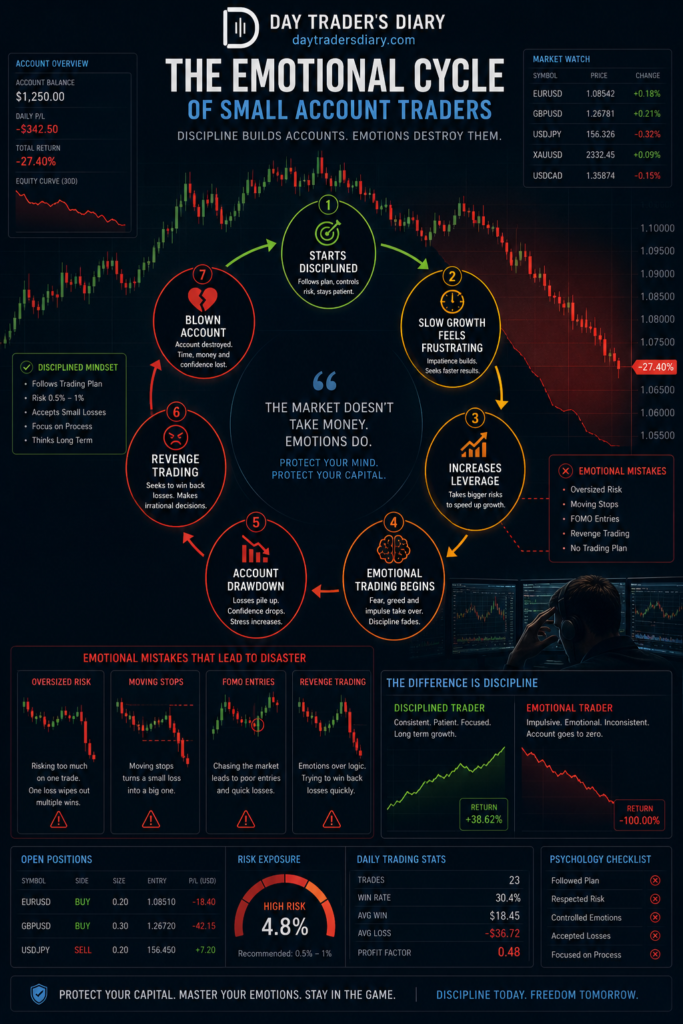
Most traders think the solution to limited capital is more aggression.
That mindset quietly destroys accounts.
A trader with a $300 or $500 forex account often starts believing they need oversized leverage to make meaningful progress. They convince themselves that one strong trade can change everything.
Sometimes it works temporarily.
That is why the habit becomes addictive.
The problem is that aggressive sizing changes decision-making quality. Once the emotional pressure becomes too high, traders stop reading the market objectively. Every trade suddenly feels important. Every pullback feels threatening. Every missed setup creates frustration.
The market stops being a probability game and starts feeling personal.
Experienced traders eventually learn something important:
A small account is not supposed to produce life-changing income immediately.
Its real purpose is teaching consistency under pressure.
That shift in mindset changes everything.
Why Many Traders Blow Small Accounts During Winning Streaks
Most traders expect losing streaks to be dangerous.
Winning streaks are often worse.
This happens constantly in forex trading.
A trader catches several clean momentum trades during a strong trending session. Confidence builds quickly. Then the risk starts increasing quietly. Entries become more aggressive. Trade quality matters less because recent wins create the illusion that the market suddenly became easier.
That is usually where the damage begins.
Strong market conditions can temporarily hide bad habits.
The trader thinks their strategy improved when in reality they simply experienced favorable volatility.
Then conditions change slightly and the oversized exposure becomes impossible to manage emotionally.
Professional traders understand that consistency matters more than short bursts of fast growth.
That is why many experienced traders keep position sizing almost painfully stable, even during profitable periods.
They understand discipline matters most when confidence feels high.
The Smartest Approach to Day Trading Small Accounts Forex
The best day trading small accounts forex approach is usually less exciting than most social media traders make it sound.
It is built around simplicity.
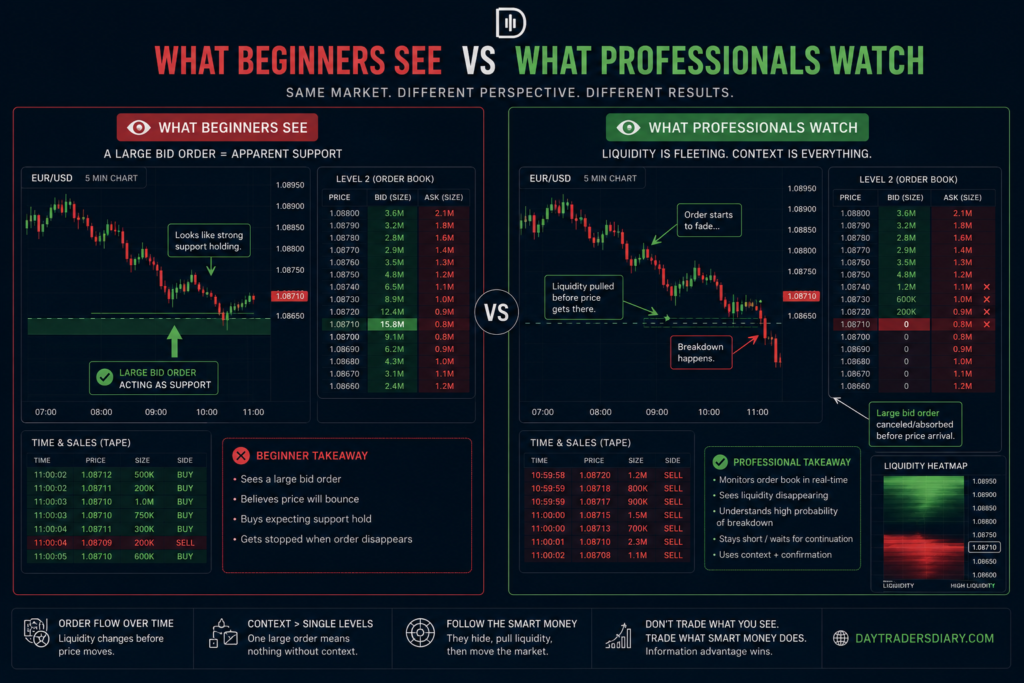
Experienced traders tend to focus heavily on a small number of markets instead of jumping between dozens of charts. They learn how specific currency pairs behave during certain sessions. They understand where liquidity enters the market and when momentum becomes unreliable.
That familiarity is more important than most newcomers know.
Most effective forex day traders tend to trade only the EUR/USD or GBP/USD during the London and New York sessions as they tend to be more liquid and have cleaner execution circumstances.
They are not chasing random movement all day.
They are waiting for structured opportunities.
This also explains why experienced traders often trade less frequently than newer traders.
Beginners think more trades create more opportunity.
Professionals know more trades usually create more emotional mistakes.
One clean trade executed properly often matters more than five impulsive entries taken out of boredom.
Why Position Sizing Is Everything for Small Accounts
Most traders underestimate how much emotional stability comes from proper position sizing.
When exposure becomes too large relative to account size, thinking clearly becomes almost impossible.
A trader risking 15% or 20% on a single trade may feel emotionally calm before entering, but the moment the trade fluctuates slightly against them, decision-making quality changes immediately.
Stops are changed.
Trades get closed too early.
The revenge trade is on.
This is where many traders quietly self-destruct.
The reason that professional traders standardize risk is because uniformity permits emotional control.
This is also where most traders miscalculate exposure without even knowing it. And by using a systematic Position Size Calculator, you remove the guesswork of emotions and keep your risk consistent throughout diverse market circumstances.
That consistency protects more than just capital.
It protects decision-making quality.
The Overtrading Trap Most Small Accounts Never Escape
One of the biggest problems with small accounts is the constant urge to trade.
The trader feels pressure to always be involved because account growth feels slow.
So they start taking trades simply because the market is moving.
This becomes especially dangerous in forex trading where lower timeframes create nonstop activity. Every candle starts looking like an opportunity.
Experienced traders eventually realize something important:
Movement is not the same thing as opportunity.
A large percentage of intraday price action is simply noise.
That is why many profitable traders create strict trading routines around specific sessions, specific setups, and maximum trade limits.
Some only trade the London open.
Some stop trading after two losses.
Some avoid low-volume conditions completely.
These rules may sound restrictive at first, but restrictions are often what protect traders from emotional decision-making.
If overtrading has become a recurring issue, related DayTradersDiary.com content on revenge trading and trading discipline connects directly to these patterns.
Why Scaling Too Fast Usually Ends Badly
Almost every trader dreams about scaling quickly.
Very few are emotionally prepared for it.
A setup that feels easy with micro-lots suddenly feels stressful once position size increases. Traders who looked disciplined at smaller exposure often become emotionally reactive once larger amounts are involved.
That transition catches many traders off guard.
Experienced traders scale slowly because they understand that psychology changes at different account sizes.
The goal is not to grow as fast as possible.
The goal is to maintain execution quality while size increases gradually.
That process takes longer than most traders expect, but it creates far more stability long term.
Why Journaling Matters More Than Most Traders Think
Most traders just follow profit and loss.
This will not do.
The actual usefulness in journaling is to recognize patterns of behavior.
Professional traders confirm:
How they felt when trading.
If they played by the book.
What session they traded on.
How they responded to losses.
Whether impatience has an effect on execution.
“Patterns emerge throughout time.
Many traders learn ultimately that their worst trades are usually the ones that come after a series of wins, during sluggish sessions or just after missing a setup.
Without journaling, these habits often remain invisible.
Using a structured Trade Journal Template helps traders review performance objectively instead of emotionally reacting to short-term outcomes.
The traders who improve fastest are usually the ones willing to study their own mistakes honestly.
Why Serious Traders Eventually Look Beyond Small Accounts
Profitable traders with limited capital eventually hit limits.
A trader can be very good and still have limited income potential since account size limits scalability.
This is one of the reasons why many disciplined traders eventually consider funded trader assessments.
Not because they are trying to take shortcuts.
Larger capital changes opportunity due to access.
There are firms like The5ers, FTMO and TradeThePool that allow traders to trade bigger accounts with professional risk structures.
The important part is mindset.
Professional traders do not approach evaluation accounts emotionally.
They approach them as scaling tools.
If a trader cannot stay disciplined on a small account, larger capital usually magnifies the same weaknesses. But for traders who already have structured execution and proper risk management, programs like The5ers can become a realistic pathway toward long-term growth without excessive personal financial pressure.
The Real Goal of Trading a Small Account
The real goal is not turning a few hundred dollars into overnight wealth.
That mindset usually creates emotional decision-making.
The real goal is learning how to execute consistently under pressure.
Small accounts show flaws quickly:
Over trading.
Over sizing.
Trade of revenge.
Impatience.
Fear of missing out.
As annoying as that process is, it’s also valuable.
Many of the traders that finally become consistently profitable originally acquired discipline with minimal capital.
Don’t be seeking faster profits, focus on improving one behavior this week.
Maybe trade less.
Perhaps cut down on the needless danger.
Perhaps we could cut less on imposing setups when slow sessions are happening.
More honestly, maybe review your blunders.
Those little tweaks add up way more than most traders think.
See related DayTradersDiary.com information on trading psychology, risk management and funded trader discipline for your next read. Those subjects are closely related to long term small account survival and growth.
FAQs
Can you grow a small forex account realistically?
Yes but growth is usually considerably slower than most traders think. Leverage aggression is significantly less important than consistency and risk control.
What is the best forex pair for small-account day traders?
Many traders like to trade the more liquid pairings such as EUR/USD and GBP/USD since spreads are smaller and execution is usually cleaner during active sessions.
Why do small trading accounts fail so often?
Most fail because traders take excessive risk, overtrade emotionally, and try to grow too quickly instead of focusing on consistency.
Should beginners use high leverage on small accounts?
High leverage puts a lot of emotional pressure. It tends to accelerate losses faster than growth without rigorous risk management.
How important is position sizing for small accounts?
It is critical. Poor position sizing destroys emotional stability and often leads to inconsistent execution and revenge trading.
How do funded trader programs help small-account traders?
Discipline traders can now work with programs such as The5ers and FTMO to acquire higher capital allocations without having to fund large accounts themselves.