
Most traders are not bad at spotting trends.
They are bad at entering them.
Price starts moving aggressively.
Candles expand.
Momentum builds.
The trader watches the move happen without them and starts feeling pressure almost immediately. Suddenly the fear of missing out becomes stronger than patience.
So they buy after three large bullish candles.
Or they short after the market already collapsed.
Then the inevitable pullback begins.
The setup itself was not wrong.
The timing was.
This happens constantly in forex day trading because emotionally, traders struggle with waiting. They want confirmation, but by the time confirmation feels emotionally comfortable, the market is often already extended.
That is why experienced traders spend less time chasing momentum and more time studying pullbacks.
After enough screen time, you realize something important:
Healthy trends do not move in straight lines.
They pause.
They retrace.
They shake traders out.
Then they continue.
Learning how to trade those retracements properly can completely change the quality of your entries, your reward-to-risk profile, and even your psychology.
Because when you stop chasing price, trading suddenly feels calmer.
This guide breaks down what a pullback in trading actually is, how professional traders approach trend pullbacks, why most traders mistime them, and how to build a practical pullback strategy that works in real market conditions instead of perfect chart examples.
What Is a Pullback in Trading?
A pullback is a transient price movement in the opposite direction of the main trend, before the price may continue to move in the original trend direction.
During an uptrend price pushes upward , retraces down temporarily and then attempts continuation upward .
In a downtrend, price falls, retraces upward briefly, then resumes lower.
The important word here is temporary.
A pullback is not automatically a reversal.
That distinction sounds simple, but emotionally it becomes difficult in live markets. Most traders see a few candles move against them and immediately assume the trend is finished.
Experienced traders think differently.
They expect pullbacks.
In fact, strong trends typically need to reverse in order to continue moving efficiently. Markets can’t expand strongly forever without retracing into liquidity.
Why Pullbacks Happen in Strong Trends
Many newer traders have a total misconception about pullbacks.
They think retracements = weakness.
Sometimes they truly point to healthy carry-on conditions.
Studies from CME Group Education frequently describe the natural ebb and flow of markets between periods of expansion and regression as liquidity flows rebalance.
Simultaneously, Market structure research via NASDAQ Market analysis shows that trends often retrace temporarily as traders go to take profits, new participants come in to take positions and liquidity has to replenish before continuation.
Behavioral finance work from the CFA Institute also shows how emotional participants often overreact during short-term price movement, creating exaggerated retracements inside broader trends.
This is why pullbacks often feel emotionally uncomfortable even when the trend itself remains healthy.
The market is constantly testing conviction.
Why Chasing Momentum Usually Ends Badly
Most traders have experienced this painful cycle.
They wait too long.
The move accelerates.
Emotion builds.
They enter late.
Then price immediately retraces against them.
Now the trader feels trapped.
They either panic close the position or hold emotionally without structure.
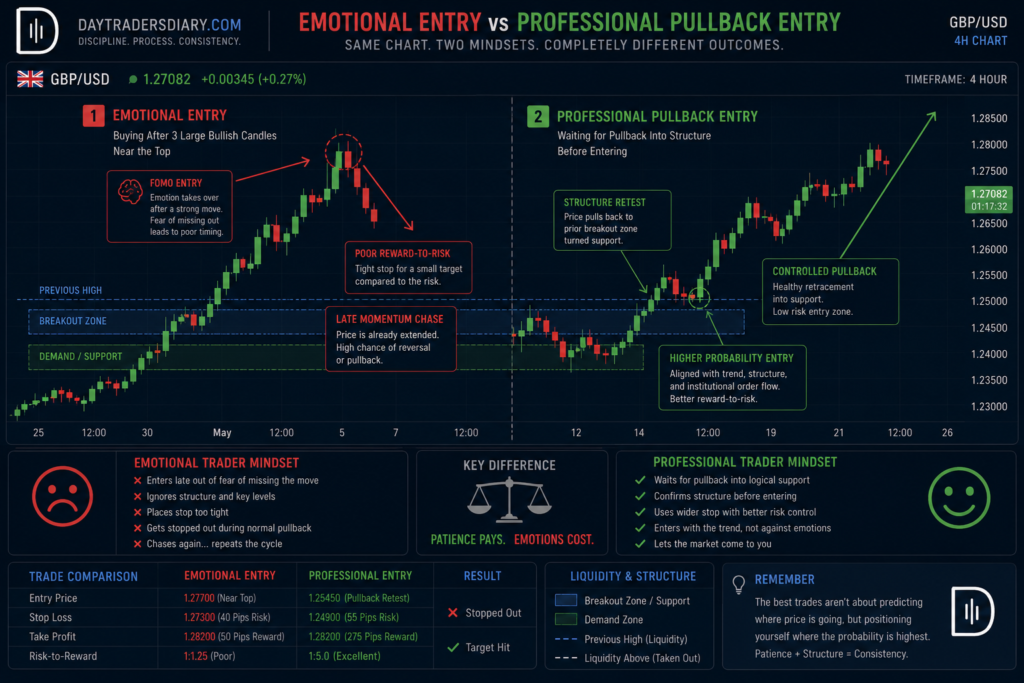
After enough experience, traders start realizing that breakout candles often create the worst emotional entries because reward-to-risk becomes distorted quickly once price extends too far.
Pullbacks improve positioning because they allow traders to enter closer to structure instead of buying emotional expansion.
That difference matters a lot over time.
One clean pullback entry can create better trade management conditions than three impulsive breakout trades combined.
The Core Idea Behind Trend Pullback Trading
A proper trend pullback approach is not to buy every dip mindlessly.
That method fails fast.
Professionals start with the context.
They want to know:
Is the higher timeframe trend still intact?
Are we seeing momentum slow or fully reverse?
Is retracement controlled or aggressive?
So where is the liquidity likely to be?
Do buyers or sellers still defend the form?
These are important questions since not every retracement becomes a continuation.
Some pullbacks become reversals.
The skill is learning how to tell the difference before entering emotionally.
What Experienced Pullback Traders Look For
Most experienced traders focus less on indicators and more on behavior.
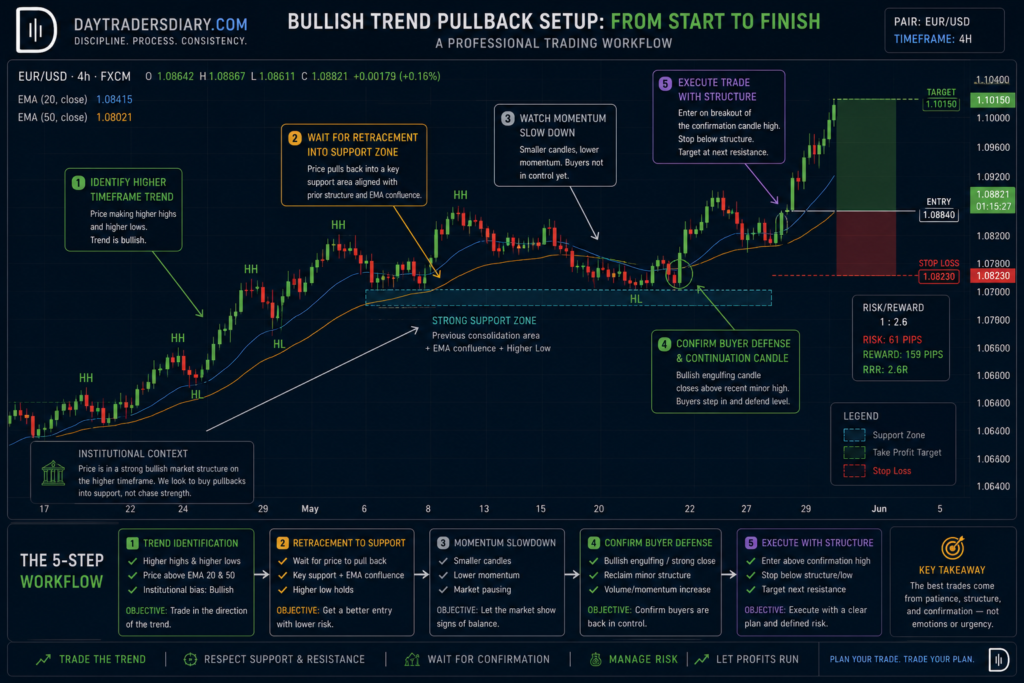
Some features of a healthy pullback are:
The general trend structure is preserved.
The retracement is slower than the impulsive move.
Volatility lasts for a short time.
Price retraces back into prior support or resistance zones.
Momentum begins to stabilize before the continuation attempts.
Think about GBP/USD breaking higher with strong impetus during the London session.
Rather of chasing the breakout candle, the trader calmly waits for price to retrace back into the initial breakout level. The retracement is slowing, sellers are weakening and buyers are starting to protect structure again.
That is the type of environment many experienced pullback traders prefer.
Not because it guarantees success.
But because the entry location makes more sense logically.
Why Most Pullback Traders Fail
The biggest mistake traders make with pullbacks is entering too early.
They assume every small retracement is an opportunity.
Then the market keeps pulling back deeper and emotional pressure increases quickly.
Another common problem is ignoring market conditions completely.
A pullback strategy that works beautifully during strong London session trends may fail repeatedly during low-volume Asian session conditions.
This is why experienced traders pay attention to:
Volatility.
Session timings .
Quality of the trend.
Liquidity conditions
Macroeconomic conditions.
Pullbacks perform best when the broad market background is supportive of continuance.
Without context, traders are inclined to approach every pullback the same, which usually leads to inconsistent results.
Indicators Can Help, But They Are Not the Edge
Many traders spend months searching for the perfect pullback trading strategy indicator.
Usually the problem is not the indicator.
It is the trader’s ability to read context.
Some traders use:
Moving averages.
VWAP
Fibonacci retracement.
RSI.
Channels Trend.
These technologies can be used to assist organize information but are not miraculous answers.
The pullback to a moving average in a strong trending environment is a whole different beast than the same configuration inside a choppy range.
Experienced traders eventually realize the edge comes from understanding behavior, not collecting indicators endlessly.
That idea connects directly with many related DayTradersDiary.com articles discussing volatility, execution discipline, and market structure analysis.
Why Pullback Trading Improves Risk Management
One reason why experienced traders love pullback trading is because it naturally increases reward to risk efficiency.
Traders might position closer to areas of support or resistance, instead of entering far away from structure.
That allows tighter stop placement without emotionally forcing trades.
But there is still one major problem many traders create:
Inconsistent risk sizing.
A good setup does not justify emotional oversizing.
This is where many traders ruin their long-term performance in silence. A systematic Position Size Calculator helps traders preserve the same exposure across different pairs, sessions and volatility environments.
That consistency matters more than most traders realize.
Because emotionally stable execution usually starts with stable risk.
Why Journaling Pullback Trades Changes Everything
Most traders rely too heavily on memory.
This is troublesome as memory is emotive.
A bad trade looks larger than it was.
A winning trade seems more repeatable than it is.
Journaling wipes away this misperception.
In particular, pullback transactions tracking helps traders identify:
What settings work best.
Which sessions have cleaner continuation.
If there were prepared entries or emotional ones.
Effect of Volatility on Trading
“After a while you start to see big patterns.
Some of the traders realize that they are better on early pullbacks after breakouts.
Others find they overtrade weak retracements in slow sessions.
But those patterns are invisible without documentation.
A structured Trade Journal Template enables traders to approach execution quality with an analytical eye and not react emotionally to random results.
That process greatly speeds up improvement.
Why Serious Traders Focus on Timing Instead of Excitement
Developing traders usually chase movement.
Experienced traders chase positioning.
That shift changes trading completely.
They wait for controlled retracements into key areas of structure to respond emotionally to big candles.
That patience gets better:
Posts.
Risk Management. •
Emotional equilibrium
Consistency of reward to risk.
It also prepares traders for more professional trading environments.
This is one reason disciplined traders often transition well into funded evaluation programs from firms like The5ers, FTMO, and TradeThePool.
These firms reward traders who can execute consistently without emotional overtrading.
A trader who understands pullback timing usually develops much stronger patience and discipline over time compared to traders constantly chasing momentum emotionally.
For traders looking to scale responsibly, a The5ers evaluation account can become a logical next step because it rewards controlled execution instead of impulsive trading behavior.
The Real Lesson Behind Pullback Trading
Trend pullbacks are not merely technical patterns.
They are tests of psychology.
The market always makes traders to behave emotionally:
Run immediately. Hunt now.
Late entry.
Don’t miss out.
Pullback trading teaches the opposing position.
Wait.
Let the price come to you.
Get in with organization, not enthusiasm.
That mind shift is so much more important than any one approach.
Let’s be honest about the transactions you’ve made recently this week.
How many losses were chasing price instead of waiting for a cleaner spot?
That answer often says more about the mentality of trading than strength of approach.
If you want to read more, check out the related articles on DayTradersDiary.com on trading psychology, volatility based execution and forex market structure. These issues are closely related to long-term consistency.
FAQs
What is a pullback in trading?
A pullback is a small reversal in the main trend, before the price continues in the original path.
What is a trend pullback strategy?
Trend pullback approach is a way of entering on retracements within an established trend, rather than following extended momentum moves.
Why do traders prefer pullback entries?
Pullback entries tend to be better positioned, tighter stop placement and better reward to risk conditions.
Which indicators are useful for pullback trading?
While many traders utilize moving averages, VWAP, Fibonacci retracements, and RSI, market structure and timing tend to matter more than indicators alone.
How do traders avoid mistaking pullbacks for reversals?
Professional traders will look at the trend structure, momentum behavior, volatility and liquidity situations, rather than react hastily to the short term retracements.
Why do funded trader programs value disciplined pullback traders?
Programs like The5ers and FTMO reward traders who demonstrate patience, controlled execution, and consistent risk management.