
Most traders don’t lose because they can’t identify good setups.
They lose because they expect every good setup to work.
That expectation quietly destroys decision-making. A single losing trade feels like proof the strategy is broken. Three losses in a row trigger strategy hopping. One big winner creates overconfidence. Before long, the trader isn’t following a system anymore. They’re reacting emotionally to individual outcomes.
Professional traders approach markets differently.
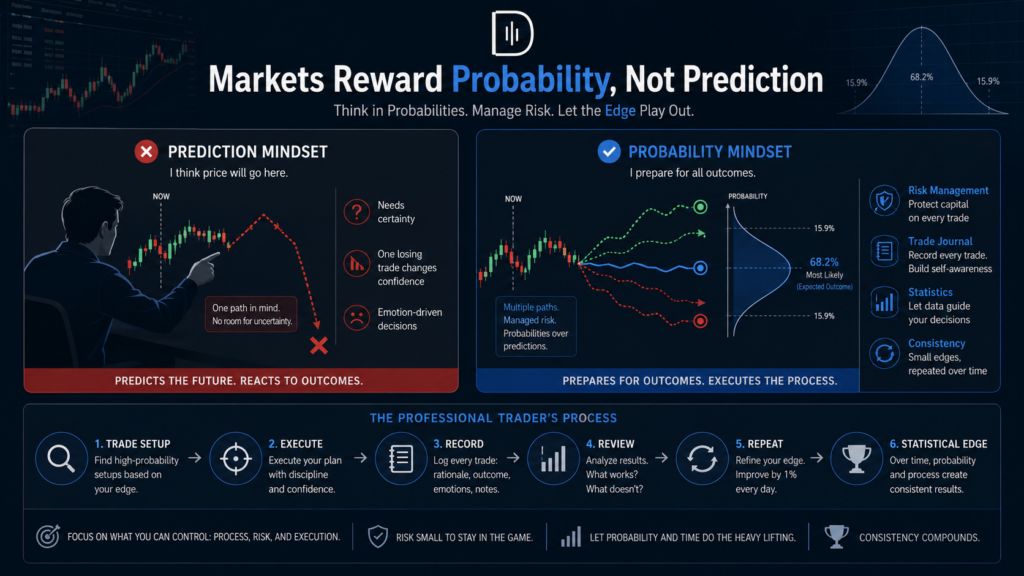
They understand that every trade is simply one event within a much larger sample. No pattern, indicator, or strategy can predict what the next candle will do with certainty. What sets the profitable traders apart from the failing traders is not prediction. It’s about learning to think in terms of probabilities.
A probabilistic trading model changes how you evaluate every setup, every loss, and every winning streak. Instead of asking, “Will this trade work?” you begin asking, “Does this trade have a positive expected outcome over the next hundred similar trades?”
That shift sounds simple.
In reality, it completely changes risk management, execution quality, emotional control, and long-term profitability.
This guide explains how probabilistic trading works in forex and day trading, why professional traders rely on probability theory rather than certainty, and how you can build a decision-making framework that withstands both winning and losing streaks.
Why Markets Can Never Be Predicted With Certainty
Millions of independent decisions happening simultaneously influence financial markets.
Central bank announcements, institutional positioning, economic releases, geopolitical events, options flows, algorithmic execution, and retail participation all interact simultaneously.
Even if you correctly identify the technical structure, unexpected order flow can invalidate your analysis within seconds.
This isn’t a weakness of technical analysis.
It’s simply the nature of probabilities.
Famous psychologist Daniel Kahneman’s book Thinking, Fast and Slow illustrates how humans instinctively desire certainty, even when ambiguity predominates decision-making. Traders often fall into this trap thinking a great looking setup should immediately materialise into a winning trade.
A constant theme in research released by the CFA Institute is that probabilistic reasoning, not deterministic forecasting, is the key to effective investment and trading decisions. The Chicago Mercantile Exchange (CME Group) also points out in its research that risk management is built on ambiguity, not certainty.
For day traders, this means one important truth.
A good trade can lose.
A bad trade can win.
Only a large sample tells you whether your edge is real.
What Is Probability Theory in Trading?
Probability theory in trading is the process of making decisions based on statistical likelihood instead of prediction.
Imagine a trading strategy with these characteristics:
48% win rate
The average reward is twice the average risk
Consistent execution over 200 trades
Many beginners reject this strategy because it loses more than half the time.
Professional traders immediately recognize its value.
Even with only 48 winning trades out of 100, the larger average winners generate positive expectancy.
The individual trade becomes irrelevant.
The sample becomes everything.
This is exactly how casinos operate.
They do not know whether the next roulette spin will produce a profit.
They know thousands of spins create mathematical certainty because their statistical edge remains positive.
Professional traders think the same way.
Research Shows Consistency Beats Prediction
Several respected studies reinforce this idea.
Research from CFA Institute demonstrates that investors consistently overestimate forecasting ability while underestimating uncertainty.
The Bank for International Settlements (BIS) has repeatedly noted that modern markets exhibit randomness over short time horizons, making precise prediction nearly impossible.
Academic research by economist Eugene Fama also supports the idea that short-term price movements exhibit significant randomness, suggesting that traders should focus on managing probabilities rather than forecasting exact outcomes.
For active forex traders, this means your competitive advantage doesn’t come from predicting every move.
It comes from consistently executing situations where probabilities are slightly tilted in your favor.
That small edge compounds over hundreds of trades.
What a Probabilistic Trading Model Actually Looks Like
A probabilistic trading model isn’t just a strategy.
It’s a complete decision framework.
Every trade answers several questions before execution.
Does this setup historically produce positive expectancy?
Is current market volatility consistent with previous successful trades?
Is the trend strength supporting the setup?
Is risk predefined?
Does this trade fit today’s trading conditions?
If those conditions align, the trade is executed regardless of emotional confidence.
Confidence becomes irrelevant.
Data becomes everything.
This is why experienced traders often appear emotionally detached.
They’re not emotionally stronger.
They’re simply trusting probabilities instead of predictions.
Building a Probabilistic Trading Forex Strategy
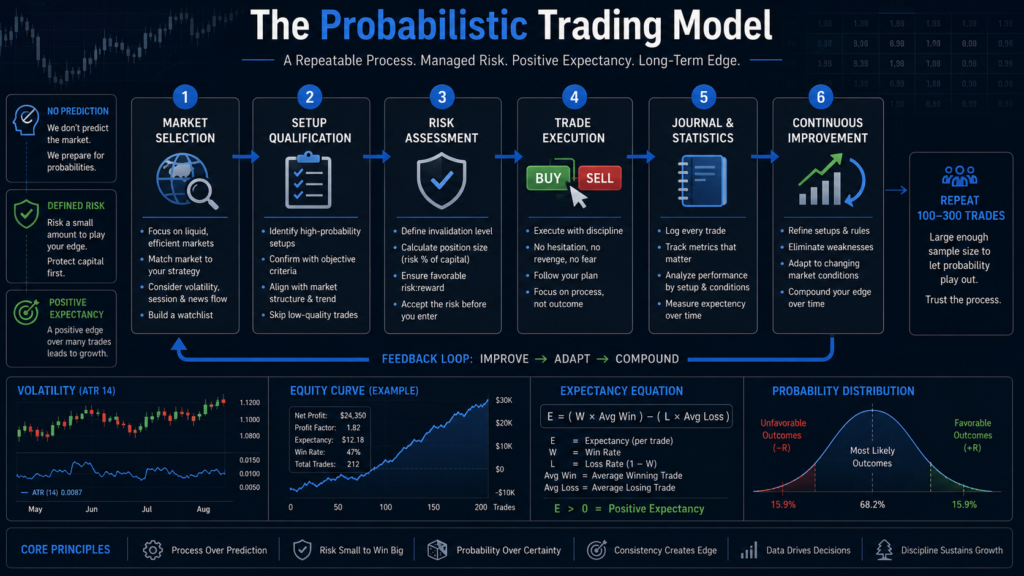
Every professional trading model follows a roughly similar sequence.
First comes market selection.
You identify environments where your edge historically performs well. Some traders perform better in strong trends. Others excel during range-bound sessions.
Second comes the setup qualification.
Instead of entering every signal, you define strict filters.
For example:
Price respects the higher timeframe trend.
Volatility, as measured by ATR, remains above average.
Risk-reward exceeds 2:1.
Major economic news is avoided.
Breakout confirmed on volume.
Each filter makes the chance somewhat higher.
None promise success.
Together they boost long term expectancy.
Third is execution.
Once the prerequisites are met, the execution is automatic.
There is no debate.
No second-guessing.
No searching for additional confirmation.
Finally comes the statistical review.
Each trade updates your database rather than your emotions.
The sample grows.
Confidence grows with it.
Why Most Traders Misunderstand Win Rate
One of the biggest misconceptions in day trading is the belief that a higher win rate equals higher profitability.
It doesn’t.
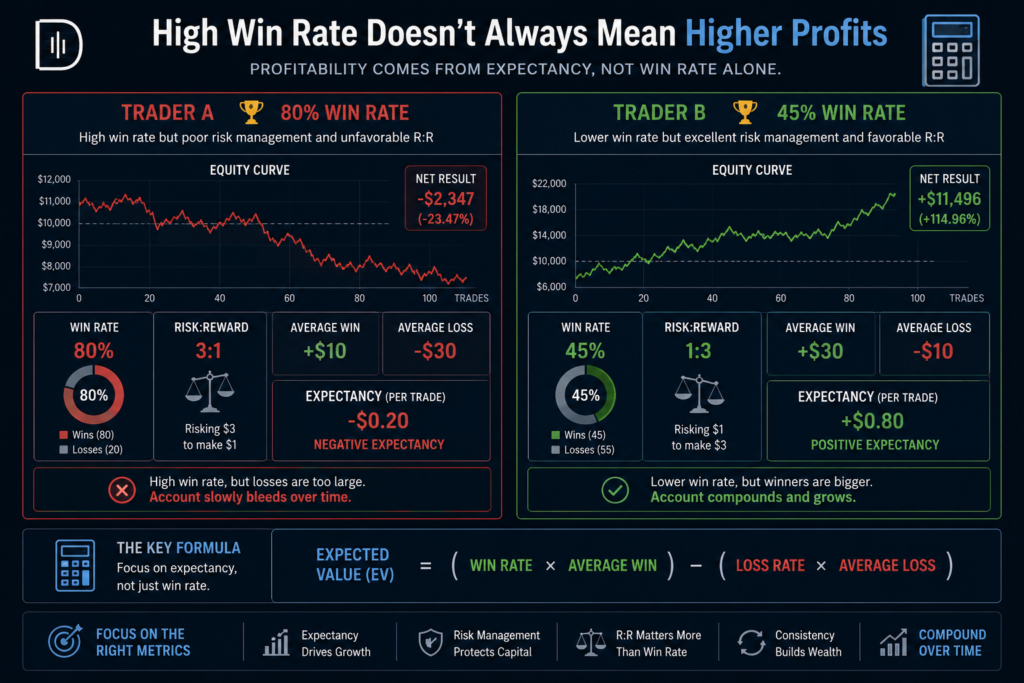
Consider two traders.
Trader A wins 80% of trades but risks three dollars to make one.
Trader B wins only 45% but makes $3 for every $1 risked all the time.
Trader B loses more often . But after hundreds of trades he often exceeds spectacularly.
The professionals are on expectancy.
Expected Value = (Win Rate × Average Win) − (Loss Rate × Average Loss)
Every profitable trading business revolves around this equation.
Nothing else matters over the long run.
How Probability Changes Your Trading Psychology
Most emotional mistakes disappear once probability becomes your mindset.
Imagine taking five consecutive losses.
A certainty-based trader thinks:
“The strategy stopped working.”
“I’ve lost my edge.”
“I should change indicators.”
A probability-based trader thinks differently.
This losing streak happens about once per 80 trades in my historical data.
The process remains the same.
I keep doing.
See the difference.
One trader switches systems.
The other is statics.
Over months, those small psychological differences create enormous performance gaps.
If you’ve already read our article on Trading Psychology, you’ll notice that this mindset aligns more with emotional consistency than with emotional suppression.
Conditional Thinking Creates Better Decisions
Professional traders constantly think in “if-then” scenarios.
If EUR/USD breaks the Asian range during the London session with rising volatility, then the probability favors continuation.
If the price reaches higher-timeframe resistance while momentum weakens, the probability favors reduced position size or profit-taking.
If volatility collapses before entry, then the probability decreases enough to skip the trade.
Notice that none of these statements predicts the future.
They respond to changing probabilities.
This approach dramatically reduces emotional decision-making.
Where Probabilistic Models Fail
Probability does not remove stretches of losing.
It only helps you survive them.
Every trade edge ends up meeting:
Market regimes
Shocks to the macroeconomy
Extended low volatility
Structural shifts
Poor execution
This is why continuous review matters.
A strategy isn’t permanently profitable.
Its statistical edge must be monitored over time.
Sometimes the market changes.
Sometimes the trader changes.
Your journal reveals which one happened.
Risk Management Makes Probability Work
Probability without disciplined risk management is meaningless.
Imagine holding a strategy with positive expectancy but risking 20% of capital on each trade.
Eventually, variance alone destroys the account.
Professional traders understand that position sizing keeps probability alive long enough for the edge to play out.
This is where most traders miscalculate risk.
Using the Position Size Calculator removes guesswork by ensuring every trade risks a consistent percentage regardless of stop-loss size.
Without proper sizing, even the best probabilistic trading model eventually fails.
How to Journal a Probabilistic Trading Strategy
Most journals run profit and loss.
Decision quality is recorded in professional journals.
After each trade, ask yourself:
Did I obey all the rules?
Did the market conditions reflect the previous winners?
Was the position size correct?
Was execution immediate?
Would I take the same trade again?
Over time, patterns emerge.
You may discover your highest expectancy setups occur only during the London session.
Or trades taken after major news perform significantly worse.
The Trade Journal Template helps organize these observations into measurable improvements instead of emotional memories.
Eventually, your journal becomes more valuable than any indicator.
Scaling a Proven Edge
Once traders consistently execute a profitable probabilistic model, another challenge appears.
Capital.
A strategy that produces 4% monthly returns behaves very differently on a $2,000 account than on a $200,000 account.
That is why many experienced traders eventually explore proprietary trading firms.
Evaluation programs offered by firms such as The5ers, FTMO, and FXIFY allow traders to demonstrate statistical consistency before receiving larger allocations.
The point is not to make easy money.
It’s showing that disciplined execution is consistent within set risk limitations.
If your edge is currently lucrative over a considerable sample size, then a The5ers evaluation account can be a reasonable next step to scale without putting in a lot more of your own capital.
Final Thoughts
The market doesn’t reward certainty.
It rewards consistency.
Every profitable trader eventually reaches the same conclusion.
Individual trades don’t matter nearly as much as the quality of repeated decisions.
A probabilistic trading model removes the impossible task of predicting every move and replaces it with something much more realistic.
Execute a positive edge.
Manage risk relentlessly.
Measure everything.
Then repeat the process hundreds of times.
Here’s a challenge for your next trading week.
Stop evaluating your trading one trade at a time.
Evaluate it after your next fifty trades instead.
You may discover your edge was never the problem.
Your expectations were.
For your next read, explore our guide on Expected Value in Trading to understand how expectancy turns probabilities into consistent long-term profitability.
Frequently Asked Questions
What is a probabilistic trading model?
A probabilistic trading model is a decision making model that makes decisions on trades based on historical probability and predicted results rather than anticipating particular market changes.
What is probability theory in trading?
Probability theory in trading applies statistical likelihood to market decisions. Traders accept that no setup guarantees success and instead focus on maintaining a positive expectancy over a large sample of trades.
How does probabilistic trading improve forex performance?
Probabilistic trading is a way for forex traders to minimise emotional decision making, stay consistent with their execution, better handle losing streaks, and focus on long run profitability rather than short run outcome.
Is a high win rate necessary for profitable day trading?
Nope. Many profitable day traders have win percentages below 50%, because their average victories are larger than their average losers. Win % isn’t everything. Risk reward ratio and expectancy are more important.
Can beginners use probabilistic trading strategies?
Yes. “Beginners actually benefit the most because thinking in probabilities helps them to cut down emotional reactions and to execute discipline based on rules, not on predictions.”
How many trades are needed to validate a trading edge?
There is no magic number, but most experienced traders would look at a minimum of 100 to 300 trades before drawing any relevant conclusions regarding the statistical success of a technique.