
Most losing traders spend the majority of their time looking for trades.
Most profitable traders spend the majority of their time preparing for trades.
That difference sounds small, but it completely changes performance.
When traders struggle, they often assume the solution is finding a better strategy, a new indicator, or a different market. What they rarely consider is that the problem may exist long before the first trade is placed.
Poor preparation creates rushed decisions.
Rushed decisions create inconsistent execution.
Inconsistent execution destroys otherwise profitable strategies.
After reviewing thousands of trader journals, funded account evaluations, and performance reports over the years, one pattern appears repeatedly:
Successful traders are not necessarily smarter than everyone else.
They are more systematic.
They follow routines.
Not because routines guarantee profits, but because routines reduce mistakes.
This article breaks down the daily routine successful day traders follow, explains why those routines work, and provides a practical framework that active forex and day traders can adapt to their own trading business.
Why Daily Routines Matter More Than Most Traders Realize
Many traders consider routines as productivity advice, not trading advise.
That’s not right.
The CFA Institute has done research that consistently shows that the quality of decision-making deteriorates when confronted with complex trade-offs in situations of stress and uncertainty. Likewise, research in behavioral finance has found that structured methods diminish emotional decision-making and cognitive bias.
Research published by psychologist Roy Baumeister on decision fatigue also supports this concept. The more decisions people make throughout the day, the lower the quality of those decisions often becomes.
For traders, this has direct repercussions.
Routine removes the unneeded decisions.
Don’t keep on asking all the time:
Should I take a trade? Is this setup valid?
“Do I want to take more risks?
The solutions are already known before the market starts.
The routine creates discipline before emotions arrive.
The Biggest Misconception About Professional Traders
Many retail traders imagine professional traders sitting at their desks all day, poring over charts.
The reality is often the opposite.
Most experienced traders spend surprisingly little time actively placing trades.
They spend significantly more time:
Preparing
Observing
Reviewing
Journaling
Managing risk
Improving processes
The actual execution often takes only minutes.
The preparation may take hours.
This shift in perspective changes everything.
Trading becomes less about finding action and more about waiting for quality opportunities.
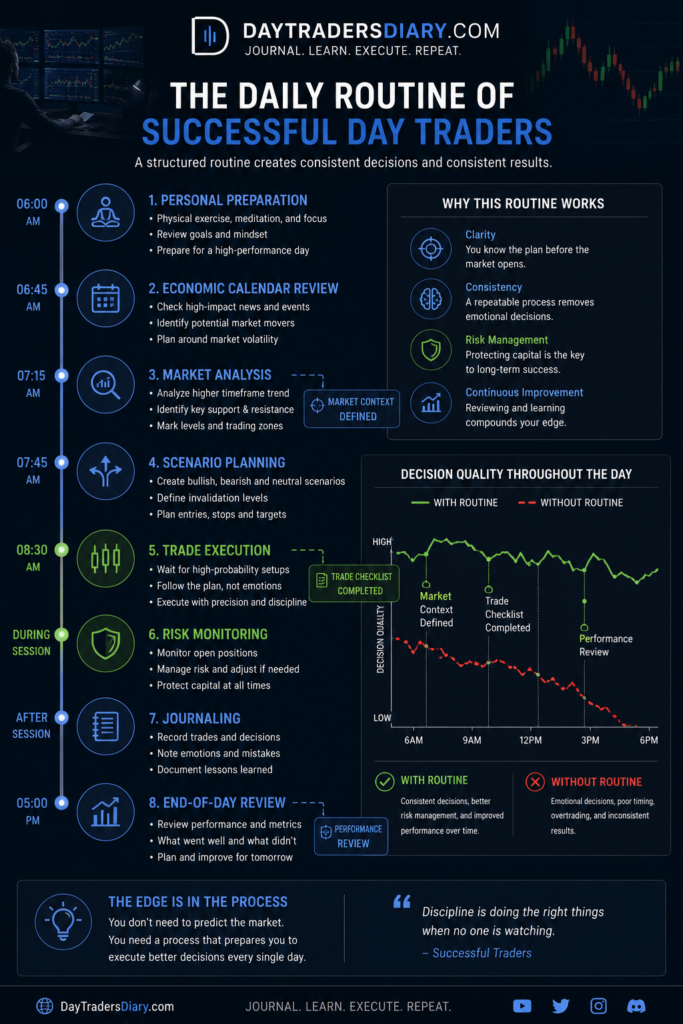
Step One: Start the Day Away From the Charts
One of the most typical blunders traders make is to open their charts just after they wake up.
It promotes a mindset that is emotionally reactive.
Professionals start differently.
Before analyzing markets, they focus on physical and mental readiness.
This does not require a complicated morning routine.
The objective is simple:
Arrive at the trading desk focused, not distracted.
A tired trader sees opportunities that do not exist.
An anxious trader sees threats everywhere.
A frustrated trader forces trades.
Market preparation begins with personal preparation.
Step Two: Review the Economic Calendar
Before looking for setups, successful traders ask an important question:
What events could move the market today?
Economic releases often define market behavior.
Interest rate decisions.
Inflation data.
Employment reports.
Central bank speeches.
Ignoring these events can invalidate otherwise strong technical setups.
Many traders focus exclusively on charts while overlooking the events driving market volatility.
Professional traders understand that context matters.
The market environment often determines whether a strategy performs well or poorly.
Step Three: Build a Daily Market Narrative
This is where experienced traders separate themselves from beginners.
Instead of immediately searching for entries, they first develop a market story.
Questions typically include:
Which markets are trending?
Which markets are ranging?
Where are the major support and resistance levels?
What happened during the Asian session?
What is likely to attract institutional attention today?
This process creates a framework for the trading day.
If you have already read our guide on How to Use Price Action Only Trading, you’ll recognize that understanding market structure before execution significantly improves decision quality.
The objective is not prediction.
The objective is preparation.
Step Four: Define Scenarios Before Trading Begins
One of the most powerful habits successful traders develop is scenario planning.
Rather than predicting one outcome, they prepare for multiple possibilities.
For example:
If EUR/USD breaks above yesterday’s high, continuation opportunities may emerge.
If the breakout fails, range conditions may dominate.
If major news creates excessive volatility, risk may need to be adjusted.
Notice the mindset.
Professional traders think in probabilities.
Not certainties.
This approach aligns closely with the concepts discussed in our article, “What Is a Probabilistic Trading Model?”
The best traders rarely predict.
They respond.
Step Five: Follow a Trading Routine Checklist
Once the market opens, successful traders often rely on a simple execution framework.
Their trading routine checklist may include:
Market conditions align with strategy.
Risk-to-reward meets minimum requirements.
Volatility is sufficient.
Entry criteria are present.
The trade plan is documented.
This process sounds basic.
Yet many traders skip several of these steps when emotions become involved.
Consistency often comes from following simple routines exceptionally well.
Step Six: Focus on Execution, Not Outcomes
This may be the most important habit on the entire list.
Successful traders judge themselves by the quality of their processes rather than by immediate results.
A perfectly executed trade can lose.
A poorly executed trade can win.
Only one of those outcomes contributes to long-term success.
This perspective reduces emotional volatility.
Instead of asking:
“Did I make money?”
The question becomes:
“Did I follow my process?”
Over hundreds of trades, this mindset creates significantly more stability.
Step Seven: Know When to Stop Trading
Many traders believe successful traders work harder.
Often, they stop sooner.
Professional traders typically establish clear limits.
Maximum number of trades.
Maximum risk exposure.
Once those limits are reached, trading ends.
The objective is to protect decision quality.
Fatigue, frustration, and revenge trading rarely improve performance.
Some of the best trading days end after only one or two high-quality trades.
Risk Management Is Part of the Daily Routine
Risk management is not something traders think about after entering a position.
It begins before the first trade.
Every professional trader knows exactly how much capital is at risk before execution.
This is where many traders make avoidable mistakes.
Using the Position Size Calculator removes guesswork and ensures risk remains consistent regardless of stop-loss size or market conditions.
The goal is not to maximize profits on individual trades.
The goal is to maintain long-term survivability.
Consistency in risk creates consistency in performance.
The End-of-Day Review Most Traders Skip
The trading day should not close with the closing of positions.
Here begins the improvement.
Successful traders analyze their decisions when they are fresh.
Common questions include:
Am I following my plan?
Did I trade on emotion?
Did I miss good opportunities, I wonder?
Did I push any setups?
What market conditions worked the best?
It’s a process of turning daily experience into long-term growth.
Mistakes tend to repeat themselves without examination.
Journaling Is Where the Real Edge Develops
Many traders treat journaling as an administrative task.
Experienced traders treat it as performance analysis.
The goal is not to record profits and losses.
The goal is to identify recurring patterns.
Over time, journals reveal valuable insights.
London session trades outperform New York session trades.
Trades taken after major news consistently underperform.
Certain setups generate most of your profits.
The Trade Journal Template helps traders systematically organize these observations.
Eventually, your journal becomes more valuable than any indicator on your chart.
The Weekly Routine That Strengthens Daily Performance
Weekly reviews help reinforce the finest daily routines.
Professional traders often analyze every weekend:
Winrate
Risk/reward ratio
Quality of Execution
Market environment
Performance psychology
Strategies performance
The objective is not self-criticism.
The objective is refinement.
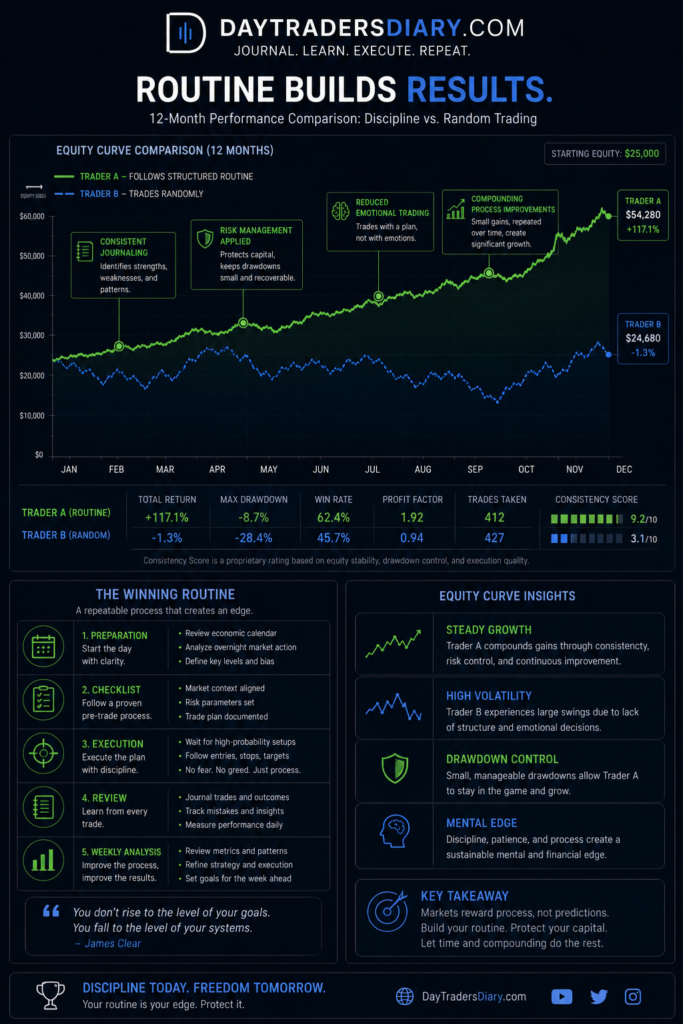
Small improvements compounded over months often produce dramatic performance gains.
Scaling Beyond Personal Capital
Once a trader develops a repeatable daily process, the next challenge often becomes account size.
A disciplined trader with a proven edge may eventually discover that consistency matters more than capital availability.
This is one reason many experienced traders explore proprietary trading firms such as The5ers, FTMO, and FundedNext.
Evaluation programs allow traders to demonstrate process consistency and risk management before accessing larger capital allocations.
The key point is often overlooked.
Funding firms are not paying for predictions.
They are paying for disciplined execution.
The same routines that help traders succeed on personal accounts often become the foundation for passing evaluations.
If your daily process consistently produces positive results, a The5ers evaluation account may be a logical next step toward scaling your trading business without significantly increasing personal capital exposure.
What a Forex Trader’s Daily Routine Really Looks Like
A successful forex trader’s day is often far less exciting than most people imagine.
Preparation.
Analysis.
Patience.
Execution.
Review.
Repeat.
There is no constant excitement.
No endless stream of trades.
No search for perfect predictions.
Just a structured process repeated consistently.
That consistency is often the edge.
Final Thoughts
Most traders spend years searching for better setups.
Many would improve faster by building a better routine.
The market changes every day.
A strong routine creates stability when market conditions become unpredictable.
If you want to improve your trading this week, don’t focus on finding another strategy.
Focus on documenting your daily process.
Identify one step you currently skip.
Then commit to improving that step for the next twenty trading sessions.
Small process improvements often create the biggest long-term performance gains.
For your next read, check out our guide “What Is a Trading Edge and How to Build One” to see how routines turn isolated victories into continuous income.
Frequently Asked Questions
What is the daily routine of successful day traders?
Most successful day traders have a process . Market prep , economic calendar review , scenario planning , disciplined execution , risk management , post market review .
Why is a trading routine important?
Trading routines assist reduce emotional decisions, increase consistency and allow traders to implement their strategy more efficiently in the context of changing market conditions.
What should a forex trader do before the market opens?
Review economic events, analyze market structure, identify key support and resistance levels, and create potential trading scenarios before searching for entries.
How long do professional traders spend trading each day?
Many professional traders spend more time preparing and reviewing than actively trading. Actual trade execution may occupy only a small portion of the day.
What should be included in a trading routine checklist?
What to include in a trading routine checklist? Market analysis, Setup validation, Risk assessment, Position sizing, Trade documentation, Post-trade review
How does journaling improve trading performance?
Journaling allows traders to find their strengths and weaknesses, repeat mistakes, and best performing setups which allows them to always grow and make better decisions.