
Every trader remembers the first time they tried to trade a major news release.
You see Non-Farm Payrolls marked in red on the economic calendar. Everyone says volatility will explode. Analysts predict a huge move. You position yourself early because you don’t want to miss the opportunity.
Then one of two things happens.
The market barely moves.
Or worse, it moves violently in both directions, stops you out, and then trends exactly where you originally expected it to.
After enough experiences like that, many traders start to believe that news trading is random.
It isn’t.
The mistake is assuming that the importance of a news event automatically determines the market’s reaction.
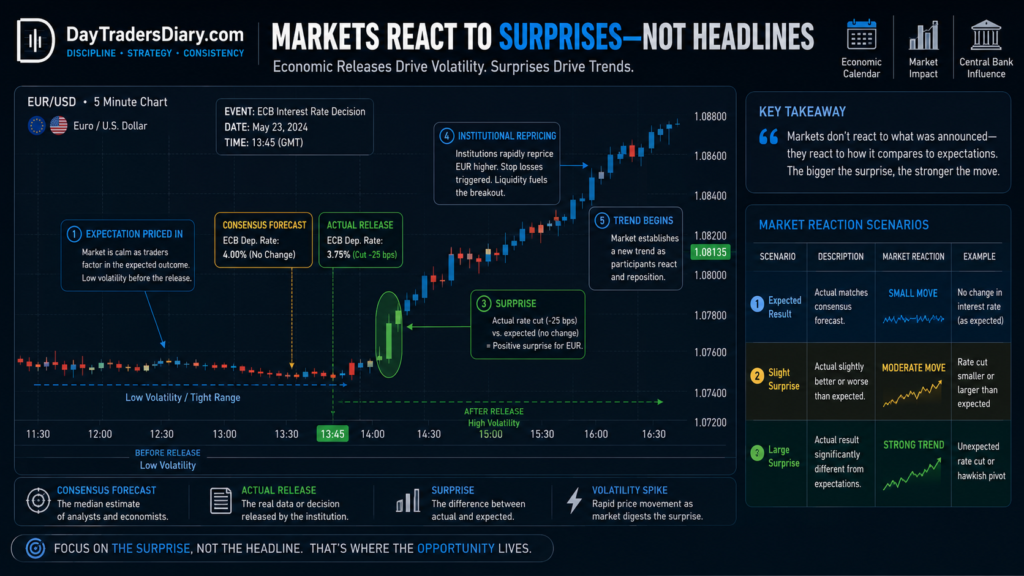
Markets do not react to headlines.
Markets react to surprises.
That distinction changes everything.
Over the years, one of the biggest differences I’ve noticed between developing traders and consistently profitable traders is this: experienced traders spend less time predicting the news itself and more time evaluating how much the market actually cares about the result.
This article discusses how to determine the news strength before something is released, how institutions view economic data, and how to develop a practical framework to decide whether a forthcoming event is worth your attention, or your patience.
Why Traders Misjudge News Strength
Most traders look at the economic calendar and classify events into two categories.
High impact.
Low impact.
While economic calendars are useful, they create a dangerous oversimplification.
A high-impact event does not always create a high-impact move.
Likewise, a medium-impact event can occasionally produce enormous volatility.
The market’s reaction depends on expectations, positioning, current economic conditions, and whether the data changes the future outlook.
A strong number that everyone expected is often less important than a moderately surprising number that forces institutions to rethink their assumptions.
The surprise matters more than the headline.
Research Shows Markets React to Expectations, Not Just Data
The Federal Reserve Bank of St. Louis (FRED) provides extensive economic data that institutions use to evaluate trends before official releases.
The Bureau of Labour Statistics (BLS) releases employment statistics, including Non-Farm Payrolls, which can generate volatility in U.S. dollar pairs when traders examine the actual findings to projections rather than just the headline figure.
The CME Group FedWatch Tool illustrates how traders continually price in future interest rate expectations before central bank decisions.
For active forex traders, these sources reveal an important truth.
By the time news is released, markets often already have an opinion.
Your job is to estimate how vulnerable that opinion is to being wrong.
The First Question: Does This News Actually Matter Right Now?
Economic importance changes.
Inflation data becomes critically important during inflationary environments.
Employment data becomes more influential when central banks focus heavily on labor markets.
Manufacturing numbers matter more during periods of slowing economic growth.
This is where many traders struggle.
They treat every CPI release, every jobs report, and every central bank statement as equally important.
Professional traders ask a different question.
“What is the market currently obsessed with?”
If inflation is dominating central bank decisions, inflation data deserves far more attention than secondary reports.
Understanding the broader narrative often matters more than memorizing the economic calendar.
The Second Question: What Is the Market Expecting?
Expectations create the benchmark.
Without expectations, there is no surprise.
Suppose analysts expect inflation at 3.0%.
An actual reading of 3.1% may not be meaningful if traders were already positioning for a stronger number.
However, a reading of 3.5% could significantly change future interest rate expectations.
The bigger the gap between expectations and reality, the bigger the possible reaction.
This is why experienced traders study consensus forecasts before major releases.
Forecasts provide context.
Context determines significance.
The Third Question: Is the Market Already Positioned for the Outcome?
Sometimes the market trends aggressively before a major release.
That movement often reveals expectations.
If traders have spent several days buying the U.S. dollar ahead of employment data, strong results may already be partially priced in.
In these situations, even positive news can trigger profit-taking rather than continuation.
This is one of the hardest concepts for newer traders to accept.
Good news does not always create bullish moves.
Bad news does not always create bearish moves.
Price reflects expectations.
News confirms or challenges those expectations.
Watch Volatility Before the Release
Volatility often reveals uncertainty.
A quiet market ahead of a major event usually indicates participants are waiting for information.
An already volatile market may suggest that expectations are shifting rapidly.
Comparing current volatility with recent averages provides valuable information.
If the market has already made an unusually large move before the release, there may be less room for surprise.
This concept aligns closely with our article How Many Pips Do London Session Breakouts Average, where volatility conditions often determine whether a move has enough fuel to continue.
Build a News Strength Scoring System
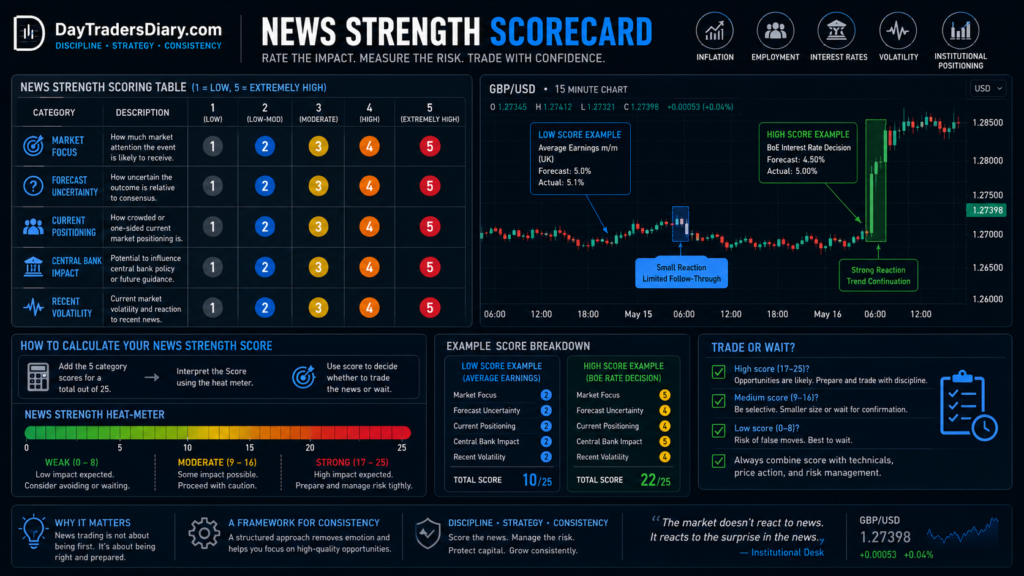
One practical approach is assigning a simple score before every major release.
Rate the event from one to five in the following categories:
Market focus.
Forecast uncertainty.
Current position.
Implications for central bank policy
The recent turmoil.
Events that score well in all categories generally merit more attention. There are a number of reasons for a strong reaction.
This process is far more reliable than simply relying on the color coding of an economic calendar.
Judge the Potential for Repricing
The strongest market moves usually occur when traders must rapidly adjust their future expectations.
This process is called repricing.
Imagine inflation unexpectedly jumps far above forecasts while traders expect rate cuts.
Institutions suddenly need to reassess future interest rates.
That creates aggressive repositioning.
Aggressive repositioning creates volatility.
Volatility creates opportunity.
The more an event can change future expectations, the stronger the potential reaction.
News Strength Does Not Equal Trade Quality
One of the biggest mistakes traders make is assuming strong news automatically means an excellent trade.
High volatility often increases spreads, slippage, and emotional decision-making.
Sometimes the best decision is waiting for the initial reaction to settle before participating.
Patience often produces cleaner setups than attempting to predict the first move.
Our guide, “What Does Liquidity Sweep Look Like on a Chart,” demonstrates that many major news events first collect liquidity before revealing their true direction.
Build a Pre-News Decision Framework
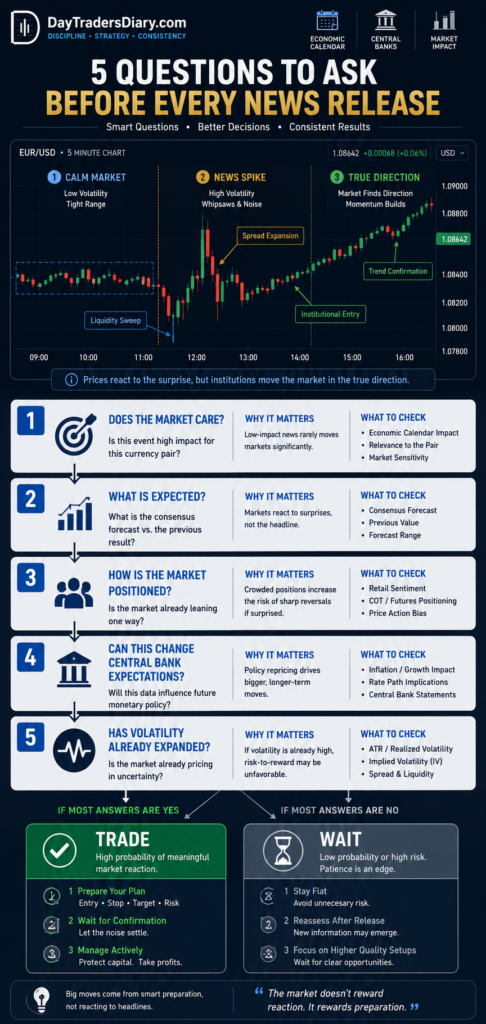
Five questions to ask yourself before every major release
Is the market paying attention to this info right now?
What’s the consensus expectation?
Where is the market positioned now?
Could this change central bank expectations?
Has volatility already expanded significantly?
If you cannot confidently answer these questions, you may not understand the event well enough to risk capital.
Preparation is an edge.
Risk Management Becomes Even More Important Around News
News trading changes market conditions.
Spreads widen.
Slippage increases.
Volatility expands.
Even excellent analysis can produce unexpected outcomes.
This is where most traders miscalculate risk. Using the Position Size Calculator removes guesswork by adjusting your position size based on your stop-loss distance and predefined account risk, rather than on emotional confidence before a news release.
Risk management matters even more when uncertainty is highest.
Turn News Events Into Data
Most traders remember big gains and losses around important announcements.
Very few follow them systematically.
Start recording every major event you trade or observe.
Document the expected number.
Record the actual result.
Note whether the market was already trending beforehand.
Measure the initial move and the final move.
Evaluate whether your pre-release analysis correctly judged the event’s strength.
After dozens of observations, you’ll begin identifying recurring patterns.
This is where the Trade Journal Template becomes valuable. It allows you to review not only your trades but also your decision-making process around economic events.
Data-driven learning always outperforms memory-driven learning.
Scaling Requires Consistency, Not Excitement
Many traders are drawn to news trading because of the possibility of large moves.
Professional traders focus on consistency.
Evaluation firms such as The5ers, FTMO, and FundedNext reward traders who can execute disciplined strategies while managing risk responsibly.
A trader who understands when to avoid low-quality news environments often performs better than someone who trades every major release.
If your journal is consistently showing positive anticipation and diligent execution, a The5ers assessment account may be a logical step to managing additional cash without having to continually increase your own deposits.
Common Mistakes Traders Make Before News Releases
One error is to assume that all high-impact events are equally important.
Another is to disregard market expectations totally.
Also often traders mistake personal opinions for the market consensus.
Others forget that the market may have already priced in the likely outcome.
The most expensive mistake is believing volatility automatically creates opportunity.
Volatility only creates opportunity when combined with preparation and disciplined execution.
Final Thoughts
Learning how to judge news strength before release is not about predicting the future.
It is about estimating how vulnerable the market is to surprise.
That is a completely different skill.
For the next month, stop asking whether a news event is important.
Instead, ask whether the market believes it is important.
That single question will improve your analysis more than memorizing another economic calendar.
For your next read, continue with How To Build A Tick-Based Day Trading Checklist and add a pre-news analysis section to your daily preparation routine.
Frequently Asked Questions
How do you judge news strength in forex before release?
Evaluate market expectations, current positioning, central bank relevance, forecast uncertainty, and whether the event could force traders to reprice future expectations.
Why do some high-impact news events cause small moves?
Markets usually discount projected results before the publication. If the actual result is similar to expectations, there may be little reaction.
What makes a forex news event powerful?
Events become powerful when they significantly differ from expectations or change future interest rate expectations and economic outlooks.
Should I trade immediately after major news releases?
No, not really no. Often it is best to wait for spreads to normalise and initial volatility to reduce before clearer opportunities may be identified with greater risk control.
Why does good news sometimes cause prices to fall?
If the market is already priced for a strong result, good news can lead to profit-taking rather than follow through.
How should traders track their news trading performance?
Document your expectations, actual data, market reactions, volatility, positioning and results of trades into a systematic diary so you can see patterns over time.