
Many traders are obsessed with spreads.
They compare commissions between brokers to the tiniest fraction of a pip.
They fine-tune entry, exits, and position size.
Then they leave trades open overnight without giving a second thought to swap costs.
Months later, they review their account history and notice something strange.
Their strategy produced a respectable win rate.
The risk management was cautious.
But they made considerably less net money than they had hoped.
What was lacking was not a terrible strategy.
It was a cost of trading they never figured.
Costs of swapping rarely destroy a single trade.
They quietly reduce performance over dozens or hundreds of overnight positions.
That makes them one of the least discussed but most important variables for swing traders, position traders, and even some active day traders who occasionally hold positions beyond the market close.
This guide explains how to track swap costs step by step, how to determine whether they are affecting your profitability, and how experienced traders include financing costs in their decision-making rather than treating them as an afterthought.
What Are Swap Costs?
In forex trading, a swap is the financing adjustment applied when a position remains open after the broker’s daily rollover time.
All forex trades involve borrowing one currency to acquire another. Holding a position overnight creates either a financing cost or, in some cases, a financing credit.
Whether you pay or receive a swap depends on several factors.
Interest rate differences between the two currencies.
Your trade direction.
Broker pricing.
Current market conditions.
Broker markup.
Many traders simplify swaps into “positive” or “negative” overnight fees.
While technically correct, that description misses an important point.
Swap costs are part of your trading performance.
Ignoring them produces inaccurate strategy analysis.
Why Swap Costs Matter More Than Most Traders Think
Imagine two traders who are utilizing the same approach.
They both provide the same entry, exits and victory rates.
Trades are often held overnight in pairs with large negative swaps.
The other watches actively fund costs and prevents undue overnight exposure.
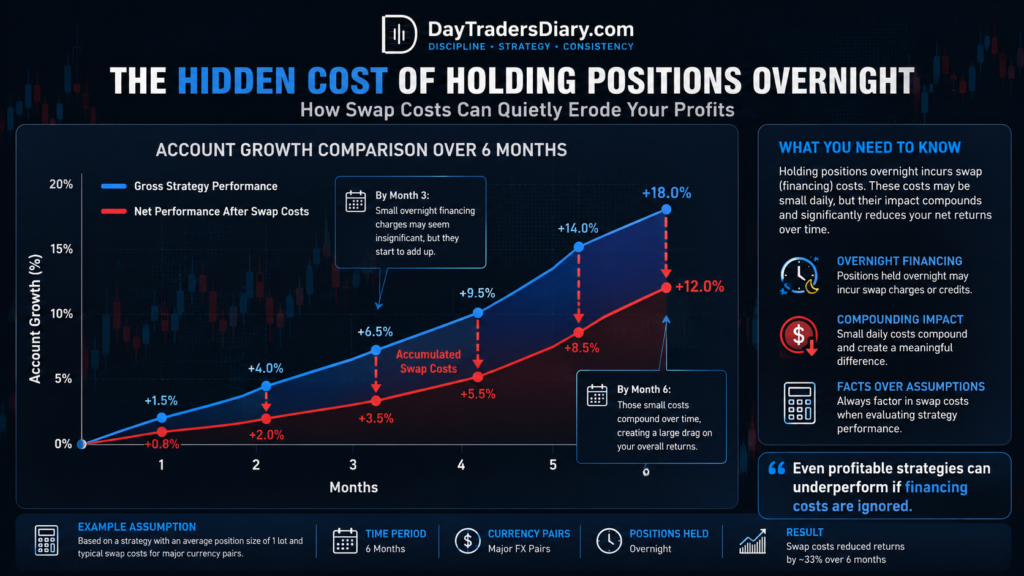
After six months, their trade execution may look almost identical.
Their account balances may not.
Small daily financing charges accumulate surprisingly quickly.
This becomes especially important for traders who scale positions or hold trades for several days.
Professional traders monitor every cost that affects expectancy.
Swap deserves the same attention as spread and commission.
Research Highlights the Importance of Financing Costs
The Bank for International Settlements (BIS) explains that interest rate differentials remain a fundamental component of foreign exchange markets, influencing both pricing and capital flows.
The CME Group provides educational resources showing how financing costs and rollover adjustments affect currency and futures positions over time.
The Corporate Finance Institute (CFI) also explains that overnight financing and carrying costs should be incorporated into strategy evaluation rather than treated as separate accounting items.
For active forex traders, the takeaway is practical.
Trading costs extend beyond spreads and commissions.
Financing costs influence long-term profitability just as much.
Step One: Know Your Broker’s Rollover Time
Every broker applies swap adjustments at a specific daily rollover time.
Many MetaTrader brokers use 5:00 PM New York time, although exact timing varies.
This matters because remaining in a position even a few seconds beyond rollover can trigger an overnight swap.
Professional traders know precisely when rollover occurs because it affects both execution and cost.
If your strategy frequently closes positions near rollover, timing alone can reduce unnecessary expenses.
Don’t think that the swaps are the same for all brokers.
Always check their published roll-over schedule.
Step Two: Record Every Overnight Position
Most traders track entry price, exit price, and profit.
Few record financing costs separately.
That creates incomplete performance data.
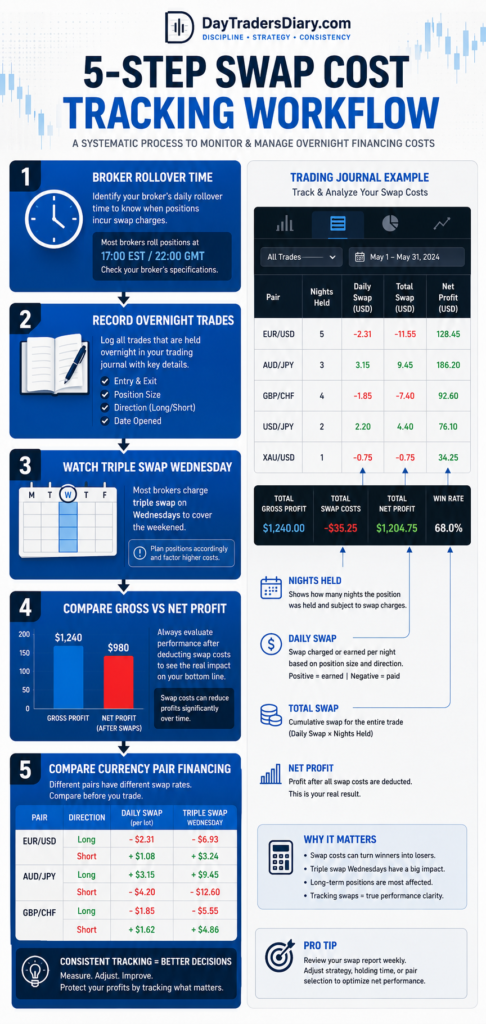
Every time a trade remains open overnight, record the following.
Currency pair.
Trade direction.
Position size.
Number of nights held.
Daily swap applied.
Total accumulated swap.
Once these figures become part of your journal, patterns begin appearing that would otherwise remain invisible.
Step Three: Understand Triple Swap Days
One surprise for many newer traders is the triple swap adjustment.
Because forex spot markets settle two business days after the trade date, brokers typically apply three days of financing on one weekday to account for weekend settlement.
For many forex brokers, this occurs on Wednesday evening for most currency pairs.
Holding a position through triple swap day can significantly increase financing costs or credits.
Professional traders always know when a triple rollover occurs before deciding whether a trade is worth holding.
Step Four: Separate Trading Performance From Financing Costs
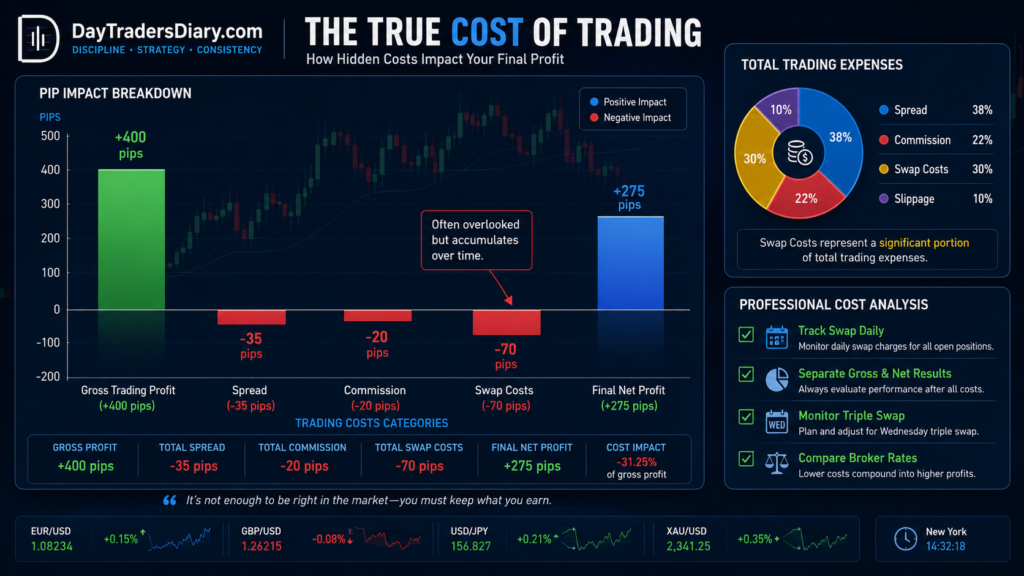
Let us say that your system makes 400 pips over 3 months.
That’s great.
And now add financing expenses.
The net performance is significantly lesser than intended.
Without separating trade performance from swap expenses, it becomes impossible to evaluate whether the strategy itself is improving or whether financing costs are quietly reducing profitability.
One useful exercise is maintaining two performance columns.
Performance of gross trading.
Net performance after swap, spread and commission.
This tells immediately if finance requires more attention.
Step Five: Compare Currency Pairs
Not every currency pair carries the same financing profile.
Interest rate differences constantly change.
Broker pricing changes.
Central bank policy changes.
Holding AUD/JPY overnight may produce very different financing compared to EUR/USD or GBP/CHF.
Professional traders compare expected swap costs before entering longer-term positions.
Sometimes two technically similar opportunities produce meaningfully different net returns after financing.
Why Swap Costs Should Influence Trade Selection
Swap costs should never determine your market bias.
They should influence trade management.
Suppose two setups satisfy your trading plan.
One carries significant negative overnight financing.
The other has minimal financing costs.
Everything else being equal, the second trade offers better long-term efficiency.
This does not mean avoiding every negative swap.
It means recognizing financing as another variable affecting expectancy.
Small advantages compound over hundreds of trades.
Build a Swap Cost Trading Strategy
A practical track swap costs trading strategy begins before entering the market.
Review expected holding time.
Estimate financing costs based on current broker rates.
Compare those costs with your projected reward.
Once you factor in the cost of over night, ask if the trade still meets your minimum risk/reward criteria.
While you are trading, keep track of the swap accumulation with the unrealized profit.
If funding starts to have a big impact on the original thesis for the trade – re-consider the position, rather than ignore the increasing cost.
Professional traders monitor costs continuously.
They do not calculate them after the trade ends.
Day Traders Should Still Understand Swap Costs
Many traders assume that swap costs only matter for swing trading.
That assumption is not always correct.
Unexpected market volatility.
News events.
Execution delays.
Holding a losing position overnight.
All of these situations can expose day traders to financing adjustments they never planned to pay.
Every trader who wants to avoid needless surprises must understand swap dynamics.
Even if trades overnight are few and few between, it still matters to be prepared.
Risk Management Includes Financing Costs
One of the biggest mistakes is sizing a position without looking at the whole cost of trading.
Spread .
Commission.
Switch.
Slid.
Together they decide the real cost of the execution.
This is where most traders get risk wrong. The Position Size Calculator removes the guesswork by helping you match your position size to your intended account risk, before financing and execution expenses start eating into your returns.
Position sizing should always reflect total expected exposure rather than entry price alone.
Turn Swap Data Into Better Decisions
Most trading journals never include financing information.
That is a missed opportunity.
Start tracking all overnight adjustments.
Compare swap rates for currency pairs
Find the average financing per trade.
Calculate annual financing over overall strategy returns.
Often, important patterns show themselves in a matter of months.
Perhaps one pair of currencies will always give you good technical results, but not good net results since you are paying too much for financing.
Another pair may produce smaller gross returns but much greater net returns.
Those insights are difficult to discover without structured data.
Our downloadable Trade Journal Template makes it easier to separate execution quality, strategy performance, and financing costs into measurable categories.
Scaling a Strategy Requires Knowing Every Cost
Professional evaluation firms put a lot of emphasis on execution consistency.
The5ers, FTMO, FundedNext and other companies want traders who can make disciplined decisions and not just one-off extraordinary transactions.
Understanding swap costs demonstrates another level of professionalism.
It shows that your strategy accounts for every meaningful variable affecting profitability.
If your trading journal consistently demonstrates disciplined execution, controlled risk, and accurate cost analysis, a The5ers evaluation account can become a logical next step toward trading larger capital without continually increasing your personal investment.
Common Mistakes Traders Make With Swap Costs
The first mistake is to ignore financing altogether.
The second is that all brokers have similar swap prices.
The third is to forget about triple rollover days.
Another common error is evaluating strategies using gross returns instead of net returns after all trading expenses.
Finally, many traders continue holding positions because they are emotionally attached to the trade, even when financing steadily reduces the reward potential.
Professional traders monitor every expense because every expense affects expectancy.
Final Thoughts
Most traders spend years improving entries.
Far fewer spend time improving cost awareness.
Yet the market does not care whether losses come from poor analysis or unnecessary expenses.
Both reduce profitability.
Tracking swap costs is not about becoming obsessed with small numbers.
It is about understanding the complete economics of your trading strategy.
For the next month, record every overnight financing adjustment separately from your trading results.
You may discover that improving cost management increases profitability without changing your strategy at all.
For your next read, continue with How To Build A Tick-Based Day Trading Checklist and add rollover timing and expected financing costs as part of your pre-trade routine.
Frequently Asked Questions
What are swap costs in forex trading?
Swap charges are overnight financing adjustments that are levied on FX positions that are kept open past the broker’s daily rollover time. Traders may pay or receive a swap depending on the currency pair and the direction of the trade.
Why should traders track swap costs?
Tracking swap costs helps measure the true profitability of a trading strategy by separating gross trading performance from financing expenses.
How do I track swap costs effectively?
Record every overnight trade, including the currency pair, trade direction, position size, number of nights held, daily swap amount, and total accumulated financing cost.
What is a triple swap in forex?
Triple swap is an overnight financing adjustment that accounts for weekend settlement. For many brokers and currency pairs, it is applied on the Wednesday rollover, although policies can vary.
Do day traders need to worry about swap costs?
Most day traders avoid overnight financing because they close positions before rollover. However, unexpected overnight positions caused by volatility or delayed exits can still incur swap charges.
Can swap costs affect a profitable strategy?
Yes. When multiple trades are involved, overnight financing costs can add up and a strategy with high gross returns can have poor net performance. Monitoring these costs allows traders to assess the real efficacy of their trading strategy.