
Every trader has been there.
You see a high impact news event coming up. Maybe NFP, CPI, or a central bank rate decision. You expect volatility, you expect opportunity, and you want a piece of the move.
So you enter early or jump in right after the release.
Price spikes in your direction for a few seconds, then violently reverses, hits your stop, and only then moves exactly where you originally expected.
That is not bad luck. That is how news trading works if you approach it like a normal market.
This guide is not about predicting news outcomes. It is about understanding how liquidity behaves around news and how to position yourself so you are not the one providing liquidity for others.
What Actually Happens During High Impact News
Most traders think news moves markets because of the data itself.
That is only part of the story.
Large institutions already have expectations priced in. What moves price is the difference between expectation and actual data, combined with liquidity conditions at the moment of release.
Research by central bank and liquidity studies by organisations like the Bank for International Settlements and CME Group have shown that big economic announcements tend to widen spreads, shrink order books and send volatility spiking sharply.What does that mean in practice?
It means your stop loss is sitting in an environment where liquidity is unstable. Price can jump across levels without trading smoothly through them.
That is why you see wicks that make no sense on a normal chart.
Retail traders often interpret this as manipulation. In reality, it is a function of how orders are matched when liquidity disappears.
Understanding this changes your approach completely. You stop trying to trade the first move and start thinking about where liquidity will be after the initial reaction.
Why Most Traders Get Whipsawed
It is an easy error to make.
They treat news like a preparation for a breakout.
They watch the price compress before the event and think the expansion will be clean. So they place tight limits just above or below recent highs or lowsWhat actually happens is this:
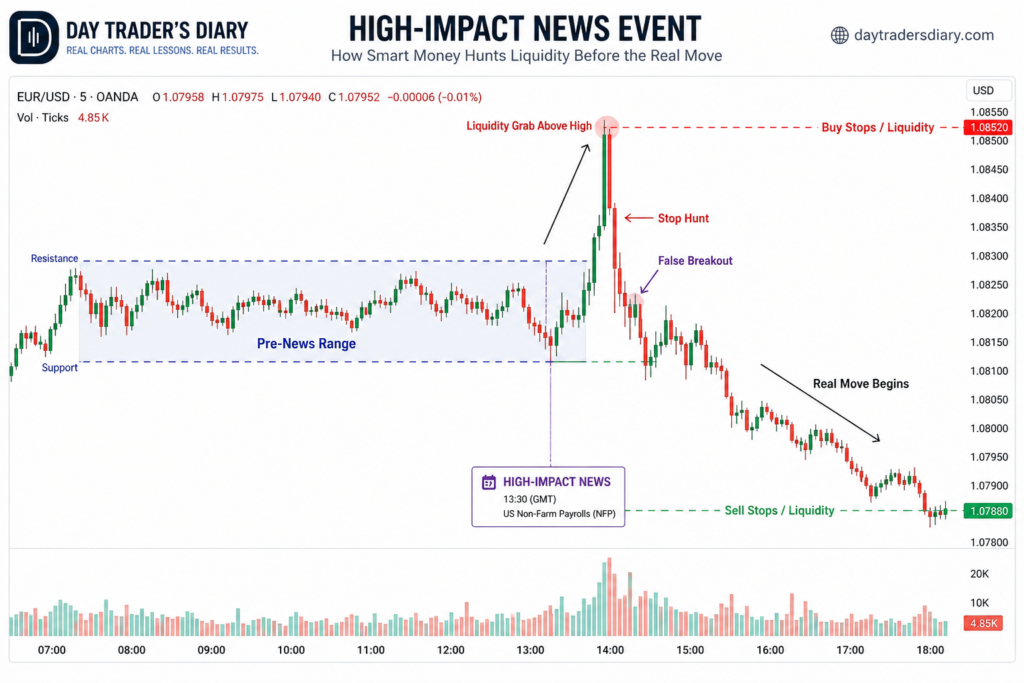
Price spikes above a key level, triggers breakout buyers, immediately reverses, takes out stops below, and then chooses the real direction.
That entire sequence can happen in seconds.
If you are trading without accounting for this behavior, you are effectively placing your stop exactly where the market needs liquidity.
If you have read our breakdown on How to Identify Trend Reversals Intraday, you will recognize this as a form of liquidity sweep. News simply amplifies it.
A Practical Framework for Trading News Without Getting Trapped
You need a structured approach, not a reaction.
The first shift is timing.
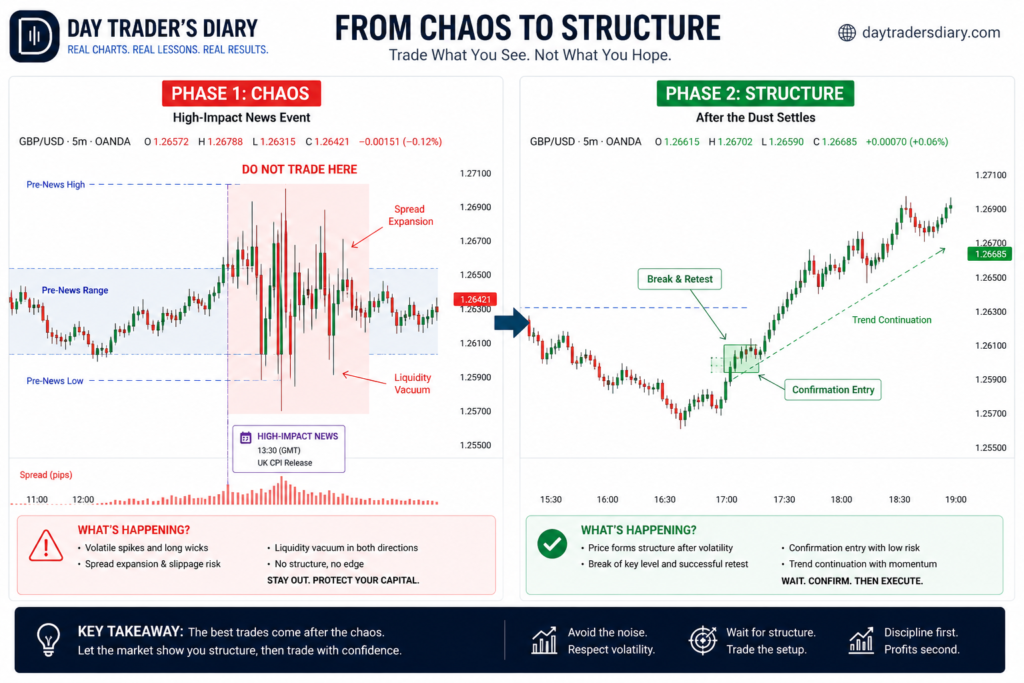
Stop trying to trade the first 30 seconds. That is where spreads are widest and price discovery is chaotic. Let the initial reaction play out.
Then focus on the second phase.
This is where the real trade often exists.
After the spike, the market begins to stabilize. Liquidity returns, spreads normalize, and direction becomes clearer. That is where you want to participate.
It’s like a two-step process.
The first move springs the trap.
Second move indicates intent.
Example : imagine EURUSD , around CPI time .
Price jumps 25 pips within seconds, then reverses and falls below pre-news lows. That tells you the buyers were stuck.” The real move is probably down. Your entry is not the spike. Your entry is the retest or continuation after the trap.
Reading News Reactions Like a Trader, Not a Gambler
Instead of predicting direction, focus on behavior.
Ask yourself a few key questions in real time.
Did price sweep both sides of the range or only one?
Did volume expand with follow-through or just spike and fade?
Is the move holding above or below key intraday levels?
If price breaks a level but cannot hold it, that is information. It suggests imbalance is not strong enough.
This aligns closely with concepts discussed in How to Trade the EURUSD Daily Range, where the reaction around range highs and lows often defines the session bias.
The Role of Liquidity Zones During News
News doesn’t generate new levels. It speeds up the transition between existing elements.
Add clear liquidity zones before a large release.
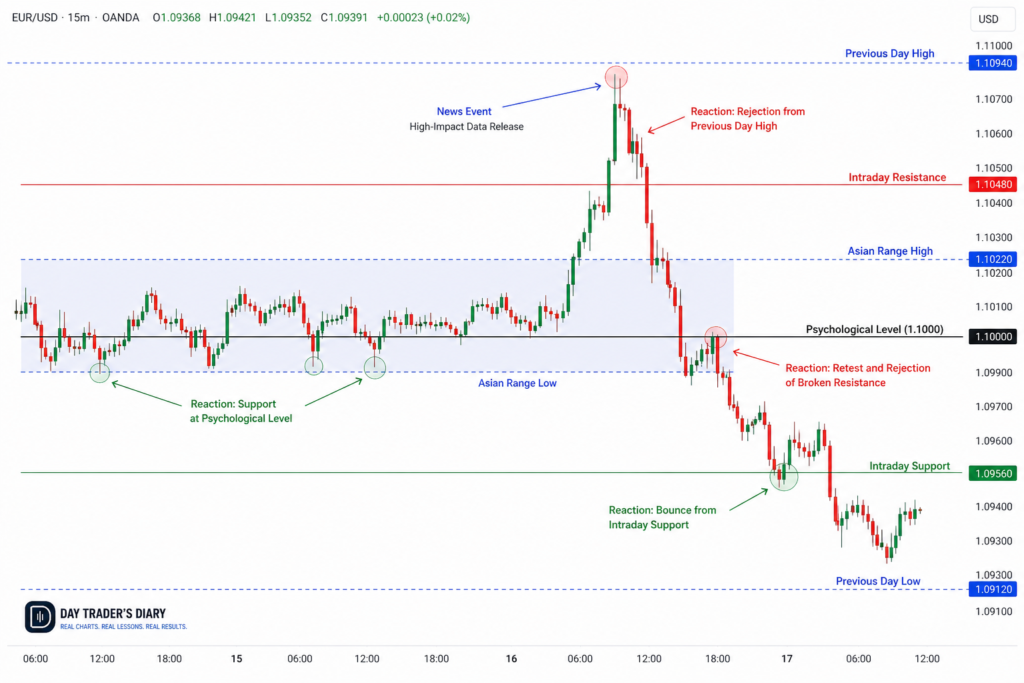
Last session highs and lows
high and low range Asia
Important support and resistance levels
Round numbers in psychology
In the news these regions are like magnets.
They often spike into them, cause pauses and then decide direction.
If you go in blind in the middle of nowhere, you’re trading noise. Waiting for price to interact with these zones you are trading structure.
Execution Timing That Actually Works
Delaying execution was one of the best adjustments I did.
I don’t take market orders at the announcement, I wait for confirmation.
It may be as simple as:
A 5-minute candle close after the spike
A break and retest of a key level
A failed breakout pattern
For example, GBPUSD spikes above resistance during a news release but closes back below it on the next candle.
That rejection is more valuable than the spike itself.
It gives you a defined invalidation point and a clearer direction.
Risk Management During News Is Non Negotiable
News trading amplifies everything.
Slippage increases. Spreads widen. Execution becomes less predictable.
This is where most traders underestimate risk.
A 10 pip stop during normal conditions may effectively become a 15 or 20 pip loss during a fast spike.
This is where most traders miscalculate risk. Using a Position Size Calculator removes guesswork and ensures your lot size reflects real stop distance, not ideal conditions.
If volatility doubles, your position size should adjust accordingly.
That is how professionals survive high impact events.
Journaling News Trades the Right Way
Most traders log wins and losses but miss the details that matter.
If you are trading the news your journal should be about behaviour.
Event type log
Market Expectation vs Actual Result
Initial direction of spikes
where liquidity was pulled
Where the main push began
Your timing of entry against the release
Use your Trade Journal Template to track this consistently.
After enough trades, patterns become obvious.
You may find that you perform better trading post-news continuation rather than initial breakout attempts.
That knowledge alone can make a difference in your score.
The Psychological Trap of News Trading
There is a hidden challenge here.
News trading feels exciting.
Fast moves create the illusion of easy money. That emotional pull leads traders to overtrade, increase size, and abandon discipline.
The reality is that news requires more patience, not less.
The best traders I know often sit out the initial move completely. They are not missing opportunities. They are filtering low quality ones.
If you cannot stay disciplined during high volatility, you should not be trading it.
Scaling News Trading with Capital
Once you understand how to handle news volatility, it becomes a powerful edge.
High impact events provide movement that can produce strong R multiples in short periods.
But again, capital matters.
Consistent execution on a small account limits the impact of your edge. That is why many experienced traders explore evaluation programs from firms like The5ers, FTMO, or similar prop firms.
These programs let you use a proven approach on larger capital within set risk parameters.
A The5ers evaluation account only makes sense if your process is already defined and repeatable. It’s not a cheat. It’s a scale tool.
If your journaling shows consistent performance during news events, that is a logical next step.
What Most Traders Never Realize About News
The biggest insight is this.
News does not create opportunity. It reveals positioning.
The move you see after a release is often the market correcting imbalances that existed before the event.
If you focus only on the headline number, you miss that context.
If you focus on how price reacts to levels, you start trading like a professional.
Final Takeaway
The news in trading isn’t about speed. The key is to keep your cool under pressure.
If you want to improve at one particular item starting today, don’t trade the first move after release.
Wait and see the reaction after liquidity gets hit. Trade it. That single adjustment will eliminate a large portion of unnecessary losses.
Next read: How to Identify Trend Reversals Intraday or Best Day Trading Mistakes Checklist.
FAQs
Is it better to trade before or after news releases?
For most traders, it is safer to trade after the initial reaction as spreads normalise and trend becomes evident.
Why do forex pairs spike both directions during news?
Because liquidity is thin and large orders trigger stops on both sides before the market finds balance.
Can beginners trade high impact news?
They can, but it is better to first observe and journal reactions before risking real capital.
What is the best strategy for news trading?
There is no one best strategy. Liquidity sweep and post-news continuation setup are more reliable than breakout trading.
Should I widen my stop loss during news?
Yes, but only if you adjust position size accordingly. Wider stops without smaller size increase risk significantly.