
A lot of traders think they have a strategy problem when they actually have a timing problem.
The setup looks perfect.
The breakout confirms.
Momentum starts building.
Then one economic release hits the market and price violently reverses in seconds.
The trader blames manipulation.
Or spread widening.
Or “smart money.”
But the truth is usually much simpler:
They were trading blind into scheduled volatility.
This is a stage which is crossed by almost every skilled forex trader. You spend months studying technical analysis, and then you find that macroeconomic timing is often what makes a setup work out or utterly blow apart. That realization changes how traders approach the market.
The economic calendar stops becoming “news for investors” and starts becoming a survival tool for active traders.
After enough time in forex, one thing becomes obvious:
Good traders do not just analyze charts.
They analyze timing, liquidity, volatility conditions, and market expectations surrounding those charts.
This guide breaks down how professional traders track the economic calendar for forex, why most retail traders misuse it, how economic events actually impact day trading conditions, and how to build a structured calendar routine that improves execution quality dramatically.
Because in fast-moving forex markets, being technically right at the wrong time can still lose money.
Why Most Traders Misunderstand Economic Calendars
Many developing traders believe economic calendars are only useful for long-term investors or fundamental analysts.
That is usually because they misunderstand what the calendar actually represents.
An economic calendar is not just a list of news events.
It is a schedule of potential volatility shifts.
That distinction matters.
CME Group Education research regularly reveals that scheduled macroeconomic events have a very large influence on liquidity, volatility expansion and short-term market behavior across leveraged markets.
Meanwhile, Reuters Markets reporting frequently illustrates how market expectations are immediately transformed by central bank speech, inflation statistics and employment releases.
Research around behavioral finance published through the CFA Institute also highlights how uncertainty and volatility influence trader psychology, often leading to impulsive execution and poor risk management during high-impact events.
Experienced traders understand something newer traders often overlook:
The calendar does not just move price.
It changes trader behavior too.
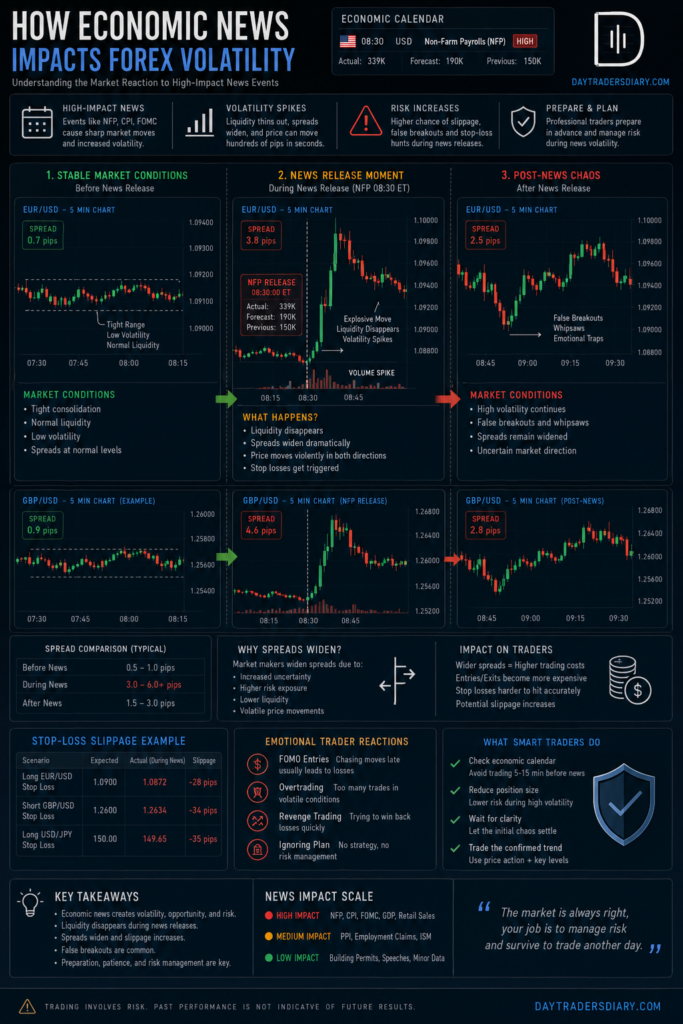
Why Economic Events Create Dangerous Trading Conditions
Most retail traders underestimate how quickly market conditions change during major economic releases.
Spreads are widening out.
Liquidity evaporates.
The slip is growing.
On false breakouts.
A technical setup that works brilliantly under stable London session conditions can quickly fail when a Non-Farm Payrolls or a Federal Reserve release.
The annoying thing is that many traders don’t make the connection.
They say:
“My strategy just didn’t work anymore.”
In fact, the environment changed dramatically.
That’s why pros don’t just “trade the chart.”
They swap the chart context.
That awareness is the difference between focused execution and emotional gambling.
The Most Important Economic Events Forex Traders Track
Not every calendar event matters equally.
One of the biggest mistakes newer traders make is trying to react to every release.
Experienced traders focus on events capable of genuinely shifting expectations and volatility.
Some of the most important forex calendar events include:
Rate choices.
CPI inflation numbers.
Non Farm Payrolls.
GDP releases.
Central bank talks .
Data on retail sales.
Unemployment statistics.
Its importance is highly dependent on the current state of the macroeconomy.
For example, during periods when inflation dominates market sentiment, CPI data becomes far more important than secondary economic releases.
Professional traders constantly ask:
“What is the market currently sensitive to?”
That question matters more than blindly reacting to headlines.
The Best Economic Calendar Tools for Forex Traders
Most experienced traders eventually narrow their calendar tracking to a few reliable tools instead of checking random social media commentary.
Like Forex Factory, these platforms are still popular since they clearly arrange events by:
Level of impact.
currency significance
Earlier readings.
Predicts expectations.
Publish results.
Traders also choose the Investing.com Economic Calendar, which offers a wide range of filtering choices and covers a large spectrum of markets.
Some institutional traders rely heavily on Bloomberg or Reuters Markets for deeper macroeconomic context and central bank analysis.
The important part is not which platform you choose.
It is whether you build a repeatable process around it.
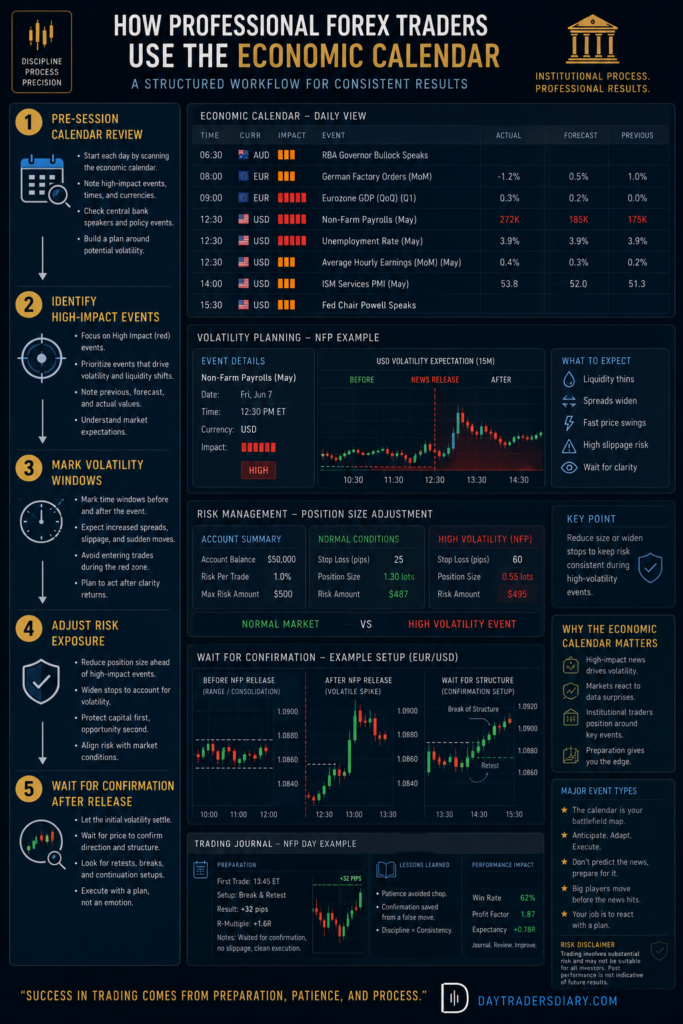
How Experienced Traders Actually Use the Economic Calendar
Professional traders rarely stare at economic releases all day waiting emotionally for reactions.
They prepare in advance.
Most experienced day traders review the calendar before the trading session begins and identify:
High impact events.
Periods of expected volatility
Possible changes in liquidity
Pairs most prone to react.
That preparation impacts decisions in a big way.
For example, a disciplined trader might decide:
“I will not enter breakout trades 15 minutes ahead of CPI.”
Or:
“I will shrink during Federal Reserve speeches.
Those sound like easy selections.
But they do prevent a significant number of unwanted emotional trades.
The economic calendar is not meant to predict direction perfectly.
It is meant to improve preparation.
Why Expectations Matter More Than the Actual Number
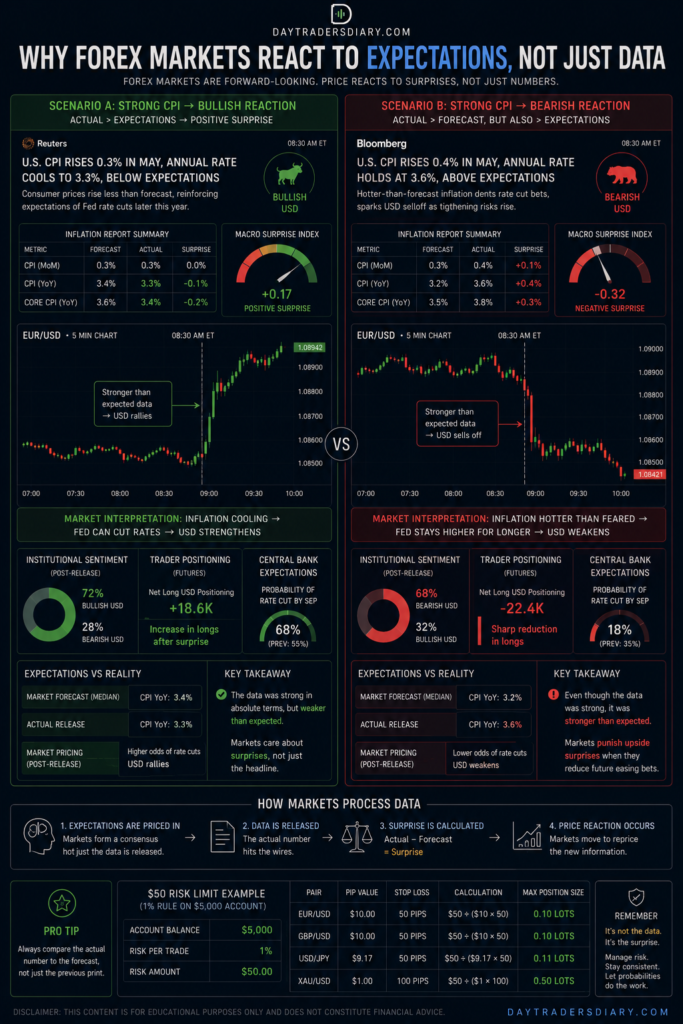
This is one of the biggest lessons traders eventually learn.
Markets do not move based only on economic data itself.
Markets move based on the difference between expectations and reality.
A strong inflation report may still trigger a selloff if traders expected something even stronger.
That confuses many developing traders.
They see “good news” but price moves the opposite direction.
Experienced traders understand that market positioning and expectations often matter more than the raw number itself.
That’s what expert traders follow:
Consensus Prediction.
Earlier readings.
Central bank forecast
Market sentiment before release.
The release itself is often less important than the context around it.
Why News Volatility Destroys Emotional Discipline
Trading on impulse amid a big news storm is one of the quickest ways for traders to lose discipline.
Low cost.
The candles are aggressive.
An emotion comes up.
Suddenly, traders throw off their typical process entirely.
They chase breakouts down.
Stop losses for emotional moves
larger on a whim.
Trade no organization. Entry.
Most traders realize after enough experience that news volatility exposes emotional vulnerabilities rather quickly.
That is why many professional traders reduce exposure around major events instead of becoming more aggressive.
The goal is not catching every move.
The goal is protecting execution quality.
Why Risk Management Matters More During News Events
Economic releases magnify risk-management mistakes dramatically.
A normal stop-loss may become meaningless during high-impact volatility if slippage expands aggressively.
This is where many traders unknowingly take oversized exposure because they fail to adjust properly for market conditions.
Using a structured Position Size Calculator helps traders maintain consistent exposure even when volatility conditions change between trading sessions.
That consistency becomes incredibly important during macroeconomic events.
Because once traders lose control of exposure, emotional execution usually follows shortly after.
Why Journaling Economic Events Improves Performance
Most traders never review how economic events affect their actual performance.
That is a major mistake.
A structured journal often reveals patterns traders completely miss in real time.
Some traders discover they perform poorly during high-volatility releases.
Others realize they become impulsive during central bank announcements.
Some traders like to trade after the volatility has calmed down rather than when the information comes out.
Without documentation these patterns are not obvious.
A systematic Trade Journal Template helps traders to review:
News event performance.
Execution quality .
Volatility environment.
Releases emotional behaviour.
That data over time becomes very useful.
Because traders stop trusting their recollection and start trusting evidence.
Why Serious Traders Eventually Focus on Controlled Execution
Most developing traders look for excitement.
Eventually seasoned traders need consistency.
That alteration radically affects their approach to news trading.
They stop trying to predict every release.
They stop forcing trades during chaotic conditions.
They focus more on controlled execution and long-term survival.
This is one reason many disciplined traders eventually explore evaluation programs from firms like The5ers, FTMO, and TradeThePool.
These firms reward consistency, exposure control, and structured execution rather than emotional overtrading.
A trader who already understands how to manage risk around economic events usually adapts far better to funded environments than traders still gambling through volatility impulsively.
For disciplined traders looking to scale responsibly, a The5ers evaluation account can become a logical next step because it rewards process stability instead of reckless short-term risk-taking.
The Real Purpose of Tracking the Economic Calendar
The economic calendar is not designed to assist traders forecast every market move accurately.
Its purpose is to assist traders prepare well.
That planning makes all the difference:
Risk management gets better.
Execution is quieter.
Position sizing gets smarter.
Emotional reactions are more uncontrolled.
This week take a hard look back at your recent losing trades.
How many occurred just before or during important economic releases?
Most traders discover an important pattern once they start paying attention to timing instead of focusing only on technical setups.
For your next read, explore related DayTradersDiary.com content on forex risk management, trading psychology, and volatility-based execution discipline. Those topics connect directly with long-term trading consistency.
FAQs
What is the best economic calendar for forex traders?
Many Forex traders use Forex Factory and Investing.com Economic Calendar, because they provide precise event timing, projections and impact levels.
Why do economic events move forex markets?
Economic releases influence interest rate expectations, market sentiment, liquidity, and future central bank policy expectations.
Should day traders avoid trading during major news events?
Sometimes not. But many seasoned traders will trim exposure or wait for volatility to subside before making bets.
Which economic events matter most in forex trading?
Interest rate decisions, inflation reports, Non-Farm Payrolls, GDP releases, and central bank speeches are among the most important forex-moving events.
Why do markets sometimes move opposite to economic data?
Markets do not react to the basic facts but to the disparity between expectations and actual results.
How do funded trader programs handle news trading?
The5ers and FTMO are examples of programs focused on disciplined risk management and measured execution under turbulent market conditions.