
Every trader remembers their first losing streak.
Not because of the money.
Because of what happened afterward.
The first few losses usually feel manageable. Then another trade fails. Confidence starts fading. You hesitate on good setups but somehow become aggressive on poor ones. Soon, you’re increasing position sizes, taking trades outside your plan, and trying to “win it back.”
Ironically, the biggest damage during a losing streak rarely comes from the original losses.
It comes from the emotional decisions that follow them.
Every consistently profitable trader has experienced periods where nothing seems to work. Losing streaks are not evidence that you’re incapable of trading. They are a normal consequence of operating in a probabilistic business where even excellent strategies produce sequences of losses.
The traders who survive are not the ones who avoid losing streaks.
They are the ones who know how to respond to them.
This guide explains how experienced forex traders handle drawdowns, distinguish between normal variance and genuine strategy problems, and recover without destroying months of progress.
Losing Streaks Are a Mathematical Reality
One of the hardest lessons in trading is accepting that profitable systems still lose.
Research published by the CFA Institute and studies in behavioral finance show that humans consistently underestimate randomness. We naturally assume several losses in a row mean something is wrong, even when those losses fall within normal statistical expectations.
Psychologist Daniel Kahneman’s research also shows that people feel the agony of losses more than the joy of wins. This characteristic, known as loss aversion, explains why traders generally abandon winning strategies after a very small number of lost trades.
For day traders, the implication is clear.
A losing streak is not automatically evidence that your strategy has failed.
Sometimes it is simply the cost of having an edge.
The challenge is knowing the difference.
The Biggest Mistake Traders Make During Losing Streaks
Most traders believe their biggest enemy is the market.
During a losing streak, their biggest enemy becomes inconsistency.
Imagine a trader who normally risks 1% per trade.
After five consecutive losses, frustration builds.
The next trade risks 3%.
Then 5%.
The strategy hasn’t changed.
Risk management has.
Even if the next few trades win, the account is now being driven by emotion instead of probability.
Professional traders understand something important.
You never recover from emotional trading with more emotional trading.
You recover by returning to your process.
Separate Bad Trading From Bad Outcomes
This is where many traders become trapped.
A losing trade does not necessarily mean you traded poorly.
Likewise, a winning trade does not automatically mean you traded well.
Ask yourself after every loss:
Did I follow every rule?
Did I respect my entry criteria?
Was my risk consistent?
Did I manage the position according to plan?
If the answer is yes, then the loss may be part of the statistical distribution of your strategy.
If the answer is no, the problem is execution rather than the strategy itself.
This distinction matters because the solution is completely different.
Know When Variance Ends and Strategy Problems Begin
Every strategy experiences normal drawdowns.
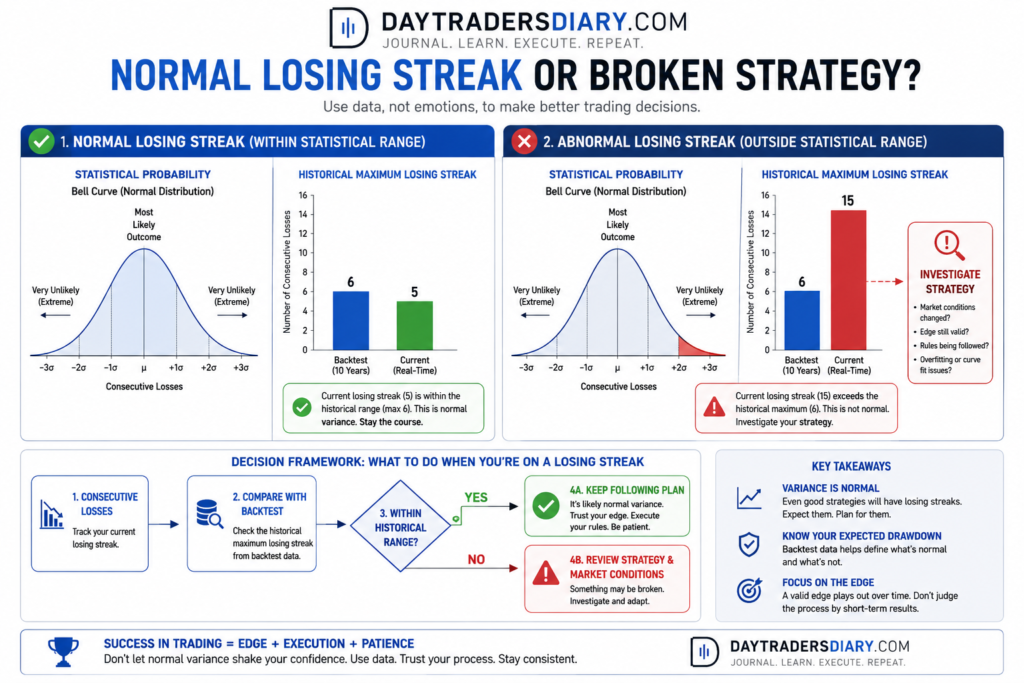
The question is whether your recent losses fall within historical expectations.
Suppose your backtesting shows that your strategy occasionally produces six consecutive losing trades.
You experience five losses this week.
Nothing unusual has happened.
Now imagine you’ve suffered fifteen consecutive losses when your historical maximum was six.
That deserves investigation.
This is one reason traders should spend time on Trading Edge Backtesting before risking real capital.
Backtesting creates realistic expectations.
Without it, every losing streak feels like a crisis.
If you’ve read our article on What Is a Trading Edge and How to Build One, you’ll understand why confidence comes from data rather than recent outcomes.
Reduce Risk Instead of Increasing It
Most traders respond to losing streaks by increasing risk.
Professionals often do the opposite.
Reducing position size accomplishes two things.
First, it protects capital during periods of uncertainty.
Second, it reduces emotional pressure.
When every trade carries less financial weight, it becomes easier to execute objectively.
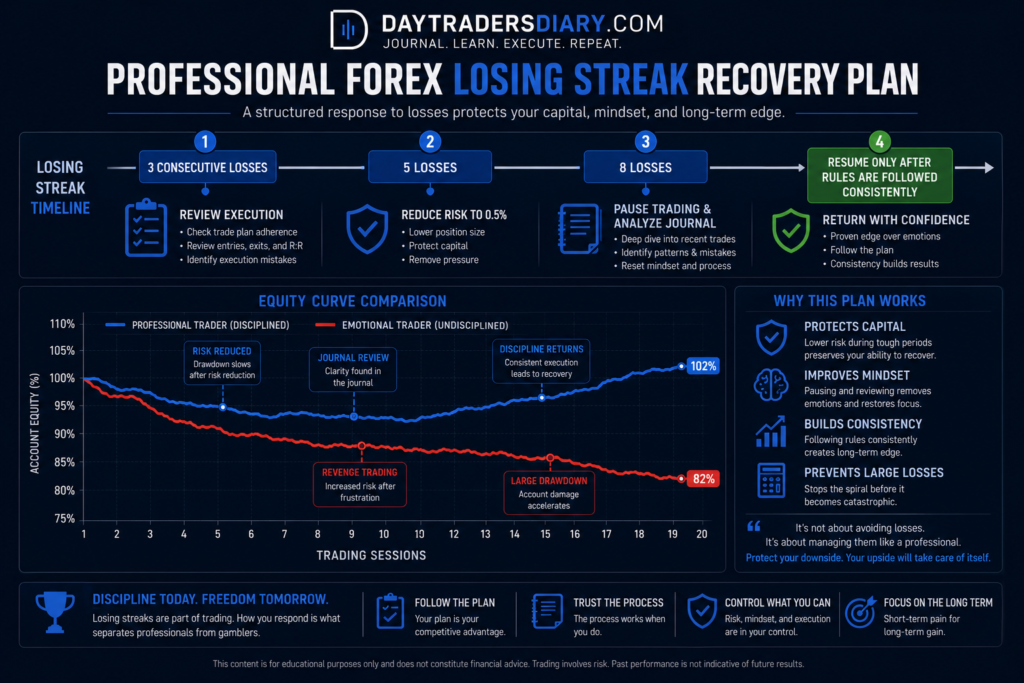
Some traders temporarily reduce risk from 1% per trade to 0.5% until consistency returns.
The objective isn’t maximizing recovery speed.
It’s restoring discipline.
Stop Looking at Your Account Balance
During losing streaks, traders often check their account balance after every trade.
This creates a dangerous feedback loop.
The more attention shifts toward money, the less attention remains on execution.
Experienced traders redirect their focus.
Instead of asking:
“How much did I lose today?”
They ask:
“Did I follow my trading plan today?”
That single change often prevents emotional decision-making.
Create a Losing Streak Recovery Plan
Every trading plan should include instructions for difficult periods.
Before the next losing streak arrives, answer these questions.
How many straight losses to get a review?
When to reduce the size of the position?
When should we take a break from trading?
Which performance metrics should be considered?
When will regular position sizing be?
Having these decisions written in advance prevents emotional reactions when losses occur.
Don’t Change Your Strategy Too Quickly
A common mistake is abandoning a profitable system after several losing trades.
Suppose we have a strategy that wins 55% of the time.
Mathematically, losing streaks are expected.
Changing strategies every time performance temporarily declines prevents statistical edges from playing out.
Professional traders do research before making modifications.
They look at current results compared to past performance.
They only consider changing the strategy if the differences are noteworthy.
More often than not, patience pays off better than constant optimization.
Use Your Journal to Diagnose the Problem
Your journal becomes especially valuable during losing streaks.
Instead of relying on memory, review the evidence.
Look for recurring patterns.
Were the losses concentrated in one market session?
Did they occur during high-impact news?
Were they mostly trend trades or range trades?
Were your entries early?
Were there any emotional exits?
If you’ve been maintaining the Trade Journal Template, you’ll already have this information available.
Instead of guessing what went wrong, you’ll be working with objective data.
Many traders discover that the strategy wasn’t the problem at all.
Execution was.
Risk Management Determines How Fast You Recover
A trader who loses 5% of their account requires a relatively modest gain to recover.
A trader who loses 40% faces a much steeper challenge.
This is why experienced traders treat risk management as their primary recovery tool.
The Position Size Calculator removes guesswork by ensuring every trade risks an appropriate percentage of capital regardless of market volatility or stop-loss size.
During losing streaks, consistency matters far more than aggression.
Protecting capital today preserves opportunity tomorrow.
The Psychology of Returning to the Market
Eventually, every trader must place another trade.
That moment often feels uncomfortable.
Confidence is lower.
Doubt is higher.
The goal is not waiting until fear disappears.
The goal is trusting your process despite uncertainty.
Many experienced traders begin with smaller positions.
Others trade only their highest-quality setups for several sessions.
The objective is rebuilding confidence through disciplined execution rather than quick profits.
Confidence earned through process lasts much longer than confidence earned through luck.
Why Losing Streaks Can Make You a Better Trader
It seems contradictory, yet losing streaks often speed up progress.
Winning covers up mistakes.
Losing reveals them.
Most traders improve their:
“Risk and risk management.
Caution.
Trading choice.
Discipline of Execution.
Journaling Routine.
Hard times make you look at yourself straight.
Handled properly, losing streaks become valuable tuition, not lasting setbacks.
Scaling a Proven Process
One characteristic shared by successful proprietary traders is emotional consistency.
Evaluation programs are designed to identify traders who can maintain discipline during both winning streaks and losing streaks.
Firms such as The5ers, FTMO, and FundedNext understand that every profitable trader experiences drawdowns.
What separates successful candidates is how they manage them.
A trader who consistently follows their process, maintains disciplined risk, and documents performance through detailed journaling is demonstrating exactly the qualities these firms value.
If your trading stats are consistently good long-term, notwithstanding the occasional losing run, then a The5ers evaluation account might be the sensible next move to scale your trading business, without having to put up considerably more of your own funds.
Final Thoughts
Losing streaks test more than your strategy.
They test your discipline.
The market doesn’t care how many losses you’ve had.
It only responds to the next decision you make.
This week, instead of trying to eliminate losing streaks, build a recovery process.
Define exactly how you’ll respond after three losses.
After five.
After ten.
Make those decisions while you’re thinking clearly, not while emotions are in control.
The next losing streak will eventually arrive.
Whether it becomes a temporary setback or a major drawdown depends entirely on the process you follow.
For your next read, explore our guide on How to Create a Trading Journal That Works to learn how structured reviews help you recover faster and improve after every setback.
Frequently Asked Questions
How do professional forex traders handle losing streaks?
Pros don’t trade emotionally. They are motivated by pre-set parameters of risk. They review their trading records. They review their executions. They stick to the same position sizes and don’t chase their losses.
How many losing trades in a row are normal?
It depends on the win rate of your plan. Systems that are profitable can lose 5-10 times in a row. Backtesting allows you to know what is statistically normal for your method.
Should I stop trading after a losing streak?
If your losses result from emotional mistakes or exceed your strategy’s historical drawdown, temporarily reducing activity or pausing to review your journal can be beneficial.
Should I increase my position size after several losses?
No. Chasing losses by taking on more risk usually causes bigger drawdowns. Most experienced traders will hold their position or cut their risk for a period until they are consistent again.
How can a trading journal help during losing streaks?
A trading journal helps identify whether losses stem from changing market conditions, poor execution, or weaknesses in the strategy, allowing you to make evidence-based improvements instead of emotional decisions.
Can profitable traders still experience losing streaks?
Yes. Every profitable trader experiences losing streaks because trading is based on probabilities rather than certainty. Long-term success depends on how consistently you manage those periods.