
Most traders think they know how they’re performing.
Ask them why they had a profitable month, and they’ll say their strategy worked.
Ask them why they had a losing month, and they’ll blame market conditions.
The problem is that neither answer is based on evidence.
It’s based on memory.
Memory is selective.
It remembers the huge winner that made your week.
It remembers the painful loss that ruined your mood.
It forgets the dozens of average trades that actually define your performance.
That’s why so many traders spend months trying to improve without making meaningful progress.
They’re solving the wrong problems.
Professional traders don’t evaluate themselves by how much money they made last week.
They evaluate whether their process is improving.
Profit is the result.
Performance is the cause.
Once you understand that distinction, your entire approach to trading changes.
This guide explains how to evaluate your day trading performance like a professional, which metrics actually matter, and how to use data to build a more consistent trading business.
Why Most Traders Evaluate Performance Incorrectly
A profitable week does not always mean you traded well.
A losing week does not always mean you traded poorly.
Research published by the CFA Institute consistently emphasizes the importance of process-driven evaluation rather than outcome bias when assessing investment decisions.
Psychologist Daniel Kahneman reached a similar conclusion through decades of research into decision-making under uncertainty. People naturally judge decisions based on outcomes instead of the quality of the process that produced them.
Trading magnifies this mistake.
A trader can break every rule and still make money.
Another trader can execute perfectly and lose because probability doesn’t guarantee individual outcomes.
Professional traders understand this difference.
They measure execution first.
Results second.
The Purpose of Performance Evaluation
Evaluating performance is not about proving that you’re profitable.
It’s about identifying what deserves improvement.
Each review must address questions like:
What brought in most of my profits?
What blunders did I lose most money on?
What kind of market conditions suit my strategy?
Where did I lose my discipline?
The goal is ongoing improvement.
Not self-criticism.
Stop Measuring Profit Alone
Profit is the most visible trading statistic.
It is also one of the least informative.
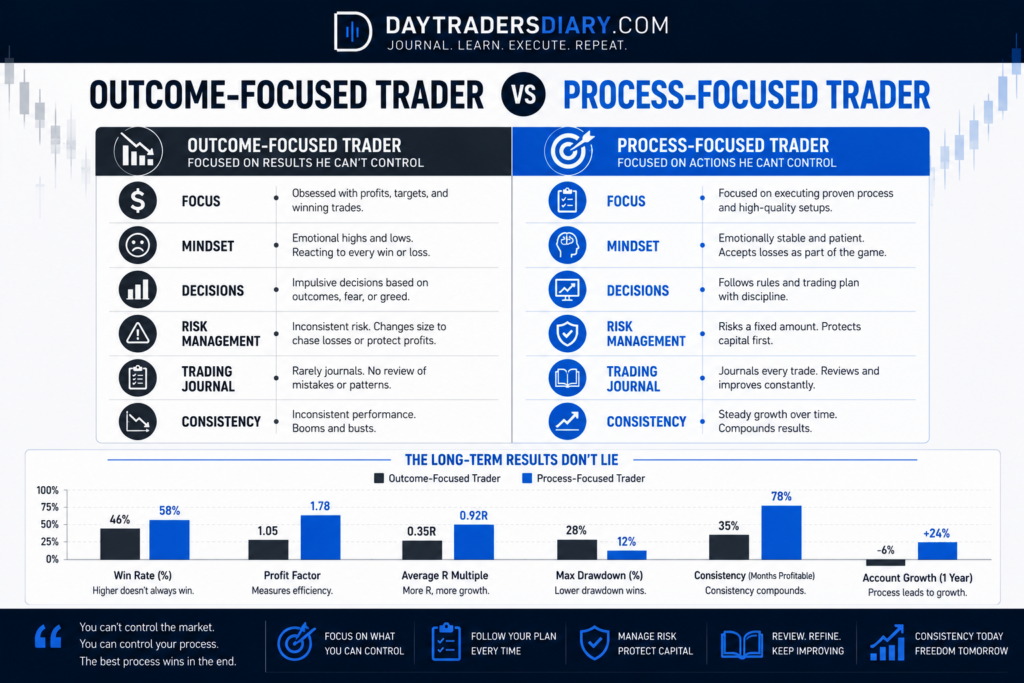
Imagine two traders each earn $2,000 this month.
Trader A followed every rule.
Trader B doubled position size after every loss.
The financial result looks identical.
The long-term outlook does not.
Performance evaluation should include both financial outcomes and behavioral consistency.
Without process metrics, profit becomes misleading.
The Metrics Professional Traders Actually Track
Professional traders rarely focus on a single statistic.
Instead, they evaluate a complete performance profile.
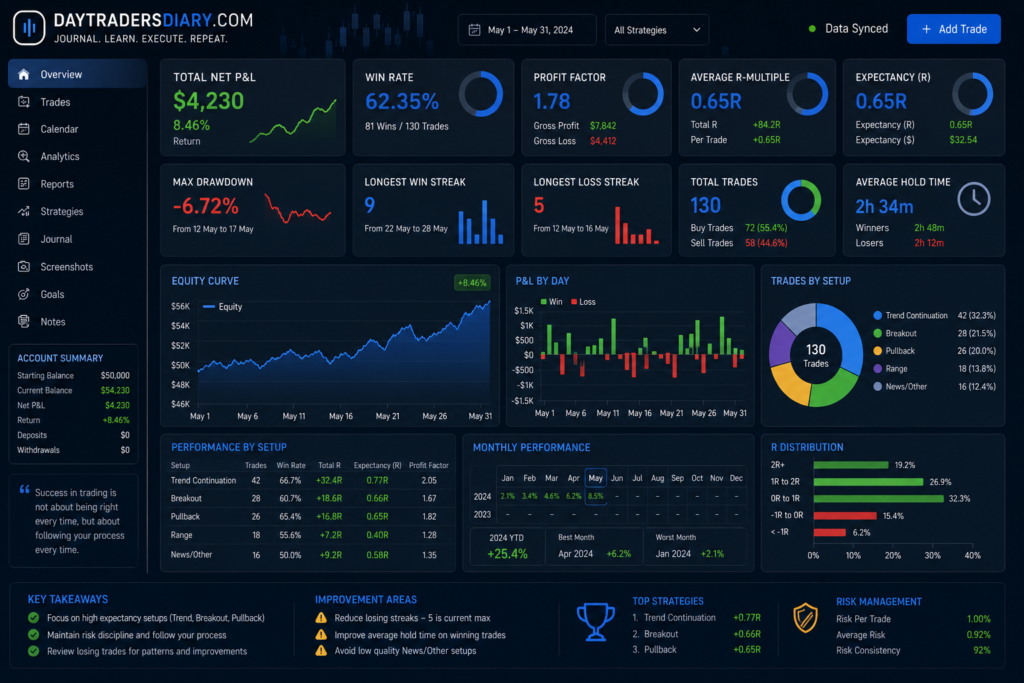
Important metrics include:
Win rate.
Average reward-to-risk ratio.
Expectancy.
Profit factor.
Maximum drawdown.
Average trade duration.
Performance by strategy.
Performance by market condition.
Execution quality.
Emotional discipline.
Each statistic answers a different question.
Together, they explain why your results occur.
If you’ve already read our guide on How to Track Your Win Rate Like a Pro, you’ll know that win rate alone tells only a small part of the story.
Evaluate Strategies Separately
One common mistake is combining every trade into one monthly report.
Suppose you trade:
Breakouts.
Trend pullbacks.
Range reversals.
Scalping setups.
If one strategy consistently loses money while another performs exceptionally well, an overall performance report may hide that fact.
Professional traders isolate each strategy.
This reveals where the real edge exists.
Rather than changing everything, they improve only the areas that need attention.
Review Performance by Market Conditions
Markets evolve constantly.
Your strategy doesn’t perform equally well in every environment.
Evaluate results during:
Trending markets.
Sideways markets.
High volatility.
Low volatility.
Major news sessions.
Quiet sessions.
You may discover your strategy performs best after strong momentum but struggles during consolidation.
If you’ve read our guide on How to Trade Flat Markets, you’ll recognize why matching strategy to market conditions often improves results more than modifying the strategy itself.
Professional traders adapt.
They don’t force trades into unsuitable environments.
Measure Execution Quality
One statistic deserves far more attention than it receives.
Execution quality.
After every trade, ask yourself:
I followed every rule?
Did I go where I wanted to?
Did I respect my stop loss ?
Did I make my target feel.
Did I follow my trading plan to the letter?
Separate score from profit execution.
Over time, it will tell you if your losses are due to bad strategy or bad discipline.
This distinction changes everything.
Analyze Losing Trades Differently
Many traders review losing trades emotionally.
Professionals review them analytically.
Every losing trade falls into one of three categories.
A good trade that lost.
A poor trade that lost.
A good idea executed poorly.
Each category requires a different response.
Good trades should continue.
Poor trades should disappear.
Poor execution should be corrected.
All loss is equally frustrating without categorization.
Build a Weekly Performance Review
Daily reviews identify immediate mistakes.
Weekly reviews reveal recurring patterns.
Questions worth asking include:
Which strategy was the best?
Which session provided the most quality opportunities?
Am I overtrading?
Was the risk constant?
Could feelings have affected decisions?
What can I do for next week?
Notice that only one question focuses on future improvement.
That’s intentional.
Performance reviews should lead directly to actionable changes.
Your Journal Is More Valuable Than Any Trading Analytics Platform
Many traders believe they need expensive software to improve.
Trading analytics platforms certainly provide useful reports.
But they cannot explain your thought process.
They cannot measure patience.
They cannot record hesitation.
They cannot identify emotional mistakes.
Your Trade Journal Template fills those gaps.
When combined with statistics, screenshots, and written observations, your journal becomes a complete performance analysis system.
The most valuable insights often come from combining numbers with context.
Risk Management Should Be Evaluated Every Week
A separate review is deserved by risk management.
Think about:
Was the same risk % used on each trade?
Did I really enhance the risk?
Did I stay inside my daily loss limit?
Were position sizes calculated correctly?
This is where many traders quietly undermine otherwise profitable strategies.
Using the Position Size Calculator removes guesswork and ensures position sizing remains consistent regardless of stop-loss distance or market volatility.
Consistency in risk makes every other performance metric more reliable.
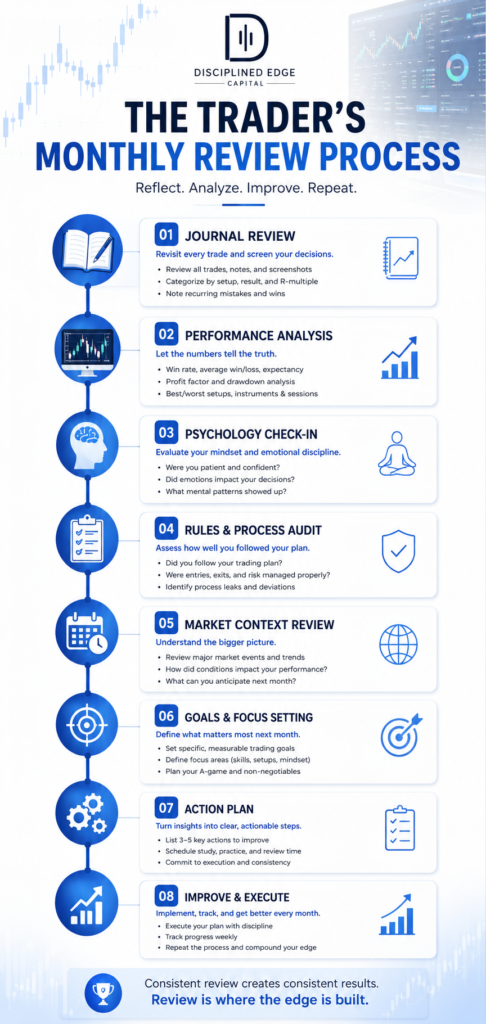
Build a Monthly Improvement Plan
The purpose of performance analysis is not to collect statistics.
It’s improving performance.
At the end of every month, choose one area to improve.
Not five.
One.
You may need to stop trading during low-volatility sessions.
You may need better patience before entering breakouts.
You should reduce unnecessary trades.
Small improvements repeated monthly create substantial progress over a year.
The professional trader almost never throws away his system and starts over.
They shine them.
Why Emotional Performance Matters
Many traders evaluate technical performance while ignoring psychological performance.
But emotional stability frequently makes the difference in the long run.
Monitor elements like:
Assurance prior to admission.
Trade stress.
Wait with patience.
Impulse buying.
Revenge trade.
FOMO.
Over time, you’ll notice that your emotional state often predicts trading performance better than the market itself.
This idea connects closely with our article on How to Handle Losing Streaks in Forex, where emotional recovery plays a central role in long-term consistency.
Scaling a Proven Trading Process
Your performance data continually shows positive expectancy, focused execution and good risk management and another opportunity will come your way.
Scaling
Proprietary trading firms such as The5ers, FTMO, and FundedNext evaluate traders based on the same characteristics your performance review should measure.
Consistency.
Discipline.
Risk management
Method.
Big gains not uncommon.
A trader with a full record of his performance receives more than insight into himself.
They develop objective proof that their edge is repeatable.
If your stats show a consistent and disciplined execution through diverse market conditions, then a The5ers evaluation account could be a reasonable next step to trading bigger capital without dramatically increasing your own financial exposure.
Final Thoughts
The market provides feedback every day.
Most traders never learn how to read it.
Instead of asking whether today was profitable, ask whether today made you a better trader.
Review your trades.
Study your decisions.
Measure your execution.
Improve one weakness at a time.
Over hundreds of trades, those small improvements become your competitive advantage.
For your next read, explore our guide on How to Create a Trading Journal That Works to build a structured review process that turns every trade into actionable insight.
Frequently Asked Questions
How do I evaluate my day trading performance?
Don’t only look at earnings but measure your performance by looking at important measures like win rate, expectation, risk to reward ratio, drawdown, execution quality and following your trading plan.
What metrics should day traders track?
Key variables are win rate, average reward to risk ratio, profit factor, expectation, drawdown, execution quality, strategy performance and consistency of risk management.
Is a trading analytics platform necessary?
A trading analytics program can easily make it easy to analyze your performance, but a complete trading notebook with statistics, screenshots and written remarks can be just as beneficial if you keep it consistently.
How often should I review my trading performance?
Review your trades daily, do a deep-dive performance review weekly to spot patterns, and do a full review monthly to guide the long-term improvement.
Why is execution quality important?
Execution quality helps determine whether profits and losses resulted from following your trading plan or from emotional decisions, making it easier to improve consistently.
How can I improve my trading performance over time?
Focus on your journal review, focus on one weakness at a time, always manage risk, and measure process based metrics instead of assessing success by short-term earnings.