
Most losing traders believe their problem is finding better entries.
They spend months searching for indicators, testing new strategies, and tweaking chart settings. Every losing trade feels like proof that they need a more sophisticated setup.
What often gets overlooked is that many trades fail long before the entry signal appears.
The real mistake is trading against market structure.
I’ve seen traders buy aggressively into a market that has been making lower highs for hours. I’ve seen others short a strong uptrend simply because an oscillator showed overbought conditions. Sometimes those trades work, but over hundreds of trades, fighting structure becomes an expensive habit.
Market structure is one of the simplest concepts in trading, yet it remains one of the most misunderstood.
Professional traders don’t begin with indicators. They begin by asking a simple question:
Who is controlling the market right now?
The answer is usually found in market structure.
This guide will explain what Forex market structure is, how professionals use it, why it matters more than most indicators, and how you can build a practical market structure trading strategy into your daily routine.
What Is Forex Market Structure?
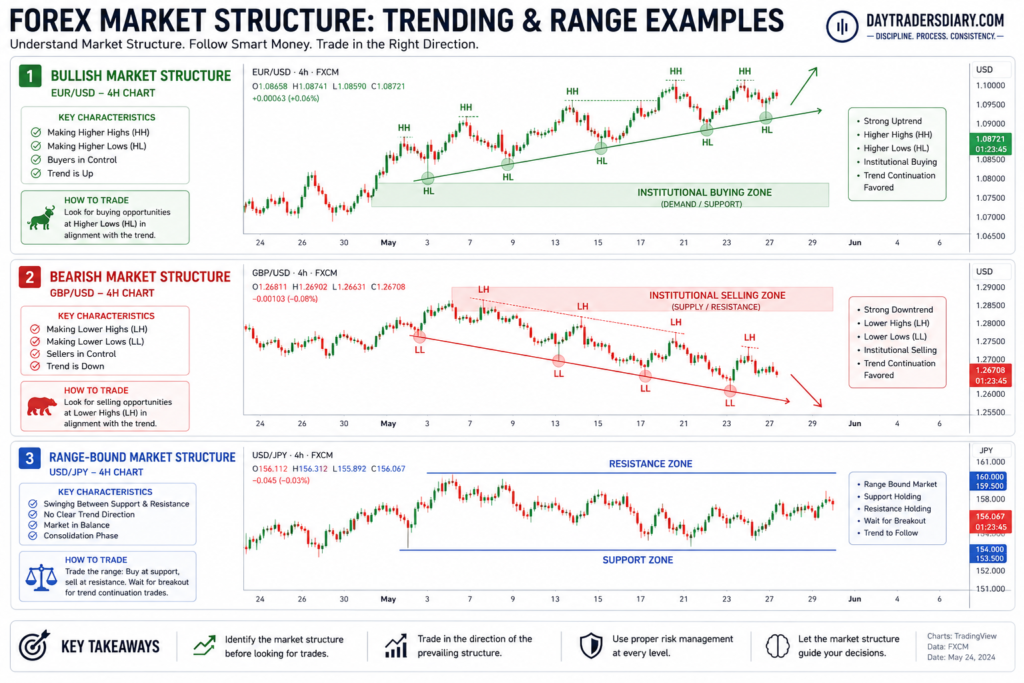
Forex market structure refers to the way price moves over time through a sequence of highs and lows.
At its core, market structure tells traders whether buyers or sellers currently have control.
An uptrend is when the price keeps making higher highs and higher lows.
A downtrend is formed when price keeps making lower highs and lower lows.
A range is established when price goes sideways and has no directional control.
That sounds simple because it is.
The challenge comes from interpreting these shifts in real time.
Most traders focus on individual candles. Experienced traders focus on the story those candles create together.
The market structure offers the context.
Tradable setups are tradable without context.
When you have context, you start to screen for possibilities that fit with the prevailing market direction.
Why Market Structure Matters More Than Most Indicators
Many technical indicators are simply mathematical calculations based on past price.
Market structure is price itself.
Research from the Bank for International Settlements consistently highlights how order flow and market participation drive currency movement. Meanwhile, studies published by the Federal Reserve Bank of New York emphasize how market participants continuously adjust positions as information enters the market.
For traders, this means one important thing.
Price movement reflects collective market decisions.
Market structure allows you to observe those decisions directly rather than through a secondary indicator.
Think of it this way.
If EUR/USD continues making higher highs and higher lows, institutions are demonstrating willingness to buy at increasingly expensive prices.
That information often matters more than what an oscillator says.
Understanding the Three Types of Market Structure
Bullish Market Structure
Price is pushed up above former highs and pull backs are defended until former major lows are broken. This builds a bullish market structure.
The keys are simply ordered:
Higher, higher.
Higher lows.
Higher highs.
Higher Lower.
Many traders get into the trap of waiting for perfect pullbacks that never come.
Great trends are often not comfy.
Retracements aren’t often very deep if institutions are aggressively building positions.
Bearish Market Structure
A bearish market structure follows the opposite pattern.
Price continues producing lower highs and lower lows.
Every rally becomes weaker than the previous one.
Sellers remain in control.
One useful observation I’ve noticed over years of trading is that many traders can identify downtrends visually but still struggle emotionally to trade them.
Human psychology naturally wants to buy perceived bargains.
The market doesn’t care about perceived value.
It only cares about order flow.
Range-Bound Market Structure
Not every market trends.
In fact, a large portion of Forex trading occurs within ranges.
This is where many trend-following traders give back profits.
Ranges often trap traders because breakouts appear convincing before reversing.
Understanding whether you’re trading a trend or a range can dramatically improve decision quality.
The Difference Between Structure and Trend
Many traders use the terms interchangeably.
They are like , not the same .
Trend is the direction.
Structure is the framework creating that direction.
A market may still technically be in an uptrend while showing signs of structural weakness.
For example, imagine EUR/USD creates a new high but struggles to produce a meaningful follow-through move.
Momentum begins fading.
Buyers are becoming less aggressive.
The trend still exists, but the structure is starting to weaken.
This distinction often helps traders identify reversals before indicators catch up.
How Professional Traders Read Market Structure
Most retail traders focus on what happened.
Professionals focus on what should happen next.
A practical market structure framework begins with three questions.
First, what is the prevailing pattern on the higher timeframe?
Second, where’s the last swing high and swing low?
Third, What would disrupt the current order?
For example, if GBP/USD continues creating higher lows, buyers remain in control.
The moment a significant higher low breaks, the market sends new information.
That information deserves attention.
Professional traders aren’t predicting.
They’re responding.
Market Structure Breaks and What They Really Mean
One of the most searched concepts today is the market structure break.
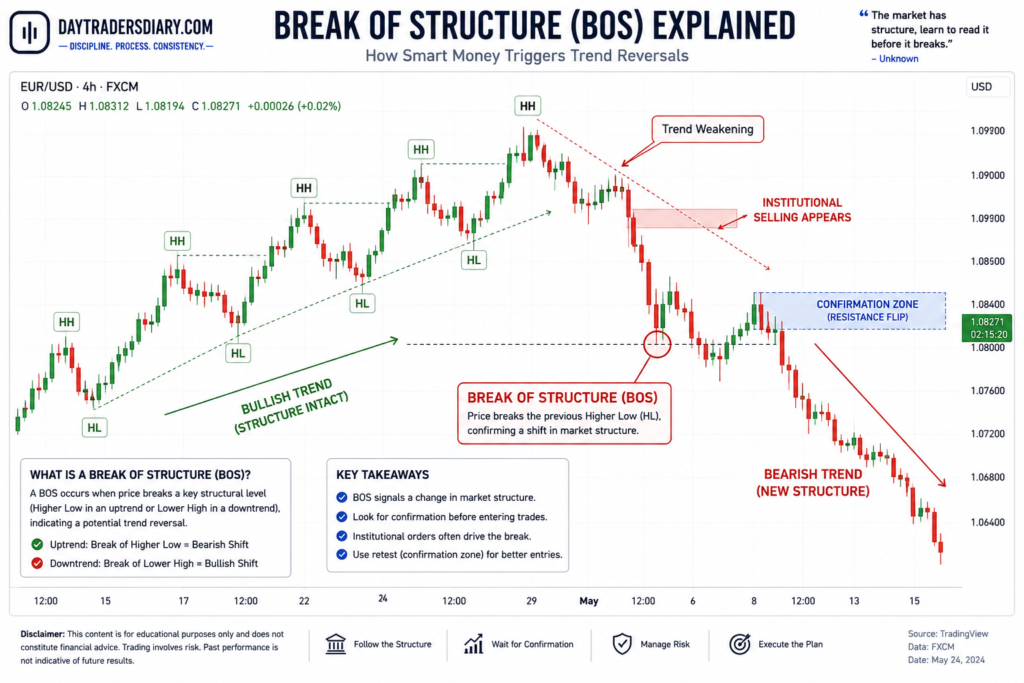
A break of structure occurs when price violates a significant swing point that was maintaining the current trend.
Many traders think any break of structure is a reversal.
That assumption generates unneeded losses.
Sometimes a structure rupture will result in a complete trend change.
Sometimes it just signals a deeper retreat before the trend restarts.
It depends on the context.
A structure break during major economic news carries different implications than a structure break during a quiet session.
This is why combining market structure with economic awareness often produces better results than relying on structure alone.
A Practical Market Structure Trading Strategy
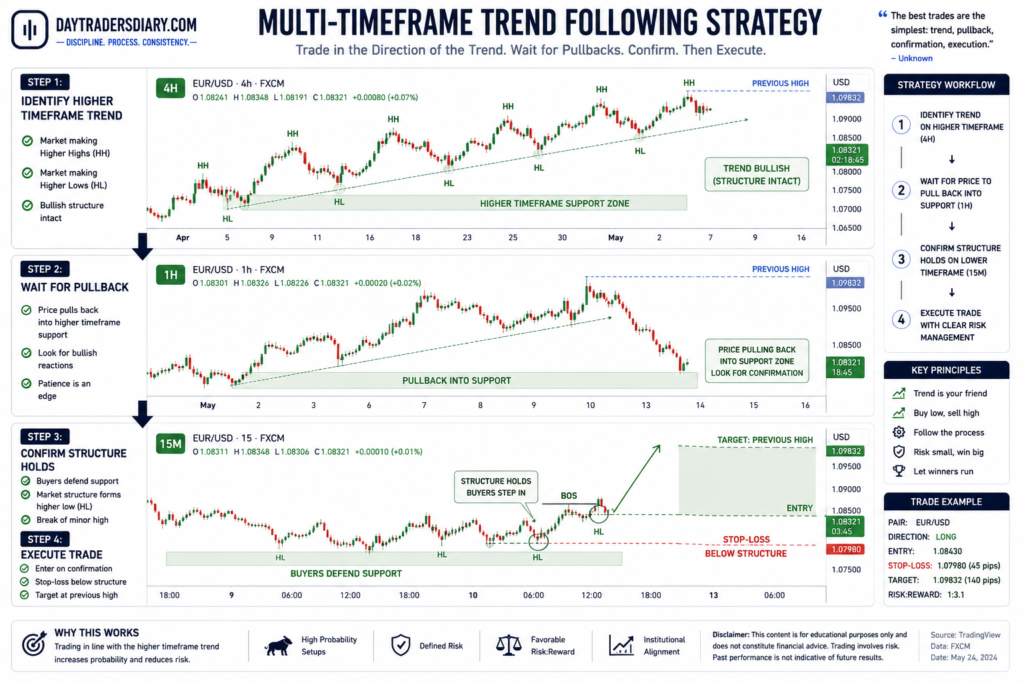
One framework I have found useful focuses on alignment.
Start by identifying the primary structure on the higher timeframe.
Move down to your execution timeframe.
Wait for a pullback.
Look for evidence that the dominant structure remains intact.
Consider a bullish example.
The four-hour chart shows higher highs and higher lows.
Price retraces toward a previous support area.
The pullback eases.
Buyers step in again.
Forms the next higher low.
That sequence gives a natural place to cooperate with the trend.
You’re not buying because some indicator turned green.
You’re purchasing because market players keep defending bullish structure.
The Most Common Market Structure Mistakes
The first mistake is forcing trades against dominant structure.
The second mistake is identifying structure from a timeframe that doesn’t match the trading plan.
The third mistake is assuming structure never changes.
Markets evolve.
The best traders evolve with them.
Another overlooked mistake is focusing exclusively on entries while ignoring invalidation levels.
A market structure trader should always know exactly where the analysis becomes wrong.
Risk Management and Execution
Market structure helps to identify opportunities.
Risk management evaluates if those opportunities translate into revenues.
This is where a lot of traders get their risk calculation wrong.
Structure based setup may seem good but the financial success is ultimately determined by position size.
Using the Position Size Calculator removes guesswork and ensures every trade risks a consistent percentage of capital regardless of stop loss distance.
This becomes especially important when trading around major support and resistance levels where stop placement varies significantly.
Market structure without risk control is incomplete analysis.
Journaling Market Structure Trades
Most trading journals focus on profits and losses.
A better approach is documenting structural observations.
Note the market structure before to each trade.
Check if the trade was in line with the prevalent trend.
Invalid document of the structure.
Monitor if the trade worked by design or by chance.
Patterns arise over time.
Many traders find that their best quality transactions come when many timeframes line up structurally.
The Trade Journal Template can help identify these patterns much faster than relying on memory.
Scaling an Edge Beyond Personal Capital
Once traders develop consistency using market structure, they often encounter a different challenge.
Capital.
A trader producing steady returns on a small account still faces limitations.
That’s why so many competent traders finally look into evaluation programs.
Once they’ve demonstrated they can trade consistently, disciplined traders can access larger pools of funds with firms such as The5ers, FTMO and TradeThePool.
The key distinction is that funded trading should be viewed as a business opportunity rather than a shortcut.
Market structure provides an edge.
Risk management preserves that edge.
Access to larger capital allows the edge to scale.
If your structure-based approach is producing consistent results, evaluating programs such as The5ers may be worth exploring as part of a long-term growth plan.
Final Thoughts
Market structure is not another trading strategy.
It is the foundation underneath nearly every successful trading strategy.
Indicators can help.
News analysis can help.
Sentiment analysis can help.
But all of them ultimately flow through price.
And market structure is the language price uses to communicate who is winning the battle between buyers and sellers.
For the next month, try a simple exercise.
Before taking any trade, identify whether the market is creating higher highs and higher lows, lower highs and lower lows, or moving sideways.
You may discover that many trading decisions become significantly easier once you stop focusing on individual candles and start focusing on the structure behind them.
If you’re looking for your next read, check out DayTradersDiary’s tutorial on trend pullback trading and support and resistance tactics to get a sense of how market structure fits in with higher-probability trade ideas.
FAQs
What is Forex market structure?
Forex market structure refers to the sequence of highs and lows that reveals whether buyers or sellers currently control the market.
What is a market structure break in trading?
A market structure break occurs when price violates a significant swing high or swing low that was maintaining the current trend.
Is market structure better than indicators?
Market structure provides direct information from price action, while indicators are derived from price. Many professional traders use structure as their primary framework and indicators as secondary confirmation.
How do beginners identify market structure?
First, identify higher highs and higher lows for uptrends or lower highs and lower lows for downtrends. Look at the sequence as a whole, not separate candles.
Can market structure be used for day trading?
Yes. Day traders use market structure extensively to determine the direction of a trend, find entrances, define risk and manage transactions across various time frames.