
Many traders take years perfecting entrances, testing indicators and looking for the right situation. Then one morning a seemingly perfect trade gets stopped out in seconds.
The chart didn’t suddenly become wrong.
The market simply received new information.
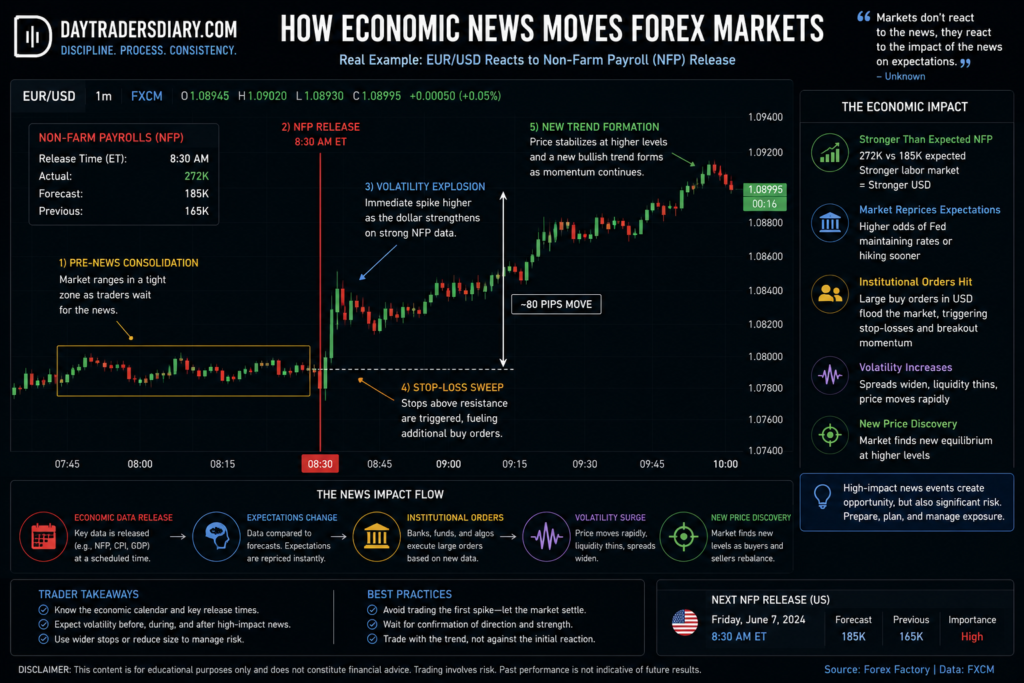
If you’ve ever watched a currency pair explode 80 pips in less than a minute and wondered what happened, chances are you ignored something sitting right in front of you: the economic calendar.
I had to learn this lesson the hard way.
When I started trading, I used to dismiss economic happenings as background noise. I was nearly exclusively a technical analyst. Support and resistance, moving averages, chart patterns, trend lines. Up until then, everything made sense. Then, a perfectly valid setup failed because a central bank news hit the market five minutes after I entered.
The problem wasn’t my strategy.
The problem was that I was trading without understanding when the market was likely to receive information capable of changing trader expectations instantly.
Today, the economic calendar is one of the first things I check every trading day. Not because I trade every news event, but because understanding when important data is released helps me understand when risk changes.
This guide will show you how skilled traders use a Forex economic calendar, which events are most important, how to read the data and how to create a practical routine around economic releases without turning into a news trader.
Why Economic Calendars Matter More Than Most Traders Think
A common misconception is that economic calendars are only useful for fundamental traders.
That is simply not true.
Even pure technical traders are affected by economic releases because institutions, hedge funds, banks, and algorithmic systems react to new economic information immediately.
A technical setup that works perfectly during normal market conditions can fail during a major economic announcement because market participants suddenly reassess currency valuations.
The economic calendar doesn’t predict direction.
What it does provide is awareness.
Awareness of when volatility may increase.
Awareness of when spreads may widen.
Awareness of when liquidity may disappear.
Awareness of when your normal trading rules may need adjustment.
Many experienced day traders spend more time managing event risk than predicting market direction.
That alone should tell you how important economic data really is.
What the Research Shows
Research from the Bank for International Settlements consistently shows that macroeconomic information remains one of the largest drivers of currency price discovery.
Data from the Federal Reserve Bank of New York has also highlighted how financial markets rapidly incorporate new economic information into prices, often within seconds of release.
Meanwhile, studies published through the International Monetary Fund continue to demonstrate how monetary policy expectations strongly influence exchange rates.
What does this mean for day traders?
The takeaway is surprisingly simple.
Markets often move less because of the actual number released and more because of how that number changes expectations.
A stronger-than-expected inflation report matters because traders begin adjusting expectations about future interest rates.
A weak employment report matters because it may signal slower economic growth.
The calendar helps traders understand when these expectation shifts are likely to occur.
What Information Appears on a Forex Economic Calendar?
At first glance, economic calendars can seem overwhelming.
Rows of announcements, country flags, percentages, forecasts, previous numbers, impact ratings, and release times can make it look more complicated than it actually is.
Most calendars contain five key pieces of information.
The event itself.
The scheduled release time.
The previous reading.
The market forecast.
The actual result once released.
The real edge comes from understanding the relationship between expectations and reality.
Markets generally care less about whether a number is good or bad and more about whether it differs from what participants expected.
A strong number that everyone anticipated may barely move the market.
A result that’s somewhat weaker than expected and surprises investors might cause big volatility.
Which Economic Events Matter Most?
Not all economic releases deserve equal attention.
Professional traders typically focus on events capable of influencing interest rate expectations or economic growth projections.
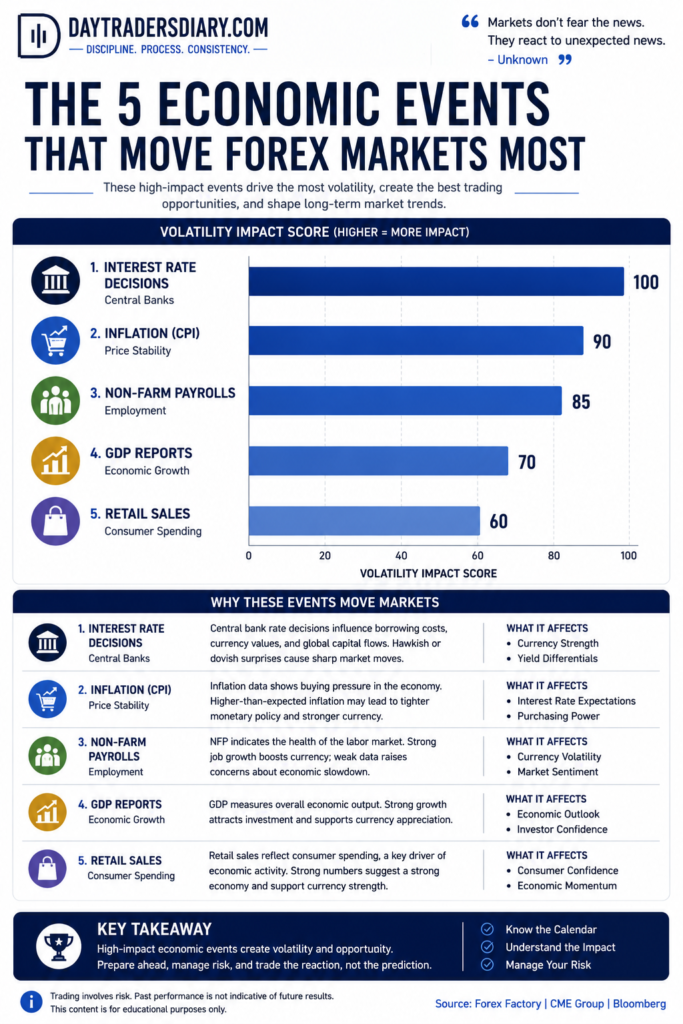
For Forex traders, several events consistently rank among the most important.
Central Bank Decisions
Interest rate decisions by institutions such as the Federal Reserve, European Central Bank and Bank of England often trigger big market movements.
You can have big trends even when rates do not move but central bank comments can do it.
Inflation Reports
Consumer Price Index readings are carefully monitored as inflation is a key aspect of future interest rate decisions.
Currency markets tend to move dramatically on surprise inflation data.
Employment Data
Reports like U.S. Non-Farm Payrolls are still among the most anticipated economic announcements in the world.
Employment strength provides significant insight into economic health and consumer spending potential.
GDP Releases
Traders use Gross Domestic Product statistics as a measure of economic growth trends and anticipated monetary policy direction.
Retail Sales and Consumer Spending
Consumer activity drives a significant portion of economic growth.
Stronger or weaker spending data can influence currency valuations quickly.
A Practical Daily Economic Calendar Routine
One of the biggest mistakes traders make is checking the calendar after entering a trade.
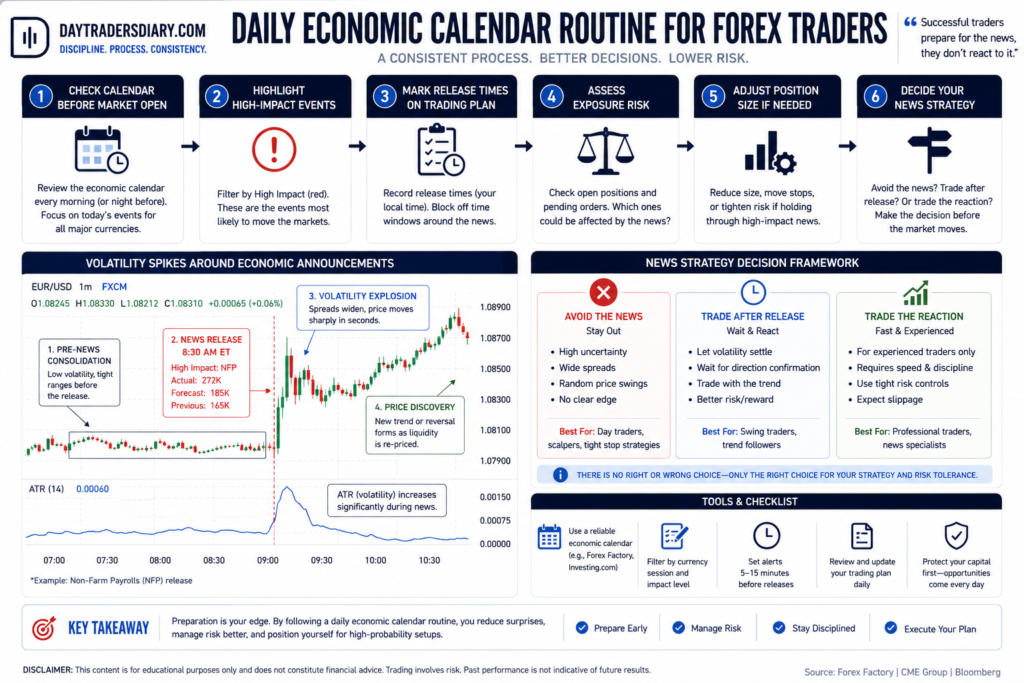
A better approach is creating a consistent pre-market process.
Before opening charts, review all scheduled high-impact events.
Identify which currencies may be affected.
Mark release times directly on your trading plan.
Ask yourself these 3 questions.
Am I going to miss out on the trade during this event?
Am I going to cut back on position size?
Am I going to be looking for opportunities once I’m out?
This basic technique avoids many avoidable losses.
You stop being surprised by volatility because you already know when volatility is likely to appear.
How Technical Traders Can Use Economic Calendars
Many profitable traders never trade the actual news release.
Instead, they use the calendar as a risk filter.
For example, imagine EUR/USD is approaching a key resistance level thirty minutes before a major inflation report.
Rather than forcing an entry, an experienced trader may wait for the announcement.
The response of the market typically gives more information on direction, momentum and institutional positioning.
Patience often makes better opportunity than forecast.
That’s why traders who are well versed in both technical analysis and economic timing tend to do better than traders who only focus on one side of the problem.
Risk Management Around Economic Releases
This is where a lot of traders get into problems.
The risk characteristics of economic events can change instantaneously and drastically enhance the volatility.
A stop-loss that generally offers sufficient protection can be susceptible to abrupt price surges.
Spreads can widen.
Slippage can increase.
Liquidity conditions can change.
This is where most traders miscalculate risk. Using the Position Size Calculator removes guesswork and ensures position sizing remains consistent regardless of market conditions.
If you regularly trade around major announcements, reviewing your position sizing process should become part of your preparation routine.
For additional guidance, readers should also review DayTradersDiary’s articles on Forex risk management, volatility-based position sizing, and trading high-impact news events.
Journaling Economic Calendar Decisions
Most trading journals focus on entries and exits.
Very few traders document their interaction with economic events.
That is a mistake.
Start recording:
Did you trade before the release?
You didn’t make it to the event?
What effect did volatility have on execution?
Did the spreads go wider?
Was your approach acting weird?
Patterns take time to develop.
Some traders would rather avoid the large releases altogether.
Others find their strongest trades occur after the initial reaction settles.
Using the Trade Journal Template can help uncover these insights much faster than relying on memory.
Scaling Beyond Personal Capital
One reality many profitable traders eventually face is that consistency alone does not automatically create significant income.
Capital matters.
A trader generating a 5% monthly return on a $2,000 account faces very different opportunities than a trader applying the same edge to a six-figure account.
This is one reason many experienced traders explore evaluation programs offered by firms such as The5ers, FTMO, and TradeThePool.
These programs are not shortcuts to profitability.
They simply provide access to larger capital for traders who can demonstrate discipline, risk control, and consistency.
If your economic calendar preparation process is already improving execution and decision-making, evaluating a funded account pathway may be a logical next step.
Final Thoughts
The economic calendar is not a prediction tool.
It is a risk awareness tool.
The traders who survive longest are rarely the ones who predict every market move correctly. They are usually the ones who understand when market conditions are changing and adjust accordingly.
For the next thirty trading days, challenge yourself to review the economic calendar before every session and document how each major release affects your trading decisions.
You may discover that some of your biggest losses were never caused by poor analysis.
They were caused by poor timing.
For a logical next read, explore DayTradersDiary’s guide on Forex Risk Management and Position Sizing to build a complete framework around economic event trading.
FAQs
What is a Forex economic calendar?
A Forex economic calendar is a schedule of upcoming economic announcements, central bank decisions, and financial reports that can influence currency prices.
What is the best economic calendar for Forex trading?
Many traders use calendars provided by Forex Factory, Investing.com, and major brokers because they offer forecasts, historical data, and impact ratings.
Should beginners trade major news releases?
Most beginners benefit from observing news events first rather than trading them directly. The volatility can be difficult to manage without experience.
Which economic events move Forex markets the most?
Central bank rate decisions, inflation announcements, jobs data, GDP releases and remarks from central bank officials all affect markets.
How often should I check the economic calendar?
Active day traders should look at the calendar before each trading session and be aware of any major impact events during trading hours.