
Most traders think they’re reading the market, but in reality they’re reacting to it.
They wait for a breakout, see a candlestick pattern, or follow an indicator signal. By the time they enter, the move is already underway or about to fade. Then comes the confusion. The setup looked perfect, but price reverses almost immediately.
The problem is not your strategy. It’s that you’re trading the outcome of order flow, not the cause of it.
This guide is built from real trading experience and backed by data. It’s not about adding another indicator. It’s about understanding what actually moves price in the forex market and how you can position yourself before the move becomes obvious.
What Order Flow Really Means in Forex
Order flow just means the interaction of buyers and sellers at certain prices. Every move you see on a chart is a product of imbalance. Buyers more aggressive than sellers force price higher. More aggressive sellers push it down.
In centralised markets such as futures this can be seen directly using tools such as the DOM or footprint charting. The forex is decentralised, which means it is less transparent. But that does not mean order flow is opaque. It only means you have to read between the lines.
The key is to recognise that price is not random. It goes from liquidity to liquidity. Stops, pending orders and institutional positioning produce areas of activity. Once you learn where these pockets are, you start seeing the market differently.
Data from the Bank for International Settlements shows that much of the volume of forex trading is due to institutional movements rather than retail speculation. In practice, this means something quite simple. The moves that matter are not caused by indicators. They are triggered by working orders of large players.
Likewise, the research cited by the CME Group on order flow and market microstructure indicate price tends to accelerate after liquidity is taken, not before. That is why breakouts often fail the first time. The market is draining liquidity before it makes a real move.
Once you understand this, you stop chasing candles and start anticipating behavior.
Reading Order Flow Without a Footprint Chart
Most forex traders don’t have access to full order book data. That’s fine. You don’t need it to build an edge.
You can read order flow through price behavior if you know what to look for.
Start with how price reacts at key levels. Not just whether it moves, but how it moves. Does it spike quickly and reverse? Does it grind slowly? Does it break and hold or break and fail?
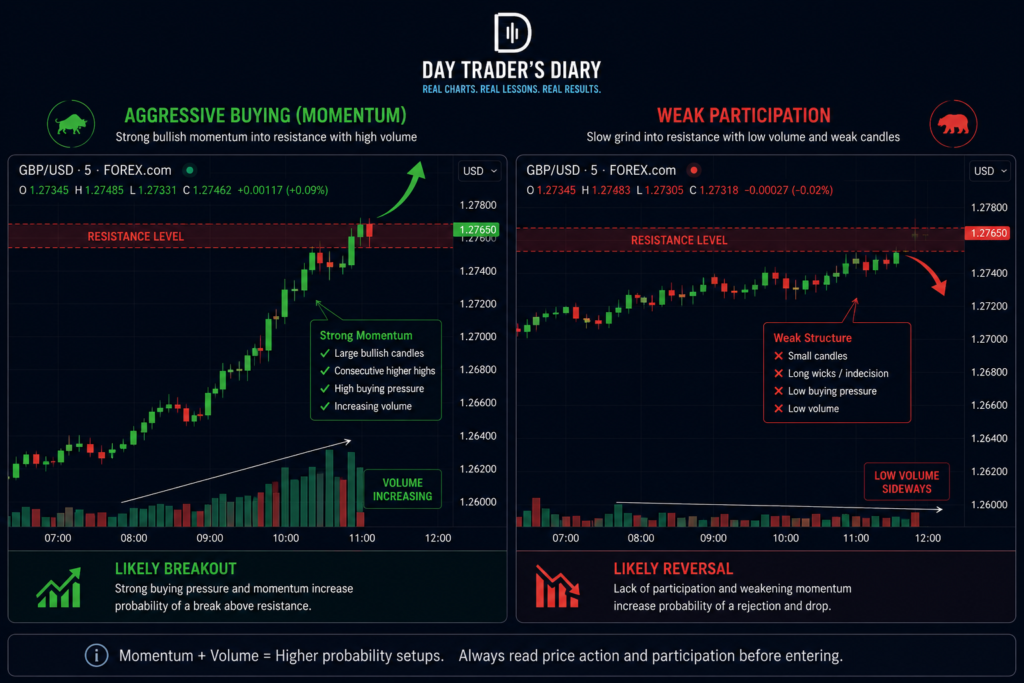
A rapid level rejection frequently suggests that aggressive commands have been eaten up. A slow grind into a level is frequently an indication of weak involvement. This is where a lot of traders fall into the trap of thinking sluggish movement indicates strong.
Let’s say the EURUSD is testing a resistance level during the London session. Candles are small, momentum is diminishing, price continues to rise. Most traders expect the trend to carry on. A seasoned trader senses lack of assertiveness. When the price gets to the level and reverses rapidly, it is not by chance. That is a change in order flow.
This is the kind of nuance most strategies miss.
If you’ve already explored concepts like liquidity sweeps or false breakouts in our price action strategies section on DayTradersDiary, this is where it all connects.
A Practical Framework for Trading Order Flow
We’re not trying to see every step ahead.” It is to place yourself with where the genuine participation is.
The first step is to locate the obvious liquidity zones. Previous session highs and lows, equal highs and lows and important support or resistance levels. Traders place stops and entry in certain regions so they attract orders. Then observe how price approaches these zones. If price accelerates into a level, it often means stops are being targeted. If it slows down, it suggests hesitation.
Now focus on the reaction.
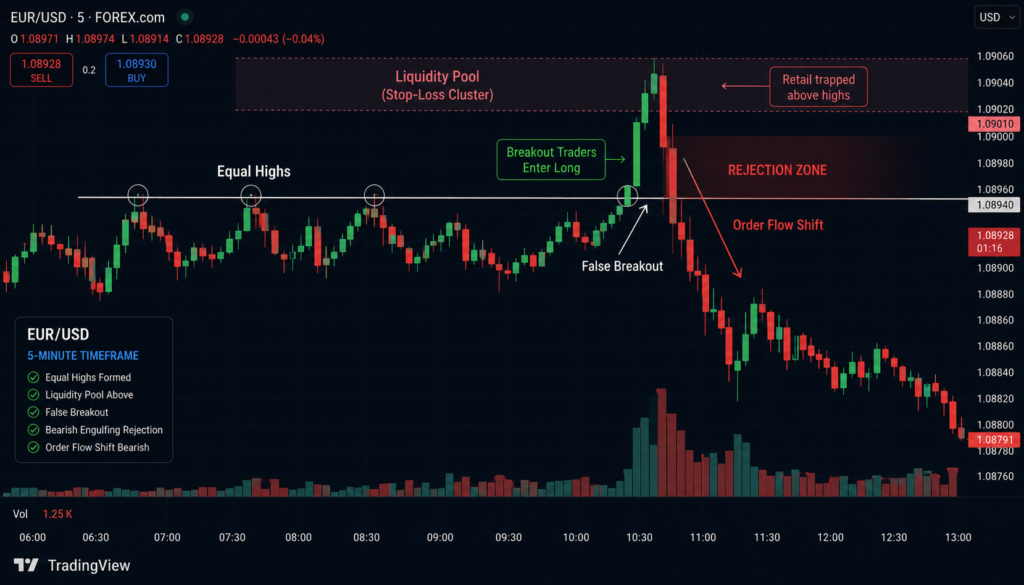
If price breaks a level and immediately snaps back, that’s a failed breakout. In order flow terms, it means the breakout orders were absorbed and opposing pressure took control.
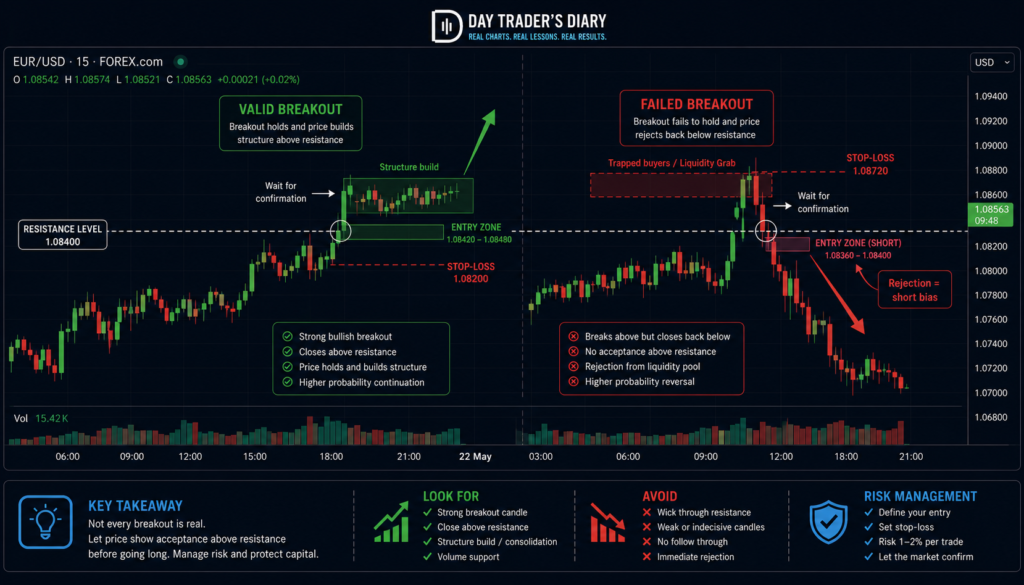
If price breaks and holds, with continuation, it indicates that the imbalance is real.
A simple way to think about it is this. Don’t trade the level. Trade the reaction to the level.
Imagine GBPUSD breaking above a previous high. Retail traders jump in long. Instead of following them, you wait. If price holds above and builds structure, you can join with confidence. If it rejects quickly and falls back below, that’s your short opportunity.
This logic aligns closely with what we’ve covered in our guide on how to trade false breakouts on DayTradersDiary. The difference here is that you’re understanding why the breakout fails, not just that it fails.
Where Most Traders Misinterpret Order Flow
The biggest problem is mixing together volume and direction.
High activity does not imply continuation. It often shows up at turning points. This is why big players need liquidity to get in and out of positions.
Another issue is putting too much emphasis on indicators that try to replicate order flow. A lot of these tools are behind or oversimplifying what is really happening.”
Real order flow reading is context-dependent. It’s about time, structure and behaviour.
For example, a reversal at a random level during low liquidity hours means very little. The same reversal at a key level during London or New York session carries much more weight.
This is where experience starts to separate traders. You begin to filter signals based on when and where they occur.
Risk and Execution in Order Flow Trading
Order flow offers you an informational advantage, but it is the execution that makes you money.
The big thing I see is traders getting in too early. They wait for a reaction, rather than for confirmation. This causes wasteful draw downs.
Wait for the market to show its hand. A rejection, a shift in structure, or a failure to continue.
Then define your risk clearly.
This is where most traders miscalculate risk. They either place stops too tight and get taken out by noise, or too wide and destroy their risk to reward.
Using a position size calculator removes guesswork. It allows you to size trades based on structure rather than emotion.
If you’re trading a failed breakout, your stop should logically sit beyond the level that invalidates your idea. Not at an arbitrary number.
Execution is not about speed. It’s about precision.
Journaling Order Flow Observations
Order flow is a talent you learn by doing it again and over and reviewing it.
You want to start recording not just your trades, but the context of your trades. What caused the reversal? What did the method consist of? Did we see a liquidity grab before the move?
Over time, patterns emerge.
This is where a structured trade journal template becomes essential. It forces you to capture details that your memory will miss. Especially after a long trading session.
You’ll start noticing things like certain setups working better during specific sessions, or how often false breakouts occur around major levels.
This is how you refine your edge.
Scaling the Edge with Capital
There’s a point where improving your execution is no longer the bottleneck. Capital becomes the constraint.
You can have a solid order flow strategy, disciplined risk management, and still see slow account growth simply because your position size is limited.
That’s why many serious traders examine evaluation programs.
Companies like The5ers, FTMO, and TradeThePool offer a systematic route to access larger funds while preserving risk controls. The major benefit is not just money. It’s the infrastructure. The rules under which you trade simulate the professional trading settings.
The5ers, for example, is a good match for order flow trading, which requires patience and accuracy more than frequency and stresses the need of consistency and low drawdown.
Maybe you are already regularly implementing your plan and are ready to open an evaluation account to grow your returns without personal risk.
The Real Edge in Order Flow Trading
Order flow isn’t a shortcut. It’s a change of viewpoint.
You stop asking where the price is going & start asking why it is moving.
Just that one modification makes you more choosy, more patient, and more in line with how the market really works.
If you take one thing from this, make it this. Stop reacting to candles and start studying behavior around key levels.
As a next step, go back through your last 20 trades and analyze how price behaved before your entry. Not after. Before.
You’ll likely find that the clues were always there.
FAQs
Is order flow trading possible in forex without volume data?
Yes . You don’t have centralised volume, but you can read order flow through price movement, liquidity zones, and reaction patterns.
What is the best timeframe for order flow trading?
Lower timeframes like 1-minute to 15-minute charts work well for execution, but always combine with higher timeframe context.
Are order flow indicators reliable in forex?
These are mostly estimates. They can help but should never replace reading price structure and behaviour.
How do I know if a breakout is real or fake?
Look at the reaction after the break. If price holds and builds structure then it is more likely to be real If it reverses fast then it’s probably a liquidity grab.
Can beginners use order flow concepts?
Yes, but it takes practice. Focus on simple observations, like how price responds at crucial levels, instead of trying to interpret everything at once.