
Most losing traders do not fail because they cannot read charts.
They fail because they change their opinion every five minutes.
Price moves up, and they become bullish. A red candle appears, and suddenly they become bearish. One news headline changes everything. One losing trade makes them doubt the entire setup.
I learned this lesson the hard way.
Early in my trading journey, being flexible meant having no strong opinion. I would react to every candle, every pullback, and every market rumor. The result was predictable. I chased moves, entered late, exited early, and constantly found myself trading against the larger market direction.
Then I started studying how professional traders approach the market.
One thing became obvious.
Before they place a trade, they already have a bias.
Not a prediction.
Not a guarantee.
A bias.
That single shift changed the way I looked at the market.
A trading bias is like a filter. It tells you what configurations are worth looking at and which ones you can ignore. It decreases noise, increases consistency, and structures your decision-making.
In this guide, you’ll learn what a trading bias really means, how professional traders build a daily bias, when bias helps, when it becomes dangerous, and how to use it without becoming stubborn.
What Is a Trading Bias?
A trading bias is your directional expectation for the market based on available evidence.
If your analysis suggests EUR/USD is likely to move higher, your bias is bullish.
If your analysis suggests GBP/USD is likely to decline, your bias is bearish.
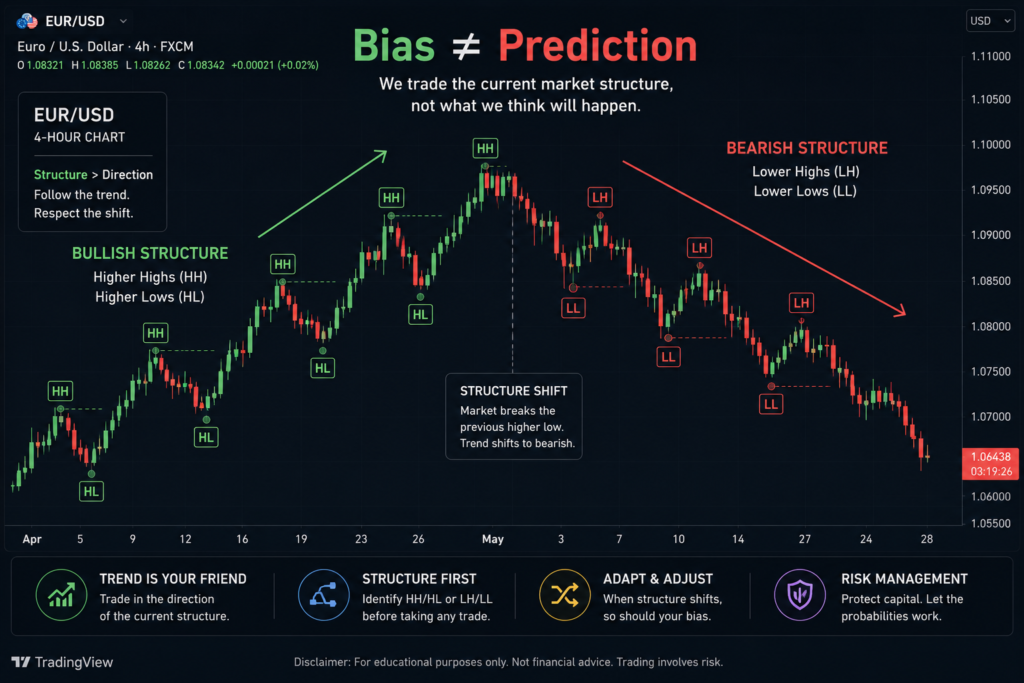
The important distinction is that a bias is not a prediction.
A prediction says, “The market will go up.”
A bias says, “Based on current information, I prefer buying opportunities until the market proves otherwise.”
That difference matters.
Good traders remain flexible. They operate with a directional bias while remaining willing to change their view when new information arises.
Think of a trading bias as a GPS route. It guides your decisions, but if the road is closed, you take a different path.
Why Trading Bias Matters More Than Most Traders Realize
One of the biggest problems in day trading is information overload.
Every trading session produces thousands of data points. Candlestick patterns, support levels, resistance zones, economic reports, sentiment shifts, and institutional flows all compete for your attention.
Without bias, everything looks tradable.
With a bias, the market becomes much simpler.
Instead of looking for every possible setup, you focus on setups that align with your directional view.
This naturally improves selectivity.
The National Bureau of Economic Research has published a number of studies on the fact that decision quality deteriorates when people are presented with too many options. Traders have the same difficulty. Too many options can result in poor execution.
A trading bias reduces that complexity.
It creates a framework for making decisions rather than reacting emotionally to every price fluctuation.
What the Research Says About Market Direction and Trend Persistence
Several studies have found that financial markets often display momentum characteristics over specific periods.
Research published by the University of Chicago and work from renowned economist Eugene Fama demonstrated that trends can persist longer than many market participants expect.
Disciplined processes tend to outperform solely reactive decision-making, according to research from the CFA Institute.
What does all this mean for traders?
That doesn’t mean patterns always continue.
It suggests that markets are often good to traders who go with the grain, rather than fighting the grain all the time.
A trading bias helps create that alignment.
The lesson is simple.
The goal is not to predict every move.
The goal is to position yourself on the side with the higher probability consistently.
The Different Types of Trading Bias
Most traders think bias only means bullish or bearish.
In reality, there are several layers.
A directional bias indicates whether you expect the price to rise or fall.
A session bias focuses on what you expect during a particular trading session.
A fundamental bias comes from economic developments, interest rates, inflation trends, or central bank policy.
A technical bias comes from chart structure, trend analysis, and price action.
Many professional traders combine all of these.
For example, if the Federal Reserve maintains a hawkish stance while EUR/USD trades below major resistance and continues making lower highs, both the fundamental and technical picture may support a bearish bias.
When multiple factors point in the same direction, confidence often increases.
How Professional Traders Build a Daily Bias
The biggest misconception about daily bias trading is that it requires complex analysis.
Most experienced traders follow a surprisingly simple process.
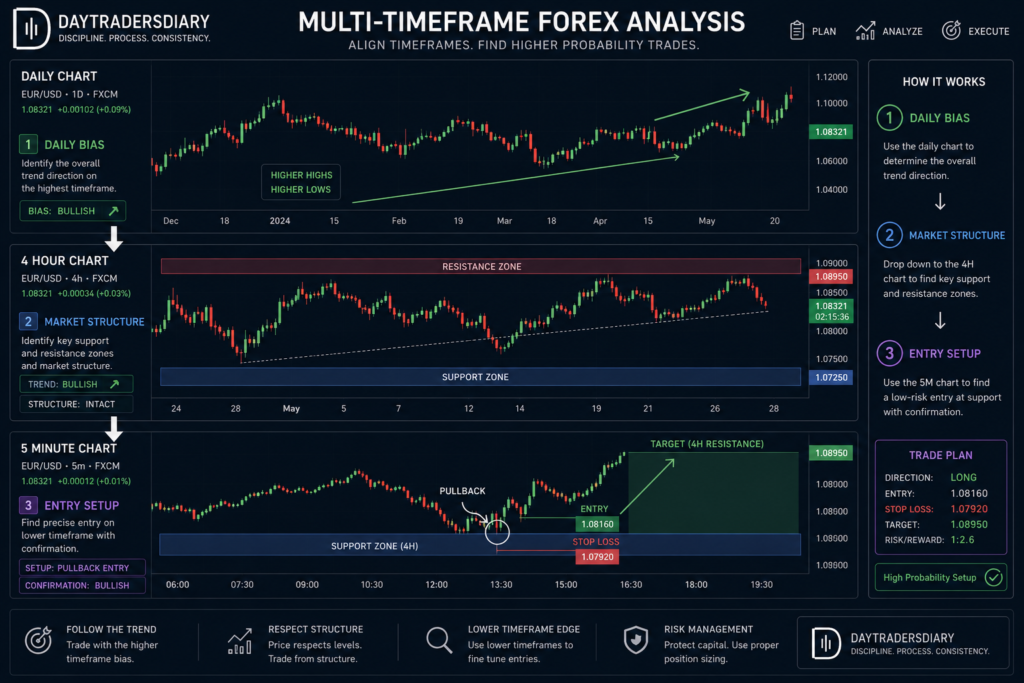
They begin with the higher timeframe.
Before looking at a five-minute chart, they examine the daily and four-hour charts.
The first question is straightforward.
Is the market trending, ranging, or transitioning?
If EUR/USD has been producing higher highs and higher lows for several weeks, the broader bias remains bullish.
Next comes key level analysis.
Professional traders identify key support and resistance zones where institutional activity is likely to be concentrated.
Then they check the economic calendar.
Major events such as CPI, Non-Farm Payrolls, and central bank decisions can completely reshape market expectations.
Finally, they combine everything into a working hypothesis.
For example:
EUR/USD stays above daily support. The market structure is positive. Bias for lengthy stays unless today support fails.
This one sentence sets the tone for the entire trading day.
A Practical Daily Bias Trading Framework
Here’s a framework I’ve seen many profitable traders use successfully.
Start by analyzing the daily timeframe.
Determine whether the market is making higher highs, lower lows, or consolidating.
Move down to the four-hour chart.
Find important support and resistance levels.
Check all the upcoming economic events.
Ask yourself this question:
“If I had to buy or sell today, which side would I choose?”
Your answer is your first bias.
Throughout the session, focus primarily on setups that align with that bias.
If the market proves your bias wrong, adjust accordingly.
The keyword is adjust.
Not defend.
When Trading Bias Becomes Dangerous
Bias helps traders.
Attachment destroys traders.
There is a huge difference.
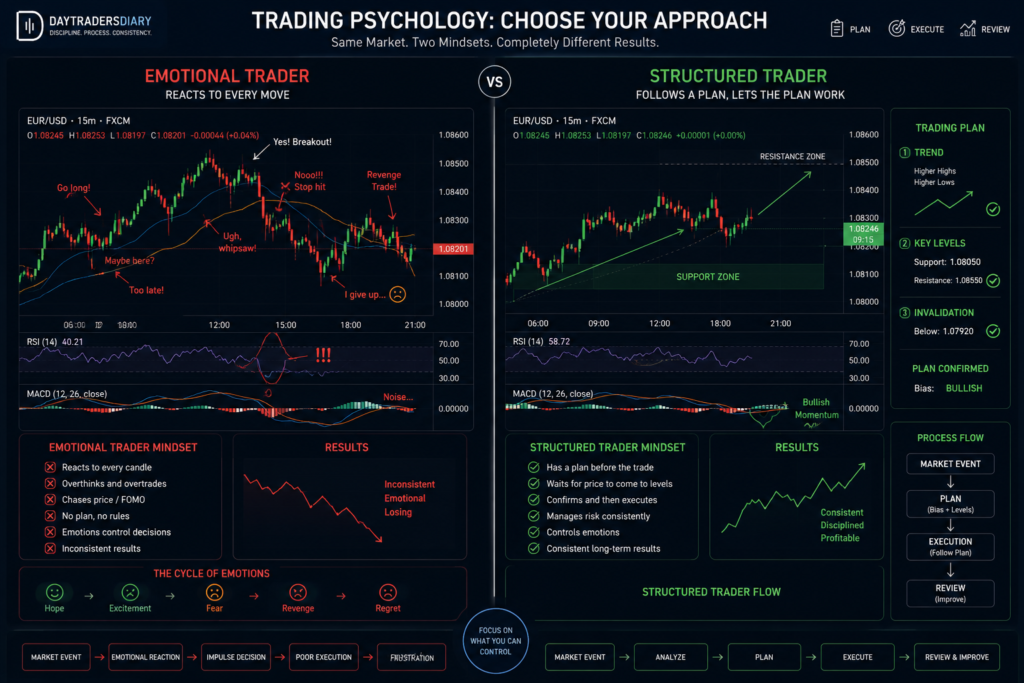
Many traders become emotionally invested in their market outlook.
They stop analyzing and start defending.
You see this constantly after major economic releases.
A trader develops a bullish bias on EUR/USD.
The market breaks key support.
Instead of reassessing, the trader keeps buying because they “know” the market should rise.
This is no longer trading.
It is arguing with the market.
Professional traders understand that price always has the final vote.
Your bias is simply a working theory.
If evidence changes, the theory changes.
Combining Trading Bias With Market Structure
One of the most effective ways to use bias is through market structure.
Let’s say EUR/USD is making higher highs and higher lows.
You are bullishly biased.
Rather than purchasing random breakouts, you wait for pullbacks into support.
You let the market discount for that.
This way you have a better risk-to-reward while staying with the overall trend.
If you haven’t already, reading our guide to market structure trading can help reinforce this concept, as bias and structure work exceptionally well together.
Trading Bias and Risk Management
A strong bias does not justify a larger risk.
This mistake has ruined many promising traders.
The market does not care how confident you feel.
Risk must remain consistent.
In fact, some of the biggest losses occur when traders become overly convinced that they are right.
This is where proper position sizing becomes essential.
Before entering any trade, calculate your position size based on your account risk, stop-loss distance, and trade structure.
This is where most traders miscalculate risk. Using a Position Size Calculator removes guesswork and ensures every trade carries appropriate exposure regardless of market conditions.
Bias should influence trade selection.
It should never influence risk discipline.
How to Journal Your Trading Bias
One habit dramatically improved my own trading performance.
I started recording my daily bias before the market opened.
Not after.
Before.
Every morning I would write:
What is my directional bias?
Why do I have this bias?
What would invalidate this bias?
At the end of the day, I reviewed the results.
Over time, patterns emerged.
Some biases were based on solid evidence.
Others were emotional reactions disguised as analysis.
Using a Trade Journal Template makes this process far easier by providing a consistent structure for reviewing your decision-making process.
The goal is not to be right every day.
The goal is to understand whether your reasoning process is improving.
Scaling Beyond Personal Capital
One reality eventually confronts every profitable trader.
Even a strong edge has limitations when trading a small account.
A trader generating 5% monthly returns on a $2,000 account produces very different results than the same trader generating 5% on a six-figure account.
This is why many skilled traders explore evaluation programs.
Firms such as The5ers, FTMO, and FundedNext provide access to larger trading capital for traders who can demonstrate consistency and risk control.
The attraction is not simply more money.
It is capital efficiency.
A trader with a proven process, disciplined risk management, and a repeatable bias framework may find evaluation accounts a logical next step.
If you’ve developed a consistent trading edge and feel constrained by account size, exploring a The5ers evaluation account may be worth considering as part of your long-term trading plan.
The Real Purpose of a Trading Bias
Many traders believe there is bias to forecast market direction.
It does not.
The real goal is to increase the quality of decisions.
A trading bias helps you filter noise, focus attention, stay consistent and not get emotional.
The best traders are not necessarily the best forecasters.
They are often the best decision-makers.
A well-constructed bias creates structure.
Structure creates consistency.
Consistency creates performance.
That sequence matters far more than predicting the next candle.
Conclusion
If you want to improve your trading immediately, stop trying to predict every market move.
Instead, develop a daily bias before the session begins.
Write it down.
Define what supports it.
Define what invalidates it.
Then trade according to that framework rather than reacting emotionally to every fluctuation.
For your next trading session, challenge yourself to create a written daily bias before opening a single chart. You may be surprised how much calmer and more focused your trading becomes.
As a next read, explore our guide on Forex Market Structure to see how professional traders combine directional bias with price action to create higher-probability trading opportunities.
FAQs
What is trading bias in forex?
Trading bias is a directional bias based on technical, fundamental or market structure analysis It allows traders to focus on higher likelihood chances while weeding out superfluous setups.
What is daily bias trading?
Daily bias trading involves establishing a market outlook before the trading session begins and using that outlook to guide trade selection throughout the day.
Is trading bias the same as predicting the market?
No. A bias is a working assumption based on current evidence. Predictions imply certainty, while bias remains flexible and can change when market conditions change.
How do professional traders determine market bias?
Most professional traders analyze higher timeframes, market structure, support and resistance levels, economic events, and overall sentiment before forming a directional bias.
Can a trading bias improve profitability?
Having a trading bias can help with consistency since it reduces impulsive actions and allows traders to focus on setups that fit the bigger market conditions. But it needs to be coupled with disciplined risk management and execution.