
Every trader remembers that trade that seemed like the perfect revival.
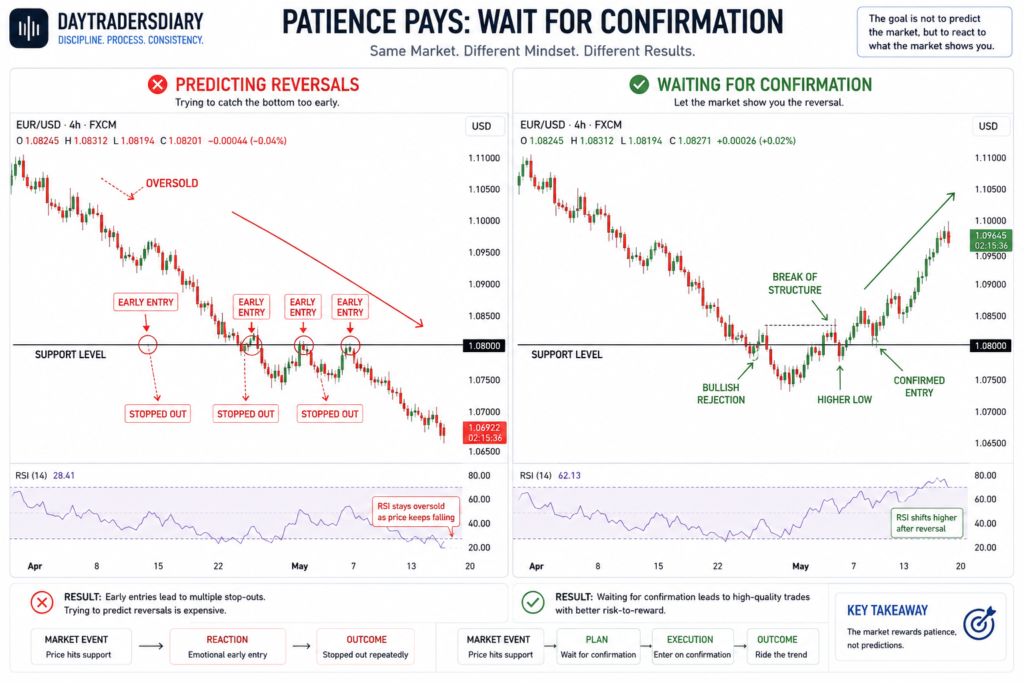
The price has been falling for hours. The market was oversold. Support was near. It was like everything was in place for a rebound.
So you bought it.
Five minutes later, the price dropped again.
You bought more.
Then it dropped again.
By the end of the session, what looked like a reversal was simply a trend continuing exactly as it had before.
Most traders do not lose money trading reversals because reversals are difficult to identify.
They lose money because they try to predict them before the market confirms anything.
I learned this lesson after spending years trying to pick tops and bottoms. It felt smart. It felt exciting. It also drained my account more than almost any other mistake.
The truth is that professional traders rarely trade reversals because they think a market has gone too far.
They trade reversals because the market has provided evidence that conditions are changing.
That distinction changes everything.
This guide explains how to identify genuine reversal opportunities, what confirmation actually means, and how experienced traders build reversal trades around evidence rather than hope.
Why Most Traders Struggle With Reversal Trading
The idea of buying at the lowest price or selling at the highest price is incredibly appealing.
It feeds directly into human psychology.
Nobody wants to enter after a move has already started. Traders naturally want the best possible price.
The problem is that strong trends often remain strong longer than most traders expect.
According to research from the CFA Institute and studies examining momentum in financial markets, trends frequently persist because market participants underreact to new information before eventually adjusting their expectations.
For traders, this means that a market that appears extended can continue moving much further.
What feels like a reversal often turns out to be nothing more than a temporary pause before another wave in the existing trend.
That is why confirmation matters.
Confirmation shifts your focus away from prediction and toward evidence.
What Is a Reversal in Forex Trading?
A reversal occurs when the market changes direction and establishes a new trend.
This is different from a pullback.
A pullback is a temporary correction inside an existing trend.
A reversal signals that the previous trend may be ending altogether.
For example, imagine EUR/USD has been making lower highs and lower lows throughout the week.
A pullback can lead to a short-term recovery before selling takes over again.
If it’s a real reversal, then the sellers would break the market structure, make higher lows, and eventually form a new uptrend.
The challenge is recognizing the difference before risking capital.
Why Confirmation Is More Important Than Timing
Many traders focus entirely on getting the perfect entry.
Professional traders focus on getting the correct market conditions.
There is a major difference.
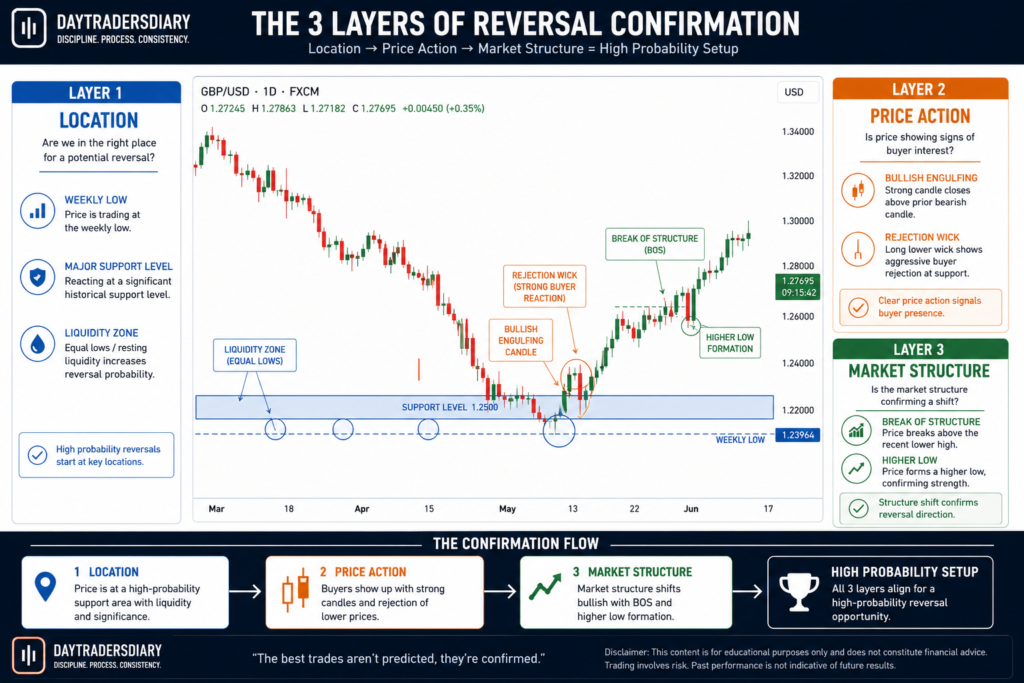
Imagine two traders watching GBP/USD approach a key support level.
Trader A buys immediately because support is nearby.
Trader B waits.
Trader B wants evidence that buyers are actually stepping into the market.
The price is right.
There is a bullish engulfing candle.
Market structure changes.
A higher low is formed.
Trader B walks in.
Trader A gets the better deal.
Trader B has greater odds.
Better odds almost usually beat better pricing after hundreds of trades.
The Three Layers of Reversal Confirmation
The strongest reversal trades often include multiple forms of confirmation.
The first layer is location.
Reversals occurring in the middle of nowhere rarely matter.
Look for reversals at significant support and resistance levels, psychological levels, weekly lows or tops, or important liquidity zones.
Context is given by location.
The second layer is price action.
This is where traders commonly watch for rejection candles, engulfing patterns, failed breakouts, pin bars or big momentum shifts.
Price action tells you what participants are doing in real time.
The third layer is market structure.
This is where many retail traders fall short.
A bullish candle alone does not create a reversal.
A break in structure often carries much more significance.
If a bearish market suddenly stops making lower lows and begins creating higher highs, the market is providing evidence that sellers may be losing control.
The probability of a successful reversal increases considerably when location, price action and market structure all agree.
How to Identify Reversal Opportunities in Forex
One of the most reliable approaches starts with higher timeframes.
Many traders search for reversals on a five-minute chart while ignoring what is happening on the four-hour or daily chart.
This creates unnecessary confusion.
Start by identifying major areas where institutional traders may become active.
These often include:
Last week’s highs and lows
Significant support & resistance zones
Psychological numbers rounded
Areas where major trends started before
When price gets to these zones, start looking for confirmation.
Do not ask whether the market should reverse.
Ask whether the market is actually reversing.
That mindset alone can improve trade selection immediately.
A Practical Reversal Trading Framework
Let’s walk through a realistic example.
Suppose EUR/USD has been falling throughout the London session.
Price eventually reaches a daily support level that has held multiple times over the past month.
At this point, many traders buy immediately.
Instead, wait for confirmation.
Price stops making new lows.
A strong bullish rejection candle forms.
The next swing high breaks.
Volume increases.
Buyers begin creating higher lows.
Now conditions are changing.
Instead of guessing, you are reacting to evidence.
Your stop can be placed below the recent swing low.
Your target can focus on the next major resistance area.
The trade becomes structured rather than emotional.
The Best Price Reversal Indicators
Everyone wants a magic price reversal indication.
Sadly, there’s no reliable signal that reliably anticipates turning points.
But some instruments can help with confirmation.
The Relative Strength Index can assist spot extremes in momentum.
The Average True Range might provide you some context on volatility.
Changes in trend direction can be seen by moving averages.
Volume indicators may show institutional involvement.
The crucial thing to know is indicators are supposed to confirm observations, not replace them.
Still, price activity remains the key source of information.
Indicators are pieces of evidence.
Not the last decision.
Understanding Liquidity Sweeps Before Reversals
One idea that separates skilled traders from novices is liquidity.
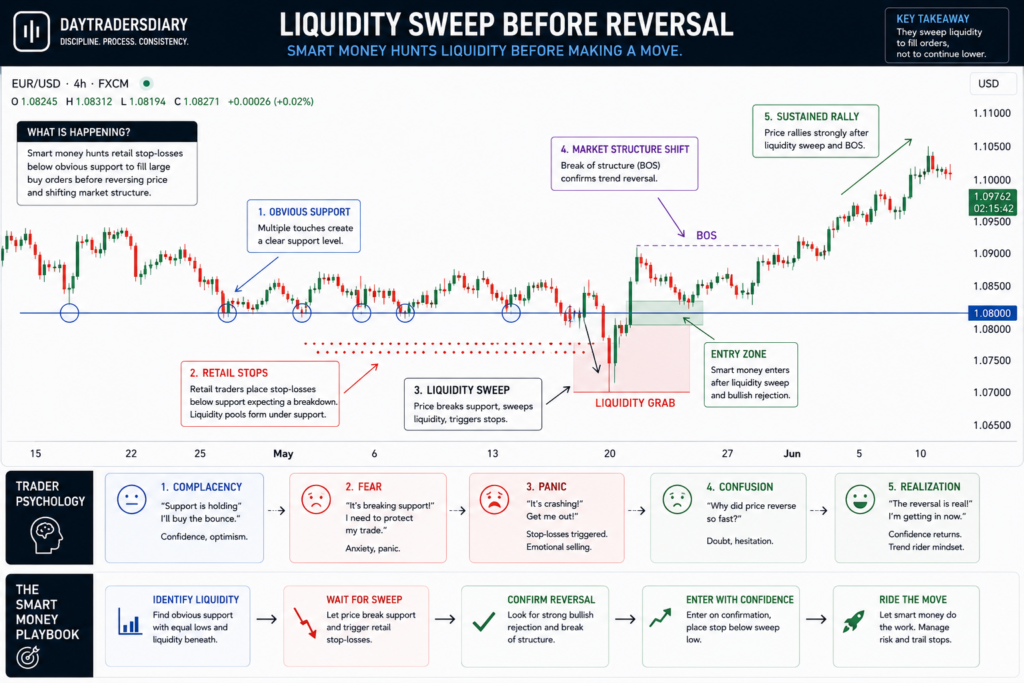
Markets typically overshoot clear support and resistance levels before reverting.
This is commonly called a liquidity sweep.
Think of it as a strong support level where thousands of traders have their stop losses.
So liquidity is there, so large players know.
Price dips briefly below support triggering stop losses, bringing in breakout sellers and then quickly reversing upward.
To inexperienced traders, the breakout looked genuine.
To experienced traders, it was a liquidity event.
Understanding liquidity sweeps can dramatically improve reversal timing because many major reversals begin this way.
If you have not already studied liquidity concepts, our guide on Forex Market Liquidity provides additional context.
Why Market Structure Matters More Than Candlestick Patterns
Many beginners become obsessed with candlestick formations.
They memorize dozens of patterns but struggle to make money.
The reason is simple.
A bullish engulfing candle against a strong bearish structure often means very little.
Market structure tells a much larger story.
If a market transitions from lower highs and lower lows into higher highs and higher lows, the underlying order flow may be changing.
That shift often carries more importance than any single candle.
This is why understanding market structure is one of the most valuable skills a reversal trader can develop.
Our article on Forex Market Structure explores this concept in greater depth.
Risk Management When Trading Reversals
Reversal trades offer attractive reward potential.
They also produce many false signals.
That reality makes risk management essential.
One mistake I see repeatedly is traders increasing position size because a setup “looks perfect.”
The market does not reward confidence.
It rewards discipline.
All reversal trades have to be entered with pre-set risk.
Your stop placement has to be based on market structure, not emotion.
Many traders make calculation errors here. A Position Size Calculator removes the guesswork and ensures you are taking the same risk on every trade, regardless of how far your stops are.
The goal is survival first and profits second.
Without survival, there is no opportunity to benefit from future setups.
How to Journal Reversal Trades Effectively
Most traders review winning trades.
Few review their decision-making process.
That is where the real edge exists.
For every reversal trade, document the following:
What level was involved?
What confirmation occurred?
Was the market structure aligned?
Was the reversal successful?
If not, why?
Over time, patterns emerge.
You may discover that reversals near weekly levels perform significantly better than those near intraday support.
You may notice that liquidity sweeps provide stronger signals than traditional candlestick patterns.
A Trade Journal Template helps organize these observations and transform them into actionable improvements.
The objective is not to collect trades.
The objective is to collect insights.
Scaling a Reversal Trading Edge
A profitable reversal strategy can become a powerful long-term edge.
The challenge many traders eventually face is capital.
Generating consistent returns on a small account proves skill.
Generating those same returns on larger capital changes outcomes dramatically.
This is why many disciplined traders eventually explore evaluation programs offered by firms such as The5ers, FTMO, and FundedNext.
These programs are not shortcuts to success.
They are opportunities for traders who have already developed a repeatable process and consistent risk management framework.
A trader who can consistently identify high-probability reversals and manage risk effectively may find evaluation accounts a logical next step in their development.
If your strategy is producing consistent results but account size limits growth, exploring a The5ers evaluation account may be worth considering.
The Biggest Lesson About Trading Reversals
The market rarely rewards impatience.
Most failed reversal trades happen because traders want to be first.
Professional traders understand something different.
Being early and being wrong are often the same thing.
Confirmation exists for a reason.
It protects you from fighting strong trends, guessing tops and bottoms, and turning opinions into losses.
The goal is not to catch the exact turning point.
The goal is to jump in when the odds start to move your way.
This attitude can turn reversal trading from a guessing game into an organised trading strategy.
Conclusion
The next time you think a market is about to reverse, resist the urge to jump in immediately.
Instead, pose one basic question:
What proof is there to turn right now?
Find the place.
Watch the price movements.
Look at the structure of the market.
Hold for confirmation.
Then do.
Most traders spend years trying to predict the turning points. The traders who live longest learn to wait for proof.
For your next read, check out our tutorial on Trading Bias and How to Use It to see how directional context can improve reversal trade selection.
FAQs
How do you identify a reversal in forex?
A reversal is typically identified through a combination of key support or resistance levels, market structure shifts, price action confirmation, and changes in momentum.
What is the best price reversal indicator?
There is no one best reversal indicator. You can use indicators such as RSI, ATR, moving averages and volume to help you confirm, but price action and market structure are still the most crucial.
What is confirmation in reversal trading?
Confirmation is an indication that market circumstances are changing. Break of market structure, powerful rejection candles, liquidity sweeps, momentum shifts; stuff like that.
Are reversal trades better than trend trades?
Not necessarily. Reversal trades can yield larger rewards but trend trades usually have a higher win ratio because they tend to go with the market direction.
Should beginners trade reversals?
Beginners can trade reversals, but they should focus on confirmation-based setups rather than attempting to predict tops and bottoms before evidence appears.