
The trader enters correctly.
Price moves in the expected direction.
The position reaches 1R.
Then the trader closes half.
Price continues to 3R.
The trader closes another quarter.
Price reaches 4R.
The remaining position is stopped at breakeven.
The trade is recorded as a winner.
But when the trader reviews 50 similar trades, something looks wrong.
The win rate is good.
The losing trades are controlled.
The equity curve looks comfortable.
Yet the average winning trade is much smaller than the original strategy’s potential.
This is one of the hidden problems with exit fractioning.
Taking partial profits feels like sophisticated risk management because the position gets smaller as the trade becomes profitable.
Sometimes it is.
Sometimes it is simply a more complicated way of saying:
“I was uncomfortable giving back open profit.”
That distinction matters.
Exit fractioning is not automatically good or bad. It is an execution method. Its value depends on how it affects expectancy, drawdown, exposure, and your ability to follow the strategy when the market behaves differently from the last few trades.
For an aggressive day trader the question isn’t really:
“Where do I take partial profits?
It is.
“How do I cut down on exposure without blowing up the payoff distribution that makes my strategy work?”
That is the problem we are going to solve.
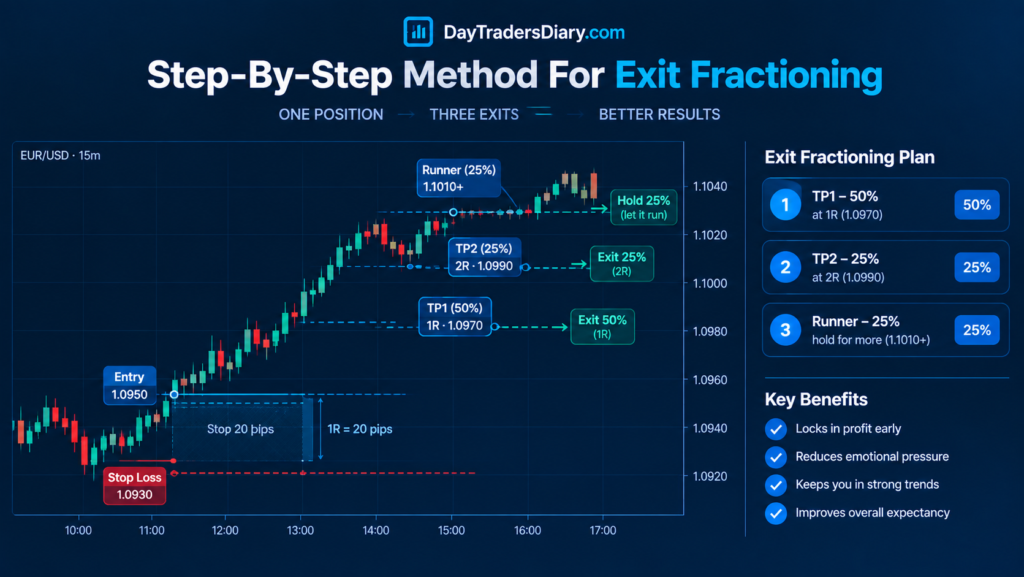
What Is Exit Fractioning?
Exit fractioning means closing a position in predetermined portions rather than exiting the entire trade at one price.
For example, a trader might enter one full position and then:
Close 50% at 1R.
Close 25% at 2R.
Leave 25% as a runner.
The exact percentages are not important.
The structure is.
Instead of treating the trade as a single all-or-nothing decision, the trader creates multiple exit points.
This can be useful when a strategy experiences uncertainty about how far a winning move will travel.
But it introduces a new variable.
Every partial exit changes the amount of capital participating in the next part of the move.
That means exit fractioning changes the distribution of returns.
It does not merely change psychology.
This is why you should never evaluate an exit fractioning method by asking whether it “locks in profit.”
Almost every partial exit locks in some profit.
The more important question is:
What did you give up to lock it in?
Why Traders Start Fractioning Their Exits
Most traders do not begin using partial exits because they have been mathematically optimized.
They start because of an experience.
They hold a trade to +2R.
The market reverses.
The trade exits at +0.2R.
The trader feels they “gave back” a large winner.
The next time a trade reaches +1R, they take half off.
Then another trade reaches +1.5R and reverses.
The trader takes another partial.
Eventually, the habit becomes part of the strategy.
This is where psychology enters.
The trader is no longer asking:
“What exit maximizes my tested expectancy?”
They are asking:
“How much profit can I take before I feel uncomfortable?”
Those are completely different questions.
The Behavioral Reason Exit Fractioning Feels So Good
Research by Terrance Odean and Brad Barber has documented the disposition effect, the tendency for investors to realize gains more readily than losses. Their work found this behavior across different investor groups and markets, with individual investors showing particularly strong effects in several datasets.
For a day trader, the important lesson is not that partial exits are psychologically wrong.
Realizing a gain can provide immediate emotional relief.
You can see how this affects a live trade.
Trade at +0.8R.
You can see your unrealized profit.
You know the market can change.
Closing 50% gets you something tangible.
The psychological burden is relieved.
That alleviation can be helpful if the remaining position is part of a tried plan.
But if the partial exit exists only to remove discomfort, you have turned your exit into an emotional regulation mechanism.
That can be expensive over the course of hundreds of trades.
Exit Fractioning Is a Distribution Decision
This is the concept I want traders to understand before choosing any percentages.
Suppose your strategy produces these possible outcomes:
-1R
+0.5R
+1R
+2R
+4R
+6R
Now, imagine two exit methods.
The first holds the full position until the strategy’s normal exit.
The second closes 50% at +1R and lets the rest run.
The second method will usually produce a smoother distribution.
But it may also reduce exposure to the +4R and +6R outcomes.
If those large winners are responsible for a meaningful portion of your long-term expectancy, the smoother equity curve may come at a high cost.
So departure fractioning should be evaluated by anticipation not comfort.
A Simple Mathematical Example
Imagine 100 trades.
Your original strategy produces:
45 losses at -1R = -45R
35 winners at +1R = +35R
15 winners at +2R = +30R
5 winners at +5R = +25R
Total:
+45R
Now create an exit-fractioning mechanism where winners exit early.
Say the five +5R transactions turn into +2R on average because the trader is taking some risk off the table along the way.
Those five trades now contribute only +10R instead of +25R.
Your total falls from +45R to +30R.
Nothing about the entries changed.
Nothing about the stop changed.
The strategy can appear more consistent while becoming materially less profitable.
This is why “I have fewer losing trades” is not enough.
The entire return distribution matters.
The First Rule of Exit Fractioning
Never fraction an exit unless you know what problem the fraction is solving.
There are legitimate reasons.
You may want to reduce exposure near a major level of resistance.
You may want to bank part of a move when the first target has a statistically strong reaction rate.
You may want to maintain a runner for unusually large trends.
Consider reducing psychological pressure while preserving upside.
But “because price is in profit” is not a sufficient reason.
Profit alone does not tell you whether the trade should be reduced.
Step One: Define the Original Trade Thesis
Before thinking about partial exits, define the trade.
Suppose you buy GBP/USD because the market has broken a four-hour resistance level and retested it successfully.
Your thesis might be:
“Price should hold above the former resistance and continue toward the next higher timeframe liquidity zone.”
That thesis gives you a framework.
If the market continues to hold above the level, there may be no reason to reduce the position simply because it reaches +1R.
If the price approaches the next major resistance zone, the reason for taking a partial becomes much stronger.
This is the difference between price-based fractioning and emotion-based fractioning.
Step Two: Identify the Natural Exit Zones
Do not begin with:
“I will take 50% at 1R.”
Begin with:
“Where is the market likely to react?”
Possible exit points include:
Prior session high or low.
Supply or demand at a higher timeframe.
Big support or resistance.
Liquidity pool.
Measured structural goals.
targets modified for volatility.
Session extremes.
A previous breakout origin.
The key is that the exit should have a reason independent of your position size.
If the market reaches a meaningful opposing structure, reducing exposure can make sense.
If it reaches an arbitrary R multiple for no market-based reason, the decision warrants more scrutiny.
Step Three: Separate Target From Management Level
This is a subtle distinction.
A target is where your original trade thesis expects the price to reach.
A management level is where you change how much risk the remaining position carries.
They can be the same.
They do not have to be.
For example:
Entry: 1.1000.
Structural stop: 1.0970.
First management level: 1.1030.
Major target: 1.1070.
At 1.1030, you might reduce 25%.
But you may still expect the trade to reach 1.1070.
That means the first exit is not your prediction of the final destination.
It is a change in exposure.
This distinction exists, making it much more logical.
Step Four: Decide the Fractions Before Entry
The percentages should be known before the trade starts.
A simple structure could be:
75% core position.
25% runner.
Or:
50% first target.
30% second target.
20% runner.
There is no universal ideal split.
The correct fraction depends on the strategy.
A trend-following strategy may need a large runner because its edge comes from occasional outsized moves.
A mean-reversion strategy may benefit from taking most of the position at the first statistically meaningful target, since its edge depends on a return toward a central value.
The exit structure must fit the entry logic.
Step Five: Calculate What Each Fraction Actually Represents
Here is where traders tend to deceive themselves.
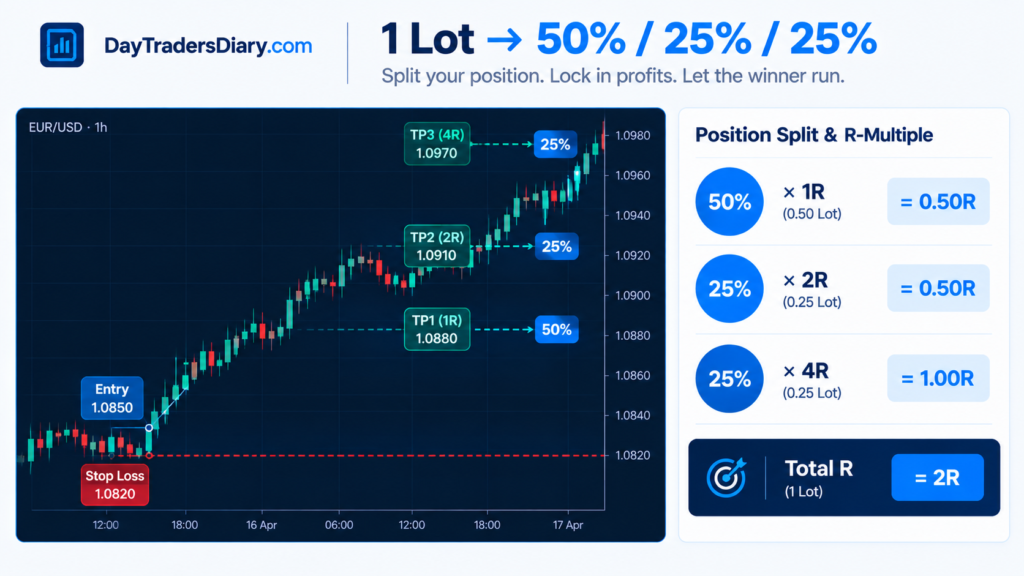
Assume you enter with 1 lot.
You close 50% at +1R.
You now have 0.5 lot.
If the remaining half reaches +3R, the total trade result is not +3R.
The first half contributed +0.5R.
The second half contributed +1.5R.
Total:
+2R.
That sounds obvious.
Yet traders often look at the chart and think:
“I caught the move from entry to +3R.”
They did not.
They captured an average outcome of +2R.
The distinction becomes very important when comparing different exit systems.
Step Six: Use R to Measure Every Partial Exit
R is the simplest approach to evaluate exit fractioning.
Say the original risk is $100.
A trade has three exits:
50% at +1R.
25% at +2R.
25% at +4R.
The total result is:
0.50 × 1R = 0.50R
0.25 × 2R = 0.50R
0.25 × 4R = 1.00R
Total = +2R.
Now, suppose another trade hits only the first target and then reverses.
The result is:
0.50 × 1R = +0.50R
If the remaining 50% is stopped at breakeven:
Total = +0.50R.
Both are winners.
But they contribute very differently to the strategy.
That is why your journal should record the weighted result, not just “TP1 hit.”
Step Seven: Decide What Happens to the Stop
This is where exit fractioning becomes closely connected to risk management.
Some traders automatically move the stop to breakeven after taking partial profit.
That can feel sensible.
But it can also create a hidden problem.
Suppose your trade reaches +1R.
You close half.
Then move the stop on the remaining half to breakeven.
Price pulls back normally.
The remaining half exists at zero.
The market then continues to your original +4R target.
You made +0.5R instead of potentially capturing +4R.
If this happens frequently, your partial exit has not protected your strategy.
It has systematically removed the right tail.
The solution is not “never move to breakeven.”
The solution is to test whether the breakeven rule improves the entire distribution.
Step Eight: Distinguish Risk Reduction From Profit Taking
These are not the same thing.
Suppose you risk 1R initially.
The trade reaches +1R.
You close 50%.
Now your remaining position has only half the original exposure.
That is risk reduction.
If you also move the stop to the entry, you may eliminate the possibility of a full loss of the original position.
That is another risk change.
The trader should know exactly what each action accomplishes.
Otherwise, the trade can become a collection of habits:
Partial.
Breakeven.
Partial.
Manual exit.
The result may feel sophisticated while being statistically undefined.
Step Nine: Build an Exit Hierarchy
A useful approach is to establish an exit hierarchy.
First, determine the invalidation exit.
If the thesis is wrong, exit.
Second, determine the structural management zone;
If price approaches a meaningful counter-trend level, consider reducing exposure.
Third, set the continuing aim.
If price breaks that zone with conviction, ride it out long enough to partake.
Fourth, define the trailing or final exit.
This can be based on structure, volatility, time, or your original strategy rule.
The hierarchy prevents every candle from becoming a new exit decision.
The Difference Between Scaling Out and Cutting Winners
These two behaviors look identical on a chart.
Psychologically, they are very different.
Scaling out means:
“I am reducing exposure because price has reached a predefined condition.”
Cutting a winner means:
I am minimizing my exposure because I am scared the profit will go away.
The market can’t tell the difference.
Your stats might.
If you find that you tend to exit quicker after substantial unrealized profits, you may be responding to the emotional value of open profit rather than market facts.
That is precisely why the disposition effect matters to active traders.
A Practical Forex Exit Fractioning Example
Suppose you buy EUR/USD at 1.0850.
Stop: 1.0820.
Initial risk: 30 pips.
You identify:
Target A: 1.0880.
Target B: 1.0910.
Target C: 1.0960.
That gives:
A = +1R.
B = +2R.
C = +3.67R.
You decide before entry:
50% at A.
25% at B.
25% runner.
Now, suppose the price reaches A.
You close half.
Then Price arrives at B.
You wrap another quarter.
The other quarter arrives at C.
Your weighted result is:
50% x 1R = 0.50R 25% x 2R = 0.50R 25% x 3.67R = 0.92R Total = +1.92R
The trade was a 3.67R winner on the chart.
Your actual realized result was 1.92R.
That is not a criticism.
It is simply the number that belongs in your performance statistics.
What Happens If You Use a 25/25/50 Structure?
Now imagine:
25% at 1R.
25% at 2R.
50% runner.
If the final 50% reaches 3.67R:
0.25 × 1 = 0.25R
0.25 × 2 = 0.50R
0.50 × 3.67 = 1.84R
Total = 2.59R.
Same entry.
Same stop.
Same market.
Completely different outcome.
The exit method has materially changed the strategy.
This is why exit fractioning should be tested with the same seriousness as entry conditions.
Why the “Perfect Exit” Does Not Exist
Traders often optimize their exits by looking backward.
They see that the price reached +5R.
They think:
“I should have held everything.”
Then another trade reaches +1R and reverses.
They think:
“I should have taken everything.”
This is hindsight.
A real exit strategy must operate without knowing the future.
The objective is not to capture the maximum theoretical move.
The objective is to capture a repeatable portion of the distribution at an acceptable risk level.
That is a much more realistic standard.
Research on Exit Rules Gives an Important Warning
Recent work on the impact of exit criteria on trading outcomes shows that exit rules can have a large impact on win rates and the distribution of payoffs, even when entry and position sizes are held constant . A 2026 SSRN study studied the effect of stop and target thresholds on the links between trade-level success, reward asymmetry and portfolio-level results using randomized entry into the S&P 500. This is a working document just released, and should be seen as evidence of study, not as a settled consensus.
That finding has an obvious implication for exit fractioning.
If changing one exit threshold can materially alter the distribution, changing the entire exit architecture can do even more.
You cannot bolt partial exits onto a strategy and assume the original backtest still describes the new strategy.
It does not.
You now have a different system.
A Recent XAUUSD Study Is Particularly Relevant
A 2026 SSRN study examined a commercial structural-break strategy on XAUUSD using tick-level data from 2024 to 2026. The authors found that the tested asymmetric partial-exit rule increased the win rate but did not improve risk-adjusted return, and they also described the partial-exit structure as institutionalizing the disposition effect. Importantly, the authors identify the study as preliminary and note limitations involving the specific commercial strategy and tick-data attribution.
That is exactly the kind of result day traders should pay attention to.
A higher win rate can feel like an improvement.
It is not necessarily an improvement.
If partial exits increase the percentage of winning trades while reducing the size of the largest winners, the strategy may feel easier to trade while producing no better risk-adjusted performance.
That is why your evaluation should include expectancy, profit factor, average R, maximum drawdown, and the distribution of winners.
Not the win rate alone.
Execution Research Also Matters
Exit fractioning is ultimately an execution problem.
Once you start dividing a position into multiple orders, you introduce more decisions, more execution points, and potentially more slippage and spread costs.
Research on optimal trade execution has long treated liquidation as a dynamic problem rather than a single binary action. Models of optimal execution explicitly consider the trade-off between waiting for better prices and the risk of adverse price movement.
For a retail day trader, the lesson is simpler.
Every extra exit decision should have a purpose.
If taking four partial exits yields almost the same gross outcome as taking two but adds complexity and execution costs, the additional complexity may not yield any net benefit.
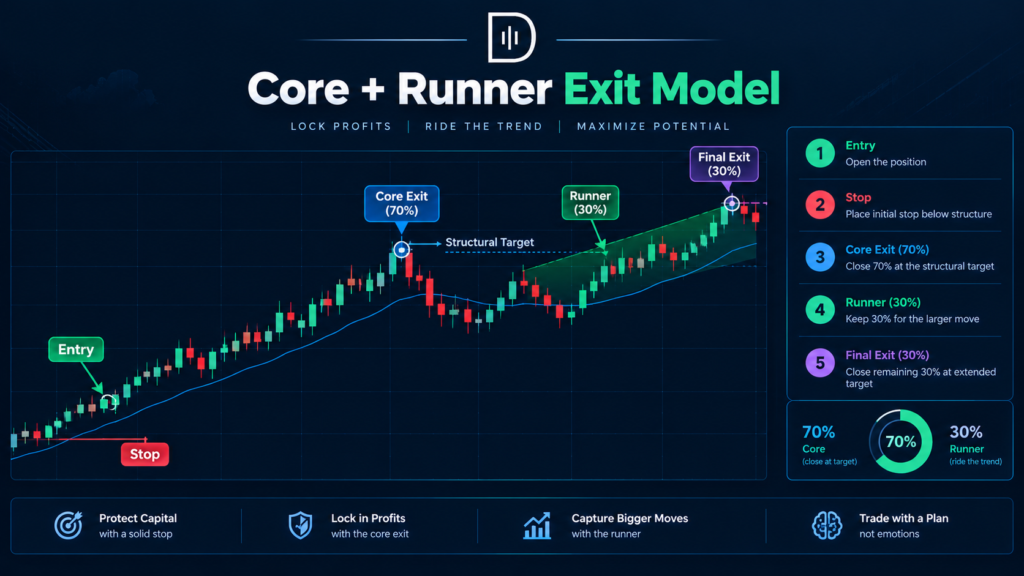
Step Ten: Create a “Core + Runner” Model
For many discretionary day traders, a core-plus runner model is easier to test than five partial exits.
The core position is designed to monetize the normal move.
The runner is set to note the anomalous move.
For instance,
70% of core.
Runner 30%.
The core is on a predetermined structural goal.
The runner is left open until the market breaks a trailing condition.
This creates a useful division.
The core pays you for being right about the expected move.
The runner gives you participation if the market moves unusually strongly.
That is often more robust than repeatedly taking tiny pieces off every few candles.
When a Runner Is Actually Useful
A runner makes the most sense when your strategy has a fat right tail.
Suppose most trades reach 1R to 2R, but a small number reach 5R, 7R, or 10R.
Those outliers may contribute disproportionately to long-term expectancy.
A runner protects your participation in those moves.
But if your strategy is mean reversion and large extensions are rare or usually reverse, a large runner may be unnecessary.
Again, the exit method must match the entry edge.
Exit Fractioning for Trend Following
Trend-following systems generally need more patience.
If your entry captures the beginning of a directional expansion, closing too much too early can undermine the strategy’s rationale.
Imagine a breakout strategy with a low win rate but occasional 5R and 8R winners.
Taking 50% off at 1R could be disastrous if those large winners are the main source of expectancy.
The trader may experience a higher percentage of winning trades while making less money.
This is one of the most dangerous psychological traps in trading.
The strategy feels better.
The statistics get worse.
Exit Fractioning for Mean Reversion
Mean-reversion strategies can be different.
Suppose price moves sharply away from VWAP or a statistical mean.
Your edge comes from the expectation that price will return toward equilibrium.
The distance to the mean is often a more logical exit than waiting for an extended trend.
In that environment, taking a larger fraction at the mean or first major reaction zone can make more sense.
The trade is not designed to become a trend.
Trying to force a runner into every mean-reversion trade may actually weaken the strategy.
Exit Fractioning Around Liquidity Levels
Liquidity levels can provide useful fractioning points.
Suppose you are long and the price approaches the previous day’s high.
That level may attract reactions.
You could reduce the position there while retaining a runner in case the price breaks through.
The important thing is that the partial is based on market structure.
You are not saying:
“Price reached +1R, so I have to close 30%.”
You say:
“Price has reached a level where the probability distribution of the next move might have changed, so I will cut my exposure but still participate on the upside.”
That is a much stronger reason.
Exit Fractioning and Time
Not every exit should be based on price.
Time can matter.
Suppose you enter a breakout during the London session.
Thirty minutes later, the price has moved only 0.2R.
Your strategy expects rapid continuation.
The lack of movement may be information.
A time-based exit can be useful if your backtest shows that trades failing to progress within a certain window have poor expectancy.
But again, test it.
Do not close because “it feels slow.”
Define slow quantitatively.
The Time-to-Progression Metric
One useful journal variable is:
Time to First Favorable Progression
Measure how long it takes the trade to reach +0.5R or +1R.
Then compare successful and unsuccessful trades.
You may discover:
Trades that reach +0.5R within 10 minutes tend to continue.
Trades taking more than 30 minutes to reach +0.5R frequently reverse.
That gives you a potentially useful management rule.
It also tells you something deeper about your setup.
The strategy may depend on immediate momentum.
Exit Fractioning and Volatility
Volatility should also influence how you think about partial exits.
Suppose a trade reaches +1R quickly because the market suddenly expands.
A normal pullback might now be larger than it would be in a quiet market.
Moving the entire remaining position to breakeven may therefore increase stop-outs.
The opposite can happen in low volatility.
A sluggish grind can make a trailing stop overly tight relative to the regular noise.
This is why the exit technique should be tested in terms of volatility regimes.
Your diary can keep track of ATR or other volatility measure at entrance and during management.
Then compare the outcomes.
The Most Important Exit Question
Before taking a partial, ask:
“If I were flat right now, would this price be a logical place to initiate the opposite side of the trade?”
If the answer is yes, reducing exposure may make sense.
Otherwise ask yourself why you are cutting.
Perhaps there is a statistical goal.
Maybe it’s a time condition.
Maybe there’s a volatility situation.
But if the sole response is:
Perhaps you are handling likelihood, not emotion, for I have profit.”
Exit Fractioning and Risk Management
CME Group’s position-sizing guidance starts with two basic inputs: the logical stop location and the amount of account capital you are willing to risk. It emphasizes that the stop should correspond to a level that tells you whether the trade thesis is wrong, rather than being chosen randomly.
Exit fractioning should follow the same logic.
First, define the original risk.
Then define how the risk changes as the trade progresses.
For example:
Initial risk = 1R.
At +1R, close 50%.
Remaining risk at original stop = 0.5R.
Move stop to breakeven only if the strategy’s rules permit it.
At +2R, close another 25%.
Remaining exposure = 25%.
Now the trade is structurally different from the original position.
You should know exactly how different.
Use a Position Size Calculator Before You Think About Fractions
This is where many traders reverse the process.
They choose a position size first.
Then decide where the stop goes.
Then decide how much to take off.
The sequence should be the opposite.
Identify the structural invalidation.
Determine account risk.
Calculate the initial position size.
Then design the exit fractions.
The DayTradersDiary Position Size Calculator is useful here because it keeps the initial risk calculation separate from the emotional decisions that occur once the trade is live.
The calculator doesn’t tell you where to take profits.
This helps guarantee that you’re starting with the correct exposure.
That makes a difference.
Exit Fractioning and Maximum Daily Loss
Partial exits can also interact with daily risk limits.
Let’s take three trades, for example.
Trade 1 loses 1R.
Partial departures. Trade 2R on 2 wins
Trade 3 loses 1 Round.
You may end up with no net gain.
But your execution history isn’t flat.
You had three decisions to make.
You paid three sets of spreads and commissions.
You exposed the account to multiple periods of market risk.
If you use a daily loss limit, measure risk at the account level rather than assuming partial exits; this makes the day safer automatically.
The overall exposure matters.
Exit Fractioning on Prop Trading Accounts
This becomes even more important when trading under evaluation or funded-account rules.
The account may have constraints on maximum daily or overall loss.
A partial exit can reduce open exposure, but it does not change the fact that the original trade may have been poorly sized.
Nor does it guarantee that a sudden market move will not affect the remaining position.
The5ers’ current High Stakes program, for example, publishes a 5% maximum daily loss and 10% maximum loss, alongside its evaluation and scaling structure.
For a trader using partial exits, the practical question is:
“Does my exit process help me remain comfortably inside those limits during normal variance?”
That is more useful than simply asking whether partial profits feel safer.
Exit Fractioning and Scaling Capital
A good exit system can become more valuable as account size grows because dollar exposure increases.
But scaling should not automatically mean adding more partial exits.
A trader with a larger account may be tempted to micromanage every position because the dollar value of each fluctuation becomes more noticeable.
That can make execution worse.
The better objective is consistency.
If a 70/30 core-and-runner model works at a small size, scale the same process before adding unnecessary complexity.
Capital should increase the size of the process.
It should not change the logic of the process.
Why Evaluation Programs Can Fit This Approach
For traders with a documented edge, the capital constraint can become the next bottleneck.
You may have a strategy that works with disciplined risk but insufficient capital to generate meaningful dollar returns.
An evaluation account can provide one possible route to larger nominal trading capital without requiring the trader to fund the entire notional amount personally.
But the important word is possible.
An evaluation program is not a shortcut around execution discipline.
Its rules become part of your trading environment.
The5ers High Stakes currently uses a two-step evaluation, unlimited time to complete the stages, a 5% maximum daily loss, a 10% maximum loss, and a scaling framework that can increase account allocation toward $500,000. Its current published rules also state that funded traders can request payouts on a biweekly basis, subject to the program’s conditions.
That structure may appeal to traders whose strategy already has controlled risk and whose exit process does not depend on breaking specific program rules.
Other firms use different drawdown structures, payout conditions, consistency rules, and restrictions.
The right comparison is therefore not:
“Which firm offers the biggest account?”
It is:
“Which rule set allows my existing trading process to operate normally?”
For a serious day trader, that is a much more useful question.
If your exit fractioning method helps you systematically reduce exposure around major targets while leaving enough capital participation for large winners, an evaluation such as The5ers can be considered as one potential path for scaling that process.
How to Test an Exit Fractioning Method
Do not test it by looking at five profitable trades.
You need a meaningful sample.
Start with your existing strategy.
Record every trade using the original exit.
Then replay the same trades using your proposed fractioning model.
Compare:
Average R.
Median R.
Win rate.
Profit factor.
Maximum drawdown.
Largest winner.
Average winner.
Average loser.
Number of trades above 3R.
Number of trades above 5R.
Time in trade.
Give back from the maximum favorable excursion.
You are looking for changes in the distribution.
Maximum Favorable Excursion Is Especially Important
Suppose your average winning trade reaches +3.5R at some point before eventually closing at +1R.
That tells you something.
The strategy is capable of producing more than it realizes.
Now, imagine your fractioning system consistently converts those trades into +1.5R.
You may have reduced giveback.
But you may also have destroyed part of the edge.
Maximum favorable excursion helps you identify that relationship.
For every trade, ask:
How far did the trade go in my favor?
How much of that movement did my exit process actually capture?
The difference is not automatically a problem.
It is information.
Giveback Is Not Always Bad
Traders often become obsessed with minimizing giveback.
Suppose a trade reaches +6R and closes at +3R.
The trader thinks:
“I gave back 3R.”
But the relevant question is:
“What did the strategy historically need to give back to capture large winners?”
If the answer is 2R to 3R, then the giveback is part of the strategy.
Trying to eliminate it may eliminate the winners.
This is a key psychological shift.
You are not paid for having the smallest possible drawdown from peak unrealized profit.
You are paid according to the realized distribution produced by your system.
A Better Exit Metric: Capture Ratio
You can compute a simple metric.
The ratio of realized profit to maximum favorable excursion. Profit Capture Ratio = Realized Trade R / Maximum Favorable Excursion R
Say the transaction goes to +4R, but closes at +2R.
Ratio of capture:
2 / 4 = 50%.
Now compare 100 trades.
Maybe your original exit has a 48% capture ratio.
Your fractioning model has a 62% capture ratio.
That looks better.
But you also need to check whether the fractioning method reduces the frequency or magnitude of the largest winners.
A higher capture ratio is not automatically better.
It is simply another measurement.
The Exit System Should Match Your Edge
This is probably the most important principle in the article.
If your edge comes from a high win rate and small, frequent mean-reversion gains, aggressive profit-taking may fit.
If your edge comes from low win rate and large trend moves, aggressive profit-taking may damage the strategy.
If your edge comes from breakout continuation, you probably need meaningful exposure after the breakout.
If your edge comes from a return to VWAP, a runner may add little value.
The exit is not separate from the strategy.
It is part of the strategy.
Common Exit Fractioning Mistakes
Taking the Same Fraction at Arbitrary R Levels
A trader closes 25% at 1R, 25% at 2R, and 25% at 3R because those numbers look balanced.
There is nothing inherently wrong with that.
But unless the levels correspond to your strategy’s distribution, they are arbitrary.
Moving to Breakeven Automatically
A partial profit does not automatically mean the remaining trade should have a breakeven stop.
That rule needs its own testing.
Closing More Because the Position Is Larger
This is emotional scaling.
The exit should be based on market conditions and strategy rules, not on how large the dollar profit looks.
Adding Too Many Exit Decisions
If you need eight separate management actions to trade one setup, the strategy may be underdefined.
Complexity should solve a measurable problem.
Evaluating Success by Win Rate
A strategy can win more frequently and make less money.
Always look at the expected value and the distribution of returns.
A Simple Exit Fractioning Template
For a new strategy, start with something simple.
Define the initial risk.
Define the first structural target.
Define the final target or trailing condition.
Choose one partial.
Choose one runner.
Then test.
For example:
50% at the first structural target.
50% held for continuation.
If the first target is reached, the remaining half follows a predefined trailing rule.
That is enough.
If the data later shows that a third exit materially improves the distribution, add it.
Do not begin with five.
The Trade Journal Should Track the Reason, Not Just the Price
Your Trade Journal Template should contain an exit-reason field.
Do not simply write:
“TP1.”
Write:
“Reduced 50% at previous daily high.”
Or:
“Reduced 25% because price reached tested volatility extension.”
Or:
“Exited runner after break of M5 higher-low structure.”
This creates useful data.
After 50 trades, you can compare exit reasons.
You may discover that partials at higher timeframe resistance improve expectancy.
You may discover that arbitrary 1R partials do not.
That is the kind of information that improves a trading process.
A Five-Question Exit Review
Ask about each fractional trade:
Did I stay inside the pre-determined ratio?
Exit – was it news from the market or discomfort?
What was the best trip?
How much of that motion did I get to see?
Would the same exit have made sense if I had no open profit?
The fifth question is particularly powerful.
It removes the emotional reference point of your current P&L.
Exit Fractioning and the Psychology of Open Profit
Unrealized profit creates a strange mental state.
The money is visible.
But it is not realized.
As prices move, the trader mentally converts them into something they own.
A move from +2R to +1R can therefore feel like a 1R loss even though the trade is still profitable.
That mental framing can lead to increasingly aggressive profit-taking.
You need to separate:
Realized profit.
Unrealized profit.
Expected value.
They are not the same thing.
A strategy that routinely gives back some unrealized profit can still be superior to one that captures every small gain if the larger winners drive expectancy.
The “Flat Position” Test
One of the best ways to reduce emotional exits is to imagine you are flat.
Price is currently at your target.
You have no position.
Ask:
“Would I enter here?”
If not, why not?
Maybe because the market is at resistance.
Maybe because volatility has changed.
Maybe because the trend is exhausted.
If the answer is:
“I would not enter because the setup is no longer attractive,” then reducing exposure has a logical basis.
But if you would happily enter the same position from scratch, closing purely because the trade is profitable may deserve reconsideration.
This is not a perfect decision rule.
It is a useful psychological test.
When Full Exit Is Better Than Fractioning
Sometimes the cleanest decision is to shut everything down.
If the original thesis is disproved, it need not be managed partially.
If the price hits a key resistance level and your method has always been reversed there, the runner may have little statistical evidence.
If volatility collapses and the setup depends on continuation, holding may not make sense.
If the trading session is ending and your strategy is intraday, the time condition may dictate a full exit.
Fractioning should not become a religion.
Sometimes the entire position should come off.
When Not to Fraction
Do not fraction simply because other traders do it.
Do not fraction because it makes a chart screenshot look professional.
Do not fraction because you want to increase your win rate.
Do not fraction because you are afraid of giving back profit.
Do not fraction if the added complexity has no measurable benefit.
Fraction when the strategy has a reason to reduce exposure while preserving participation.
That is the standard.
The Advanced Version: Conditional Fractioning
Once you have enough data, you can make fractioning conditional.
For example:
Take 50% at target one when volatility is normal.
Take 25% when volatility is elevated and leave 75% for continuation.
Take no partial when the market is in a strong trend, and the target sits inside open space.
Take a larger partial when the price reaches a historically significant level of resistance.
Now the exit becomes adaptive.
But there is a warning.
Every additional condition creates another opportunity for overfitting.
Keep the number of conditions small.
Test each one independently.
A Step-By-Step Exit Fractioning Process
Here is the complete process in practical form.
Step 1: Define the entry thesis.
Know why you are in the trade.
Step 2: Define the invalidation.
Know exactly what proves the thesis wrong.
Step 3: Calculate initial risk.
Use the structural stop and your account risk limit.
Step 4: Identify structural reaction zones.
Look for levels where price has a reason to respond.
Step 5: Decide whether fractioning is appropriate.
Not every strategy needs it.
Step 6: Choose the fractions before entry.
Avoid live improvisation.
Step 7: Define the remaining-position stop logic.
Do not automatically move to breakeven unless it has been tested.
Step 8 : Set the runner condition.
Know what keeps the last place open.
Step 9. Log each partial exit in R.
Calculate the weighted answer.
Step 10: Look at maximal favorable excursion.
Measure what the strategy might have captured.
Step 11: Compare the fractioned system with the original exit.
Do not assume smoother equals better.
Step 12: Keep only the rules that improve the distribution.
Everything else is noise.
What “Good” Exit Fractioning Looks Like
Good exit fractioning usually feels boring.
You know the percentages before the trade.
You know the levels.
You know what happens to the stop.
You know when the runner ends.
You do not stare at every tick waiting for a reason to close another piece.
You do not feel clever because you took three profits.
You execute.
That is the point.
A good exit system should reduce decision fatigue, not create more of it.
What “Bad” Exit Fractioning Looks Like
Bad exit fractioning feels active.
The trader closes 20%.
Then another 10%.
Then another 15%.
Then moves the stop.
Then moves the target.
Then, it closes the runner because a candle looks “weak.”
At the end, the trader cannot explain why the position was reduced at each stage.
That is not a strategy.
That is improvisation.
The market may reward it occasionally.
It cannot be reliably evaluated.
The Real Edge Is Often in What You Leave Open
Most traders focus on what they take.
Advanced traders also study what they leave.
If early exits consistently cut down your largest winners, the missing edge may not be in your entries.
It may be in your willingness to maintain exposure when the market continues to behave according to the original thesis.
This is why a runner can be valuable.
It forces the trader to remain exposed to the right tail without requiring the entire position to survive every pullback.
That is the practical compromise between “take profit early” and “hold everything.”
Frequently Asked Questions
What is exit fractioning in forex?
Exit fractioning is the practice of closing part of a forex position at one or more predefined points while leaving the remaining position open. It is also called scaling out or partial profit-taking.
Is exit fractioning profitable?
It can be, but it is not always profitable. Fractioning alters the return distribution. Its worth hinges on whether the new exit structure increases expectancy, drawdown, risk-adjusted return, or execution quality when costs are included.
What is a good exit fractioning method for day trading?
A simple core-and-runner structure is often a useful starting point. For example, a trader might close part of the position at a tested structural target and leave the remainder to follow a predefined continuation rule. The exact percentages should come from testing rather than a universal formula.
Should I take partial profits at 1R?
Not necessarily. If 1R is a meaningful level in the market structure then a partial may make sense. If 1R is a random number then taking profits at 1R may minimize exposure to larger winners without providing a real statistical edge.
Should I move my stop to breakeven after taking a partial profit?
Only if your strategy has tested the rule can a breakeven stop reduce the size of losing outcomes in the remaining position. Still, it can also remove the trade during normal retracements before the expected move resumes.
What percentage should I close at the first target?
There isn’t a universally applicable proportion. A 25%, 50%, or 70% first reduction all can make sense depending on the strategy. Compare different fractions on avg R, expectation, max drawdown and frequency of big winners.
Does scaling out increase win rate?
It can increase the percentage of trades classified as winners because a trade may realize a small profit before reversing. But a higher win rate does not automatically mean higher profitability.
What is a runner in forex trading?
A runner is the portion of a position left open after one or more partial exits. Its purpose is generally to capture unusually large moves that extend beyond the strategy’s normal target.
Is scaling out better for trend following or scalping?
Depends on the plan. Scaling out too much can undermine anticipation because trend tracking systems frequently need considerable exposure to big winners. Mean-reverting systems might have good reasons to take larger chunks near pre-defined equilibrium or reaction levels.
How do I backtest exit fractioning?
The identical historical entries and starting stops can be run via several exit models. Compare whole exits, one partial, and one runner, several partials; average R, expectation, profit factor, maximum drawdown, maximum favorable excursion, average winner, largest winner, and frequency of trades.
What is the biggest mistake traders make with partial exits?
The most damaging thing you can do is use partial exits to ease emotional pain rather than to react to a tested market scenario. The trader is more comfortable but the approach could be giving up exposure to its most profitable bets.
Can exit fractioning help with prop firm accounts?
It can help manage exposure, but it does not automatically improve a strategy or protect an account from drawdown rules. The exit structure should be tested against the specific firm’s daily loss, maximum loss, payout, and execution rules.
Your Exit Should Be a Strategy, Not a Comfort Mechanism
Exit fractioning has a legitimate place in active trading.
It can reduce exposure to important levels.
It can smooth the distribution of outcomes.
It can preserve participation in unusually large moves.
It can make a psychologically difficult strategy easier to execute.
But there is a price for every partial exit.
You give up some exposure to future movement.
Sometimes that price is worth paying.
Sometimes it quietly destroys the part of the strategy that made the system profitable in the first place.
The only reliable way to know is to measure it.
For your next 30 to 50 trades, record the maximum favorable excursion and every partial exit in R. Then compare your actual results against a simple alternative where you take fewer or no partials.
Do not ask which method feels better.
Ask which method yields the better distribution after accounting for costs.
That is the difference between managing a trade and managing a strategy.
The next article to study should be How to Measure Entry Delay Risk in Forex. Entry quality and exit quality are connected more closely than most traders realize. If you enter late and then compensate by taking profits early, the combination can compress both sides of your trade’s payoff distribution.
The goal is not to catch every pip.
It’s to construct an exit procedure that always leaves you exposed enough when your edge is working, and takes you out when the original reason for the trade is running dry.