
A trade can be technically correct and still become a poor trade because you entered it too late.
This happens constantly around economic news.
A trader marks a clean support zone before CPI. Price reacts exactly as expected. The first move happens quickly, but the trader hesitates because the spread widens or the candle becomes aggressive. Thirty seconds later, the trader enters after the market has already moved 25 pips.
The stop is still placed at the original technical level.
The target is still the original target.
The analysis looks unchanged.
But the trade is no longer the same trade.
That difference is where many traders misjudge entry delay risk from news.
They look at the chart and ask, “Was my direction right?”
The more useful question is:
“How much of my original trade quality disappeared between the planned entry and the actual entry?”
News creates a particularly difficult version of this problem because the delay is often rational. Waiting for confirmation around CPI, NFP, FOMC decisions, central-bank statements, or major inflation data can protect a trader from entering the first violent move.
But confirmation has a cost.
Sometimes the market gives you better information after the release. Sometimes it simply gives you worse price.
The professional task is not to eliminate entry delay.
It is to know when the information gained by waiting is worth more than the price and risk deterioration caused by waiting.
That is what this article is about.
What Is Entry Delay Risk From News?
Entry delay risk is the additional trade risk created when the actual execution occurs later or at a worse price than the original planned entry.
Suppose EUR/USD has a planned long entry at 1.0850.
Your stop is 1.0825.
Your original risk is therefore 25 pips.
The market releases a major inflation number. Price jumps higher and trades through 1.0870 before you enter.
You eventually buy at 1.0870.
If your stop remains at 1.0825, your actual risk is now 45 pips.
The trade did not become 80% more dangerous because your chart changed.
It became 80% more dangerous because your entry changed.
This is the distinction traders frequently miss.
The original trade risk was:
25 pips.
The actual trade risk became:
45 pips.
The delay increased the distance to the stop by 20 pips.
That 20-pip difference is not theoretical. It directly changes position sizing, reward-to-risk, drawdown exposure, and the amount of price movement required before the trade becomes attractive.
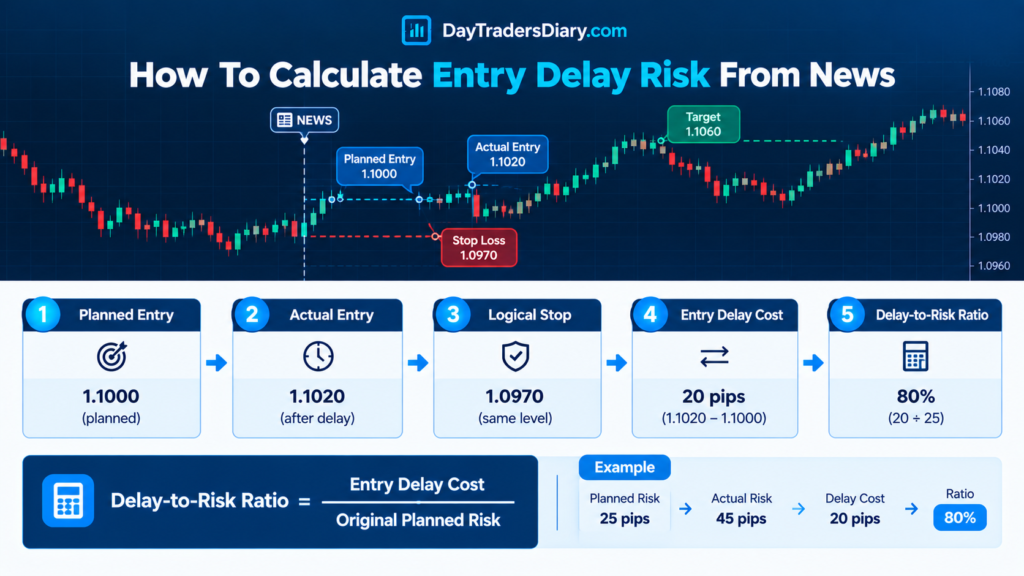
A useful measurement is the Delay-to-Risk Ratio:
Delay-to-Risk Ratio = Entry deterioration ÷ Original planned risk
In this example:
20 ÷ 25 = 0.80
The entry deterioration consumed 80% of the original risk budget.
That should immediately change how you think about the trade.
A delay of 20 pips sounds small.
A delay equal to 80% of your original risk is not small.
The Most Important News Trading Distinction
There are actually three different situations that traders often combine under the phrase “news trading.”
The first is entering before the announcement.
The second is entering immediately after the announcement because the market is moving.
The third is deliberately waiting for the initial reaction to settle before entering.
These are not the same strategy.
The first accepts announcement risk.
The second accepts execution and volatility risk.
The third accepts opportunity cost and entry deterioration risk.
That third category is where many experienced traders eventually find themselves.
They do not want to predict the first reaction to news.
They want to observe what the market does with the information.
That can be a sensible approach.
The mistake is waiting for confirmation without defining how much deterioration is acceptable.
A trader might say, “I will wait for the candle to confirm.”
But what does confirmation mean?
A five-pip move?
Twenty pips?
A complete break of structure?
A retest?
A close above the previous high?
A second candle?
If you cannot define the confirmation condition before the trade, you can easily turn a disciplined waiting strategy into emotional chasing.
Why News Makes Entry Delay Different
Normal market movement and news movement have different execution characteristics.
Around major announcements, price can move rapidly while liquidity conditions change. Research from the Federal Reserve has documented strong high-frequency reactions in exchange rates around macroeconomic announcements. Other Federal Reserve research has also found that major U.S. macroeconomic announcements can have a strong effect on currency returns and volatility.
The practical lesson for the day trader is simple.
The market is not just moving quicker.
The link between pricing, liquidity, expectations and execution is evolving.
This is important because a chart can make a late entry look visually identical to the original setup even if the trade economics are totally different.
Imagine a breakout setup with a planned 15-pip stop and 45-pip target.
The trader expects 3R.
News hits.
Price immediately moves 18 pips through the planned entry.
The trader waits for a retracement and enters 10 pips above the original entry.
The stop is still 15 pips below the original technical level.
Now the actual risk is 25 pips and the remaining target might only be 35 pips.
The original trade offered 3R.
The delayed trade offers approximately 1.4R.
The chart still looks bullish.
The trade quality has changed dramatically.
This is why news-related entry delay should be treated as an execution problem, not just a directional problem.
What Research Says About News Reactions
High frequency research from the Federal Reserve has consistently demonstrated that exchange rates react quickly to macroeconomic pronouncements. In one research of exchange rates and interest rates around announcements, there were strong short-window reactions to macro releases.
Another Federal Reserve study using high-frequency FX data found that major U.S. macroeconomic news had a strong impact on both returns and volatility in emerging-market currencies.
More interestingly for execution, research using high-frequency EBS FX data found that trading activity can increase sharply following macroeconomic announcements. The researchers also documented a two-stage reaction around one particular release, with an immediate price jump followed by a later surge in trading volume and volatility.
The important takeaway for a day trader is not that news automatically creates opportunity.
It is that the first move and the later trading environment can behave differently.
That creates a useful distinction:
Initial reaction is information. Follow-through is confirmation.
You should not automatically pay any price to obtain confirmation.
The market can give you better information while simultaneously giving you a worse entry.
Your job is to measure both.
The News Delay Equation
Before entering a post-news setup, calculate three numbers.
Start with your planned entry.
Then identify your actual entry.
Then identify the original logical stop.
From those three numbers, calculate the planned risk and actual risk.
For a long trade:
Planned Risk = Planned Entry – Stop
Actual Risk = Actual Entry – Stop
For a short trade:
Planned Risk = Stop – Planned Entry
Actual Risk = Stop – Actual Entry
Then work out:
Entry delay cost = actual risk – expected risk
And lastly:
Delay to Risk Ratio = Cost of Entry Delay / Planned Risk
This ratio is more valuable than just writing down how many pips you missed.
A five-pip delay means almost nothing without context.
Five pips on a 50-pip planned stop is very different from five pips on a 10-pip planned stop.
The first represents 10% deterioration.
The second represents 50%.
That is why experienced traders should think in R rather than raw pips whenever possible.
A Practical Example With EUR/USD
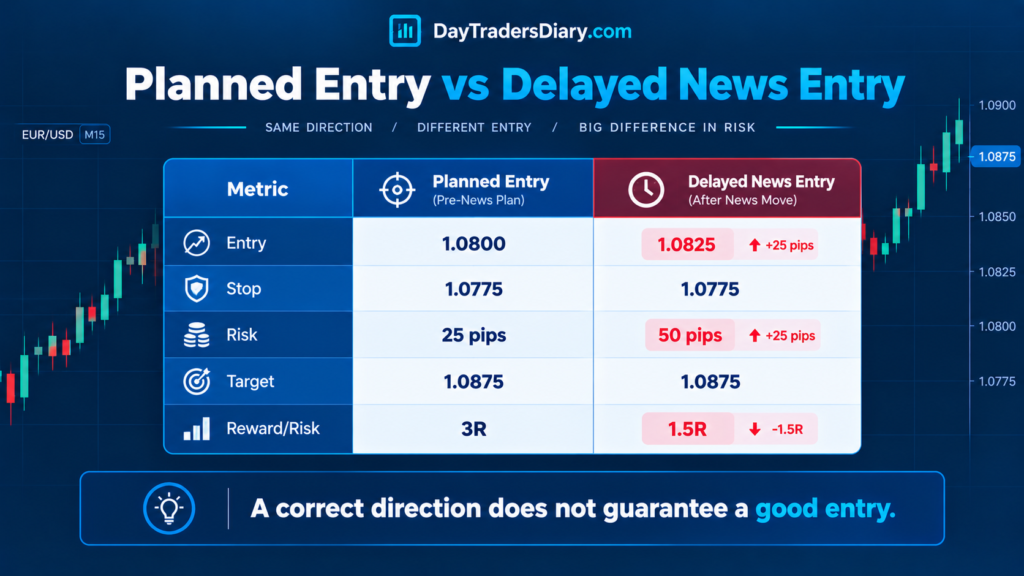
Suppose you plan to buy EUR/USD at 1.0800.
Your technical invalidation is 1.0775.
Your planned risk is therefore 25 pips.
Your original target is 1.0875.
That creates a 75-pip reward.
Your planned reward-to-risk ratio is 3R.
Now a major U.S. economic release arrives.
The first candle explodes upward.
You do not enter.
Price reaches 1.0815.
You wait for a pullback.
The market pulls back to 1.0808 and begins rising again.
You enter at 1.0808.
The stop remains 1.0775.
Your actual risk is now 33 pips.
The target remains 1.0875.
Your potential reward is now 67 pips.
Your new reward-to-risk ratio is roughly 2.03R.
Nothing is wrong with a 2R setup.
But you need to recognize that you no longer have the original 3R setup.
You have created a new trade.
This sounds obvious, but traders routinely manage the second trade according to the assumptions of the first.
That is where execution errors begin.
The 20 Percent Deterioration Rule
A useful starting framework is to define a maximum acceptable entry deterioration before you enter.
For example, suppose your original risk is 30 pips.
You might decide that you will tolerate no more than 20% additional risk from delayed execution.
Twenty percent of 30 pips is 6 pips.
That gives you a maximum acceptable actual risk of 36 pips.
If price has moved far enough that your actual stop distance becomes 40 or 45 pips, you do not simply say, “The setup is still valid.”
You say:
“Trade specification is invalid now but setup may still be valid.”
That’s a powerful distinction.
You are not trying to anticipate if price will continue.
You are setting the terms on which you will play.
The exact percentage should come from your own data.
Twenty percent is not a universal rule.
It is a testing framework.
Some strategies may tolerate 10%.
Others may tolerate 30%.
A momentum strategy might have a completely different threshold from a mean-reversion setup.
The important thing is that the threshold exists before emotion gets involved.
News Confirmation Has a Hidden Price
One of the most misunderstood concepts in trading is the idea that confirmation is free.
It is not.
Confirmation is purchased with price.
Suppose your original setup offers 3R.
You wait for confirmation.
The market moves 0.5R in your direction.
You enter.
Your remaining upside is now smaller.
At the same time, your stop may still be the same distance away.
Your reward-to-risk ratio has deteriorated.
This creates an important question:
How much confirmation is enough?
The answer depends on what uncertainty the confirmation is supposed to remove.
If you are waiting to confirm that a liquidity sweep has failed, you might only need a structural shift.
If you are waiting for a breakout to prove itself, you may need a candle close.
If you are waiting for a news shock to settle, you may need a volatility contraction and a retest.
But each additional confirmation condition creates another opportunity for price to move without you.
That means confirmation should remove a specific uncertainty.
If it does not, it is probably just hesitation disguised as discipline.
A Better Way To Define Confirmation
Instead of:
“I’ll wait for confirmation.”
Confirm beforehand.
Here’s how to do it:
“I will not go in directly after CPI. I’ll wait for the initial urge to finish then need a five minute structure break and retest. I will enter only if the actual stop distance is less than 20% above my original intended risk.
Now you have a process.
The market can either satisfy it or fail to satisfy it.
This removes a large amount of discretionary negotiation during the most emotionally difficult part of the session.
The same approach works for NFP, FOMC, ECB decisions, Bank of England announcements, employment data, inflation releases, GDP releases, and other scheduled events that can alter short-term volatility.
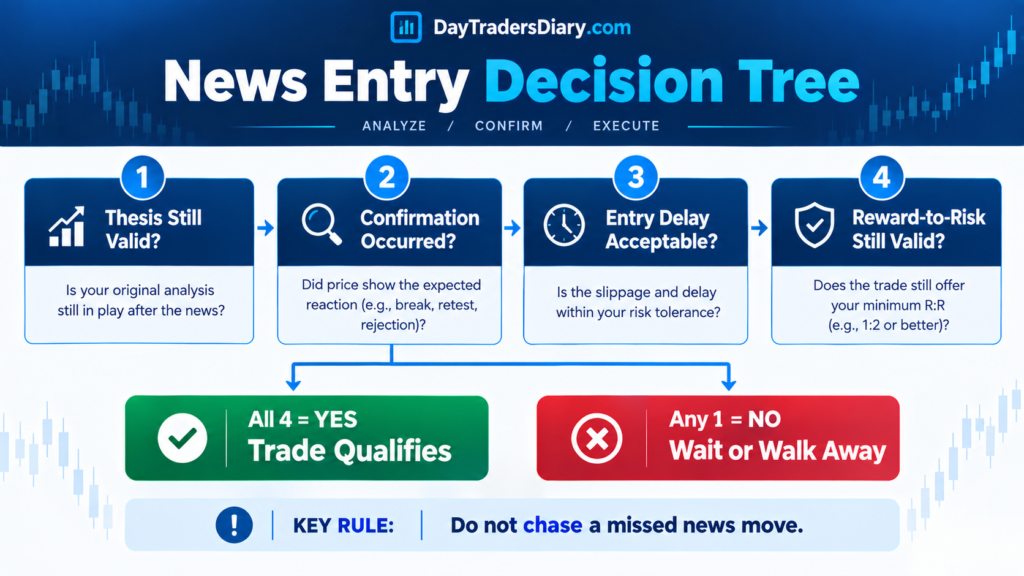
The News Entry Decision Tree
A useful pre-news routine begins before the announcement.
First identify whether the setup exists independently of the news.
If the setup only exists because the news is about to happen, you are dealing with a different strategy.
Then identify the logical invalidation level.
Do not move the stop closer simply to make the delayed entry look attractive.
Next calculate the original R.
Then decide what confirmation you require.
After the release, calculate the actual entry distance to the stop.
If the deterioration is within your predefined threshold and the confirmation condition is present, the trade remains eligible.
If confirmation exists but the entry deterioration exceeds the threshold, the trade should normally be treated as missed rather than repaired.
That last step is difficult.
Traders hate watching a market move without them.
But a missed trade is often cheaper than converting a high-quality setup into a low-quality chase.
When Waiting Is Actually Better
Entry delay is not automatically negative.
Sometimes waiting improves the trade.
Imagine a major announcement creates an initial spike downward.
You were originally looking to buy.
Instead of entering before the news, you wait.
The first reaction breaks support.
Then price quickly recovers.
A five-minute candle closes back above the level.
Price retests it.
The retest holds.
Your original entry was lower, but the post-news structure has now given you information that did not exist before the announcement.
You may be paying a higher price.
But you are buying a different and potentially more informed setup.
This is why entry delay should not be judged purely by distance.
The correct question is:
What did I receive in exchange for the worse price?
If the answer is “nothing,” the delay is probably harmful.
If the answer is “I gained evidence that the initial news reaction was rejected and the original thesis survived,” then the deterioration may have purchased useful information.
That is a completely different situation.
The Information-to-Deterioration Ratio
This leads to a more advanced concept.
Call it the Information-to-Deterioration Ratio.
You do not need a perfect mathematical formula for it.
You can evaluate it through two questions.
How much uncertainty did the delay remove?
How much trade quality did the delay destroy?
Suppose waiting five minutes confirms that a major liquidity sweep failed.
That could be valuable information.
But suppose waiting for three additional candles gives you almost no additional information while reducing the trade from 3R potential to 1.2R.
The second delay has poor economics.
The trader has confused more information with better information.
More confirmation is not always better confirmation.
Entry Delay and Position Sizing
This is where execution and risk management become inseparable.
If your planned entry was 1.0800 and your stop was 1.0775, your planned risk was 25 pips.
If you later enter at 1.0810 with the same stop, your actual risk is 35 pips.
If you keep the same position size, you are risking 40% more price distance than originally planned.
That is not a minor execution difference.
It is a position-sizing error.
You have two choices.
You can reduce your position size to maintain the original dollar risk.
Or you can reject the trade because the deterioration has damaged the strategy’s expected payoff.
This is where most traders miscalculate risk.
They decide their risk before the trade, but they do not recalculate it after the entry moves.
A position size calculator is useful here because it forces the relationship between entry, stop distance, account risk, and position size into a single calculation rather than leaving it to mental estimation.
For a delayed news entry, the calculator should be used with the actual entry and actual stop, not the numbers from your original chart.
That difference alone can prevent a surprising number of oversized trades.
Do Not Move the Stop to Hide Entry Delay
One of the worst responses to delayed entry is moving the stop closer simply because the original stop makes the new trade unattractive.
Suppose your planned entry was 1.0800 with a stop at 1.0775.
You enter late at 1.0815.
The original stop creates 40 pips of risk.
You decide that is too much.
So you move the stop to 1.0795.
Now the trade looks cleaner.
But the market structure has not changed.
You have not reduced the underlying risk.
You have simply reduced the amount of adverse movement you are willing to tolerate.
This is a classic example of allowing the desired position size to dictate the stop rather than allowing market structure to dictate the stop.
If the logical stop is too far away after the delayed entry, the correct answer may simply be that the trade no longer qualifies.
That is not failure.
That is execution discipline.
News Delay Can Destroy Your Original R-Multiple
Suppose a setup originally offered 2.5R.
After the news, your entry is 0.5R worse.
Your remaining target may now only offer 1.5R.
The strategy has changed.
This is why traders should record both planned R and actual R in their journals.
Without both numbers, you cannot determine whether poor performance came from the strategy or from execution deterioration.
A strategy might produce excellent results when entered according to plan.
The trader might still lose money because they consistently enter late.
That is not necessarily a strategy problem.
It is an execution problem.
This distinction matters enormously during performance review.
Build a News-Specific Entry Delay Log
Your journal should contain a dedicated section for news-related trades.
Schedule the planned event.
Record the currencies affected:
Make a note of the suggested entry.
Enter the real record.
Record the planned halt.
Write down the stop.
See the planned aim.
Note the real target.
Then record the reason for the delay.
Was it deliberate confirmation?
Fear?
Spread expansion?
Platform hesitation?
Waiting for candle close?
Uncertainty about the news result?
Watching another pair?
This last field is more important than it looks.
Two traders can have identical five-pip delays for completely different reasons.
One may have a tested confirmation model.
The other may simply be afraid.
Their future improvements should therefore be completely different.
Your Trade Journal Should Separate Delay From Error
This is one of the most useful changes you can make.
Do not label every delayed entry as a mistake.
Instead classify the outcome.
Planned delay means the delay was part of the strategy.
When a delay is needed, it signifies that the execution was purposely delayed because the market conditions no longer justify an instant entry.
Emotional delay refers to the trader hesitating when the setup was still valid.
Technical delay implies that platform, spread, connection or execution issues contributed.
Chasing delay means the trader entered after missing the original price without a new setup.
Once you classify trades this way, patterns become visible.
You may discover that your planned confirmation entries perform well.
Your emotional delays may perform badly.
Your chasing entries may have a high win rate but terrible average R because winners are too small.
Without categorization, all of these trades simply appear as “late entries.”
A downloadable Trade Journal Template can make this review much easier because the important fields can be captured consistently rather than reconstructed from memory at the end of the week.
The 20-Trade News Study
Do not change your entire trading system after three news trades.
Build a sample.
Twenty trades is enough to start identifying obvious behavioral patterns, although it is not enough to prove statistical significance for a strategy.
Split the trades into categories.
Compare trades entered within the planned range against trades that experienced moderate delay.
Then compare moderate delay against severe delay.
Look at average R, not just win rate.
Suppose your data looks like this:
Planned-entry trades average +0.48R.
Moderately delayed trades average +0.21R.
Severely delayed trades average -0.34R.
Now you have useful evidence.
The problem may not be news.
The problem may be excessive entry deterioration.
That distinction allows you to improve the process without unnecessarily eliminating a profitable setup.
Measure Maximum Favorable Excursion
Another useful metric is Maximum Favorable Excursion, or MFE.
MFE tells you how far price moved in your favor after entry before the trade ended.
For news-related entries, compare MFE against entry delay.
You may discover something surprising.
Perhaps delayed entries have a similar win rate to normal entries but much smaller MFE.
That would suggest your directional edge remains intact, but your late entries are capturing less of the move.
This can explain why a trader says:
“My analysis is right, but my account is not growing.”
The analysis may indeed be right.
The execution is simply capturing too little of the available movement.
Measure Capture Ratio
You can take this one step further with a simple capture ratio.
If the market moved 100 pips in the favorable direction after the original setup and your delayed entry captured only 35 of those pips, your capture ratio is 35%.
Now compare that with trades where you entered close to the original level.
If normal trades capture 65% of favorable movement while delayed news trades capture 30%, you have identified an execution leak.
This is more actionable than saying:
“I need to be more disciplined.”
You now know exactly what needs work.
The Hidden Problem With Win Rate
News delay can also distort your win rate.
Imagine you take profits quickly after entering late because the remaining target is smaller.
Your win rate improves.
But your average winner falls.
You might feel that your news strategy has become more consistent.
Your equity curve may tell a different story.
This is why delayed entries should be evaluated using average R, expectancy, profit factor, maximum drawdown, and average winner, not just win percentage.
A high win rate can hide poor reward capture.
That is especially dangerous when the trader’s delayed entry is followed by aggressive profit-taking to compensate psychologically for the worse entry.
The trader is solving one execution problem by creating another.
The Psychology of Missing the First Move
There is a psychological reason news delay becomes dangerous.
The trader watches price explode without them.
The brain interprets the move as evidence that the trade was right.
Then the trader feels pressure to participate.
The longer the move continues, the stronger the feeling becomes.
Eventually the question changes from:
“Does this trade still meet my rules?”
to:
“How can I get into this move?”
That is the beginning of chase behavior.
A professional response is different.
You do not ask whether price will continue.
You ask whether the current price still satisfies the original risk and reward conditions.
If it does, enter.
If it does not, wait for a new setup.
The distinction is subtle but critical.
You are not refusing to trade because you missed the entry.
You are refusing to trade because the current trade no longer meets your specification.
A News Trade Can Become a New Trade
This is perhaps the most important concept in the entire framework.
A delayed entry does not always mean the original trade is damaged.
Sometimes the original trade is simply gone.
A new trade may then develop.
For example, EUR/USD breaks above resistance after CPI.
You miss the breakout.
Price pulls back.
The former resistance becomes support.
A new bullish structure forms.
You can now define a fresh entry, fresh stop, and fresh target.
That is not a late entry anymore.
It is a new setup.
Treating it as a new trade forces you to recalculate everything.
That protects you from carrying emotional attachment from the original setup into a completely different market condition.
When You Should Walk Away
There are situations where the best news execution is no execution.
Walk away when the entry has moved too far relative to the original risk.
Walk away when the stop would have to be artificially tightened.
Walk away when the target has become too close.
Walk away when your confirmation requirement has not actually occurred.
Walk away when the market has become too volatile for your normal execution model.
Walk away when you find yourself thinking about the trade you “missed” rather than the trade currently available.
That last one is psychological, but it is measurable.
If your reason for entering begins with “I should have bought earlier,” you are probably evaluating the past rather than the current opportunity.
A Better News Trading Routine
The strongest routine begins before the announcement.
Mark the setup.
Record the planned entry.
Record the logical invalidation.
Calculate the planned R.
Define the confirmation requirement.
Define the maximum acceptable entry deterioration.
Then let the announcement happen.
After the initial reaction, reassess the market as though you have no position and no emotional attachment to the original setup.
Ask whether the thesis still exists.
Ask whether confirmation occurred.
Ask how much the entry deteriorated.
Ask what the current reward-to-risk ratio looks like.
Then make a binary decision.
The trade qualifies.
Or it does not.
There should be very little negotiation after that point.
How This Connects With Entry Delay Risk Outside News
The same framework applies outside economic announcements.
You can use it for breakout confirmation.
You can use it after liquidity sweeps.
You can use it after structure breaks.
You can use it when waiting for candle closes.
You can use it after a spread spike.
You can even use it when you deliberately delay an entry because you are unsure about market conditions.
This connects naturally with the broader concept of measuring entry delay risk.
If you have already studied how planned and actual entries change your initial risk, news simply adds another variable: the market can change much faster while you are deciding.
That makes pre-defined thresholds even more valuable.
Scaling and Capital Growth
There is another reason this matters.
A small execution leak becomes much more important as account size grows.
If poor news entries cost you an average of 0.15R per trade, that may not feel significant when you are trading very small size.
But repeated across hundreds of trades, the leak becomes meaningful.
As capital increases, you do not need to make your strategy more complicated.
You need to preserve its execution quality.
This is one reason professional traders pay so much attention to process metrics.
The goal is not simply to find more setups.
The goal is to capture a greater percentage of the edge that already exists.
For traders who have a tested strategy but limited personal capital, evaluation-based funding programs can be one professional pathway to gaining access to larger nominal trading capital.
The key term is professional.
You can’t fix poor execution with an evaluation account.
And pre-defined drawdown guidelines can actually highlight bad execution more quickly.
A good strategy trader might blow up an evaluation account by continually entering late around news, over-sizing after missing moves, or tightening stops to make up for botched entries.
That makes execution discipline particularly relevant when considering firms such as The5ers, FTMO, FundingPips, or other proprietary trading programs.
The exact rules differ by firm and can change, particularly around news trading, drawdown, leverage, holding periods, and execution restrictions.
The5ers, for example, currently publishes specific restrictions around order execution during high-impact news for its High Stakes program while allowing existing positions to remain open through news. That distinction is directly relevant to a trader whose strategy depends on entering after an announcement rather than holding a position into it.
The lesson is plain.
Don’t decide your financial structure first, then decide your strategy. choose what you need to execute your strategy, then choose the capital structure.
If your edge relies primarily on getting in within seconds of key releases, a firm’s news policy is important.
If your edge depends on waiting for post-news structure confirmation, a different set of rules may matter more.
The professional approach is to match the trading process to the account structure.
If your personal capital is limiting the size at which a proven edge can operate, researching a current The5ers evaluation can be reasonable as part of that progression. But treat the evaluation as a test of execution consistency, not as a shortcut to capital.
The Position Size Problem Most Traders Miss
There is another hidden consequence of delayed news entries.
Your position size should often change even when your stop location does not.
Suppose you normally risk $100 and your original stop distance is 20 pips.
Your position size is calculated around that 20-pip risk.
After the news, your entry is 30 pips away from the same stop.
If you use the original position size, your dollar risk has increased by 50%.
If you reduce the position size, you preserve the original dollar risk.
But there is still another question:
Does the trade have enough remaining reward to justify entering at all?
This is where risk management becomes more sophisticated than simply maintaining a fixed dollar risk.
Position sizing controls the amount you can lose.
It does not restore a damaged reward-to-risk profile.
That is why position size and entry quality must be evaluated separately.
The Three-Gate News Entry Model
A useful framework is to think of every delayed news trade as having three gates.
The first gate is Thesis.
Does the original market idea still make sense?
The second gate is Execution.
Has the actual entry moved too far relative to the original risk?
The third gate is Payoff.
Does enough reward remain to justify the current risk?
A trade must pass all three.
A setup can pass the thesis gate but fail execution.
It can pass execution but fail payoff.
It can pass payoff but fail the thesis because the post-news structure has invalidated the original idea.
This three-gate model prevents one attractive feature from overriding the rest.
A strong directional move cannot compensate for an unacceptable entry.
A beautiful technical structure cannot compensate for an invalidated thesis.
A low-risk entry cannot compensate for insufficient remaining reward.
Build a Personal News Delay Threshold
Do not copy someone else’s threshold.
Build yours.
For the next 30 relevant trades, record the planned entry, actual entry, planned risk, actual risk, delay-to-risk ratio, confirmation type, remaining R, outcome in R, and MFE.
Then group the results.
Look at trades with less than 10% deterioration.
Then 10% to 20%.
Then 20% to 30%.
Then above 30%.
You may discover that your performance deteriorates sharply beyond a certain point.
That point becomes your provisional threshold.
Repeat the study with another sample.
If the pattern remains, you have something much more valuable than a generic rule from a trading article.
You have a rule derived from your own execution data.
One Final Test: Remove the Entry
There is a powerful review exercise you can perform after every major news trade.
Erase your actual entry from the chart.
Look at the market as if you are flat.
Then ask:
“Would I enter here right now?”
If the answer is no, you have identified a potential chase.
This test removes the psychological attachment created by watching the original move.
It also helps distinguish a genuine continuation setup from the emotional need to participate.
The market does not know that you were planning to enter five minutes ago.
It does not care that you missed the first 30 pips.
Only your trading psychology cares.
That is why the flat-position test is so useful.
Common Questions About Entry Delay Risk From News
What is entry delay risk in forex?
The risk of entrance delay is the additional trade risk introduced when the entry actually takes place at a worse price than the intended entry. It can increase the distance to a stop, decrease the reward-to-risk, lower the profit potential or need a smaller position size.
How do you calculate entry delay risk?
Calculate the original distance from planned entry to the logical stop, then calculate the distance from actual entry to that same stop. The difference is the entry deterioration. Divide that deterioration by the original risk to calculate the Delay-to-Risk Ratio.
Is it better to wait for confirmation after news?
Not automatically. You can wait and see if the first reaction was accepted or refused . But the confirmation is expensive . The question is whether the information you get is worth the loss in entry quality.
How much entry delay is acceptable?
No universal number. As a reasonable beginning point, test a maximum degradation like 20% of original risk, and then compare results with your own historical trades. differing tactics will permit differing amounts of delay.
Should I reduce position size after entering late?
Sometimes I am. If the logical stop is the same but the actual stop distance is bigger, then reducing position size can maintain the original dollar risk. But reduced position size does not correct a poor reward-to-risk ratio.
Should I move my stop closer after a delayed news entry?
Not just to compensate for the poorer entrance. The stop should remain on based on valid logical market invalidation. If the logical stop makes the delayed trade undesirable, it is usually cleaner to reject the trade than to force a tighter stop.
Can a delayed entry become a new trade?
Yeah. If the initial setup is gone but a new one arises, treat the chance as a new trade. Recalculate entry, stop, target, risk and reward. Don’t carry assumptions from the initial set up.
What should I record in my trading journal?
Planned Entry Actual Entry Planned Stop Actual Stop Planned Target Actual Target Delay Cause Confirmation Kind Delay-to-Risk Ratio Final R Maximum Favorable Excursion This enables you to separate the performance of strategy from the performance of execution.
The Real Edge Is Knowing When Not To Chase
The biggest improvement in news trading rarely comes from predicting the number better.
It comes from understanding what happens after the number.
A professional trader can be directionally correct and still lose money because the entry was too late.
Another trader can miss the first move and still make a good quality trade because they waited for a fresh structure and reassessed the entire setup.
It’s not a matter of bravery.
It is a measurement.
If news moves the market, quit worrying about whether you were right.
Assess the impact of the delay on the deal.
How much did stopping distance vary?
What happened to so much R?
How much confirmation did you really receive?
How much of the favorable move remained?
Did your position size still match your intended risk?
And most importantly, would you still take the trade if you had never seen the original setup?
That last question can save more money than another indicator.
For your next 30 news related trades, record planned entrance vs actual entry and calculate the Delay-to-Risk Ratio on each occasion. Don’t try to fix everything at once. Identify the point at which your performance starts to decline, and then construct your execution rule based on that evidence.
Once you can measure entry delay, you stop treating late entries as vague feelings.
You can see exactly where your edge is leaking.
For the next step, read How To Measure Entry Delay Risk in Forex and connect the news-specific framework to your broader entry-quality and execution process.