
Most traders spend weeks trying to improve entries and almost no time learning how to exit well.
That mistake is expensive.
A weak entry with disciplined trade management can still make money. A great entry with poor exits often turns into frustration. I have seen traders catch the best move of the day, move their stop too tight, get clipped out, then watch price run another 40 pips without them.
This is where ATR trailing stops become valuable.
They give your stop loss room based on actual market volatility instead of emotions. Instead of guessing where to place a stop, you use market behavior to decide. That one change can make things more consistent than changing indicators every week.
If you trade forex during the day, scalp sessions, or swing momentum swings for a few hours, learning about ATR trailing stops can dramatically transform how you safeguard your winnings.
What ATR Actually Measures and Why Traders Misuse It
ATR stands for Average True Range. It was introduced by J. Welles Wilder and remains one of the most practical volatility tools ever built.
ATR does not predict direction. It measures movement.
That distinction matters. Many newer traders expect ATR to tell them whether EURUSD will rise or fall. It will not. ATR tells you how much the pair is moving on average over a selected period.
For example, if EURUSD has a 14-period ATR of 0.0008 on a 15-minute chart, the market is averaging around 8 pips of movement per candle range.
Why does that matter?
Because a 5-pip stop in an 8-pip environment is often noise. A 5-pip stop in a 3-pip environment may be enough.
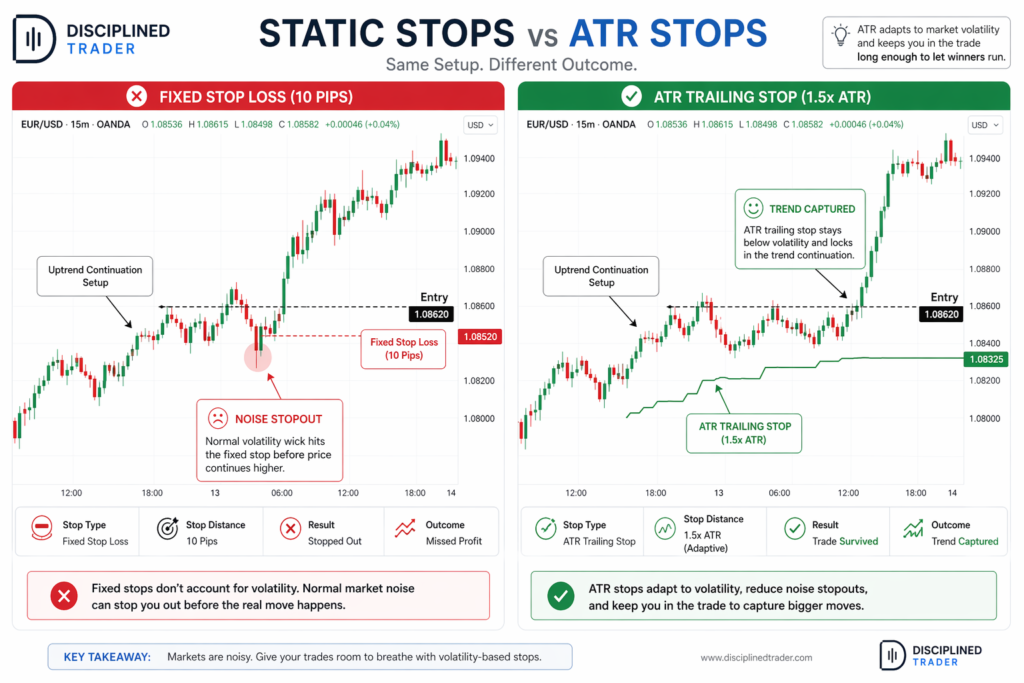
That is why fixed stops often fail. They ignore volatility.
You can learn about ATR principles directly from places like the CMT Association, CME Group instructional materials, and MetaTrader documentation, which all talk a lot about tools that use volatility. The main point of all of them is simple: markets go up and down. Your paradigm for risk should change with them.
Why ATR Trailing Stops Work Better Than Static Stops
Static stops are easy but blunt.
You decide on 10 pips, 15 pips, or 20 pips and use it on everything. That may feel consistent, but markets are not consistent.
London open GBPUSD behaves differently from late New York USDJPY. NFP Friday behaves differently from mid-August summer flow.
ATR trailing stops adjust dynamically.
When volatility expands, the stop widens enough to avoid random shakeouts. When volatility contracts, the stop tightens and protects open profit faster.
This is especially useful for traders reading our guides on Best Risk/Reward Ratios for Day Trading and How to Trade the EURUSD Daily Range, because both topics rely heavily on realistic exit expectations.
How to Build an ATR Trailing Stop Framework
The biggest mistake traders make is copying random settings online.
There is no magic ATR multiplier. You need one matched to your strategy.
Think in three layers.
Layer One: Choose the Timeframe
Your ATR should usually match the chart you execute on.
If you enter on the 5-minute chart, start with ATR from the 5-minute chart. If you execute on the 15-minute chart, use that chart first.
Using a higher timeframe ATR can work, but it creates wider stops.
Layer Two: Choose the Period
There are 14 periods in the classic setting.
That’s an excellent place to start because it has a lot of data and takes into account developments that are happening right now. Shorter settings, like 7, work quickly but can be loud. Longer settings, like 21, are smoother but take more time.
My practical opinion is
Scalpers usually like between 7 and 10.
Day traders commonly use 14, although trend riders may like 20 or more.
Layer Three: Choose the Multiplier
This is when personality and tactics come into play.
1x ATR is very aggressive.
1.5x ATR is even.
2x ATR is calm.
3x ATR is for sessions that are particularly volatile or have big swings.
For example:
You buy GBPUSD when it breaks out. The ATR on the 5-minute chart is 6 pips.
Your trailing stop is 9 pips away from the price at 1.5x ATR.
At 2x ATR your trailing stop is 12 pips.
One gives tighter profit lock. One gives trade room.
Neither is universally right.
How I Use ATR Trailing Stops for Intraday Forex
When momentum is clean, I follow structure and ATR.
Let’s say that EURUSD smashes the London range highs and starts to trend strongly.
I don’t just follow every candle without thinking. I ask instead:
Is the market going up or down?
Are pullbacks not that deep?
Is there still liquidity in the session?
Is ATR getting stronger or weaker?
If momentum is good, I let ATR breathe. I tighten if the momentum slows down at a key resistance level.
This is important because signs should help you understand the situation, not do the thinking for you.
Many traders lose transactions that they would have won if they had read the market instead of following the instrument.
Best ATR Trailing Stop Setups by Style
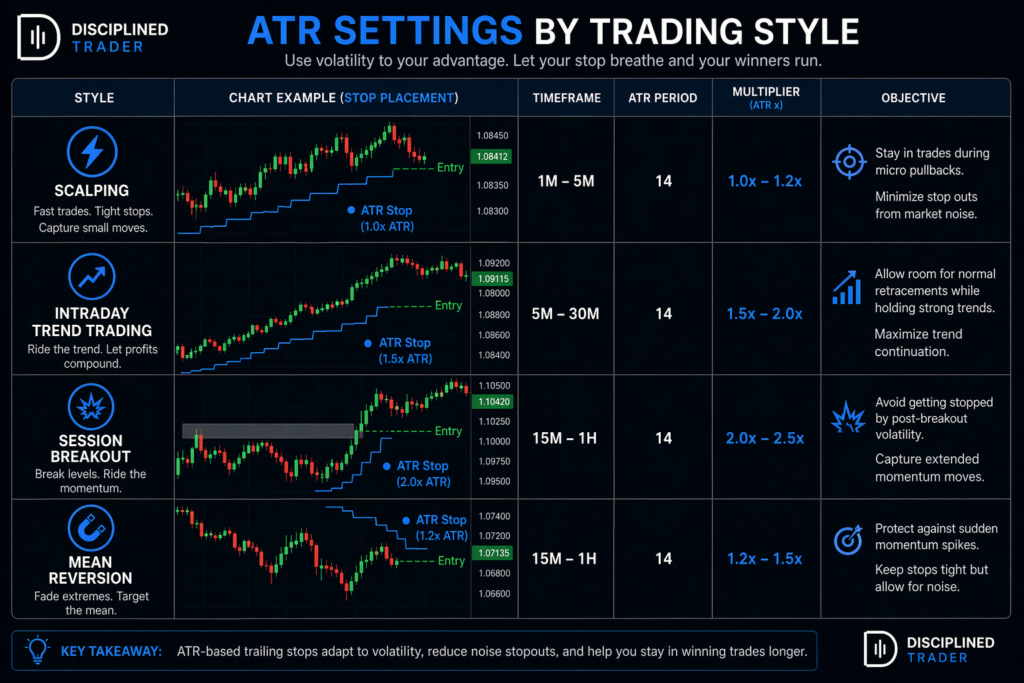
Scalping
Use 5-minute chart ATR with 7 to 10 period setting and 1x to 1.3x multiplier.
Goal is quick protection. Scalpers cannot allow large retracements.
Standard Intraday Trend Trading
Use ATR 14 for 5 to 15 minutes, with a multiplier of 1.5 to 2.
This is often the best balance for aggressive forex traders.
Session Breakout Trading
Start with an impulsive move. Once above the breakout zone, form a tail. Don’t follow breakout noise too carefully.
Mean Reversion
ATR trailing stops don’t work as well here. Mean reversion often aims for defined areas. Use ATR more to set the size of your first stop than to set the size of your trailing stop.
When ATR Trailing Stops Fail
No tool wins everywhere.
ATR trailing stops struggle in choppy range conditions because volatility may be enough to trigger stops repeatedly while price goes nowhere.
They also fail when traders apply them too early.
If you enter and then quickly follow with a tight multiplier, regular pullback will take you out before the trade has a chance to develop.
This is why I like to utilise a two-step model:
The first stop is based on the setup being invalid.
Change to an ATR trailing stop after the price goes up 1R.
That puts reasoning ahead of management.
Risk Management and Position Sizing Matter More Than the Stop Type
A lot of traders worry too much about where to put their stops and not enough about how big their positions are.
Even a great stop with too much leverage can hurt accounts.
This is where most traders get the risk wrong. The Position Size Calculator takes the uncertainty out of things and helps you match the lot size to the ATR-based stop distance.
If ATR widens from 8 pips to 14 pips, your lot size should usually shrink if risk stays constant.
Professionals understand this instinctively. Retail traders often ignore it.
How to Journal ATR Trailing Stop Performance
If you don’t keep track of stop behaviour, you don’t know what it is.
Log the following in your Trade Journal Template:
ATR setting that was used
Used a multiplier
Session in the market
Pair bought and sold
Why did you leave?
Maximum positive excursion
Did stop cut the winner early?
Did halt save profit in a good way?
Patterns show very quickly after 30 trades.
You may discover GBPUSD responds best to 1.8x ATR during London while USDJPY works better at 1.3x during Asia overlap.
That insight is where edge comes from.
ATR Trailing Stops and Capital Growth
Good traders often hit a ceiling.
They learn how to make entries, keep their cool, and manage risk, but their own money limits how much they can profit each month. obtaining 3% on a small account is different than obtaining 3% on a big account.
That’s why a lot of disciplined traders look into evaluation tools from companies like The5ers, FTMO, and others.
The draw is not imaginary earnings. It gives you access to more buying power under restrictions that limit risk.
If your journaling demonstrates actual regularity and managed drawdowns, the next step could be to open a The5ers assessment account. This way, you can scale a technique that has already worked instead of risking your own money.
Before punishment is not the right time to ask for money. After repeatable execution is the right time.
Advanced Trader Insight Most Miss
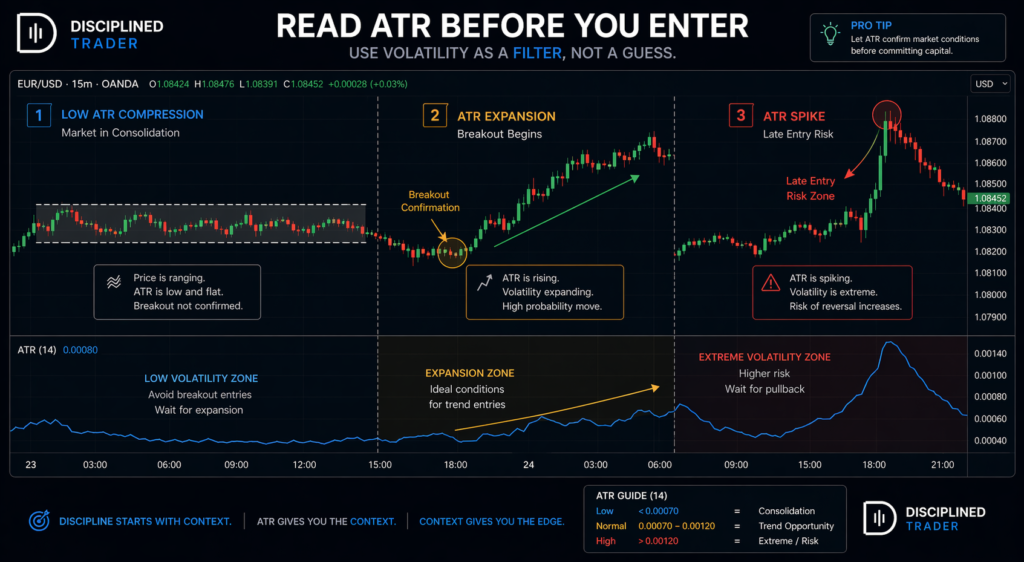
ATR is more than just a stop tool. It is a filter for market conditions.
If ATR is very tight, you may have to wait for breakouts because expansion generally comes after contraction.
If ATR is going up following a news surge, it’s risky to enter late since the stop distances get more and the return is smaller.
So, before you go in, ask:
Is ATR getting bigger before the move?
Is ATR at its highest point after the move?
Is the present level of volatility normal for this session?
That one habit can help you get better at a lot of things.
Common Mistakes With ATR Trailing Stops
Using the same settings on every pair.
EURUSD and GBPUSD behave differently. NASDAQ and USDJPY behave differently.
Ignoring session timing.
ATR during Asia session differs from London open.
Trailing too early.
Many traders convert a good setup into a scratch trade.
Using ATR without price structure.
If price is sitting above major support, structure matters too.
Final Takeaway
ATR trailing stops are powerful because they adapt to the market instead of forcing the market to fit your preferences.
But keep in mind that the stop is only as smart as the person utilising it.
Don’t use ATR to avoid thinking; use it to measure conditions. Before making any changes, test one pair, one session, and one setting cluster for 30 trades and keep track of the results.
This is the one thing I want you to do today: for one week, stop modifying entries and simply work on improving exits.
That is where many accounts quietly transform.
Next read: How to Use ATR Stops in Forex or Best Risk/Reward Ratios for Day Trading.
FAQs
What is the best ATR multiplier for day trading?
A good starting point for many intraday traders is 1.5x to 2x ATR. Scalpers who are strict may use less, whereas trend traders may use more.
Are ATR trailing stops good for forex?
Yes, especially in forex, where the volatility changes with each session. They assist stops adjust to London, New York, and times when things are quieter.
Can ATR trailing stops be used on MT4 or MT5?
Yes. Both platforms provide ATR indicators, and there are several bespoke trailing stop tools available.
Should beginners use ATR trailing stops?
Yes, but keep it simple. Use one pair, one timeframe, one multiplier, and journal results before optimizing.
Is ATR better than fixed pip stops?
Often yes, because fixed stops ignore changing volatility. ATR reflects current movement conditions.