
This is a time every forex trader has encountered.
You find a textbook setup.
The trend is tidy.
Your entry is right.
The stop loss is where it needs to be.
Then a press release drops.
Within seconds, the price explodes through your stop and then reverses in your original direction.
You blame volatility.
You blame your broker.
You blame bad luck.
But after reviewing enough trading journals, one pattern becomes obvious.
Most of these losses weren’t caused by the news itself.
They were caused by traders who didn’t understand the difference between an economic event and an economic surprise.
The calendar told them when the announcement would happen.
It didn’t tell them how much the market expected.
Professional traders know that markets react less to headlines and more to the gap between expectations and reality.
That gap is called an economic surprise.
Learning to track it won’t help you predict every market move, but it will help you avoid trading unquestioningly into the moments when volatility is most likely to explode.
This guide explains how to track economic surprises in forex, how experienced day traders interpret major data releases, and how to build a repeatable process for high-impact news rather than fear it.
Why Economic Surprises Matter More Than Economic News
Many new traders assume that strong economic data automatically strengthens a currency.
Real markets are more complicated.
Imagine the market expects U.S. Non-Farm Payrolls to increase by 180,000 jobs.
The actual release is 185,000.
Technically, employment improved.
Practically, the surprise was small.
Price may barely move.
Now imagine expectations were 180,000, but the report prints 320,000.
That’s a genuine surprise.
Institutional traders immediately reassess interest rate expectations, capital flows, and economic strength.
The larger the surprise relative to expectations, the larger the potential market reaction.
Professional traders focus on expectations first.
The headline comes second.
Research-Backed Insight: Why Markets React to Expectations
Research from the Bank for International Settlements (BIS) has shown that exchange rates often react most aggressively when macroeconomic announcements differ significantly from market expectations, rather than when economic data is simply strong or weak.
Similarly, the Federal Reserve has released a large body of data showing that financial markets quickly incorporate new information into prices, especially when economic releases change expectations about future monetary policy.
For day traders, this means that knowing the consensus forecast before a news release is often just as important as knowing the actual result.
Trading without understanding expectations is like entering a trade without checking the chart.
The Difference Between News and Surprise
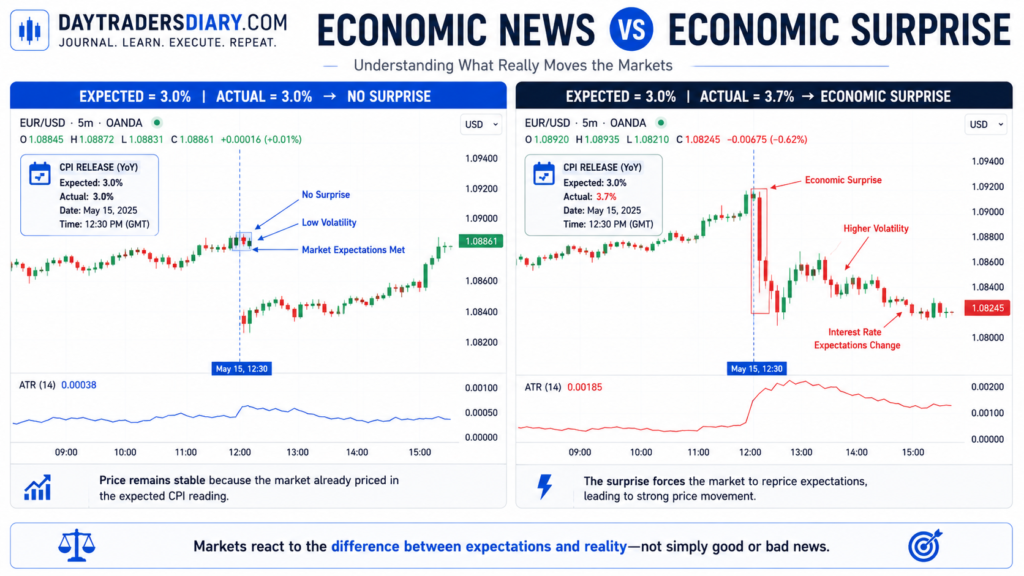
Please take two inflation reports.
Report A:
CPI, anticipated 3.0%
Real CPI is 3.0%.
The result:
Hardly a surprise.
Price action may continue to be limited.
Report B:
CPI Expected 3.0%
CPI, Real: 3.7%
Outcome:
Great surprise.
Markets will immediately start to price in possible central bank action.
Currency volatility spikes considerably.
This is why some important announcements hardly impact the price while seemingly comparable news produces spectacular changes.
Choosing the Best Economic Calendar for Forex
Every serious forex trader should begin each trading day by reviewing an economic calendar.
The most widely used calendars include those published by Forex Factory, Investing.com, and DailyFX because they display:
Release time.
Previous result.
Consensus forecast.
Actual result.
Expected impact.
However, the calendar is only the starting point.
Professional traders don’t simply note when news is scheduled.
They prepare scenarios before the release.
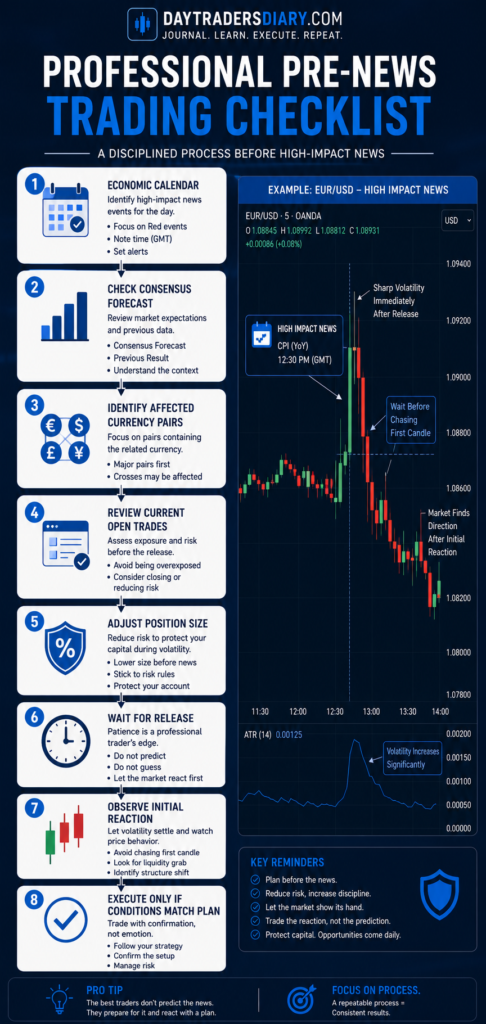
Build a Pre-News Trading Framework
Develop a routine rather than being emotional when the figures are out.
First, locate all of the high impact releases that are due to take place during your trading session.
And then pose three questions.
What is the market expecting today?
What currency pairs are going to go up or down?
Do my existing trades remain open during the announcement?
If the answers open up more questions than you can handle, the usual best thing to do is to decrease your exposure.
Preparation builds confidence.
Response is not ideal.
Focus on the Highest-Impact Reports
Not all economic releases are created equally.
Experienced day traders watch events most likely to affect monetary policy expectations.
They usually contain:
Decisions on interest rates by central banks
Inflation data.
Labor data.
GDP releases
Retail sales
PMI’s for manufacturing.
Speeches by central banks.
Minor reports may cause short-term volatility.
Major reports do influence trends.
Making such distinction increases the quality of decision making.
Watch Market Expectations Change Before the Release
One overlooked habit among professional traders is monitoring how expectations evolve.
Suppose analysts initially forecast three interest rate cuts.
Over several weeks, stronger economic data causes those expectations to fall to one cut.
By the time the official announcement arrives, much of the market adjustment has already occurred.
Price will often react to a change in expectations before the actual news.
That story is either confirmed or denied by the release.
If you trade headlines without a sense of the wider expectations, you’re likely to be confused.
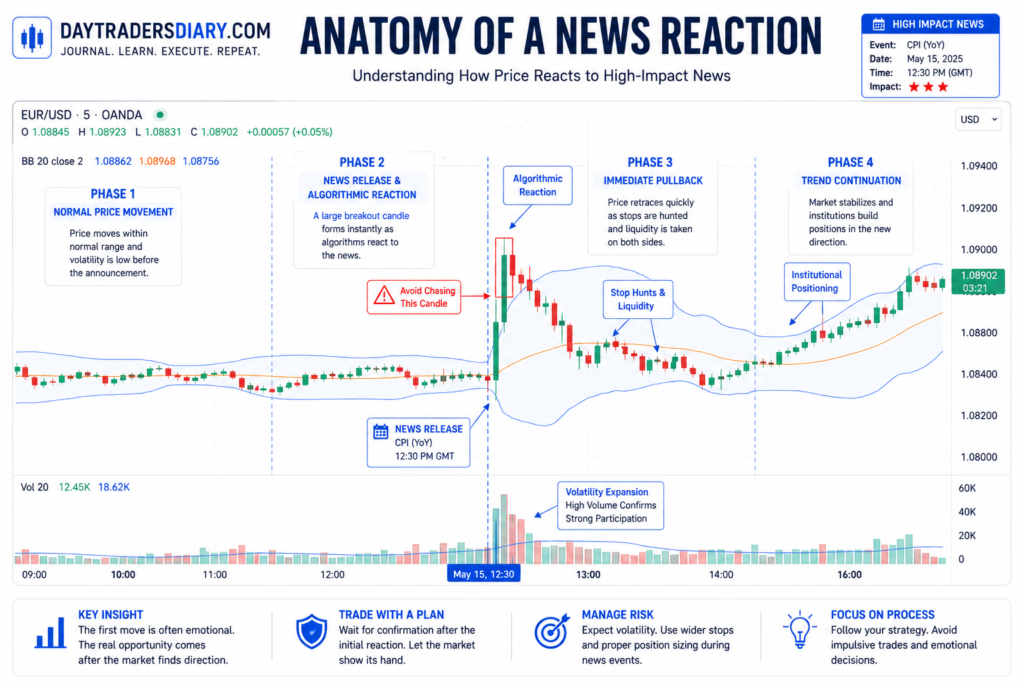
Don’t Chase the First Candle
This is where many day traders lose money.
A major announcement is printed.
The first candle moves 40 pips.
Retail traders rush into the momentum.
Professional traders often wait.
Why?
Usually, it is the algos, liquidity adjustments and stop loss orders that drive the first reaction more than persistent institutional posture.
Waiting for the volatility to settle typically gives clearer trade possibilities with more reasonable risk placement.
Patience becomes a competitive advantage.
Combine Economic Surprises with Technical Context
Economic surprises become much more useful when viewed alongside market structure.
Suppose U.S. inflation significantly exceeds expectations.
EUR/USD immediately falls into major daily support.
Should you unthinkingly sell?
Not necessarily.
Technical context still matters.
Our article on the Best Daily Charts Setup for Forex Traders explains why higher-timeframe support and resistance remain valuable even during major news events.
Economic data influences direction.
Technical structure influences execution.
The strongest trading decisions usually combine both.
Protect Capital During High-Volatility Events
News trading isn’t only about finding opportunities.
It’s also about avoiding unnecessary damage.
Volatility expands rapidly during major releases.
Spreads widen.
Slippage increases.
Normal stop-loss distances may no longer reflect actual market conditions.
Prior to each high impact event ask yourself:
What if volatility doubles? Does this trade still work?
This is where most traders miscalculate the risk.
Using the Position Size Calculator before entering a trade will guarantee that your position size is based on the actual stop-loss distance and not your emotional confidence.
Risk management becomes even more important during unpredictable market conditions.
Build a News Review Process
Tracking economic surprises should continue after the trade.
Your Trade Journal Template should include:
Economic event.
Consensus forecast.
Actual result.
Size of the surprise.
Initial market reaction.
Final market direction.
Your decision before the release.
Whether you followed your plan.
After several months, you’ll notice patterns.
Your breakout strategy may perform exceptionally after inflation surprises.
Your reversal strategy struggles following employment reports.
These insights come from structured review, not memory.
Learn Which Surprises Matter Most for Your Strategy
Not every trader needs to trade every announcement.
A momentum trader may specialize in Non-Farm Payrolls.
A trend trader may focus on central bank decisions.
A swing trader may avoid major releases altogether.
The goal isn’t to become an expert on every economic indicator.
The goal is to understand which events consistently influence your strategy.
That specialization creates confidence.
Scaling a News-Based Trading Process
Many professional firms intentionally seek a discipline requiring consistent navigation of high-impact news.
Evaluation programs reward traders who respect volatility and manage exposure prudently and avoid emotional execution.
Firms such as The5ers, FTMO, and FundedNext understand that successful traders aren’t those who predict every economic release.
They’re the traders who control risk regardless of the outcome.
If your journal demonstrates disciplined news management, consistent position sizing, and repeatable execution around economic events, a The5ers evaluation account can provide an opportunity to apply those skills with significantly larger capital.
Final Thoughts
Market uncertainty is not about economic surprises.
They show it out
The better aligned your expectations are with the institutional expectations, the more confident you can be in your trading judgments.
Don’t only look at scheduled economic reports tomorrow morning.
Ask a better question.
What does the market expect, and what might surprise it for real?
One behavior can transform the way you approach news-driven trading substantially.
Next read: How to Evaluate Your Day Trading Performance Separately examining your news trades can expose shortcomings and qualities that don’t show up in your total statistics.
Frequently Asked Questions
What is an economic surprise in forex?
Economic surprise is the difference between the actual economic data and the consensus forecast of the market. The bigger the surprise, the bigger the currency change.
Why do markets react more to surprises than headlines?
Markets are pricing in expectations ahead of announcements. When reality does not match expectations traders react by changing positions. This creates volatility.
What is the best economic calendar for forex traders?
Many traders use Forex Factory, Investing.com, or DailyFX because they provide release times, previous results, consensus forecasts, actual figures, and expected market impact.
Should beginners trade major economic news?
Beginners often do better by watching the major announcements rather than trading them right away. Usually it’s more useful to understand how markets react to economic surprises, than to chase initial volatility.
Which economic reports move the forex market the most?
The biggest market movers are usually interest rate decisions, inflation numbers, employment figures like Non-Farm Payrolls, GDP releases, and speeches from central banks.
How should I prepare before a major economic release?
Look at the market expectations, identify the affected currency pairs, review your current holdings, adjust risk as needed, and establish a plan before the announcement rather than responding after the fact.