
If you’ve ever looked back at your trade and thought, “The setup was right, but I got stopped out before the real move started,” you’ve already met the biggest challenge of the 5-second chart.
Most traders blame volatility. Others blame market makers, algorithms, or bad luck. In reality, the problem is usually much simpler. They are treating every movement as meaningful.
The 5-second chart contains valuable information, but it also contains an enormous amount of irrelevant price movement. The market is constantly processing orders from institutions, retail traders, high-frequency participants, hedgers, and liquidity providers. Not every candle represents opportunity.
Learning how to filter noise on a 5 second chart is not a magic indication. It’s about creating a method that distinguishes meaningful order flow from noise.
In this article, we combine market microstructure research, actual execution experience, and trading psychology to produce a methodology you can start using today. If you already know support and resistance, trend structure, liquidity, and risk management, this manual will assist you in enhancing your execution where many experienced traders still struggle.
Why 5-Second Charts Create So Much Noise
It’s a prevalent myth that smaller timeframes display greater information.
They are actually more random.
Every market is made up of a multitude of minor purchasing and selling decisions that have nothing to do with the direction of the trend. Big traders split up orders into smaller orders. Algorithms are constantly rebalancing positions. Liquidity suppliers are always changing quotes.
On the daily chart these little transactions just disappear.
On a 5 second chart they become into full candles.
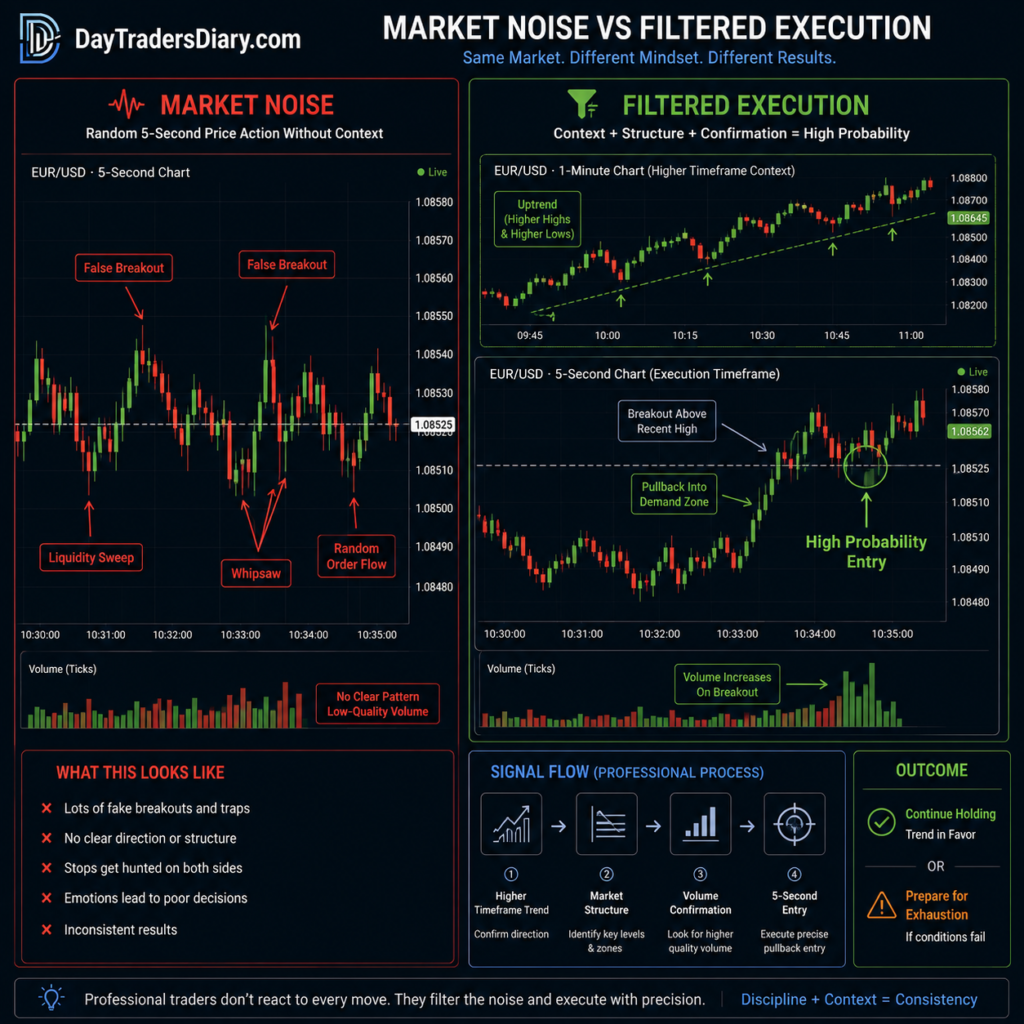
The result is a visual environment that tricks the brain into thinking that each move must be acted upon.
Experienced traders eventually realize something important.
The quality of information does not increase simply because the timeframe decreases.
Instead, the signal-to-noise ratio often becomes worse.
The goal is not to predict every movement.
The goal is to ignore most of them.
What Research Says About Market Noise
Several areas of financial research explain why short-term charts become difficult to interpret.
The CFA Institute’s research on market microstructure suggests that short-term price swings caused by bid-ask spread shifts, order filling and transient liquidity imbalances are frequently not very good indicators.
Likewise, research into high-frequency markets by the National Bureau of Economic Research (NBER) finds that much of the ultra-short-term price movement is driven by trade mechanisms, not by any real change in market value.
According to research done by the Bank for International Settlements ( BIS ) , algorithmic trading has a dual role . While it can provide liquidity , it can also cause rapid price changes , resulting in micro movements that may appear substantial , but do not change the overall market trend .
For active day traders, this research has one practical implication.
The smaller your timeframe becomes, the more important context becomes.
Without context, your brain starts reacting to market mechanics instead of market intent.
Stop Reading Individual Candles
One of the biggest mistakes traders make is to give meaning to every single candle.
A big bullish candle looks really robust.
Dangerous looks like a sharp bearish candle.
Three candles in a row appear to be momentum.
Sometimes they are.
Most of the time, they represent a temporary order imbalance.
Instead of reading candles individually, begin reading sequences.
Ask questions such as:
What is the price in relation to today’s range?
Are volumes going up or down?
Did the transfer break any major structure?
Has liquidity really reached the market?
Are you seeing this during normal trading hours?
When these answers align, the probability that the price is showing genuine intent increases dramatically.
The Context Filter Framework
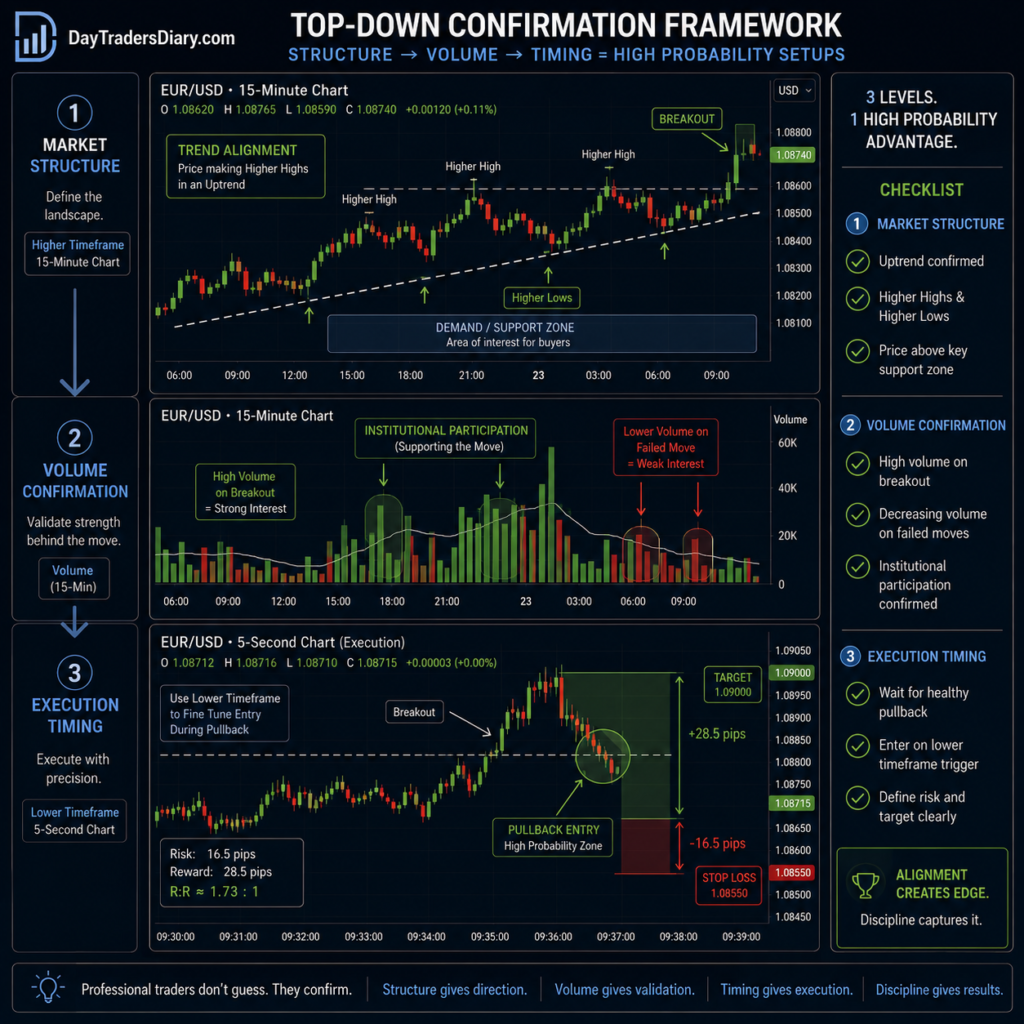
The fastest way to remove noise is to require a higher timeframe agreement before taking any 5-second trade.
The 5-second chart should never decide direction.
It should only decide execution.
For example, the one-minute chart is clearly trending higher with higher highs and higher lows.
The five-minute chart shows strong institutional buying.
The opening range has already broken upward.
Now the 5-second chart becomes an execution tool.
Instead of searching for reversals every few seconds, you only wait for pullbacks into areas where buyers have already shown commitment.
This single adjustment removes a surprising number of low-quality trades.
If you’ve already explored trend alignment techniques on DayTradersDiary.com, revisit those concepts before relying on ultra-short-term execution.
The Three-Layer Noise Filter
Professional scalpers rarely rely on one confirmation.
Instead, they stack multiple independent confirmations.
Think of this process like airport security.
One check is helpful.
Three checks. Dependable.
The market structure is the first stratum.
The second layer is participation of volume.
The third layer is timing of execution.
Only when all three are aligned does a deal become interesting.
This method seems to be slower.
Paradoxically, it can even boost trading frequency, as confidence improves and hesitation decreases.
Learn the Difference Between Activity and Opportunity
Many traders confuse market activity with opportunity.
Fast movement feels exciting.
High volatility creates urgency.
Rapid candles trigger fear of missing out.
None of these creates an edge.
Professional traders spend much of the session doing absolutely nothing.
They wait because they understand that the market constantly produces movement but rarely produces asymmetric opportunity.
One practical exercise is counting how many 5-second candles occur before your best trade of the day.
And the answer typically surprises the traders.
Hundreds.
I always knew you were on the brink.
It just takes patience.”
Session Timing Filters More Noise Than Indicators
Time of day matters more than most indicators.
Volatility is naturally high in the initial few minutes of the market opening.
Mid-day trading is usually rather fragmented and sees little participation.
Institutions realign positions, altering late-session activity once more.
Don’t trade the same thing every session. Get in the market. Create rules for executing builds.
For example:
Trade initial momentum vs mid-day-pullbacks.
Do not force continuation trades with minimal volume.
Elevate confirmation needs during lunch sessions.
Reduce confirmation requirements only when liquidity expands.
Many traders who believe they have a strategy problem actually have a timing problem.
Watch Volume Before Price
Price is telling you where the market is going.
Volume will inform you whether there was involvement behind that move.
A breakout on weak participation is usually noise.
If you see a breakout on increasing volume, pay attention.
Volume should not become another mechanical signal.
Instead, use it to verify if purchasers or sellers are actually putting their money to work.
Patience can be rewarded when volume and price diverge.
Use Fewer Indicators
Ironically, traders often respond to noisy charts by adding more indicators.
The result becomes even worse.
Five lagging indicators all reading the same price data cannot eliminate randomness.
Instead, simplify your workspace.
One structure tool.
One-volume tool.
One execution chart.
Everything else should answer a specific decision.
If an indicator does not directly influence your entry, exit, or risk, it belongs off the screen.
The Execution Checklist
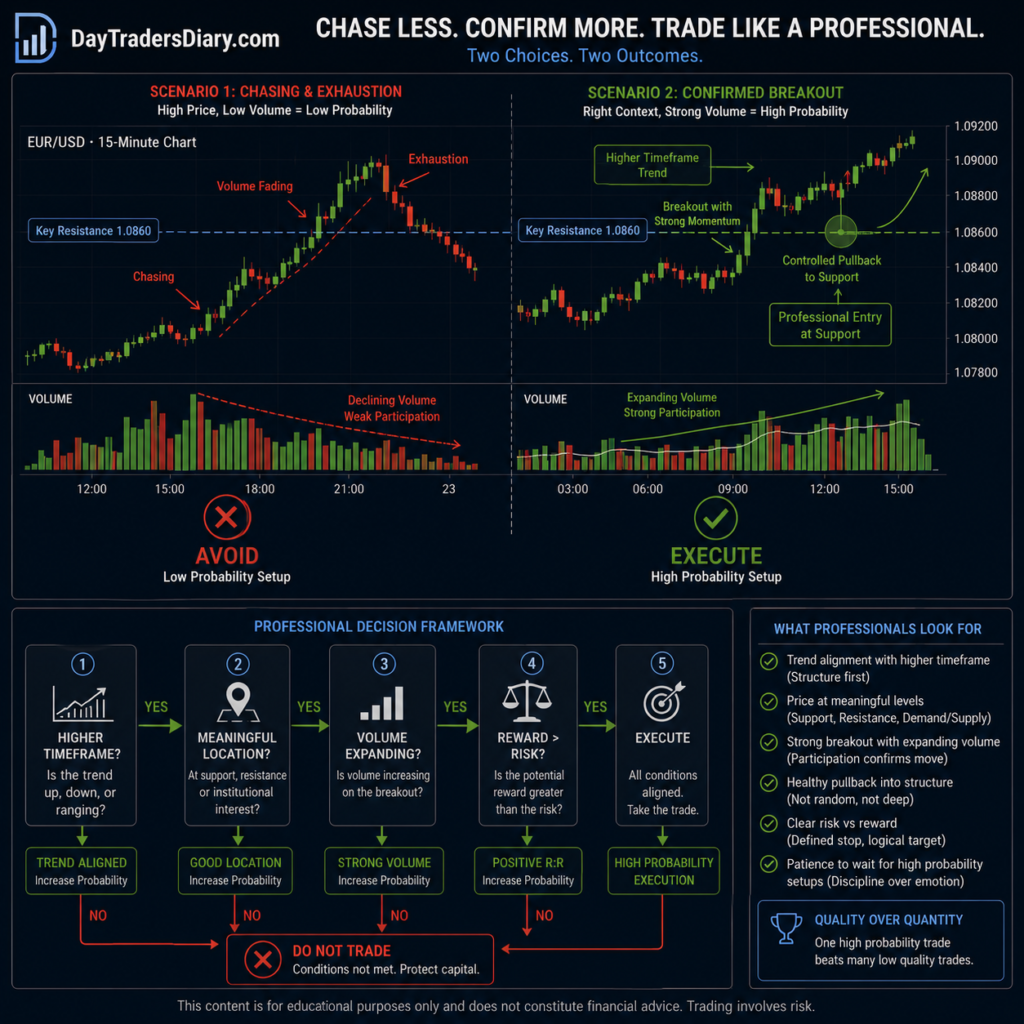
Before you take any trade on a 5 second chart, run thru five questions in your mind.
Is the higher timeframe in alignment?
Is the move happening in a meaningful location?
Are more people participating?
Is the reward still greater than the risk?
Would I still take this trade if the candles were slower?
The last question is quite powerful.
If you change your answer because the chart is moving fast, then emotion is driving the decision.
When Noise Looks Like Momentum
One deadly pattern keeps recurring.
Prices are rising.
Chasing traders
Volume cut .
The motion backtracks swiftly.
This is not all the time manipulation.
It might be fatigue.
Last chance for late entrants.
Early players start locking in profits
The result becomes a sharp reversal.
If you’ve previously read DayTradersDiary.com’s guide on identifying breakout exhaustion, you’ll notice the same principle applies here. Fast movement alone does not prove trend continuation.
Risk Management on Ultra-Fast Charts
Execution speed should never override risk discipline.
Indeed the shorter the time range the tighter risk control you require.
Traders often unknowingly increase position size since stops look smaller.
That creates hidden exposure.
A two-point stop with five times the position size often carries identical account risk to a ten-point stop.
This is where most traders miscalculate risk. Using the Position Size Calculator removes guesswork and ensures every trade risks a consistent percentage of your account, regardless of stop distance.
Consistency matters far more than tiny stop placement.
Build a Noise Journal
Most traders record winning and losing trades.
Very few records ignore trades.
That is a mistake.
Begin tracking situations where you correctly avoided poor setups.
Record why you stayed out.
Write what happened afterward.
Over time, these observations become your personal noise filter.
The downloadable Trade Journal Template on DayTradersDiary.com is an excellent place to document not only executed trades but also disciplined decisions to remain flat.
Many professionals discover that avoiding one poor trade often contributes more to long-term profitability than finding one exceptional entry.
Developing the Skill Through Deliberate Practice
Filtering noise is not a talent.
It is pattern recognition thru repetition.
Playing the market sessions at double speed is a good practice.
Stop before each entry.
Predict if the move is real intention or just transient randomness.
Then proceed with the re-play.
After hundreds of repetitions your brain starts to recognize subtle distinctions that are hard to describe but easy to perceive.
That hunch is not intuition.
Experience accumulated.
Why Better Execution Eventually Needs More Capital
Eventually, many disciplined traders reach an interesting point.
Their execution improves.
Their consistency improves.
Their account still grows slowly because position size remains limited.
This is one reason evaluation programs have become popular among experienced traders.
Firms such as The5ers, FTMO, and Trade The Pool allow traders to demonstrate consistent risk management before gaining access to larger trading capital.
The key is viewing these evaluations as professional assessments rather than shortcuts.
If a trader can’t filter noise on a 5-second chart, they won’t be able to filter noise on a 5-minute chart either.
First develop discipline and then prove your advantage. Once proven, you will frequently be able to properly manage more funds as a trader.
The5ers evaluation account is a good next step in your trading evolution if you’ve created a repeatable method and can execute it consistently not just putting more of your own funds.
The Psychology Behind Noise
The hardest part of noise filtering isn’t technological.
“It’s a very emotional thing.”
The human brain has evolved to respond to movement.
Quick graphs keep that instinct firing.
Every candle is in a hurry.
Professional traders learn to observe, instead of react.
Instead of asking, “What is this candle doing?”
They ask, “Does this change my original trade idea?”
Most of the time, the answer is no.
That single habit dramatically reduces impulsive trades.
Final Thoughts
The market does not reward traders who process the most information.
It rewards traders who process the right information.
The 5-second chart is an execution tool, not a prediction tool. Its value comes from precision, not constant activity.
Challenge yourself over the next twenty trading sessions to eliminate just one unnecessary trade each day. Review those decisions inside your journal and compare the results after a month.
You may discover that your biggest improvement does not come from finding better entries.
It comes from learning what deserves to be ignored.
For your next read, explore DayTradersDiary.com’s article on execution timing and trade management. It complements the concepts covered here and helps transform better market reading into consistently better trade execution.
Frequently Asked Questions
Is a 5-second chart too fast for most traders?
Not necessarily. The timeframe itself is not the problem. The challenge is making decisions without a higher timeframe context. Traders who use the 5-second chart only for execution generally perform better than those who use it for market analysis.
What is the best way to filter noise on a 5-second chart?
The best way is to combine higher timeframe bias, market structure, volume confirmation, session timing and rigorous execution. There isn’t one single indication that always gets rid of market noise.
Should I use indicators on a 5-second chart?
Yes, but only if they support a particular trading decision. More often than not, adding additional indicators results in conflicting messages rather than better execution.
Does volume matter on very short timeframes?
Definitely. The volume allows you to differentiate real participation from transitory price changes. A move on rising volume is usually more significant than a move on weak participation.
Why do I keep getting stopped out before the market moves?
Often this is because entries are based on short term price movements and not the longer marketcontext. Generally, multi-factor alignment is better for entry quality.
How should I practice filtering market noise?
Log your trading sessions and play them back often. Keep a journal of your trades and the quality situations you purposely passed up on. This develops pattern awareness over time and emphasizes careful execution.