
One of the quickest ways to blow up a small forex account isn’t choosing the wrong trade.
It’s trading the wrong position size.
I’ve seen traders with a $500 micro account lose 8% of their capital on a single trade because they misunderstood one simple concept.
Pip value.
They knew where to enter.
They knew where to place the stop-loss.
What they didn’t know was how much each pip was actually worth.
That mistake turned an ordinary losing trade into a major setback.
The irony is that traders with smaller accounts need to know the value of a pip better than anyone else. If you have limited capital, every dollar counts. An error of $5 on a $100,000 account is not important. It can totally affect your monthly results with a $300 micro account.
In this article, we’ll look at a simple way to compute pip value in micro accounts and why it’s more important than most novices think. We’ll also look at how experienced traders utilize it to manage risk instead of calculating profit and loss.
Why Pip Value Is More Important Than Most Traders Think
Many new traders believe that lot size determines risk.
It doesn’t.
Pip value determines how much price movement affects your account.
Research from the Bank for International Settlements (BIS) shows that the forex market trades trillions of dollars daily across participants using standardized risk models. Institutions don’t think in terms of “large” or “small” positions. They think in terms of exposure.
Retail traders should do the same.
Meanwhile, the National Futures Association (NFA) repeatedly emphasizes proper risk management and position sizing as core principles for retail forex traders.
For micro account traders, this means every trade should begin with one question.
How much is each pip worth?
Everything else comes afterward.
What Is Pip Value?
Most forex pairs have a pip as the smallest normal price movement.
For pairs quoted to four decimal places, one pip equals 0.0001.
For Japanese yen pairs, one pip equals 0.01.
Pip value informs you how much money you make or lose each 1 pip move in price.
It changes depending on:
The currency pair.
Your account currency.
The lot size.
Sometimes the current exchange rate.
Without understanding pip value, risk management becomes guesswork.
What Is a Micro Account?
A micro account is simply a trading account designed for smaller position sizes.
Instead of trading standard lots of 100,000 currency units, traders often trade micro lots.
One micro lot equals:
1,000 units of the base currency.
Because position size is smaller, each pip is worth less money.
That allows traders to participate in the market while keeping risk manageable.
Micro accounts are valuable because they allow traders to develop consistency before trading larger capital.
Understanding Lot Sizes
Before calculating pip value, it’s important to understand lot sizes.
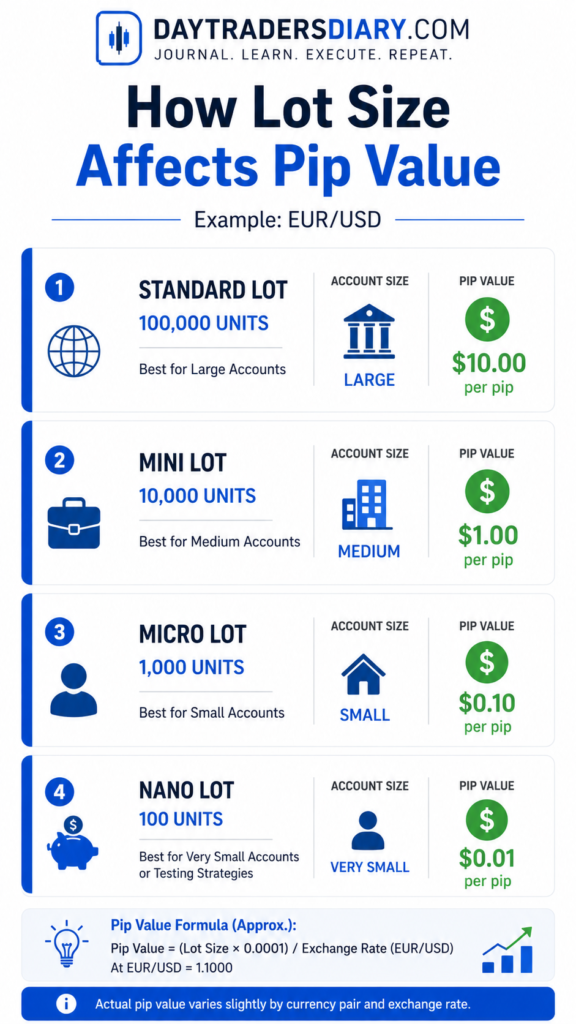
Standard lot = 100,000 units.
Mini lot = 10,000 units.
Micro lot = 1,000 units.
Nano lot = 100 units when offered by the broker.
The smaller the lot size, the smaller the pip value.
That’s why micro accounts are ideal for learning disciplined risk management.
How to Calculate Pip Value
For most forex pairs quoted in U.S. dollars, the calculation is surprisingly straightforward.
The basic formula is:
Pip Value = Pip Size × Position Size
For EUR/USD:
Pip size = 0.0001
Micro lot = 1,000 units
0.0001 × 1,000 = $0.10
Every one-pip movement is worth ten cents.
If the price moves twenty pips, the gain or loss equals $2.
The math remains simple, but its implications are significant.
Practical Example
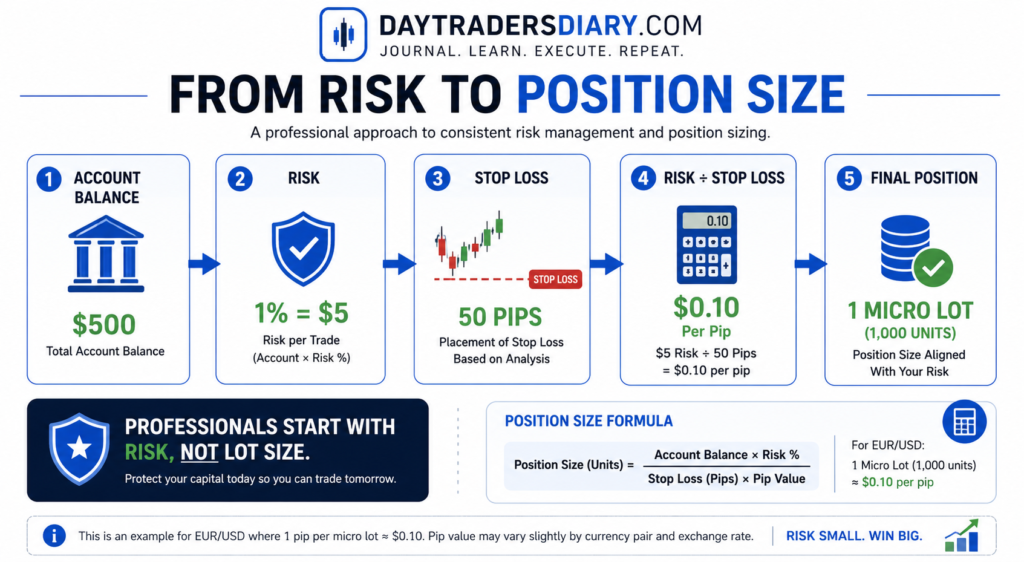
Suppose you have a $500 trading account.
You want to risk only 1% on a trade.
Maximum risk equals $5.
Your planned stop-loss is 50 pips.
Each pip should therefore represent:
$5 ÷ 50
= $0.10 per pip.
A single micro lot fits that risk perfectly.
Notice what happened.
The trade wasn’t determined by account size.
It was determined by acceptable risk.
Professional traders always begin with risk and work backward toward position size.
Why Different Currency Pairs Have Different Pip Values
Many traders become confused because pip values are not always identical.
For currency pairs where the quote currency matches your account currency, calculations remain straightforward.
Cross pairs often require currency conversion.
JPY pairs also use a different pip size because prices are quoted with two decimal places rather than four.
This is one reason experienced traders rely on calculators rather than perform manual calculations before every trade.
The goal is accuracy.
Not mental arithmetic.
Don’t Memorize Numbers
Many beginners try to memorize pip values.
Professionals rarely do.
The rates of exchange are ever-changing.
Currency conversions are different.
“Broker specs are different.”
However, the seasoned traders know the underlying notion.
First things first.
Second pip value.
Position size third.
That sequence remains consistent across all currency pairs.
Pip Value and Stop-Loss Placement
One of the biggest mistakes micro account traders make is adjusting stop-loss distance to match their preferred lot size.
This reverses the proper decision-making process.
Suppose technical analysis requires a 40-pip stop.
Some traders reduce the stop to 15 pips simply because they want to trade a larger position.
That increases the likelihood of being stopped out by normal market fluctuations.
Professional traders do the opposite.
They determine where the stop-loss logically belongs based on market structure.
Then they calculate the correct position size using the pip value.
If you’ve already explored our article on How to Calculate Position Size in Forex, you’ll recognize that stop placement and position sizing should never be treated as separate decisions.
Pip Value Is Really About Consistency
Small accounts often create emotional pressure.
Traders become obsessed with making more money per trade.
They increase lot sizes before their strategy justifies it.
One failed trade might wipe out weeks of gains.
The focus is on understanding pip value.
Rather than saying;
“How much can I earn?
You start to ask:
“How much do I want to shed?
That small change is a reflection of professional thought.
Use a Position Size Calculator Instead of Manual Math
Although every trader should understand pip value calculations, there is little reason to calculate them manually before every trade.
Markets move quickly.
Mistakes happen.
This is where the Position Size Calculator becomes one of the most valuable tools in your trading routine.
Enter your account size, risk percentage, stop-loss distance, and currency pair.
The calculator automatically determines the appropriate position size.
More importantly, it removes emotional decision-making from risk management.
Track Pip Value in Your Trading Journal
Many traders record profit and loss.
Fewer records the relationship between pip value and execution.
Your Trade Journal Template should include:
Position size.
Pip value.
Stop-loss distance.
Risk percentage.
Trade outcome.
Over time, you’ll discover whether your position sizing remains consistent across different market conditions.
You’ll also identify whether losses stem from poor analysis or inconsistent risk management.
That distinction is invaluable.
Why Micro Accounts Build Better Habits
Many traders see micro accounts as temporary.
Professional traders consider them training grounds.
Micro accounts teach:
Patience.
Discipline.
Position Sizing
Risk consistency
Emotional management.
Those skills are scalable.
Big lot sizes do not.
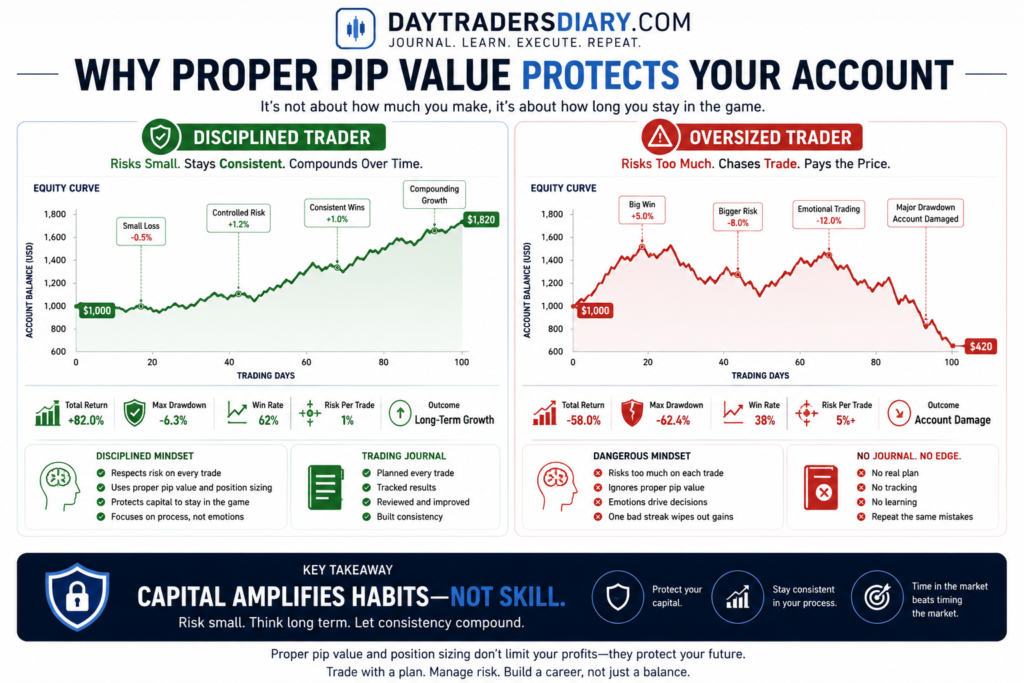
If a trader can not manage risk on a $500 account, chances are he will not manage it on a $100,000 account.
Capital amplifies habits.
It doesn’t improve them.
Scaling Beyond a Micro Account
Once you’ve demonstrated consistent profitability with disciplined position sizing, larger opportunities become available.
Many successful proprietary traders begin with small personal accounts before progressing to evaluation programs.
Firms such as The5ers, FTMO, and FundedNext place significant emphasis on disciplined risk management rather than aggressive returns.
A trader who consistently calculates pip value correctly, sizes positions appropriately, and respects predefined risk limits demonstrates exactly the type of consistency these firms seek.
If your trading journal shows stable execution over hundreds of trades, a The5ers evaluation account may provide a logical path toward managing larger capital without significantly increasing your personal financial exposure.
Final Thoughts
Learning how to calculate pip value isn’t about becoming better at math.
It’s about improving risk management.
Every successful trader eventually realizes that profitability begins long before pressing the Buy or Sell button.
It begins with understanding exactly what each pip means for your account.
The next time you prepare a trade, don’t ask how many lots you want to trade.
Ask how much one pip should be worth.
That single habit can protect your account more effectively than almost any indicator.
For your next read, explore our guide on How to Evaluate Your Day Trading Performance to learn how consistent position sizing influences long-term trading results.
Frequently Asked Questions
What is the pip value of one micro lot?
For most USD-based currency pairs, such as EUR/USD, one micro lot equals approximately $0.10 per pip. The exact value may vary depending on the currency pair and current exchange rate.
How do I calculate the pip value for a micro account?
Multiply the pip size by the position size. For most major currency pairs, a micro lot of 1,000 units produces a pip value of about $0.10 when the account is denominated in U.S. dollars.
Why does the pip value change between currency pairs?
Pip value depends on the currency pair, the account’s base currency, the lot size, and sometimes the current exchange rate. Cross pairs and JPY pairs often require additional calculations.
Should beginners use micro accounts?
Yes. Micro accounts allow traders to develop position sizing, risk management, and execution discipline while risking much smaller amounts of capital.
Can I calculate pip value manually?
Yes, but many experienced traders prefer using a position size calculator because it reduces errors and automatically adjusts for different currency pairs and account sizes.
How does the pip value affect risk management?
Pip value is the amount of money gained or lost for each pip the market moves. Having this number helps traders size their bets accurately and take the same percentage risk on every trade.