
Most traders do not fail because they lack a strategy.
They fail because they try to trade a small account like a hedge fund account.
A beginner deposits $200, opens oversized trades on GBPUSD or XAUUSD, and starts calculating how quickly the account can become $10,000. The focus immediately shifts from execution quality to emotional survival. One bad trade becomes revenge trading. Two bad trades become panic. Within a month, the account is gone and the trader starts searching for another “better strategy.”
The strategy was rarely the real problem.
The real issue was trading pressure created by unrealistic expectations and poor risk control.
This is where forex micro account trading becomes valuable. Not because it makes traders rich overnight, but because it teaches the skills most traders skip during the early stages of development.
A properly used micro account forces discipline, patience, and realistic execution habits. Those skills matter far more long term than finding another indicator combination.
This guide breaks down how experienced traders actually use micro accounts, where beginners misuse them, and how a small account can become the foundation for consistent day trading growth.
What Is a Forex Micro Account?
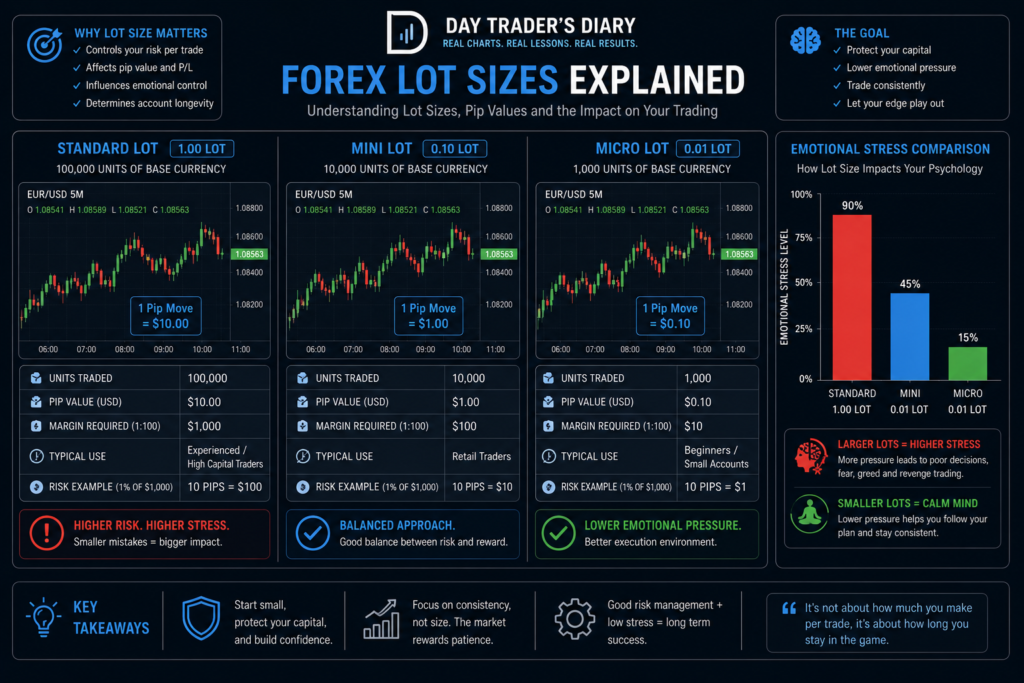
A forex micro account allows traders to trade smaller position sizes called micro lots. In most cases, one micro lot equals 1,000 currency units compared to the standard lot size of 100,000 units.
That difference makes all the psychological difference.
For EURUSD, one micro lot moves normally around $0.10 per pip. That implies traders can experience real market circumstances without subjecting themselves to enormous emotional swings.
The retail trading business generally encourages leverage and rapid growth. But data from the Bank for International Settlements shows that institutional order flow is the dominant force in the forex market, with retail traders making up a relatively tiny percentage of worldwide volume. Most retail losses originate from undue leverage and inconsistent execution, not lack of opportunity.
Research published by the Financial Conduct Authority in the UK also highlights that the majority of retail CFD and forex traders lose money primarily because of risk mismanagement.
For active day traders, this matters because micro accounts reduce emotional volatility while allowing live market participation.
That combination generates a far better learning environment.
Why Serious Traders Start Small
There is a huge gap between studying the fundamentals of trading and learning the discipline of execution.
Demo accounts are great for learning the platforms and testing methods, but they rarely show emotional flaws. “When real money is at stake, behaviour changes immediately.”
Traders are cautious.
They go away early.
They stay longer.
Revenge traded for losses.
Micro accounts provide controlled emotional exposure.
That’s why many experienced traders advocate trading little amount in the beginning even if larger capital is available. It’s not about being conservative. “It’s about scalable habits,
A trader who cannot manage risk on a $200 account will usually struggle with a $20,000 account too. More capital simply amplifies existing weaknesses.
The best forex micro account trading strategy is often not strategy-focused at all initially. It is process-focused.
Can you do the same setup over and over again for 30 trades?
Can You Hold Fixed Risk During Losing Streaks?
Can you try to prevent jumping into trades impulsively when volatility is high?
These are the real stages of development.
The Hidden Advantage of Forex Micro Accounts
Most new traders underestimate how important emotional conditioning is.
The market looks simple during winning streaks. The real challenge appears during drawdowns, missed setups, or periods where nothing seems to work.
Micro accounts help traders survive these phases long enough to improve.
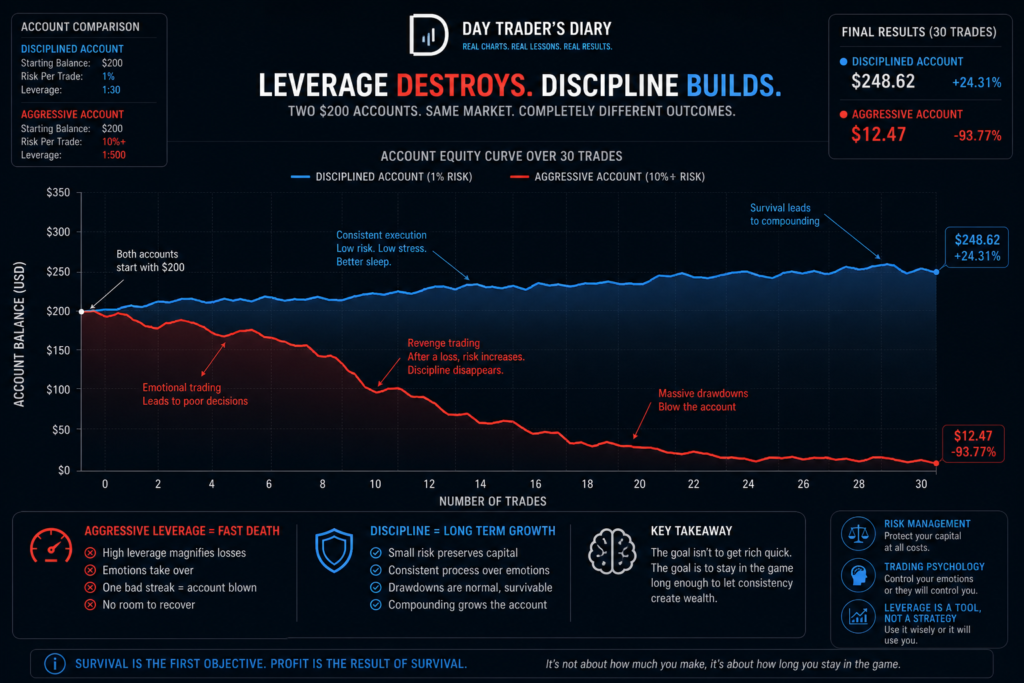
A trader risking $2 per trade thinks more clearly than a trader risking 30% of their account on one setup. Emotional pressure directly affects decision-making quality.
One thing experienced traders learn quickly is that consistency is built during boring periods, not during massive winning days.
For example, imagine trading London session breakouts on EURUSD using a small micro account. Your goal is not to double the account this week. Your goal is to execute properly:
You wait for market structure to confirm.
You pick where the stops make sense.
You gauge the trade accurately.
You make the plan without emotion to intervene.
Over time, that repetition establishes professional habits.
This fits nicely into what we address in our guides to day trading psychology and forex risk management over at DayTradersDiary. Consistency is regulated repetition, not flipping the account aggressively.
Building a Realistic Forex Micro Account Trading Strategy
Most beginners approach micro accounts incorrectly because they focus too much on profit size.
The better approach is to focus on trade quality and survival metrics.
A practical framework is to start trading one or two currency pairs. EURUSD and GBPUSD are good alternatives for liquidity, tighter spreads and steady intraday movement.
Do not move between many pairs, learn the behaviour of one market in depth.
Watch how EURUSD moves during London open volatility.
See how GBPUSD performs around important economic announcements.
Look at how fake breakouts tend to happen around the highs and lows of the prior session.
That type of screen time builds pattern recognition that the indicators alone cannot teach you.
Another important adjustment is lowering trade frequency.
Small accounts often tempt traders into overtrading because the dollar amounts feel insignificant. But bad habits built on small accounts usually remain when account size grows.
Professional traders think in percentages and quality of execution not in emotional thrill.
Why Risk Management Matters Even More on Small Accounts
The biggest mistake micro account traders make is believing small capital justifies oversized risk.
In reality, risk management becomes even more important.
A small account has less room to recover from emotional decisions. Losing 40% of a $200 account may seem minor financially, but psychologically it damages confidence and often pushes traders toward desperation behavior.
This is where proper position sizing becomes critical.
Most traders calculate trade size backwards. They decide how much money they want to make first, then force the position size to fit.
Experienced traders do the opposite.
They determine where the trade idea becomes invalid, place the stop logically, and then calculate the correct position size based on acceptable account risk.
Using a Position Size Calculator removes emotional guesswork from this process.
For example, if the market volatility calls for a wider stop during a high-impact news session, your lot size should automatically reduce. Many beginners do not do this and preserve the same position size under whatever settings.
That mistake becomes dangerous very quickly.
Micro Accounts and Trading Psychology
One overlooked benefit of forex micro account trading is psychological resilience.
A trader who survives multiple losing streaks while maintaining discipline gains something far more valuable than temporary profits. They gain emotional stability under pressure.
That stability becomes the foundation for scaling later.
You will eventually experience periods where your strategy underperforms. Every serious trader goes through this.
Micro accounts allow traders to experience adversity without catastrophic financial consequences.
This is why many funded traders still test new systems on smaller accounts before scaling them aggressively.
The account size may be small, but the lessons are not.
Journaling Small Trades Builds Big Improvements
Some traders stop journaling because the dollar amounts feel too small to matter.
That is a mistake.
The early stages of trading often reveal the clearest behavioral patterns because emotions are still raw and unrefined.
Don’t only track entries and exits
Emotional state of the pre-trade record.
Write down why you came in.
Snap some pictures of the market structure.
Evaluate whether the trade fit your goal or was emotionally driven.
Over time, patterns become obvious.
You may discover your best trades happen during the first two hours of London session. Or that most losses come from trading after frustration builds.
Using a Trade Journal Template speeds up this feedback loop significantly.
The traders who improve fastest are usually not the most talented. They are the most self-aware.
Scaling Beyond the Micro Account Phase
Eventually, disciplined traders encounter a different problem.
Skill starts improving faster than account growth.
At that point, the issue is no longer execution quality. It becomes capital efficiency.
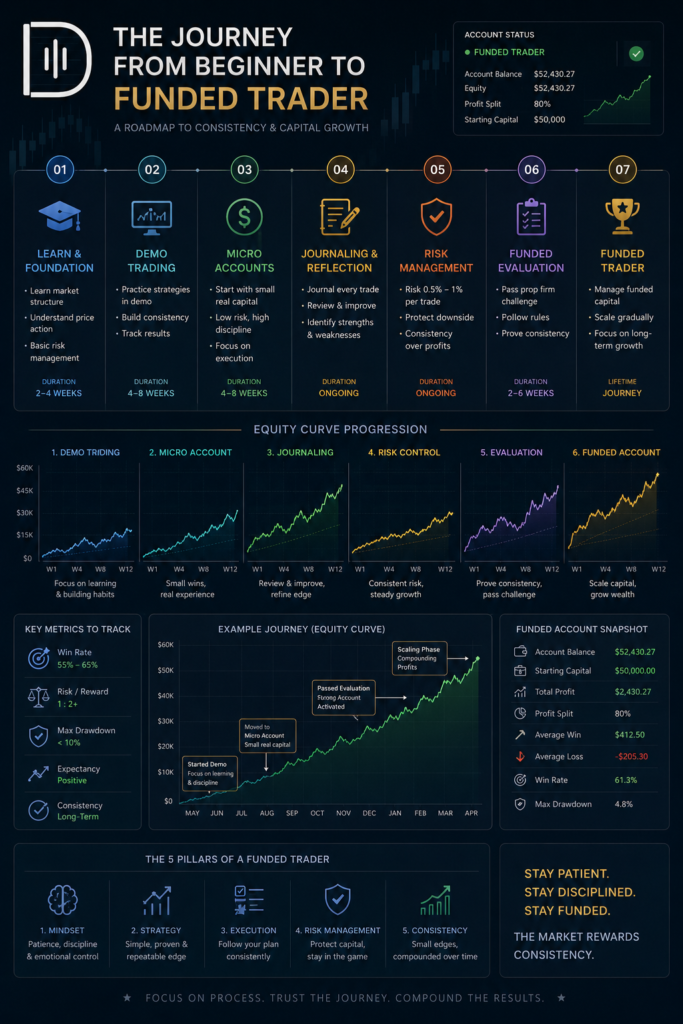
This is why many traders explore funded evaluation programs after proving consistency on smaller accounts.
Firms like The5ers, FTMO, and TradeThePool provide traders with access to larger capital while enforcing structured risk rules.
The important thing is understanding why professional traders use them.
It is not about gambling for a payout.
It is about leveraging already-developed execution skills without risking excessive personal capital.
The5ers in particular is more suitable for traders that are more focused on disciplined forex trading as opposed to aggressive short-term aims, due to its concentration on consistency and scaling.
If your journal is consistently performing over time and your risk management is already regulated, a paid evaluation can be a logical development and not an emotional shortcut.
The Real Purpose of a Forex Micro Account
A micro account is more than just a small trading account.
It’s a training environment for behaviour.
It teaches patience in an emotionally over-trading market.
It teaches survival before aggression.
Most importantly, it teaches traders how to think in probabilities instead of emotional outcomes.
The traders who eventually manage large accounts often started by learning how to respect small ones.
But for a practical challenge, try spending the following 30 trades focused exclusively on execution quality instead of profit targets.
Judge yourself by discipline, not by how your account is growing.
That one alteration forever transforms the way traders view the market.
As a next read, explore our guide on building a professional day trading routine and compare your current habits against traders who survive long term.
FAQs
What is a forex micro account?
Forex micro accounts allow traders to trade in lower lot sizes called micro lots, usually 1,000 units of currency each trade. It helps limit exposure and makes it easier for the newbie to trade live.
Is a forex micro account good for beginners?
Yup. Micro accounts are perfect for beginners as they allow them to experience the real market without the financial burden. Traders can practise execution, discipline and risk management without huge losses.
How much money do you need to start a forex micro account?
Many brokers allow traders to start with as little as $10 to $100. However, traders who want to practice proper risk management realistically often start with at least $200 to $500.
Can you make money trading a forex micro account?
Yes but consistency and skill growth should be the primary goal first. Small accounts can develop steadily over time if the risk is appropriately controlled.
What is the best forex micro account trading strategy?
Usually the ideal approach is to focus on controlled risk, consistency and good quality setups. Traders with micro accounts generally find simple price action, trend continuation and intraday breakout tactics to be effective.
Which currency pairs are best for forex micro accounts?
Popular picks are EURUSD, GBPUSD and USDJPY as they tend to have tighter spreads, good liquidity and cleaner intraday volatility.
Should beginners use leverage on a micro account?
Leverage should be used carefully. Excessive leverage is one of the main reasons retail traders fail. Lower exposure allows traders to survive longer and improve gradually.
Is a micro account better than demo trading?
For psychological development, yes. Demo trading helps traders learn platforms and test ideas, but live micro accounts expose emotional weaknesses that demo trading usually hides.
How long should traders use a forex micro account?
Traders should continue using micro accounts until they demonstrate consistent execution, disciplined risk management, and stable emotional control over a large sample of trades.
When should traders move to funded accounts?
Funded evaluations should only be considered after establishing a pattern over a number of months. Strong journaling, controlled drawdowns and repeated execution are better indicators than short term earnings.