
EUR/USD is sideways in the Asian session. London opens, Price finally breaks out; you get in expecting a strong move. All seems well for a time. Then momentum dies, Price begins to meander, and your trade fails to make headway.
Just when you begin thinking about closing, New York opens. Trading activity picks up, Price breaks the range again, and the move finally takes off.
If this sounds familiar, you may be overlooking an important part of day trading: the relationship between trading sessions.
Many traders focus on support, resistance, and entry signals but pay less attention to what happens when a new group of market participants becomes active. That change can influence how Price behaves, especially when London and New York are open at the same time.
This is where session momentum overlap becomes useful. It helps you understand when market activity may support a move and when a breakout needs more confirmation.
The key is not to trade every overlap. It is to recognise which conditions give your setup a reasonable chance of working.
What Is Session Momentum Overlap?
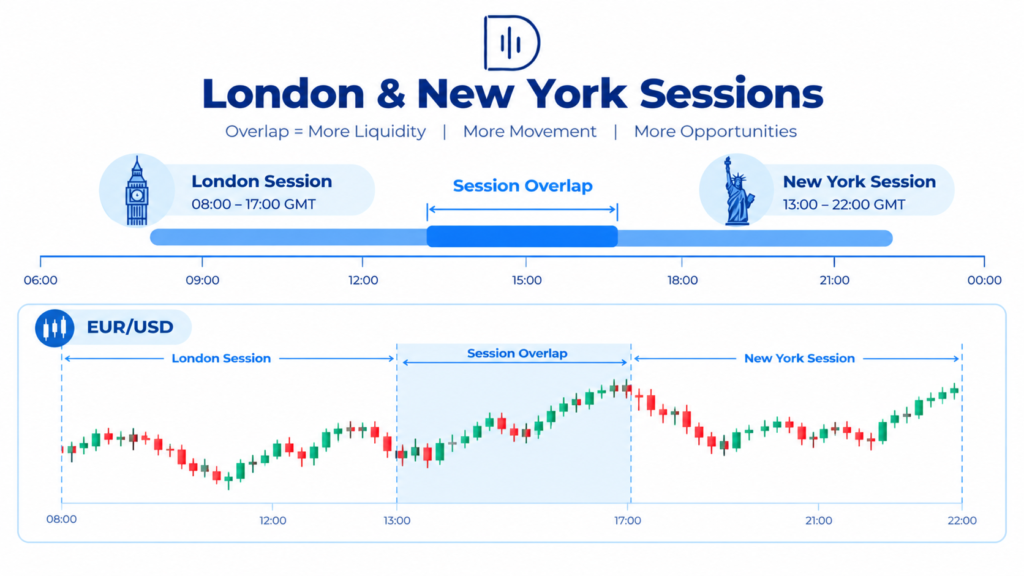
Session momentum overlap occurs when two major financial trading sessions are active at the same time. In forex, the London and New York overlap is one of the most closely watched periods because both centres play important roles in global currency trading.
During this period, market activity can increase as participants respond to economic data, existing positions, new orders, and price movements that developed earlier in the day.
But there is an important distinction: session overlap tells you when activity may increase, while momentum tells you how Price is moving.
The two are related, but they are not interchangeable.
A market can be active without developing a clear trend. Price might break above resistance, reverse below it, and continue moving sideways. In another situation, the same level might break and hold, followed by a steady move in the same direction.
Your job is to recognise the difference rather than assume that a busy session automatically creates a good trading opportunity.
Why Session Overlap Matters for Day Traders
The Bank for International Settlements reported average global forex turnover of $7.5 trillion per day in April 2022. The 2022 Triennial Central Bank Survey also showed the importance of the UK in global currency trading.
That helps explain why forex traders care about London activity. Market conditions are subject to change as market participants respond to new information and changes in prices. New York joins in, and London is still open.
The BabyPips guide to forex session overlaps provides a useful introduction to the main overlaps and their typical characteristics.
For practical trading, though, the important question is not whether a session is generally busy. It is whether your particular setup performs well during that period.
If London has established a definite path and New York continues it, a breakout plan may be a good idea. The same method may fail if New York opens with a rapid reversal or a large economic release produces chaotic price movement.
You need to understand those differences through observation and testing.
How to Assess Session Momentum Overlap
1. Start With What Happened During the Asian Session
Before London opens, take a few minutes to understand the market’s current condition.
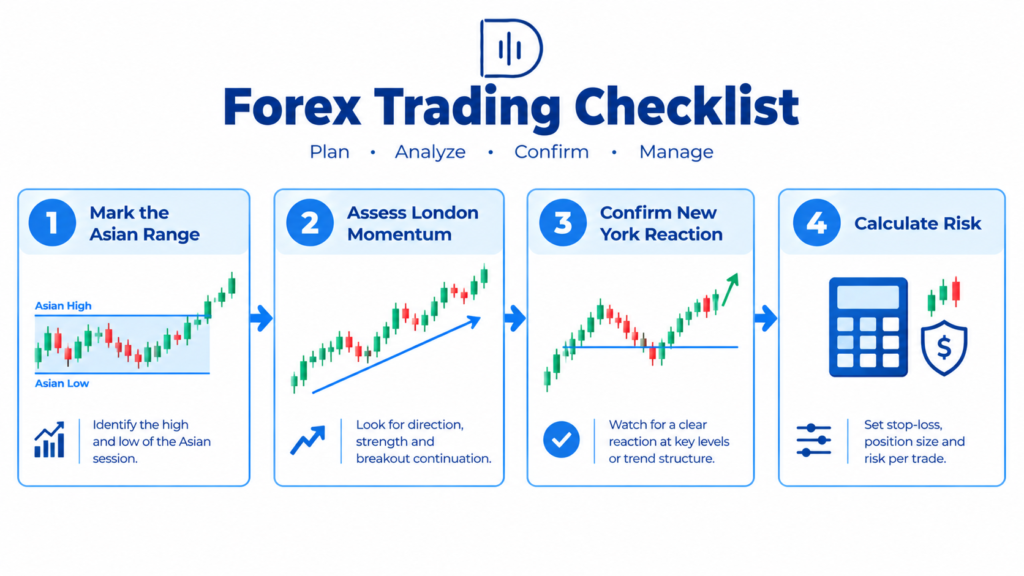
Mark the Asian session high and low, the previous day’s high and low, and any clear support or resistance levels. Then look at how Price has behaved.
Has EUR/USD been stuck in a narrow range? Has it already made a strong directional move? Or has Price repeatedly tested the same level without breaking through?
These details give you a starting point for judging what happens next.
For example, if EUR/USD has spent several hours trading within a tight range, a London breakout may be worth watching. If Price has already travelled a long distance before London opens, chasing another large candle could leave you entering near a short-term extreme.
The same breakout signal can mean different things depending on what came before it.
2. Watch How Price Behaves When London Opens
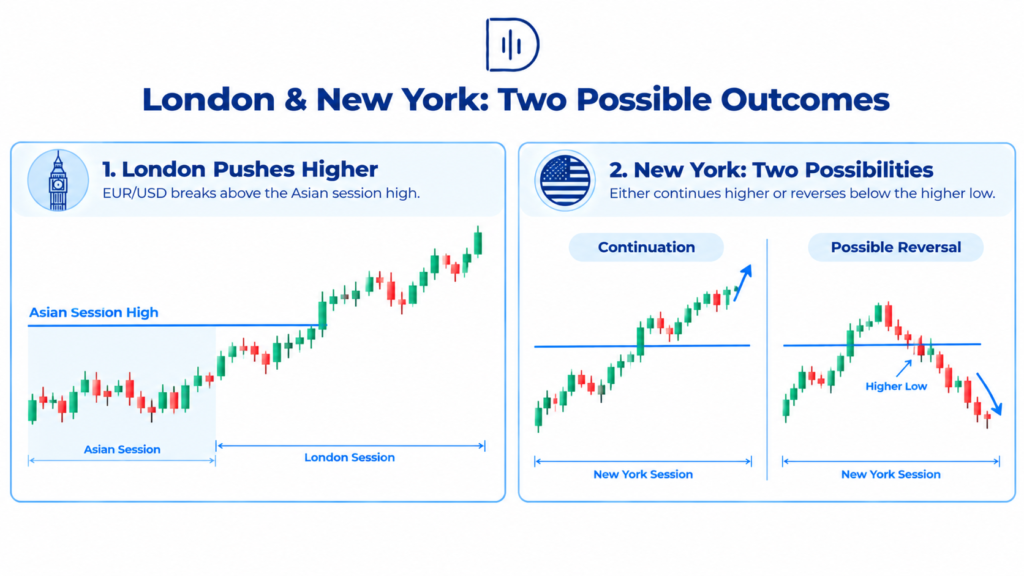
Suppose EUR/USD has been trading between 1.0800 and 1.0820 during the Asian session. London opens, and price breaks above 1.0820 with a strong candle close.
That is worth watching, but it is not an automatic buy signal.
If Price holds above 1.0820 and a pullback finds buyers, the breakout has stronger evidence behind it. You can then assess whether the next resistance level leaves enough room for a sensible trade.
Now imagine Price briefly reaches 1.0825 before dropping back below 1.0820. Buyers have not managed to hold the breakout area.
Instead of entering simply because Price crossed the level, you can wait for clearer confirmation or leave the setup alone.
This approach may mean missing some fast moves. That is part of trading with rules. You do not need to catch every breakout to build a consistent strategy.
3. Look for Confirmation When New York Opens
The London and New York overlap is particularly useful for observing whether an existing move continues or loses strength.
Imagine GBP/USD has been moving higher throughout London. As New York becomes active, Price makes another push upward but then breaks below a recent higher low.
That does not guarantee a reversal, but it tells you that the buying pressure may be weakening.
If your strategy depends on bullish continuation, you now have a reason to become more cautious. You might wait for Price to establish a new structure before considering another long entry.
On the other hand, if New York pushes Price above London’s high and holds that level, continuation may remain a reasonable scenario to evaluate.
Think of New York’s opening activity as new information, not confirmation that the London trend must continue.
4. Be Careful Around Economic News
Sometimes the strongest candle of the session is also the worst candle to chase.
US inflation data, employment reports, Federal Reserve announcements, and other important releases can cause sudden changes in currency prices. A breakout that looks convincing in the first few seconds may reverse once the market absorbs the information.
Before trading the overlap, check the economic calendar. Decide whether your strategy allows entries around major releases or whether you prefer to wait until the initial reaction settles.
A useful distinction is whether Price merely spikes through a level or manages to hold beyond it afterward.
A sustained move provides more information than the initial burst alone, although neither guarantees a successful trade.
Managing Risk During Session Overlap
Faster price movement can be attractive, but it can also create problems when your stop-loss and position size are not suited to current conditions.
Suppose your usual setup requires a 15-pip stop, but the current market structure calls for 25 pips. Keeping the same position size would increase the amount you stand to lose if the stop is hit.
Instead, calculate your position size using the actual stop distance and your chosen account risk.
The DayTradersDiary Position Size Calculator can help you work out an appropriate position size before entering.
Also, check how far Price has already travelled. If EUR/USD has broken the Asian range and moved close to the next resistance level, entering late may leave too little room for your target.
A strong move is not necessarily a good entry. You still need a clear invalidation level, acceptable risk, and enough potential reward to justify the trade.
Use Your Trading Journal to Find Your Best Session
It is easy to remember the London breakout that produced a large winner and forget the trades that failed during the same period.
A journal gives you a more honest picture.
Record the currency pair, session, Asian range, London direction, New York reaction, entry time, stop distance, and final result in R-multiples. Note whether Price continued in the same direction, reversed, or returned to its earlier range.
The DayTradersDiary Trade Journal Template can help you keep these observations organised.
After 50 to 100 trades, compare your results across different conditions. You might discover that your best trades occur when New York confirms a London breakout. Or perhaps you perform better when London creates the initial move, and you enter on a later pullback.
You may also find that your results deteriorate when you trade immediately before major economic releases.
These patterns are worth investigating, but do not assume a small sample proves an edge. Include spreads and slippage, and keep testing as market conditions change.
For more on reviewing your strategy, see How to Backtest a Day Trading Strategy.
Can Session-Based Trading Help You Scale?
Once you have evidence that your strategy performs consistently, you may start looking at ways to access more trading capital.
Prop firm evaluations are one possible option, but each firm has its own rules, fees, drawdown limits, and payout conditions. The5ers, FTMO, and TradeThePool offer different programs, so compare their current terms carefully.
Forex traders can explore the official The5ers website to see whether its current evaluation options suit their trading style.
An evaluation may be worth considering if you already have a tested session-based strategy and can follow your risk limits during both winning and losing periods.
It will not fix poor execution or turn an untested setup into a reliable one. Build the process first, then decide whether additional trading capital makes sense for your circumstances.
FAQs About Session Momentum Overlap
What is session momentum overlap in forex?
It is the time when the two main forex trading sessions are open concurrently. The extra activity could affect volatility and price movement, but it does not suggest a clear trend.
Which session overlap is best for day trading?
The London and New York overlap is popular among forex day traders because both markets are active. The best period for your strategy depends on the currency pair, setup, and results from your own testing.
How can I identify strong momentum during an overlap?
Look for decisive candle closes, breaks of meaningful price levels, follow-through, and an ability to hold beyond the breakout area. Compare the move with what happened earlier in the session.
Does session overlap guarantee a breakout?
No. The Price may trend, reverse, or stay range-bound. The overlap is a time window to watch, not a stand-alone entry signal.
Which forex pairs should I watch?
EUR/USD and GBP/USD are active during the London and New York overlap. Opportunities can also be available in USD/JPY. Focus on pairs whose spread, movement, and trading behavior suit your strategy.
Should I enter immediately when New York opens?
Not always. Need validation of your plan? Wait for Price to provide you with the conditions you need. Entering directly can expose you to fast reversals and news volatility.
Final Thoughts
The most common mistake with session momentum overlap is to think that the more active the market is, the better the trading opportunity will be.
What will the key be when the next session is underway? Does it extend the present move? Deny a breakout? Does it sit above a key level, or get quickly pushed back into the range?
For the next 20 trading sessions, focus on what happens when New York joins a market that has already been moving during London. Record the direction, the reaction around key levels, and your eventual trading results.
Do not change your rules after every loss. Give yourself enough data to identify which conditions genuinely suit your strategy.
Next read: Explore How to Measure Entry Delay Risk in Forex to understand how waiting for confirmation affects your entry timing and whether the delay improves your decisions or leaves too little of the move to trade.