
You enter a trade, price moves in your favour, and your account starts showing a nice profit. You tell yourself you will close when the move slows down. But when the first pullback arrives, you hesitate. You wait for a recovery, then another candle forms against you. Before you know it, most of your profit has disappeared.
If you have traded forex for a while, you probably know this feeling. The frustrating part is that your entry may have been perfectly fine. The problem was what happened after you entered.
Many traders spend hours improving their entries, but give very little thought to how they will get out. They enter with a target and stop-loss, then start changing both when the market behaves differently from what they expected.
An exit funnel system helps bring some order to that process. It gives you a set of conditions to follow as a trade develops, so you are not making every decision based on fear, hope, or the latest candle.
The idea is to protect yourself when the trade no longer makes sense, manage profits when the situation changes, and not close trades because a natural retreat makes you uncomfortable.
What Is an Exit Funnel System?
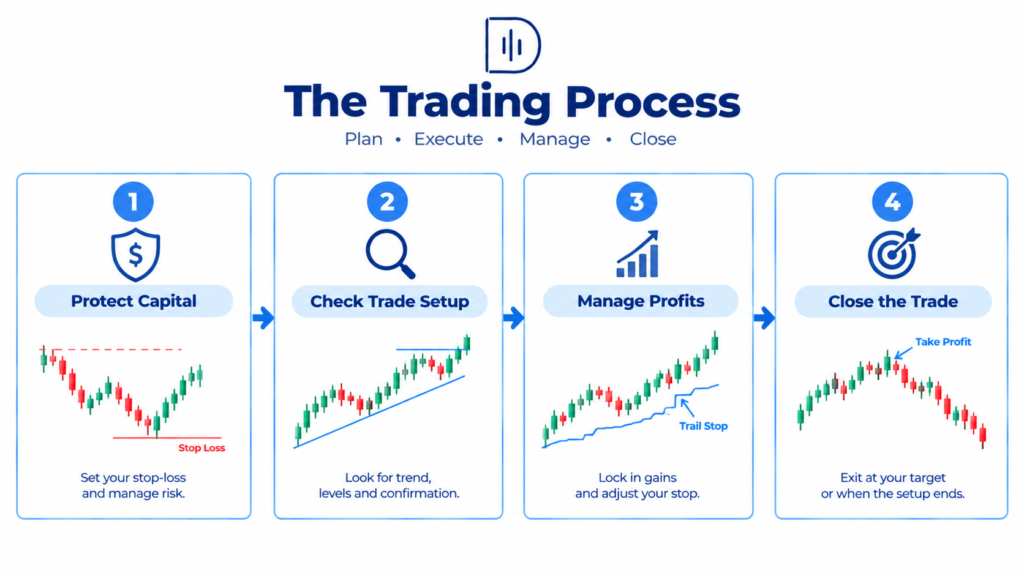
An exit funnel system is a step-by-step method for deciding when to hold, reduce, or close an open trade.
Instead of relying on one fixed exit signal, you evaluate the trade at different stages. First, you protect your capital. Then you check whether the original setup is still valid. If the price moves in your favour, you follow your profit-management rules. Finally, you close the position when your target or exit conditions are met.
Suppose you trade EUR/USD. Entry occurs when price breaks above resistance and retests it. You have a stop-loss below the trade structure and an initial objective around the next resistance.
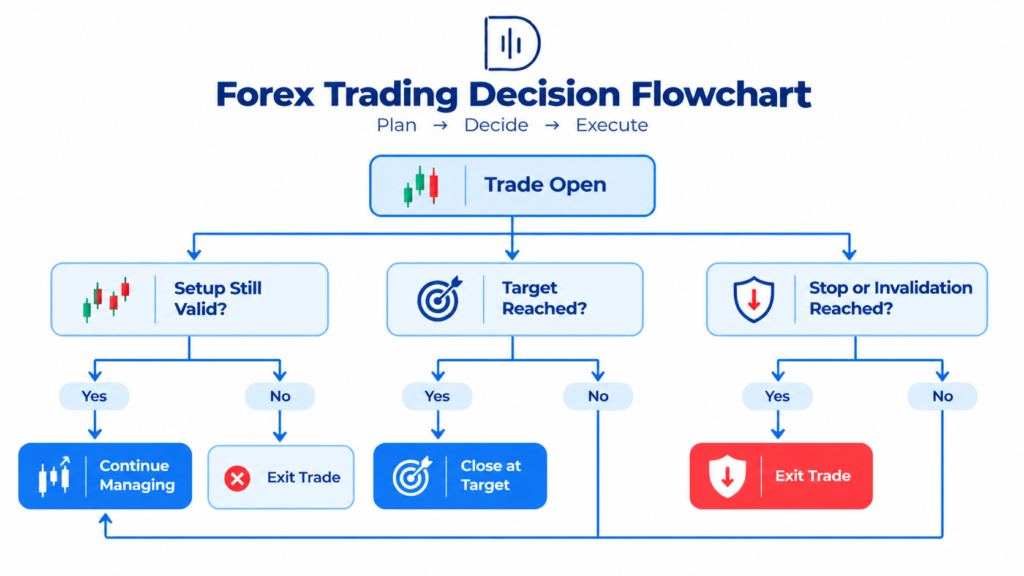
If the price continues higher, you may have a reason to hold. If it pulls back slightly but maintains its bullish structure, there may be no reason to exit yet. But if price breaks below the level that made your setup attractive in the first place, the situation changes.
That is the point of an exit funnel. You do not treat every candle as a new decision. You follow a process that tells you which information matters and what action to take.
How to Build an Exit Funnel System
1. Decide Your Exit Before You Enter
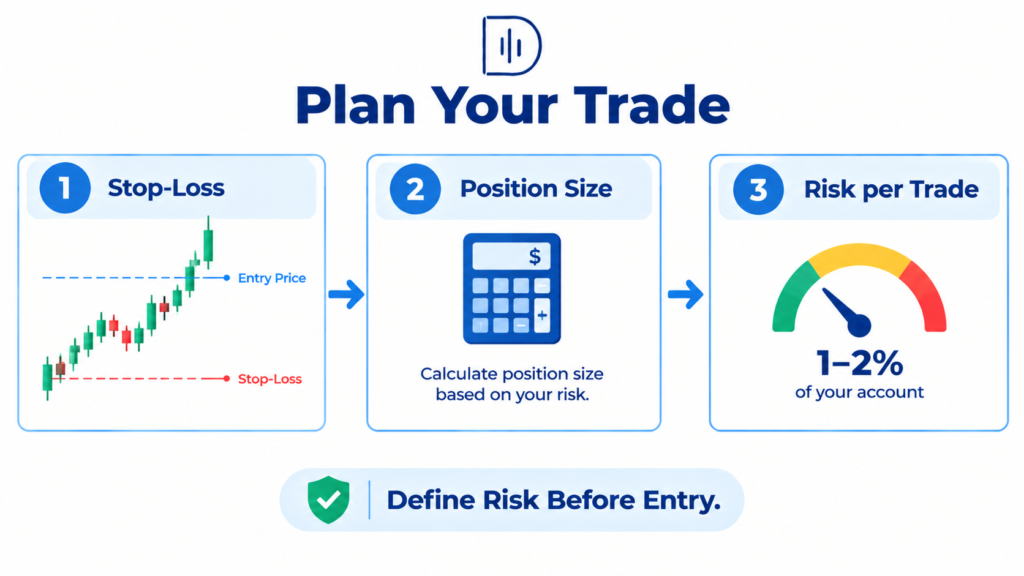
Before placing a trade, know where you will admit that the idea was wrong and where you expect the price to reach if things go well.
Suppose you buy EUR/USD at 1.0850. Your stop-loss is at 1.0835, while your target is 1.0880. You are risking 15 pips to potentially make 30 pips, giving you a planned risk-to-reward ratio of 1:2.
The exact numbers are not important. What matters is that your decision is based on the setup rather than your emotions.
If you wait until the trade is losing money to decide where the stop should go, you are more likely to move it out of fear. If you wait until you have a large open profit to decide when to exit, greed can influence the decision.
Write down your initial stop, target, and reason for closing before you enter. It gives you something objective to follow when the market starts moving quickly.
CME Group offers useful guidance on building a trading plan, including the importance of defining your trading rules in advance.
2. Check Whether Your Trade Idea Still Makes Sense
When the trade is on, your responsibility is not to respond to every price fluctuation. It is to establish whether the cause for entry still stands.
Think you bought gold following a bullish BOS. Price pushes higher, then pulls back to establish the next higher low. That retreat may look painful, but the bullish structure is still intact.
Now imagine price falls below the level that supported your setup and fails to recover. You have a different situation.
The mistake is treating these two situations the same way.
A small pullback is not automatically a reason to close. Equally, you should not hold a losing trade simply because you still believe the market will eventually move in your direction.
Decide ahead of time what price levels or conditions will void your setup. Then respect them when you arrive.
3. Manage Open Profits Without Rushing the Exit
This is where many traders struggle. They want to protect every pip of open profit, but they also want to catch a large move.
Let’s imagine your trade has hit 1R, which means an unrealized profit equal to your initial risk. You can close part of the position, move your stop according to a tested rule, or just let the trade alone till it meets your expected target.
Each choice has a trade-off.
Taking partial profits reduces your exposure, but it also reduces the amount you can make if the trend continues. A trailing stop can help you stay in a strong move, but it may close your position during a normal pullback. A fixed target keeps things simple, although the price may occasionally continue beyond it.
There is no single method that works best for every trader.
Choose an approach that fits your strategy and test it across a reasonable sample of trades. If you prefer trailing stops, our guide to building a pip-based trailing stop method can help you explore the idea further.
4. Know When It Is Time to Leave
A good exit rule should be clear enough that you can follow it without having to negotiate with yourself.
Suppose your target is reached, close according to your plan. If your stop-loss is triggered, accept the loss. If your strategy includes a time-based exit because a setup should develop within a certain period, follow that rule too.
Do not keep moving your target because you think the market might offer more. Do not close early every time a profitable candle turns red.
Of course, there are situations where market conditions change unexpectedly. Your plan can account for those situations, but the rules should be established before they happen.
The goal is not to remove every decision from trading. It is to stop making important decisions impulsively.
Risk Management: Make Your Exit and Position Size Work Together
Your exit plan cannot be separated from your position size.
A stop that is too tight may close your trade during ordinary market noise. A wider stop may give the setup more room, but it also increases the amount you could lose if you keep the same position size.
This is where many traders miscalculate risk. They choose a lot size first and then try to fit the stop around it.
A better approach is to identify the level that invalidates the trade, calculate the stop distance, and then determine the appropriate position size.
The DayTradersDiary Position Size Calculator can help you work through that calculation before placing an order.
Also, remember that a stop-loss does not guarantee an exact exit price. During fast markets or major news events, slippage can make the actual loss larger than expected. Your risk plan should account for the possibility of imperfect execution.
Research and What It Means for Traders
Two useful starting points are the CME Group’s trading education resources and the SEC’s investor education guidance on day trading.
CME Group’s educational material emphasises planning trade decisions and understanding how positions behave. For an active trader, that means deciding how a position will be managed before the pressure of a live trade begins.
The SEC advice underscores the risks of quick trading and leverage. In practice, a bad exit can do more than only take away profit from a single deal. Repeatedly holding a losing position, or adding to a position in an attempt to recover losses, can wipe out an account very quickly indeed.
Neither resource indicates that a certain exit funnel is profitable. This has to be determined by testing. These are valuable because they stress the necessity for a clear approach, regulated exposure and an honest awareness of what might go wrong.
Use Your Trading Journal to Improve Exits
You may feel that you are closing winners too early, but your journal might reveal something different. Perhaps you exit early only during certain sessions, or perhaps your trailing stop is too tight for the pairs you trade.
Without records, these patterns are easy to miss.
For each trade, record your original target, stop-loss, exit price, reason for closing, and result in R-multiples. Also record the maximum favourable excursion (MFE), which shows how far the price moved in your favour, and the maximum adverse excursion (MAE), which shows how far it moved against you.
After 50 or 100 trades, look at your exits and see if they followed your rules. Average winner, average loser, and total expectancy. Compare. Trading expenses need to be factored in so you are assessing the actual outcome, not an idealized one.
The DayTradersDiary Trade Journal Template can help you organise these details and identify areas that need attention.
Do not change your entire exit strategy after two losing trades. Look for a consistent pattern before making adjustments.
Can a Better Exit System Help You Scale?
Once you have a strategy with a tested exit process, you may start thinking about trading with more capital.
Prop trading evaluations are one possible route, but they come with their own rules and financial considerations. The5ers, FTMO, and TradeThePool offer different programs, instruments, and trading conditions, so compare the specific terms rather than assuming they are interchangeable.
You can explore the official The5ers website to review its current evaluation options.
For a trader who already adheres to risk limits and manages exits consistently, an evaluation may provide a way to gain access to a larger trading allocation without relying entirely on personal trading capital. However, fees, drawdown restrictions, payout conditions, and the possibility of failing the evaluation all matter.
If you keep moving your stop every time a trade goes against you, then adding to your available capital will not fix that behavior. First show that your procedure is valid, and then consider whether an evaluation is appropriate to your situation.
FAQs About Exit Funnel Systems
What is an exit funnel system in forex?
This is a systematic strategy to handle an open trade in various steps, including initial risk control, setup evaluation, profit management, and closing the position.
Is an exit funnel better than a fixed take-profit target?
There is no need. A simple fixed-target test. An exit funnel is more flexible but requires explicit guidelines to avoid emotional decisions. Compare the two with your own trading outcomes.
Should I take partial profits during day trading?
Taking partial profits can lessen exposure and make it easier to keep the remaining investment. But they also limit possible rewards if the price proceeds to your full target. Test whether the method improves your total expectancy.
When should I move my stop-loss to breakeven?
Move it only when your tested rules warrant it. Moving a stop too soon can close a healthy trade during a natural decline. When is the right time? Well, that depends on your setup and market conditions.
How do I know if my exit strategy is working?
Track your realized R, average winning and losing trades, MFE, MAE, drawdown & how often you follow your guidelines. Look at a substantial sample of deals, and don’t judge performance on a few trades.
Can an exit funnel help me pass a prop firm evaluation?
Having a consistent exit strategy might help you minimize exposure and follow drawdown criteria. And it can’t guarantee that you will pass. You must consider the specific trading constraints of the firm.
Final Thoughts
A trade does not end when you click the buy or sell button. In many cases, what you do after entering has just as much influence on your results as the entry itself.
An exit funnel gives you a clear way to manage that part of the process. You know when to protect your capital, when to let a trade develop, and when to accept that the opportunity has passed.
For the next 20 trading sessions, try one simple exercise: write down your exit conditions before every trade and record whether you followed them. Do not worry about making every exit perfect. Focus on making your decisions consistent enough to review honestly.
Next read: Explore How to Find High-Probability Setups and look at how your entry criteria and exit rules can work together to create a more disciplined trading process.