
Day trading forex is the use of a strategy that defines how the forex trader opens and closes their positions within the same trading day.
🔗Day Trading Explained: A Complete Beginner-to-Advanced Guide
Without such a strategy, some decisions might be based on feeling, results from the last trade, or a recent article. As such, your entries will be inconsistent, and your risk per trade will drift.
Picture a trader who tries a breakout on Monday, loses twice, and is then scalping by Wednesday. By Friday, both are dropped for a moving average system. The only problem is that none was tested on more than a few trades, so the results are not very meaningful.
🔗Day Trading Psychology: How to Stay Disciplined
In fact, all methods depend on surrounding conditions. Therefore, a setup may or may not play out depending on the pair, session, and risk plan. So the real work is in aligning an approach to those conditions, setting the rules, and testing for long enough.
Two traders can view the same chart and need different approaches. So how does a trader decide which one is suitable? It is contingent upon what market they want to watch, how much time they have, and how experienced the trader is. And trading only the morning would offer a different set of options than trading the overlap in the afternoon.
There are 7 widely discussed strategies in trading education. This guide takes a look at each of these forex day trading strategies in turn. Each relies on a different type of market behavior. And each is likely to fail without that behavior.
Entry criteria are only one aspect of many that need to be considered. Trading costs include the spread, commission, and slippage, and will be affected by the size of the position that you take in each trade. For funded account traders, daily loss limits add another layer of rules to respect each day.
🔗Best Forex Broker for Full-Time Trading: Spreads, Costs & Execution Ranked
Main Points Covered
- An explanation of what forex day trading is and why it is a trading style, not a strategy
- Popular trading methods used by forex traders today, including trend following, breakouts, and more
- The impact of trading sessions and other factors on spreads and execution
- How to calculate position size and set risk limits for each trade
- How a personal daily stop and a session routine help traders work within funded account rules
What Is Forex Day Trading?
A position closed before the day ends cannot be hit by a weekend gap. That is the core of forex day trading: opening and closing positions within one trading day. On the other hand, it leaves less time for a trade idea to develop.
A Trading Style, Not a Strategy
Two traders may close every EUR/USD position before New York closes, yet trade nothing alike. One buys pullbacks in a trend, while the other fades moves at range edges. So what is forex day trading, if not a method? It is a trading style defined by holding time, not by any entry rule.
Does the PDT Rule Apply to Forex?
Many traders still expect a $25,000 minimum before day trading. Does the pattern day trader rule apply to forex? No: that designation came from FINRA Rule 4210, which covered US securities margin accounts. US spot forex falls under the CFTC and NFA. Also, the SEC has approved the declassification of the PDT, effective from June 4, 2026.
Trend, Momentum and Breakout Strategies
Traders rarely share a favorite setup. What are the most widely used forex day trading strategies? The most popular strategies are trend, momentum, breakout, scalping, range, mean reversion, and news-based. The first three involve a commitment of price to a direction.
Moving Average Crossover
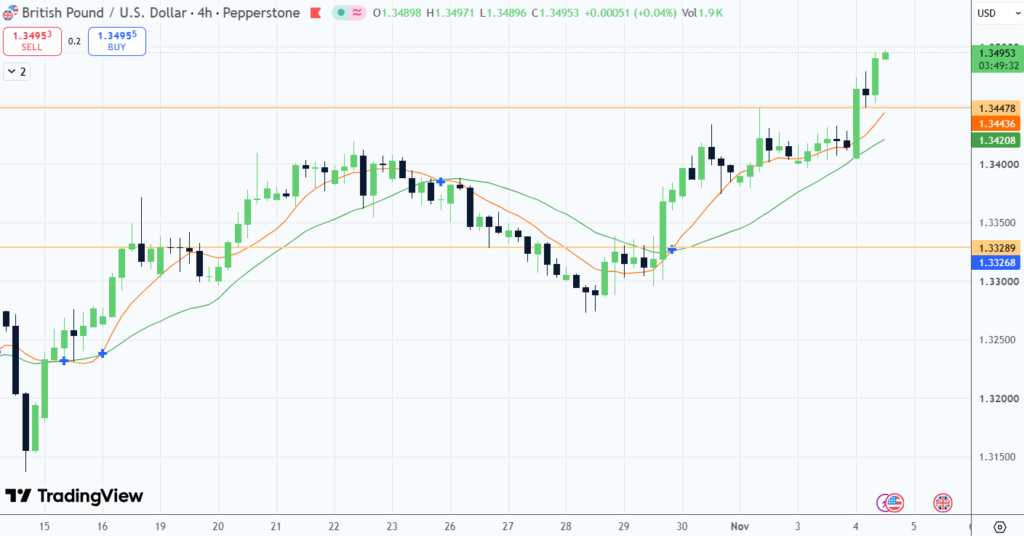
Two moving averages are a common starting point. What is the easiest day trading strategy for beginners? Usually trend following, though simple doesn’t mean profitable. How does a moving average crossover strategy work? A 5-period MA crossed with a 20-period MA can show a reversal in momentum but can be misleading in sideways movements.
🔗How to Use Moving Averages in Day Trading
More frequent trades make one incur the cost of transactions, which becomes pertinent in evaluating various trading techniques. The number of trades serves as an indicator that differs from trader to trader.
Forex Day Trading Strategies at a Glance
| Strategy | Main Idea | Illustrative Trades per Day |
| Trend trading | Follow the prevailing direction | 2–5 |
| Momentum trading | Trade strong directional movement | 3–8 |
| Breakout trading | Enter beyond established price levels | 1–3 |
| Scalping | Seek small movements through frequent trades | 20–50+ |
| Range trading | Trade between support and resistance | 3–8 |
| Mean reversion | Trade potential returns toward an average | 3–6 |
| News trading | Trade around economic announcements | 1–3 |
Breakout Trading Strategy
A clean break above resistance can still reverse within minutes. What is breakout trading? Traders enter when price closes outside of support or resistance with a stop inside the range. What is the most profitable forex day trading strategy?
🔗How To Isolate Breakout Surges
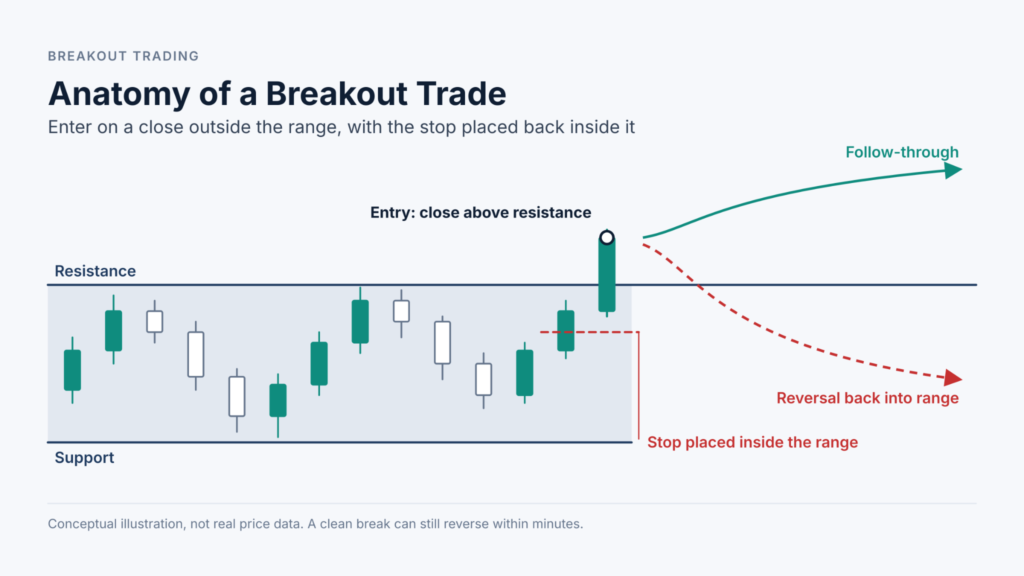
There is no one most profitable strategy; session, pair, and rules of risk all change results. Range methods tend to be the best when breakouts don’t happen.
🔗What Does Liquidity Sweep Look Like On Chart
Scalping, Range and Mean Reversion Strategies
A four-pip target sounds quite easy, but then half of that is taken up by the spread. Scalping, range trading, and mean reversion do not need large moves. But smaller targets mean every cost cuts deeper.
Scalping Strategy
Some scalps last seconds. What is scalping in forex? It means placing many short trades that aim for a few pips. What timeframe is best for forex day trading? Scalpers study 5- and 1-minute charts. Trend traders review hourly charts. Spreads kill scalps.
🔗What Time Frames Do Day Traders Use?
Common Indicator Settings for Day Traders
| Indicator | Illustrative Setting | Main Purpose |
| Moving average crossover | 5-period and 20-period SMA | Identify potential directional changes |
| Stochastic oscillator | 14 periods; 80/20 levels | Identify potential momentum extremes |
| RSI | 14 periods; 70/30 levels | Evaluate relative momentum |
| ADX | Above 25 | Assess trend strength |
| Bollinger Bands | Two standard deviations | Evaluate price relative to volatility bands |
Values of indicators serve as a reference for the analysis; however, their usefulness depends on the currency pair and the time frame used.
🔗Best Indicators for Day Trading
Range Trading and Mean Reversion
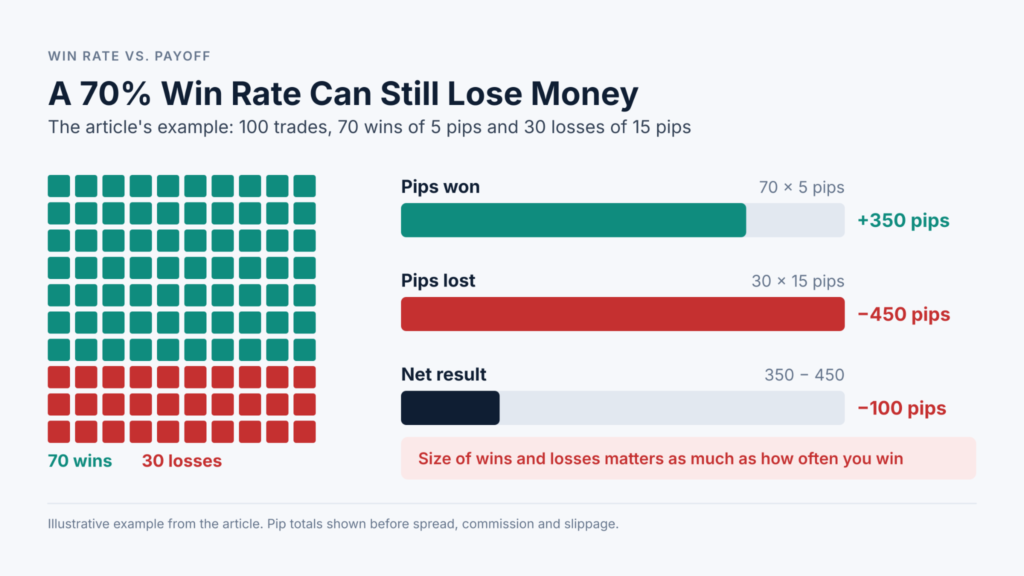
Sideways markets call for different logic. What is range trading? Buying support and selling resistance in a sideways market. What is mean reversion in forex? A bet that stretched prices return toward an average, judged with RSI or Bollinger Bands. Does a high win rate mean a good strategy? No, because the size of the wins and losses is as important as the number of winning trades. You could win 70 times 5 pips and lose 30 times 15 pips and be net negative.
🔗How to Use Pivot Points in Day Trading
The Best Time to Day Trade Forex
A nice morning breakout can die out by evening. The liquidity, volatility, and spreads fluctuate whether the center is open or closed, and many breakouts fail after the close of New York. Applying the same rules across sessions will show whether timing is the problem.
🔗How to Track Win Rate by Session
The London – New York Overlap
EUR/USD at 9 a.m. in New York is not the same as EUR/USD at midnight. When is the best time for day trading forex? There is no best session. Many traders love London and the overlap with New York, from around 8:00 a.m. to noon ET. The extra activity also helps break ranges.
🔗How To Assess Session Momentum Overlap
Forex Sessions and Matching Day Trading Methods
| Session | Typical Conditions | Methods That May Fit |
| Asian session | Often quieter, depending on the currency pair | Range trading, mean reversion |
| London session | Often higher activity in European currency pairs | Trend trading, breakout trading |
| London–New York overlap | Often elevated liquidity and volatility | Momentum, breakout, scalping |
The trading session affects market operations, but the specific pair of currencies and economic news may alter the regular conditions for trading. The overlap shifts temporarily when the USA and the UK change their clocks on different dates.
🔗How to Trade London Session for Day Traders
News Trading and Spreads
Seconds after a major data release, a quote can jump several pips. Are news trades good for day traders? They can offer fast moves, but it gets hard as spreads widen and orders move in the run-up to data releases such as the Nonfarm Payroll report. The scalpers using them incur unexpected expenses. That is why the majority of traders analyze the economic calendar and formulate their trading rules.
🔗How to Trade the New York Session
Risk Management for Day Traders
Good days vanish fast. Can you make $100 a day trading forex? There is no strategy for a fixed daily income, and losing days are normal. Going for a set amount results in oversizing.
🔗Best Money Management Tips for Day Traders
The 3-5-7 Rule
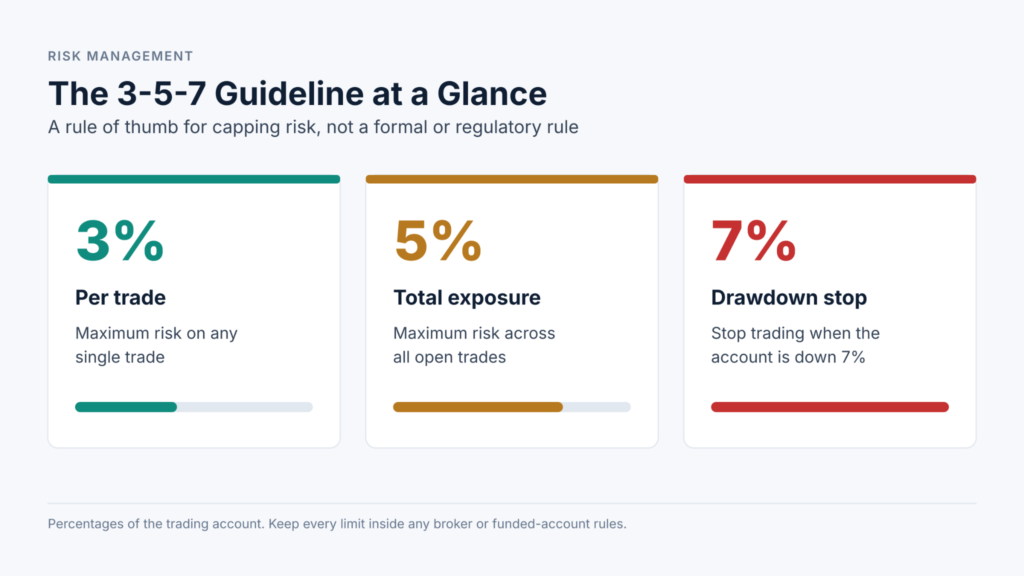
Fixed percentages help. What is the 3-5-7 rule in day trading? This guideline, not a formal rule, sets the limit of risk at 3% per trade and exposure at 5%, stopping at a 7% drawdown. Is forex day trading profitable for beginners? It has the potential, but in fact most retail accounts end up out of pocket, so a beginner should expect to be starting out small and practising first. In its 2018 review, ESMA found that 74–89% of retail CFD accounts lose money.
Position Sizing per Trade
Confidence-based sizing inflates losses. How much should I risk per trade when day trading? A fixed amount or percentage within loss limits. How do you calculate position size for a day trade? Position Size = Risk Amount ÷ (Stop Distance × Pip Value). The table below runs the numbers.
Position Size Calculation
| Item | Illustrative Value |
| Currency pair | EUR/USD |
| Planned risk | £100 |
| Stop-loss distance | 20 pips |
| Pip value per standard lot | Approximately £7.70 |
| Formula | £100 ÷ (20 × £7.70) |
| Position size | Approximately 0.65 standard lots |
Position sizing is the relationship between the stop-loss distance and the amount of money that is at risk, which helps traders keep risk relatively consistent across trades. The value per pip is determined by the account currency, exchange rate, and instrument characteristics.
Day Trading Strategies in a Funded Account
Even with an effective strategy, a funded account can be flushed in an afternoon. Most programs have an overall maximum loss and a daily maximum loss, and exceeding either often spells the end of the account. Sizes often need to be reduced due to differences in calculation methods and news policies from firm to firm.
A Personal Daily Stop
After four straight losses, many traders want just one more position. Can I day trade a funded account without a daily stop? Yes, technically, but one bad session can violate the firm’s daily limit and close out the account. A personal stop inside the firm’s limit cancels the session early.
🔗How to Manage Daily Loss Limits in Forex
Personal Daily Stop in a Funded Account
| Item | Illustrative Value |
| Account size | $100,000 |
| Maximum daily loss limit | $5,000 |
| Personal daily stop | $3,000 |
| Risk per trade | $500 |
| Risk per trade as account percentage | 0.5% |
| Consecutive full-risk losses reaching personal stop | 6 |
Most traders have a maximum loss per day, but we personally set a stop below that to leave room for execution cost and unexpected market movement against us. All values are for illustrative purposes only and do not represent the rules of a particular funded account provider.
Reviewing Each Session
It shouldn’t take a bad week to start one, since memory is such a lousy record. In a trading journal, every trading session gets documented on account of entries, exits, risks, the session that has been traded, and rule adherence. In the long term, it will help one determine whether their losses were due to the above factors. A short routine before each session keeps records consistent.
A Day Trading Routine Before Each Session
- Calendar: Review scheduled economic announcements and identify high-impact events.
- Session: Confirm the trading hours selected for the strategy.
- Strategy: Check that the setup meets the written entry requirements.
- Size: Calculate position size using the planned risk and stop distance.
- Stop: End trading when the personal daily loss limit is reached.
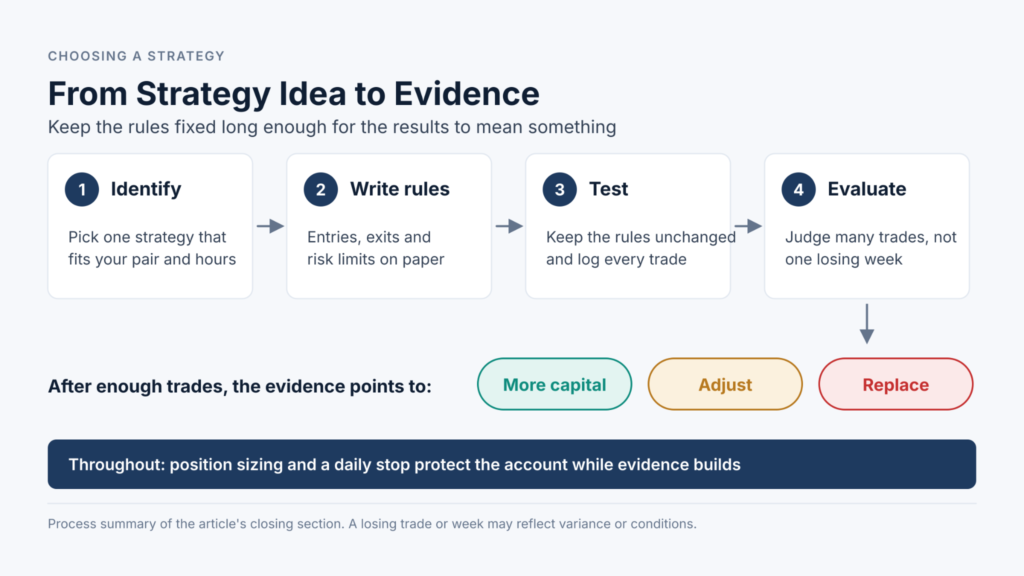
Choosing One Day Trading Strategy and Sticking to It
Entry signals are usually the easiest aspect of a strategy to learn. The strategy also needs to suit the pair you are trading, the hours you have, and the conditions of those hours. There must also be risk limits to cap the daily damage.
Testing is possible with consistency. With the rules unchanged, a trader can evaluate lots of trades and understand the impact the method has. A losing trade or even a losing week doesn’t mean the strategy is broken. It may be just variance or bad conditions.
🔗How to Evaluate Your Day Trading Performance
In other words, identify a strategy, describe the rules, and test it. Everything comes down to a realistic evaluation of every trade in the end. While this evidence builds up, proper position sizing and daily stops protect the account. A sufficient number of trades will indicate if the strategy merits more capital, adjustment, or replacement.