
Most traders spend thousands of hours staring at charts.
Very few spend enough time improving how they think.
That imbalance is one reason so many traders plateau.
Eventually, nearly every active trader reaches a point where simply studying more chart patterns stops producing meaningful progress. You already know support and resistance. You understand risk-reward ratios. You can identify trends and pullbacks.
Yet consistency remains frustratingly difficult.
The reason is simple.
Trading performance is not built entirely from chart analysis.
It comes from decision-making, market understanding, risk management, psychology, and experience.
The challenge is that experience takes years to accumulate.
One of the fastest ways to accelerate that process is by learning from traders, portfolio managers, economists, and market professionals who have already lived through multiple market cycles.
This is where podcasts become incredibly valuable.
A good trading podcast allows you to absorb lessons during your commute, workouts, walks, or downtime. More importantly, it exposes you to perspectives that most retail traders never encounter.
The goal is not to find someone who gives trade signals.
The goal is to improve how you think about markets.
In this guide, we’ll explore the best forex podcasts for day traders and explain how to use them as a serious part of your trading development process.
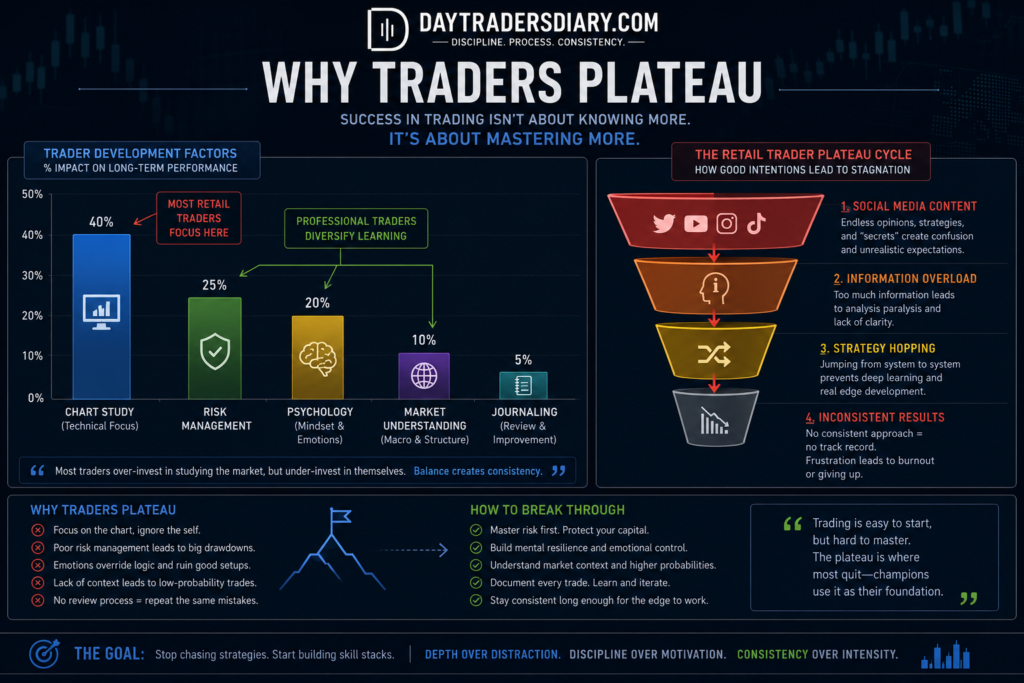
Why Most Traders Consume the Wrong Content
Many traders spend their learning time watching social media clips.
The problem is that short-form content often rewards entertainment over education.
You’ll find plenty of videos promising:
Winning techniques 100%
Hidden signals.
Immediate profits
One minute trading methods
The market doesn’t work like that.
Research published through organizations like the CFA Institute consistently emphasizes that successful investing and trading are driven by process, discipline, and risk management rather than prediction.
Similarly, educational resources from CME Group Education focus heavily on understanding market mechanics rather than finding shortcuts.
The best podcasts reflect this reality.
They focus on decision-making, market behavior, psychology, and professional thinking.
Those lessons tend to age much better than the latest social media strategy.
What Makes a Great Forex Podcast?
Not every trading podcast deserves your time.
The best ones typically share several characteristics.
First, they concentrate on the process, not the predictions.
Secondly, they have traders with practical experience of the market.
Third, they talk about failures as much as accomplishments.
And most crucially, they teach ideas that stand regardless of shifting market situations.
When evaluating a podcast, ask yourself:
Am I learning how markets work?
Or am I simply being told what trade to take?
The answer matters.
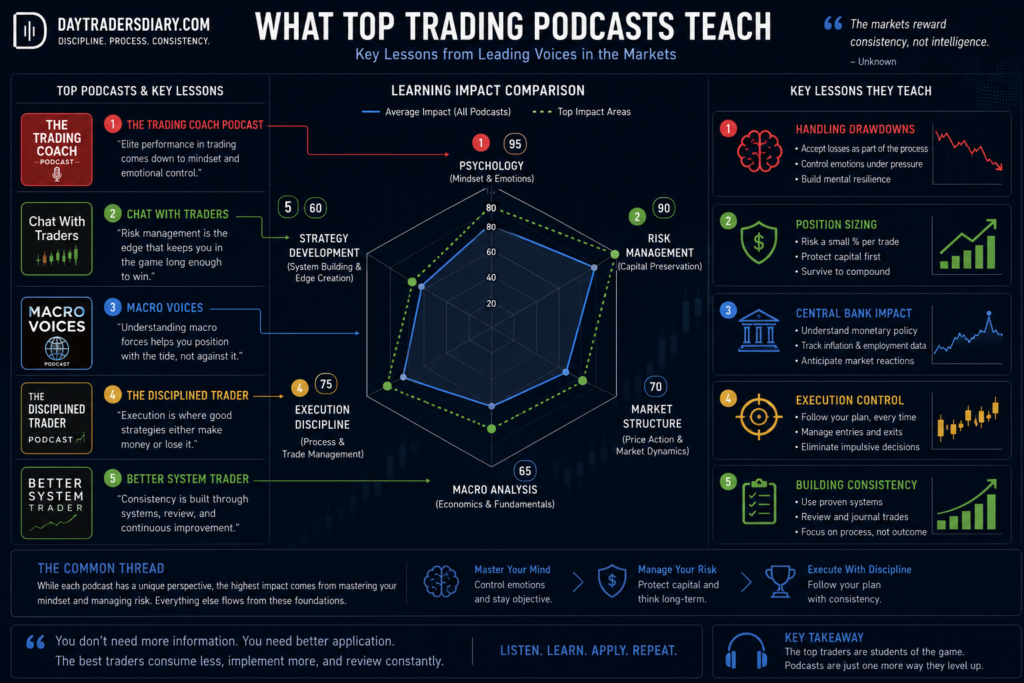
Chat With Traders
For many active traders, Chat With Traders remains one of the most valuable trading podcasts ever produced.
Hosted by Aaron Fifield, the show features interviews with hedge fund managers, proprietary traders, quantitative analysts, and successful independent traders.
What makes it particularly useful is the honesty.
Guests often speak of:
Big losses
Psychological difficulties
strategic development
Failures in risk management
Setbacks in Career
These talks provide a real insight into what trading is really like behind the social media highlights.
For day traders, the psychological lessons alone are worth the time investment.
Macro Voices
Many retail forex traders focus entirely on charts.
Professional traders rarely do.
Currencies are heavily influenced by economic conditions, interest rates, central bank policy, inflation expectations, and capital flows.
Macro Voices helps bridge that knowledge gap.
The podcast regularly features economists, fund managers, and macro strategists discussing global financial developments.
For traders who want to understand why markets move rather than simply reacting to movement, this podcast can be extremely valuable.
It also pairs well with studying economic calendars and central bank policy analysis.
Top Traders Unplugged
One reason traders struggle is that they often assume every successful market participant trades the same way.
Top Traders Unplugged questions that assumption.
The program delves into systematic trading, trend tracking, portfolio creation and risk management at an institutional level.
Even if you’re mainly trading forex intraday, getting exposure to other ways expands your understanding of market behaviour.
Many traders discover valuable ideas simply by studying methods outside their own trading style.
The Market Huddle
Markets do not exist in isolation.
Currencies, bonds, equities, commodities, and economic policy constantly influence each other.
The Market Huddle focuses on these broader relationships.
For day traders, this perspective can be extremely useful because it encourages contextual thinking rather than tunnel vision.
The more connections you understand between markets, the easier it becomes to interpret price movement.
Better System Trader
Most traders focus heavily on entries.
Professional traders often focus more on process quality.
Better System Trader explores systematic trading principles, performance improvement, and strategy development.
The lessons are particularly useful for traders trying to move beyond emotional decision-making.
Many episodes provide practical frameworks that can be adapted to discretionary forex trading.
How Podcasts Can Improve Trading Psychology
One of the most overlooked benefits of podcasts has nothing to do with strategy.
It is psychological normalization.
Every trader experiences:
Losing streaks
Self-doubt
Drawdowns
Frustration
Execution mistakes
The problem is that many traders believe they are alone.
Listening to experienced professionals discuss identical struggles helps put those experiences into perspective.
You begin realizing that setbacks are not signs of failure.
They are part of the development process.
That shift alone can improve resilience significantly.
Building a Podcast Learning Routine
Most traders listen passively.
The best traders listen actively.
Instead of consuming episodes as entertainment, treat them as educational sessions.
Make notes.
Document useful ideas.
Identify good concepts to test.
Recurrent review themes.
You’ll find something interesting in a minute.
Even successful traders don’t agree on strategy.
They seldom differ about discipline, risk management, or emotional control.
That kind of consistency is worth taking notice of.
Connecting Podcast Insights to Your Trading Plan
Information is useless if it never changes behavior.
After each podcast episode, ask:
What did I learn?
How does this apply to my trading?
What action should I take?
Maybe a discussion about drawdowns inspires you to review risk management.
Maybe an interview about execution discipline encourages stricter trade selection.
The goal is not information collection.
The goal is improvement.
Many of these lessons naturally connect with DayTradersDiary.com articles covering trading psychology, risk management, market structure, and performance tracking.
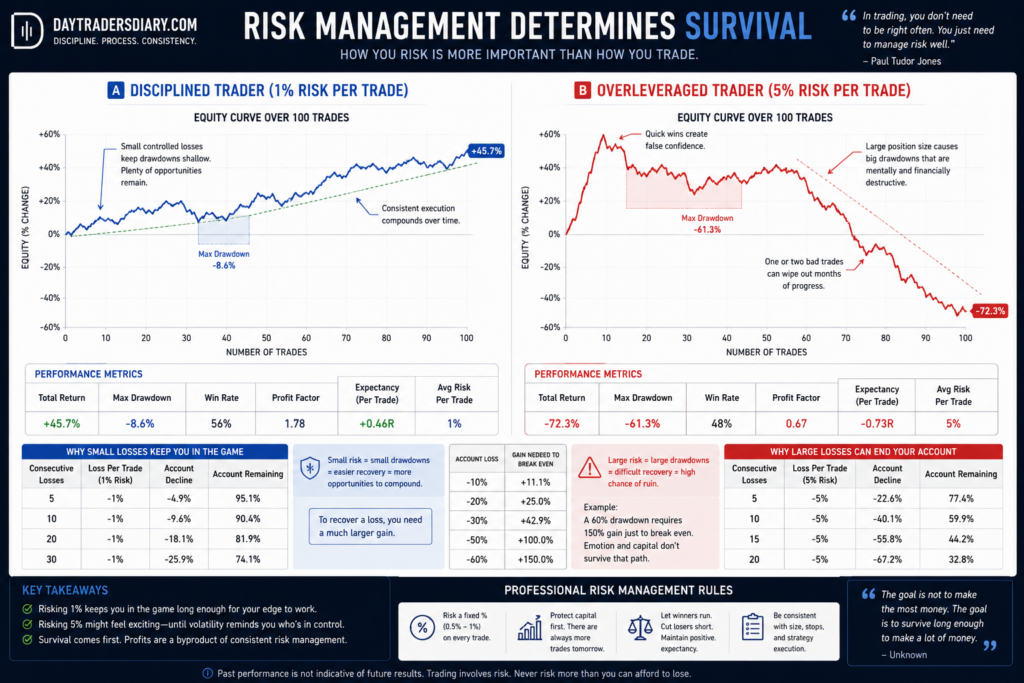
Risk Management Is Still the Real Edge
One thing becomes obvious after listening to enough professional traders.
Nobody survives long term without managing risk.
Different strategies work.
Different markets work.
Different timeframes work.
What remains consistent is risk control.
This is where most traders miscalculate exposure. Using a Position Size Calculator removes guesswork and helps ensure that every trade aligns with predefined account risk.
The best traders understand that protecting capital creates opportunity.
Losing capital removes opportunity.
Journaling Lessons Beyond Trade Entries
Many traders only journal setups.
Consider journaling educational insights as well.
Create a section in your Trade Journal Template specifically for lessons learned from books, podcasts, and market observations.
Over time, you’ll build a personalized trading knowledge base.
This process often reveals connections between psychology, execution, and performance that would otherwise be missed.
The result is continuous improvement rather than random learning.
Scaling Beyond Personal Capital
Eventually, many traders discover that knowledge and consistency solve only part of the puzzle.
Capital becomes the next limitation.
A trader with a proven edge may still struggle to generate meaningful returns on a small account.
This is one reason evaluation programs continue to attract serious traders.
Firms such as The5ers, FTMO, and TradeThePool provide access to larger capital allocations for traders who can demonstrate consistency and disciplined risk management.
Notice what these firms evaluate.
They do not care how many podcasts you’ve listened to.
They care whether you can apply what you’ve learned.
For traders who have developed a repeatable process, a The5ers evaluation account can offer a structured pathway toward scaling beyond personal capital limitations.
Final Thoughts
The best forex podcasts will not make you profitable.
No podcast can do that.
What they can do is shorten the learning curve.
They expose you to lessons that took other traders years, sometimes decades, to learn.
More importantly, they help you think differently about markets.
And in trading, better thinking often produces better decisions.
Over the next month, replace a portion of your social media consumption with high-quality trading podcasts.
Pay attention to recurring themes.
You’ll likely discover that successful traders have very different strategies but remarkably similar habits.
That realization may be more valuable than any trading setup you’ll find on a chart.
For your next read, visit DayTradersDiary.com for articles on trading psychology, risk management and how to develop a professional trading routine.
FAQs
What is the best forex podcast for day traders?
Many traders consider Chat With Traders one of the best options because it features in-depth interviews with experienced market professionals and successful traders.
Are trading podcasts useful for beginners?
Yes. Beginners can learn about market behaviour, risk management, and trading psychology through podcasts, gaining insight from experienced pros.
Can podcasts improve trading performance?
Indirectly, yes. Podcasts improve knowledge, decision-making frameworks, and psychological awareness, all of which can contribute to better execution.
How often should traders listen to market podcasts?
Quality matters more than quantity. Even one or two educational episodes per week can provide valuable insights when applied consistently.
Should traders follow podcast trade ideas?
It is generally better to focus on concepts, frameworks, and lessons rather than copying specific trade ideas.
What topics should forex traders focus on in podcasts?
Risk management, trading psychology, macroeconomics, market structure, execution discipline, and performance improvement are often the most valuable topics.