
Every trader remembers the breakout that looked perfect.
Price consolidates for hours beneath resistance. Volume starts building. Momentum appears to be increasing. Financial news is bullish. Traders begin anticipating the move.
Then the breakout happens.
Price pushes through resistance, breakout traders rush in, and everything looks exactly as expected.
A few minutes later, the market reverses sharply.
The breakout fails.
Long positions get trapped.
Price falls back into the range and continues moving lower.
If you’ve traded long enough, you’ve seen this happen countless times.
The uncomfortable reality is that not every breakout is designed to start a trend. Some breakouts exist primarily to find liquidity, trigger stop orders, and trap traders on the wrong side of the market.
This is where fade trading becomes interesting.
While most traders focus on chasing breakouts, experienced traders often watch for signs that the breakout itself is about to fail.
The ability to identify and trade fake breakouts can become one of the most valuable skills in day trading because failed moves frequently create some of the fastest and cleanest opportunities available.
In this post, I’ll teach you how skilled traders see fade-the-breakout scenarios, how to differentiate between a fake and a real breakout, and how to construct a usable framework around this widely-misunderstood strategy.
Why Most Breakout Traders Lose Money
The breakout idea sounds simple.
Resistances above buy
SELL under support.
Wait for the momentum.
The difficulty is that markets are not as simple as trading textbooks would have you think.
Large market participants require liquidity to execute positions. Retail traders often provide that liquidity by placing stop losses and breakout orders around obvious levels.
Research from the CME Group Education Center frequently highlights how liquidity concentrations form around key technical levels.
For active traders, this means obvious breakout areas often attract large clusters of orders.
Professional traders understand that before a market can move significantly in one direction, it often seeks liquidity first.
That liquidity hunt is where many fake breakout patterns originate.
Understanding What a Fake Breakout Really Is
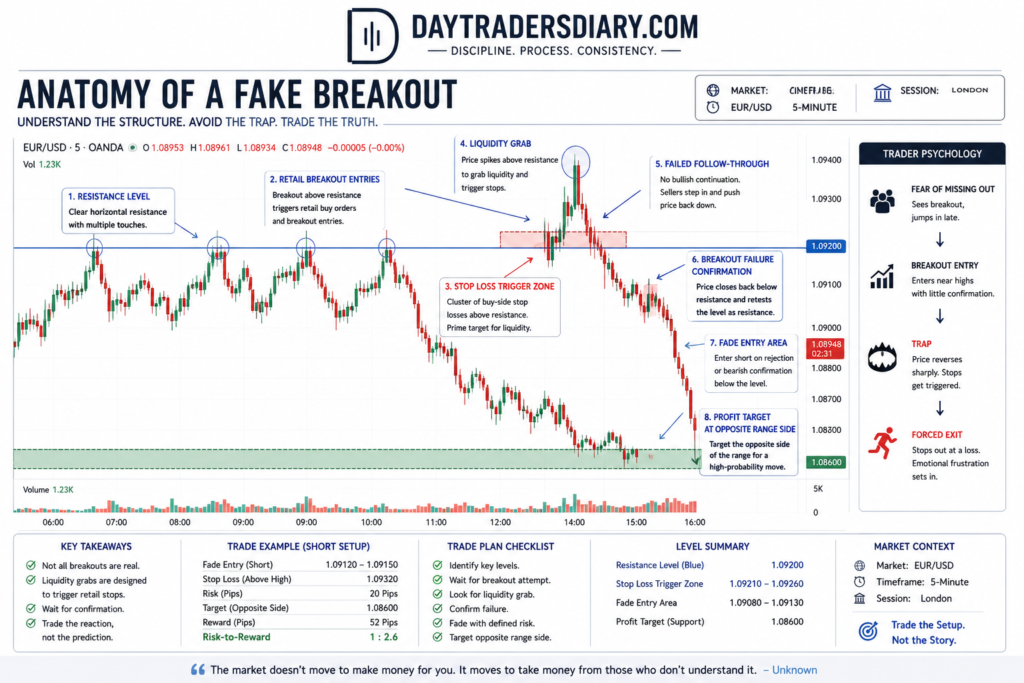
A false breakout is when the price breaks a critical support or resistance level, but fails to garner persistent involvement.
Instead of continuation, the market quickly reverses and returns inside the original range.
Many traders assume fake breakouts are random.
In reality, they often occur under very specific conditions.
The market pushes through a highly visible level.
Retail breakout traders enter aggressively.
Stop orders from opposing traders get triggered.
Liquidity enters the market.
Once enough orders have been absorbed, price reverses.
The result is a failed breakout and a growing number of trapped traders.
Those trapped traders often fuel the move in the opposite direction.
The Psychology Behind Fade Trading
One reason fade trading works is because it exploits predictable human behavior.
Most traders fear missing opportunities.
When a breakout happens, there is a lot of pressure to act.
Nobody wants to see a trend start and not be a part of it.
This emotional urgency often leads to bad entries.
Professional traders handle these kinds of circumstances differently.
Instead of saying:
How do I join this breakout?
They said:
“Who is being trapped here?
That shift in mindset alters everything.
Markets tend to go to where most traders are wrong.
Fade traders are actively looking for those situations.
Research-Backed Insights on Failed Breakouts
CFA Institute research and educational content from NASDAQ Market Insights often emphasise that liquidity, positioning, and trader psychology tend to determine market movement more than technical levels.
For day traders, the takeaway is important.
Support and resistance matter.
But the reaction around those levels often matters more than the level itself.
A breakout that immediately loses momentum provides valuable information.
The market is communicating that buyers or sellers may not have sufficient conviction to sustain the move.
That information creates opportunity.
The Professional Framework for Trading Fade the Breakout
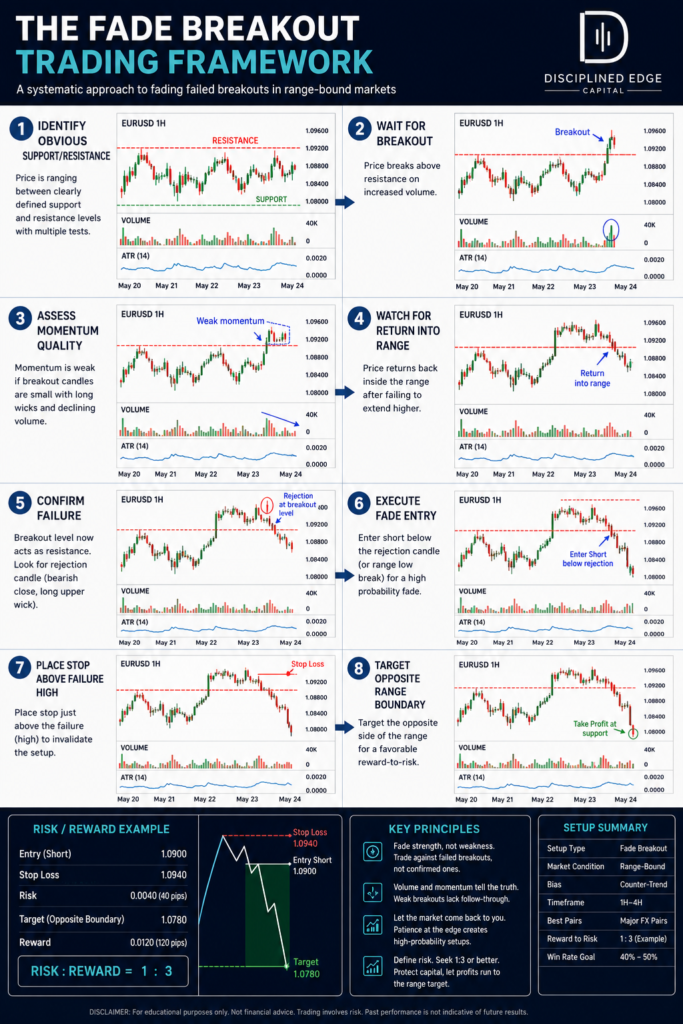
The first step is identifying an obvious level.
The best fade setups usually occur around support and resistance levels that are visible to nearly everyone.
The more obvious the level, the more likely traders are positioning around it.
Next, watch how price behaves after the breakout occurs.
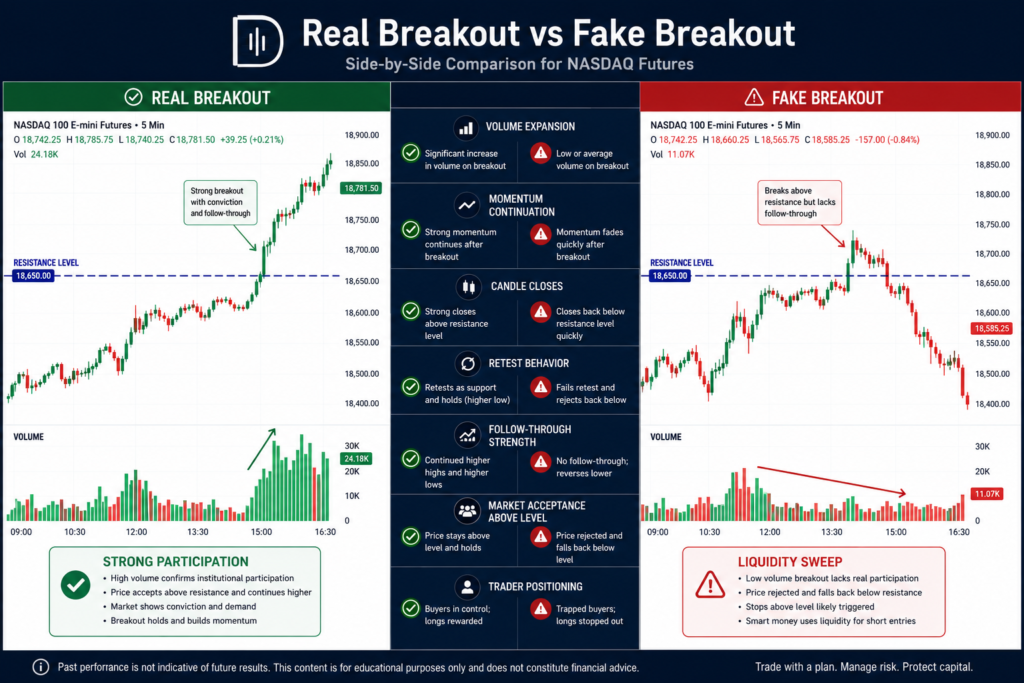
Strong breakouts typically show expansion, follow-through, and acceptance above or below the level.
Fake breakouts often display hesitation.
Price breaks the level but struggles to continue.
Momentum fades quickly.
Volume may spike initially but fail to sustain.
Once price returns inside the range, the probability of a reversal often increases significantly.
This is the point where many experienced traders begin looking for entry opportunities.
A Real Trading Example
Think about EUR/USD staying below a key resistance level for most of the London session.
Finally the price breaks through resistance.
Retail traders go long, expecting continuation.
However, the breakout candle closes weakly.
The next candle immediately falls back below resistance.
Within minutes, price is trading back inside the previous range.
This is not merely price movement.
It is information.
The market is revealing that buyers could not maintain control despite breaking an important level.
In this scenario, many fade traders begin targeting the opposite side of the range.
The trade is not based on predicting the future.
It is based on responding to new information.
When Not to Fade a Breakout
One mistake newer traders make is trying to fade every breakout.
That approach rarely works.
Some breakouts are real.
The strongest breakout conditions are generally seen when:
Main economic releases
Decisions of the central bank
Strong trend continuation phases.
open high volume session
Such scenarios often result in ongoing interaction.
Trying to fade genuine momentum can become extremely expensive.
This is why context matters.
A fade setup should never be taken simply because price crossed a level.
The reaction after the breakout matters far more than the breakout itself.
Combining Fake Breakouts with Market Structure
The best fade trades rarely occur in isolation.
They often align with broader market structure.
For example, a fake breakout into higher timeframe resistance carries more significance than a fake breakout occurring in the middle of nowhere.
Likewise, failed downside breaks into major support often create powerful reversal opportunities.
This is why traders should combine breakout analysis with concepts such as market structure, liquidity zones, trend analysis, and session behavior.
Many of these topics are covered in related DayTradersDiary.com articles on support and resistance, liquidity trading, and price action strategies.
Risk Management Matters More Than Entry Precision
Fade trading can produce excellent reward-to-risk opportunities.
However, it requires disciplined risk management.
A failed fade setup can quickly become a genuine breakout.
Professional traders understand this reality.
They define risk before entering.
This is where most traders miscalculate risk. Using a Position Size Calculator removes guesswork and ensures that stop distance and position size remain aligned with account risk.
The goal is not to avoid losses.
The goal is to ensure that losing trades remain manageable.
Journaling Your Fade Setups
Most traders remember winning fake breakouts.
They rarely remember the details of losing ones.
That’s where the power of journaling comes in.
Track:
Market session
Trade level
Bulk conditions
News environment
Break-out behaviour
Result
Patterns change over time.
You might find that false breakouts perform very well in range-bound situations but poorly during significant news events.
These insights are difficult to identify without data.
A Trade Journal Template can help organize this information and reveal patterns that would otherwise remain invisible.
Why Consistency Matters More Than Individual Trades
One successful fade setup means very little.
One failed breakout means even less.
The edge comes from repeatedly executing the same process over dozens or hundreds of trades.
Many traders become obsessed with finding perfect entries.
Professionals care about process quality.
If your framework is constantly identifying stuck traders, good risk management and discipline is in place, profitability is usually a result of execution.
Scaling Beyond Personal Capital
Eventually many traders encounter a different challenge.
Their strategy works.
Their discipline improves.
But account size limits growth.
This is one reason evaluation programs have become increasingly popular among serious traders.
Firms such as The5ers, FTMO, and TradeThePool provide access to larger pools of capital for traders who can demonstrate consistency and risk management.
The key point is that these programs reward process, not prediction.
A trader who is successful in trading the phoney breakout patterns and is disciplined enough to control his risk well is frequently in a better position of passing for evaluation than someone who takes big risks.
For traders who wish to build up their accounts over the long term, a The5ers assessment account can provide a structured approach to scaling demonstrated skills without having to depend only on their own capital.
Final Thoughts
Most traders spend their careers chasing breakouts.
Few spend time understanding why breakouts fail.
That creates opportunity.
The market is full of traders reacting emotionally to obvious levels.
When those traders become trapped, price often moves quickly in the opposite direction.
Learning to trade fade-the-breakout setups is not about predicting reversals.
It is about recognizing when the market has revealed that a breakout lacks conviction.
Over the next week, review your recent trades and identify every breakout that failed within minutes of occurring.
Study what happened afterward.
You may discover that some of the market’s best opportunities appeared right after the breakout everyone else was chasing.
Next time you read, check out the DayTradersDiary.com tips to liquidity trading, support and resistance, and market structure research.
FAQs
What is a fade breakout strategy?
A fade breakout strategy involves trading against a breakout after evidence suggests the breakout has failed and price is likely to return to the previous range.
What is a fake breakout in forex trading?
A fake breakout occurs when price moves beyond support or resistance but fails to continue and quickly reverses back inside the range.
Why do fake breakouts happen?
Fake breakouts are common because markets tend to look for liquidity at clear technical levels where stop orders and breakout entries tend to be clustered.
Is fading breakouts suitable for beginners?
Fade trading requires patience and experience because traders must distinguish between genuine breakouts and failed moves. New traders should practice extensively before risking capital.
What indicators help identify fake breakouts?
Volume analysis, ATR, market structure , support and resistance and price action confirmation can all aid in identifying potential bogus breakout patterns.
Can fake breakout trading work in day trading?
Yes. Many active day traders trade false breakouts, as unsuccessful breakouts tend to result in strong short-term reversals and good reward-to-risk ratios.