
You enter a trade, watch it move in your favour, and close early because you do not want to give back the profit. A few minutes later, price reaches the target you originally planned. On another day, you hesitate at a good entry, chase the move, and end up buying just before the market pulls back.
These situations are familiar to most active traders. The frustrating part is that you may already understand market structure, know how to use indicators, and have a trading strategy that works reasonably well. Yet your entries and exits still feel inconsistent.
Before looking for another indicator, take a closer look at how you make timing decisions.
An entry/exit timing scorecard gives you a way to review those decisions without relying entirely on whether a trade made money. It helps you understand whether you entered at the right location, waited for enough confirmation, managed the position properly, and exited for a valid reason.
The idea is simple: stop judging your trading only by profit and loss. Start judging the quality of the decisions that produced those results.
Why You Should Score Entries and Exits Separately
A good entry does not guarantee a good trade. You can enter at an excellent price and still ruin the opportunity by closing too early, moving your stop without a reason, or refusing to take profit when your trading plan tells you to.
The opposite can happen too. You might enter slightly late but manage the position well enough to capture a decent move.
If you give the entire trade one score based on its final result, you will miss these differences.
Now, think about buying a stock following a distinct decline. You enter close to support, the trend is up, and your stop is under a significant swing low. The buyers m/a u once again, and you get stopped out of the trade.
That is a losing trade, but the entry may still deserve a good score. You followed your conditions and accepted a planned loss.
Now consider another trade where you chase a breakout after a large bullish candle. Price continues higher for a while, so you make money. The result is positive, but your entry was late and the risk was poorly controlled.
These examples show why entry quality, exit quality, and profitability should be reviewed separately.
What Research Tells Us About Trading Decisions
There is a reason experienced traders become selective over time. Taking more trades does not automatically create better results.
In their research paper, Trading Is Hazardous to Your Wealth, Brad Barber and Terrance Odean examined the trading behaviour of 66,465 households. Their findings showed that the most active households underperformed the market in the period studied.
This research did not explicitly evaluate intraday timing scorecards, (although it sounds like a fun avenue for investigation), but it does highlight a problem that many day traders grasp intuitively: Motion feels like productivity when it can be harming your returns. “When you have the scorecard, you want to do the cost-benefit analysis,” Smith says. “It makes you question if a trade is worth that capital before you go in.”
Execution deserves the same attention. The CME Group guide to futures order types explains how market, limit, and stop orders work differently. This is crucial if a quick market shifts the price available between your decision to trade and the execution of your order.
You should also understand what happens when you submit an order. A good chart setup does not guarantee a perfect fill. Slippage, liquidity, and order type can all affect your actual execution.
For a day trader, the lesson is practical: a strong trading decision includes more than predicting direction. You need a sensible location, a clear reason to enter, and an execution plan you can follow.
Build a Practical Entry Timing Scorecard
You do not need complicated software to create your scorecard. A spreadsheet or trading journal is enough.
Start with a score out of 100. The following framework gives you a consistent way to assess each setup. Treat the points as a starting guide and adjust them as you learn which factors matter most to your strategy.
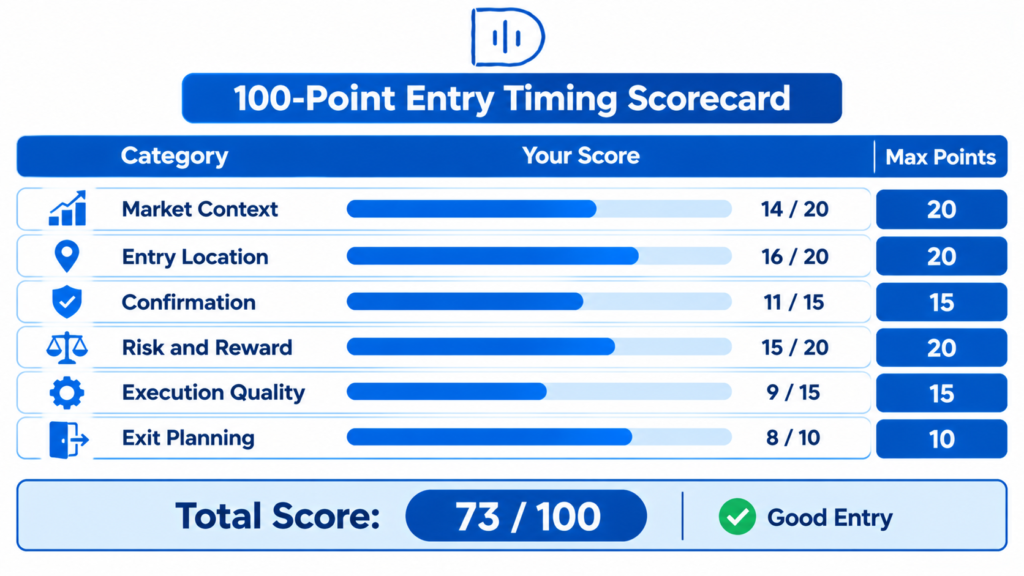
Market context: 20 points
First, ask yourself if the trade makes sense in the current market condition. Is the price trending or in a trading range or acting erratically? Are you trading the trend or looking for a reversal?
You want to believe a bullish signal in a strong downtrend not as much as you want to believe the same signal during a strong uptrend. But trades against the trend can still work, so long as they are at critical points and have sufficient rejection.
Entry location: 20 points
This is where many timing problems begin. Traders often identify the correct direction but enter at a poor price.
Check whether you are entering near support, resistance, a pullback area, a breakout level, or another location that makes sense for your strategy. If price has already travelled a long distance, ask whether you are chasing the move.
A good setup should offer a reasonable place to enter and a clear level that proves your idea wrong.
Confirmation: 15 points
Look for evidence that the market is supporting your trade idea. This could be a break of structure, a strong candle close, a volume increase, or a momentum shift.
Do not wait for every possible indicator to agree. Too much confirmation can leave you entering after the best part of the move has passed.
The purpose is to avoid entering simply because you expect something to happen.
Risk and reward: 20 points
A long way to your stop is a long room in which to measure out the reasonable distance before your next hurdle.
A setup can look good yet have low reward-to-risk for what you’re forced to risk. A bullish signal may not be worth taking if the resistance is only slightly above where you want to enter.
Execution quality: 15 points
See how you truly got into it. Did you enter at the pricing area you had in mind, or were you chasing a candle? Was the spread fair? Were you experiencing too much slippage?
A setup can look nice on paper, but if the execution is poor, it can be a bad trade.
Exit planning: 10 points
Consider your strategy for treating the position before placing your order. Know what the aim is, what the stop-loss is, and whether there are any reasons to exit the position early on.
If you have no clear exit plan, you are leaving an important decision until the moment emotions are most likely to influence you.
Once you have scored these areas, add the points together. You might initially treat a score above 80 as a strong candidate, 65 to 79 as a setup that needs closer attention, and anything below 65 as a trade to avoid.
These thresholds are not universal trading rules. They are starting points. Your own results should determine whether they make sense.
Give Exit Timing Its Own Score
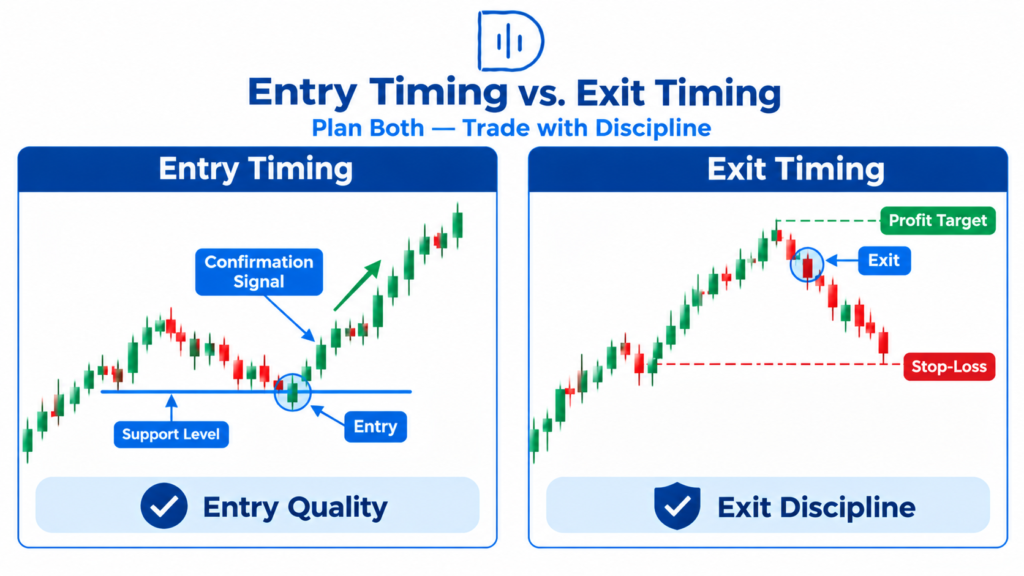
Once you are in a trade, the challenge changes. You are no longer deciding whether an opportunity is worth taking. You are deciding whether the original idea is still valid and how much of the available move you can reasonably capture.
Use a separate exit score out of 20. Give yourself up to five points for each of the following areas.
First, consider your reason for closing. Did price reach your target, break your invalidation level, or show the kind of weakness your strategy tells you to respect? Or did you close because a small pullback made you uncomfortable?
Next, review market behaviour. Did momentum genuinely weaken? Did price fail at resistance? Did the market structure change? These are more useful reasons than simply seeing a candle move against you.
Now think about profit protection. Did you move your stop to protect every penny of open profit or did you adhere to your stop as planned?
Lastly, think about your execution. Did you sell at a fair price, or did you hold out until the market turned against you?
A high exit score does not mean you sold at the exact high or bought back at the exact low. It means you made a decision that was consistent with your trading plan.
That is the standard worth aiming for.
A Simple Example: A Good Entry and an Early Exit
Suppose you buy a stock at $50 after price pulls back to a support area. You place your stop at $49.60 and set a target at $50.80.
The trade starts moving in your favour. Price reaches $50.50, but then forms two small bearish candles. You become uncomfortable and close at $50.35.
A few minutes later, the stock reaches your original target.
It is tempting to label this a bad exit. But take a closer look. Did your strategy require you to hold until the target unless the market structure changed? If so, closing because of two small candles may have been an emotional decision.
If, however, your plan allowed you to get out early as momentum faded, then the call may have been sound.
Make sure you incorporate that difference into your scorecard. Put a big number into the entry, and then you can also walk out in the conversation about the exit regarding if you broke your management rules.
This is much more useful than simply recording that you made $0.35 per share.
Which Indicators Should You Use for Entry and Exit Confirmation?
There is no single best indicator for entry confirmation. The right tool depends on the question you are trying to answer.
Moving averages can provide you with an idea of price direction. RSI can help tell you if momentum may be rising or falling. And VWAP will help you see the price as it relates to the volume-weighted average for the session, while MACD will assist you in spotting changes in momentum.
Volume might help you estimate the meaningful participation in a breakout. ATR can assist you judge volatility and keep the stops off of “normal” price swings.
The mistake is expecting one indicator to do everything.
For example, if you already know that the market is making higher highs and higher lows, adding several more trend indicators may not improve your decision. You may get more useful information by checking whether price is approaching resistance, whether volume supports the move, and whether the stop distance makes sense.
Give every indicator a specific job. If removing it does not change your decision, it probably does not need to be on your chart.
You can also strengthen your setup selection by reading our guide on how to find high-probability trading setups.
Risk Management Still Comes Before Timing
A high entry score does not mean you should increase your position size. It only tells you that the setup meets more of your trading conditions.
Your stop-loss should be placed where the trade idea becomes invalid, not wherever it produces a convenient position size. Once you know the stop distance, calculate how many shares, contracts, or lots you can trade within your risk limit.
This is where many traders get into trouble. They decide how much they want to trade first and then adjust the stop to fit the position. That approach can leave the trade exposed to normal market movement.
The Day Traders Diary Position Size Calculator can help you calculate an appropriate position based on your account balance, risk percentage, and stop-loss distance.
Also pay attention to the difference between your planned entry and actual fill. If you repeatedly enter after the market has already moved, your effective risk-to-reward ratio may be worse than the one you calculated before placing the order.
A timing scorecard should expose these problems, not hide them behind a good-looking setup rating.
Use Your Trading Journal to Find Patterns
A scorecard becomes valuable when you have enough trades to compare.
Maintain a journal for your entry score, exit score, type of setup, market session, risk taken, R result, and a short impression of your feelings after every trade. Save screenshots if you can. With a picture, so you can ensure that your choices fit the conditions of the chart to exit and an entry.
After reviewing a reasonable sample, look for repeated behaviour.
Perhaps your highest-scoring trades perform well, but your results deteriorate during sideways markets. Maybe your entries are consistent, but you regularly close profitable positions before they reach their planned targets. You might also discover that your execution becomes worse after two consecutive losses.
These patterns are difficult to notice when you rely on memory.
Use the Trade Journal Template to keep your records organised. Avoid changing your scorecard after every losing trade. Give your rules enough time and enough examples before deciding whether they need adjusting.
For a more detailed testing process, our guide on how to backtest a day-trading strategy is a useful next step.
Improve Your Timing Before Increasing Your Trading Capital
Once you understand which setups produce your best results, you can start thinking about scaling. But increasing capital before your execution is consistent can make existing problems more expensive.
You should first establish that your stronger-scoring trades perform reasonably well across different sessions and market conditions. Review your drawdowns, losing streaks, and ability to follow your rules when several trades go against you.
Evaluation programs can also be a route to trading capital for traders who have a strategy but no funds of their own. They should be treated as a serious career route, not a shortcut to skip the hard work and time required to build an edge.
You can explore the The5ers evaluation program and compare its conditions with providers such as FTMO. Traders focused on stocks may also want to research TradeThePool.
Before choosing any firm, check its fees, profit targets, drawdown calculations, payout conditions, and trading restrictions. Make sure your normal strategy fits the rules. There is little value in passing an evaluation with a trading approach you cannot realistically maintain.
Your scorecard can help you judge whether your process is consistent enough to consider that next step.
Frequently Asked Questions
What is an entry/exit timing scorecard?
An entry/exit timing scorecard is a method of grading your trading decisions. It evaluates factors such as market conditions, entry location, confirmation, risk, execution, and exit discipline. It helps you understand whether your decisions follow a repeatable process rather than relying only on profit and loss.
What is a good entry score in trading?
80/100 is a decent baseline, but that’s a small potatoes score. See if your scores seem to match real results, and if transactions with higher scores are better in the long run. Your ultimate threshold will vary depending on your plan and market conditions.
Which indicator is best for entry confirmation?
There is no one winner. Moving averages, RSI, MACD, VWAP, and volume are all tools that can corroborate different aspects of a setup. Select indications depending on what you need to know rather than throwing together multiple tools that are effectively saying the same thing.
How can I tell if I am exiting trades too early?
Compare your actual exit with the rule you established before entering. If you repeatedly close trades because of minor pullbacks or temporary changes in unrealized profit, you may be reacting emotionally. Review a group of trades before deciding whether early exits are a genuine problem.
Should entry and exit timing have separate scores?
Yes. Entry timing measures the quality of your opportunity and the price you paid. Exit timing measures how well you managed the position and followed your closing rules. Keeping them separate makes it easier to identify where your performance needs improvement.
How many trades should I score before changing my strategy?
Also, do not overreact too quickly after only a couple of trades. Analyze plenty of identical setups in multiple sessions and in different market conditions. This way, you have a higher chance of really getting a feel for a pattern as opposed to reacting to a series of wins or losses.
Final Thoughts
A timing scorecard will not help you catch every market move. It will, however, show you where your decisions are helping your performance and where they are getting in the way.
You may discover that your entries are usually good but your exits are driven by fear. You may find that you chase breakouts after large candles or regularly enter just before an important resistance level. Once you can identify the problem, you have something specific to work on.
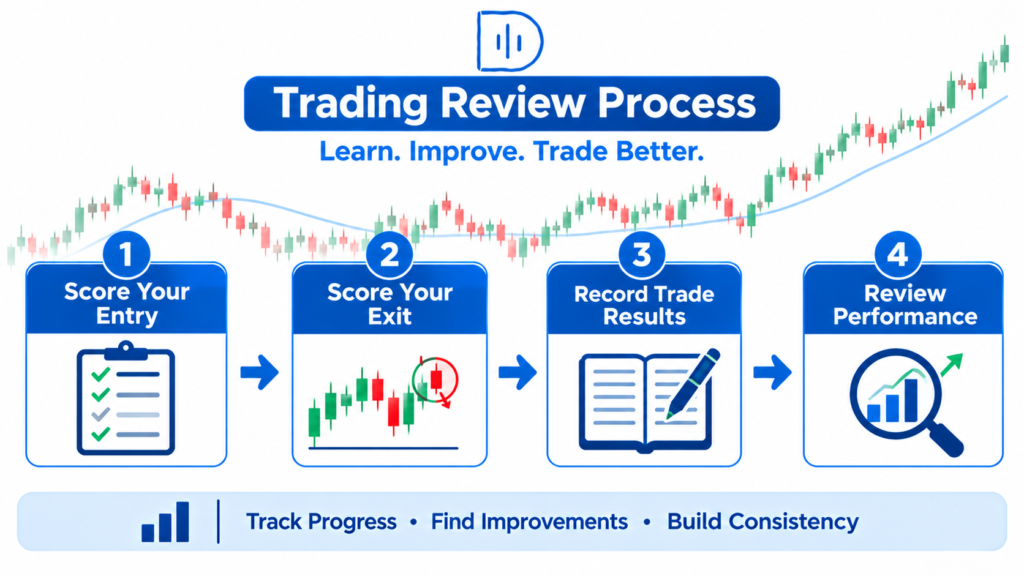
Try this with your next 20 trades. Score every entry before placing the order, then score every exit after closing the position. Keep your rules consistent throughout the exercise and review the results at the end.
Do not rush to add another indicator or rebuild your strategy. Find the one timing mistake that appears most often and work on correcting it.
Next read: How To Find High-Probability Trading Setups.