
You enter a trade with a clear plan. The market moves against you, and suddenly that plan no longer feels so clear.
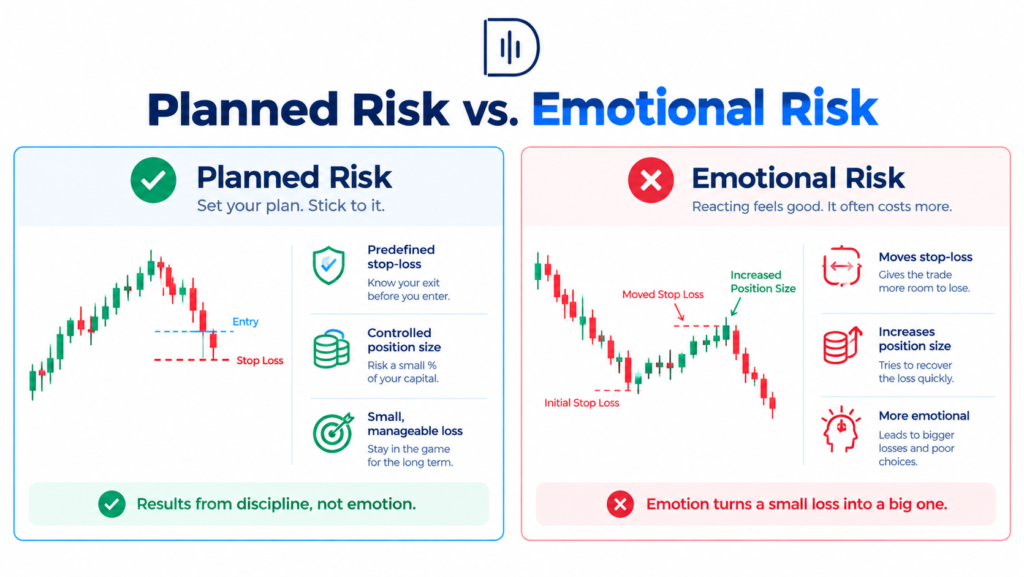
You start looking for reasons to stay in the trade. A support level that was not part of your original analysis suddenly looks important. You tell yourself the loss is only temporary. Then you move your stop, hoping the price will turn around.
Sometimes it does. That is what makes the habit dangerous. A few lucky recoveries can convince you that ignoring your rules was the right decision.
Managing losses without bias means learning to judge a trade by the information available, not by how badly you want it to recover. It is not about removing emotion from trading completely. It is about preventing emotions from influencing your decisions once you have money at stake.
Let’s look at how to recognize the biases that distort trading decisions, build a practical process for handling losses, and use your own trading data to become more consistent.
Why Losses Make Traders Abandon Their Plans
A planned loss and an unexpected loss feel very different.
When you enter a trade, you may accept that the setup has a defined chance of failing. But once the position moves against you, the loss becomes personal. You can see the money disappearing, and your attention shifts from managing the trade to avoiding the discomfort of being wrong.
This is where several common biases begin to influence decisions.
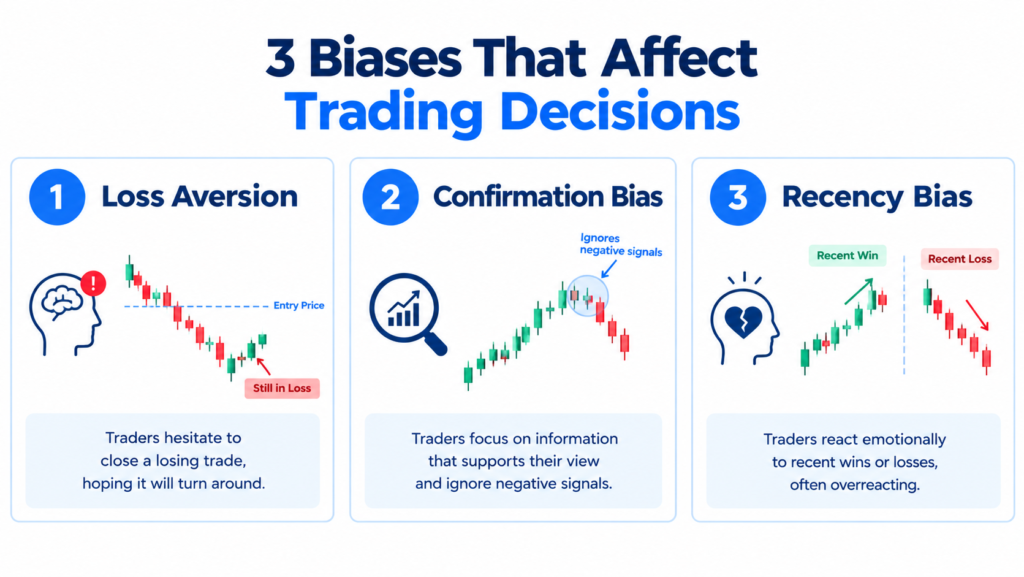
Loss aversion makes realizing a loss feel more painful than an equivalent gain feels rewarding. You may hold a losing position longer than your strategy allows because closing it would make the loss real.
Confirmation bias encourages you to search for information that supports your existing position while dismissing evidence against it. A trader with a long position in EUR/USD may see a bullish candle and ignore a break below the support level that justified the transaction initially.
Recency bias causes recent results to carry too much weight. After three losing trades, you may assume your strategy has stopped working. After three winners, you may increase your risk because you feel unusually confident.
These biases are not indications that you are unable to trade. It is the old difficulties of decision-making under uncertainty. The key is if the process captures them before they hit your account.
What Research Tells Us About Loss Bias
Psychology research helps explain why traders struggle to accept losses even when they understand risk intellectually.
In their influential paper, Prospect Theory: An Analysis of Decision under Risk, Daniel Kahneman and Amos Tversky examined how people evaluate gains and losses. Their work showed that decisions can change depending on how outcomes are framed, with people often becoming more willing to take risks when trying to avoid a loss.
For a day trader, this has a practical implication. A position that is already losing can encourage riskier decisions precisely because the trader wants to avoid closing it at a loss. Instead of evaluating whether the original setup remains valid, the trader starts evaluating how to get back to breakeven.
Research by Brad Barber and Terrance Odean, Trading Is Hazardous to Your Wealth, examined the performance of individual investors. Their findings showed that the most active households in their sample underperformed the market, with overconfidence helping explain excessive trading.
The study examined stock investors over an earlier period, so its results should not be treated as a direct estimate of how every modern-day trader performs. However, it reinforces an important lesson: acting more often does not automatically improve results.
The U.S. Securities and Exchange Commission’s day trading guidance also discusses the challenges of rapid decisions, costs, and short-term trading risks.
Taken together, these sources point toward a useful approach: create rules that reduce unnecessary decisions when emotions are strongest.
A Practical Framework for Managing Losses Without Bias
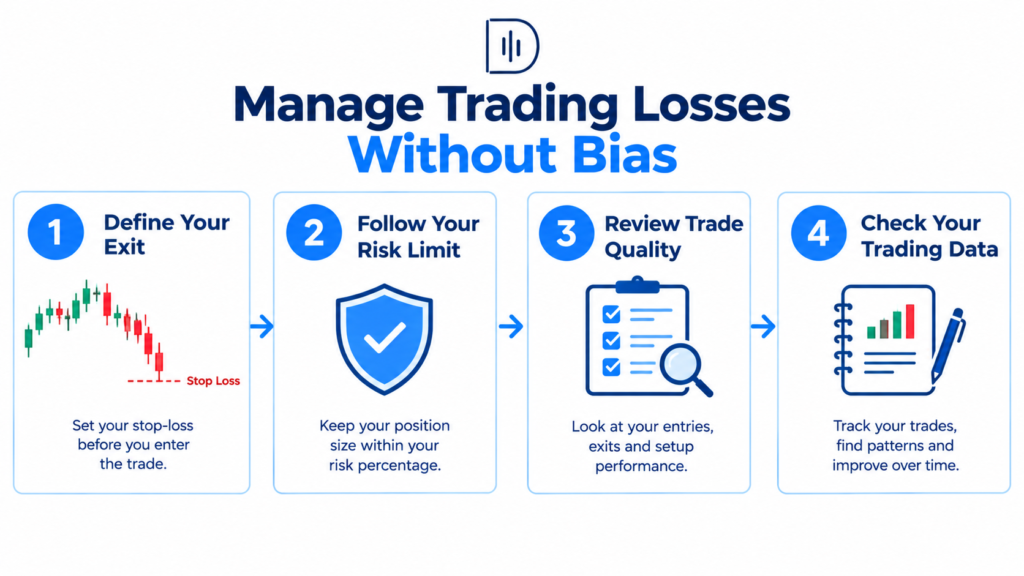
1. Decide What Makes a Trade Invalid Before Entering
The optimal moment to examine a transaction objectively is before you have money on the line.
Before joining, know what market condition will invalidate your proposal. It might be a break below a significant swing low, a failed recapture of resistance or a change in volatility that invalidates the initial setup.
Suppose you buy GBP/USD because the price holds above a support zone and forms a higher low. Your plan identifies a level below that structure where the trade thesis no longer holds.
If the price breaks that level, you should not suddenly invent a new bullish argument to justify staying in the position.
Your analysis can change when new evidence appears, but changing your opinion is not the same as changing your rules to avoid a loss.
2. Separate Trade Quality From Trade Outcome
A profitable trade can be poorly executed. A losing trade can be perfectly valid.
This difference is important to you if you wish to manage losses impartially.
Now imagine you do 2 trades on the same setup. First, you follow your entry criteria, position size, and stop-loss regulations, but the market turns around. In the second, you enter late, boost your position size, and exit early in dread. Both trades are losing money but have different concerns.
The first may be a normal losing outcome. The second exposes an execution problem.
If you judge both trades only by their financial results, you miss the information needed to improve.
After every loss, ask yourself whether the trade followed your plan, whether the setup was valid, and whether you made any decisions that were not part of your rules.
That review is more useful than asking whether you should have predicted the market better.
3. Stop Trying to Recover Losses Immediately
One of the most expensive reactions to a losing trade is the urge to make the money back before the session ends.
You take another setup that you would normally ignore. You increase your size because a small winner no longer feels sufficient. Or you enter too early because you cannot stand watching the market move without you.
This is revenge trading, and it often turns one manageable loss into a much larger drawdown.
Set a daily loss limit before the session begins. Also, decide what you will do after a specific number of consecutive losses or a clear breach of your trading rules.
For example, after two consecutive losses, you might take a short break and review whether both trades met your criteria. If you have reached your predetermined daily loss limit, stop trading for the day.
The purpose is not to assume that two losses mean your strategy has stopped working. It is to prevent frustration from quietly changing your behavior.
4. Use Evidence Instead of Feelings to Reassess Your Strategy
A losing streak does not automatically mean your strategy is broken. Equally, a profitable week does not prove that your approach is working well.
Look at a meaningful sample of trades.
If your setup has historically produced losing streaks of a certain length, a similar sequence may fall within its normal variation. If losses are larger than expected or market conditions no longer align with your strategy, further investigation may be necessary.
Avoid changing several rules after a handful of disappointing trades. You will not know which change helped, which hurt, or whether the original variation would have resolved itself.
A useful starting point is to compare your current results with your historical win rate, average loss, average winner, and maximum drawdown. Your own records provide a better reference than your emotional impression of the last few sessions.
Risk Management: Make Losses Easier to Accept
Risk management won’t eliminate the pain of a loss, but it can prevent the pain from taking over your life.
Let’s say you have $10000 in your account and you risk 0.5% per deal. Your planned risk is $50. If the setup fails and your exit works as planned, the monetary loss is restricted to the amount you agreed to in advance.
Now imagine risking $500 on the same trade. The chart has not changed, but the emotional pressure is likely to be very different.
That is why position sizing matters psychologically as well as mathematically.
Use the Position Size Calculator to determine an appropriate position size based on your account balance, risk allowance, and stop distance—and account for fees and potential slippage, especially during volatile sessions.
Do not increase your risk simply because a setup looks unusually convincing. Confidence is not a reliable substitute for evidence.
If a loss feels so uncomfortable that you cannot follow your plan, review whether your position size is too large for your actual tolerance.
Use Your Trading Journal to Expose Hidden Biases
Memory is selective. Traders often remember the loss they recovered after moving a stop, but forget the other occasions when the same decision caused a larger loss.
A journal can substitute those stories with proof.
After each failed trade, note down the setup, intended risk, actual result, market circumstances and if you stuck to your guidelines. Add a small statement regarding your decision making. Were you scared of comprehending the loss? You missed a warning sign? “Did you place another trade because you wanted to recover?”
Over time, these notes can reveal patterns that are difficult to recognize during live trading.
You may discover that your biggest losses occur after a winning streak, when confidence encourages you to increase size. Or you may notice that your first trade after a loss is often rushed.
Use the Trade Journal Template and trading tools on DayTradersDiary.com to organize your reviews. The goal is not to criticize yourself for every mistake. It is to identify recurring behaviors and change the conditions that allow them to occur.
Scaling Capital Without Scaling Emotional Risk
Once you have a tested strategy and a consistent record of following your rules, you may consider whether additional trading capital fits your long-term goals.
Evaluation programs from firms such as The5ers, FTMO, and TradeThePool offer different routes for eligible traders to pursue funded trading opportunities. Their instruments, fees, valuation conditions, and drawdown restrictions differ, so make sure you compare their current terms carefully.
The5ers and FTMO offer forex and CFD-related programs, while TradeThePool focuses on stock trading. The right fit depends on your market, strategy, and ability to operate within the applicable rules.
An evaluation should be viewed as a professional challenge, not a shortcut to capital. If you regularly break your own stop-loss rules or increase risk to recover losses, tighter external limits will not solve the underlying problem.
Before you pay for an evaluation, establish that you can accept projected losses without changing your conduct. Check your drawdowns, have consistent risk management and demonstrate that your performance is not driven by a small handful of outsized wins.
If your approach is sound, determine if a The5ers evaluation or another program suits your trading style and financial situation. Access to capital is only useful if the discipline is already there.
FAQs About Managing Trading Losses Without Bias
How can I stop being emotionally attached to losing trades?
Know your exit criteria before you begin, keep position sizes small, and check trades against your rules. This is a lousy deal and not a decision you have to renegotiate.
What is loss aversion in forex trading?
Loss aversion refers to the fact that people experience the pain of loss more strongly than the excitement of a similar gain. In the forex market, it might result in holding losing trades for too long, changing stop-losses or taking needless risks to try to get money back.
Should I stop trading after a loss?
Not really. A single loss is usual in trading. If you’ve hit your daily loss limit, broken your rules, or feel the urge to make money back right away, stopping is usually the more disciplined choice.
How do I know whether my strategy is failing or if I am trading with bias?
Review a sufficiently large sample of trades and compare your results with your historical performance. Separate trades that followed your rules from those involving impulsive entries, oversized positions, or premature exits.
Can a trading journal help reduce emotional decisions?
Yeah. For example, a journal can highlight common habits, like taking on more risk after losses or ignoring valid setups during a losing run. It’s more valuable still if you track decision quality in addition to profit and loss.
How much should I risk per trade to better manage losses?
There is no all-encompassing percentage. Your risk allowance should be based on your strategy, account size, estimated draw downs and ability to follow your plan. Whatever restriction you pick, calculate your position size before you enter and stick to the rule.
Final Thoughts
Losses are painful, and unbiased loss management is not about fooling yourself that losses don’t hurt. It means realizing that discomfort isn’t cause to reconsider a solid judgment in trading.
The next time a deal goes wrong, examine the initial notion that tries to get you away from your plan. Are you reacting to new evidence in the market or just trying to avoid being wrong?
For your next 20 trades, record whether you followed your rules independently of the financial outcome. At the end of the sample, review your mistakes and identify the one behavior that caused the most unnecessary damage.
For your next read, explore How to Evaluate Your Day Trading Performance. It can help you distinguish genuine strategy problems from execution mistakes and emotional reactions.