
Ask ten profitable traders what changed their results, and you’ll hear different answers.
Some will mention patience.
Others will credit psychology.
A few will point to a better trading strategy.
But if you look at their trading records, you’ll usually find something else.
Consistent position sizing.
One habit separates traders who survive long enough to develop an edge from those who constantly reset their accounts.
They know exactly how much they are willing to lose before they enter a trade.
Not after.
For many experienced traders, that number is 0.5% of their account.
It sounds conservative.
That’s exactly why it works.
Trading with a 0.5% risk level gives your strategy room to experience normal losing streaks without putting your capital or confidence under unnecessary pressure.
This guide explains how to calculate lot size for 0.5% risk, why professional traders often prefer this approach, and how proper position sizing creates long-term consistency.
Why 0.5% Risk Makes Sense
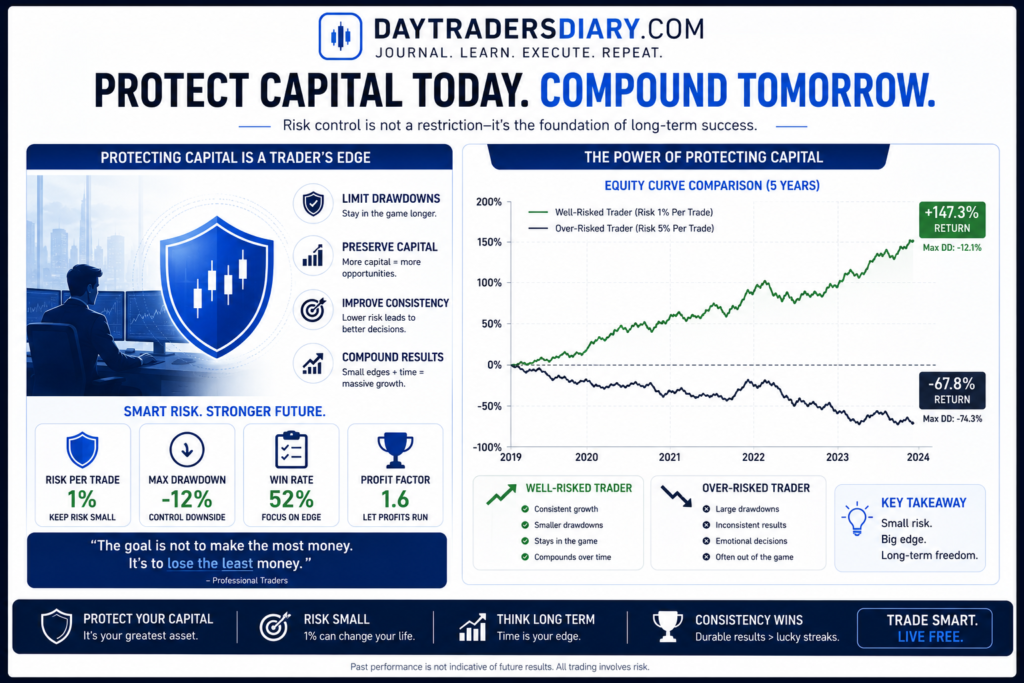
Many traders become obsessed with increasing returns.
Professionals focus on controlling losses.
Research from the CFA Institute consistently shows that preserving capital is one of the defining characteristics of successful long-term investment performance.
The National Futures Association (NFA) also emphasizes disciplined risk management as a fundamental principle for retail forex traders.
For day traders, risking less per trade provides something extremely valuable.
The ability to survive normal market uncertainty.
Even excellent trading systems experience losing streaks.
Smaller position sizes allow probability to work across hundreds of trades rather than being interrupted by emotional decision-making.
Why Most Traders Calculate Lot Size Incorrectly
A common mistake is choosing the lot size first.
Then, finding a stop-loss that fits.
Professional traders reverse the process.
They begin with:
How much am I willing to lose?
Then they determine:
Where should the stop-loss logically go?
Only after those decisions do they calculate the appropriate lot size.
Risk drives position size.
Not the other way around.
Step One: Calculate Your Maximum Risk
The first calculation is simple.
Maximum Risk = Account Balance × Risk Percentage
Suppose your trading account contains:
$10,000
Risk per trade:
0.5%
Maximum risk equals:
$10,000 × 0.005 = $50
Regardless of the setup, that trade should not lose more than $50 if the stop-loss is triggered.
Everything that follows revolves around protecting that amount.
Step Two: Determine Your Stop-Loss
The stop-loss should always be driven by market structure.
Not convenience.
Imagine EUR/USD forms a pullback within a strong uptrend.
Technical analysis suggests the trade becomes invalid if the price moves 40 pips lower.
That means the stop-loss is 40 pips away.
Not 20.
Not 15.
Changing the stop to trade a larger position usually damages long-term performance.
If you’ve already read our guide on Best Daily Charts Setup for Forex Traders, you’ll know why higher timeframe support and resistance often determine logical stop placement.
Step Three: Calculate Pip Value
Once the risk and stop-loss are determined, the pip value is simple.
Assume:
Maximum risk: $50
Stop Loss = 40 pips
So each pip should equal:
$50 / 40 = $1.25 per pip
The right lot size is the one where the position gives you around $1.25 per pip.
Notice what happened.
Position size wasn’t chosen emotionally.
It was calculated objectively.
A Practical Example
Let’s use another scenario.
Account balance:
$2,000
Risk:
0.5%
Maximum loss:
$10
Technical stop-loss:
25 pips
Each pip should equal:
$10 ÷ 25
= $0.40
Rather than increasing position size because the account feels “too small,” disciplined traders simply trade the position that matches their predefined risk.
Over time, that consistency compounds.
Why Smaller Risk Often Produces Better Results
Many traders assume that risking more automatically leads to higher profits.
Reality often proves the opposite.
Imagine two traders using identical strategies.
Trader A risks 2% per trade.
Trader B risks 0.5%.
After six consecutive losing trades:
Trader A loses nearly 12% before compounding.
Trader B loses only about 3%.
Who is more likely to continue following the trading plan?
Who is less under emotional strain?
Who can objectively judge the next opportunity?
The trader with less risk makes better decisions.
Mental stability is supported by capital preservation.
Position Size Should Change Constantly
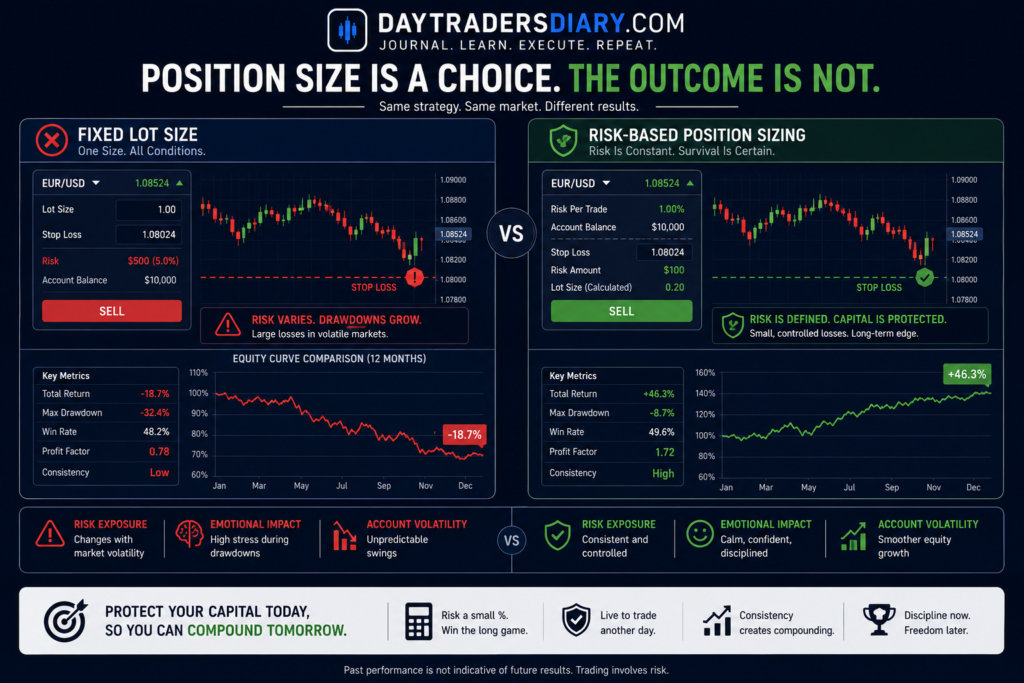
One misunderstanding among beginners is the belief that lot size should remain fixed.
Professional traders know better.
Every trade has a different stop-loss.
Every stop-loss requires a different position size.
Sometimes volatility expands.
Sometimes it contracts.
Your risk percentage remains constant.
Your lot size changes.
That is exactly how disciplined risk management should work.
Why Fixed Lot Sizes Create Hidden Risk
Many traders always trade:
0.10 lots.
Or 0.50 lots.
Regardless of the market.
This creates inconsistent exposure.
Suppose one trade requires a 15-pip stop, while another requires a 60-pip stop.
Using the same lot size means risking four times more money on the second trade.
The strategy hasn’t changed.
Risk has.
Professional traders keep risk constant.
Not the lot size.
The Position Size Calculator Removes Guesswork
Manual calculations are useful for understanding the concept.
For our daily trading we need efficiency.
Here is where the Position Size Calculator can help.
Enter:
Total account.
Risk percentage
Stop loss distance.
Currency pair
The calculator automatically calculates the correct lot size.
More importantly, it prevents emotional decisions from influencing position sizing.
Many experienced traders use it before every trade, regardless of account size.
Track Position Size in Your Trading Journal
Position sizing deserves the same attention as entries and exits.
Your Trade Journal Template should record:
Account balance.
Risk percentage.
Position size.
Stop-loss distance.
Currency pair.
Trade outcome.
After reviewing several months of trades, you’ll quickly notice whether inconsistent position sizing contributed to unnecessary drawdowns.
Many traders discover that improving risk management produces better results than changing strategies.
Why 0.5% Risk Is Popular Among Funded Traders
Proprietary traders often take less risk on purpose than regular traders may think.
The reason?
Rewards evaluation accounts, not amazing individual transactions, because consistency.
Large drawdowns make passing evaluations much more difficult.
Trading with 0.5% risk allows traders to withstand losing streaks while remaining comfortably inside daily and overall drawdown limits.
This idea aligns closely with our article on How to Handle Losing Streaks in Forex, where disciplined position sizing plays a central role in recovery.
Scaling Beyond Personal Capital
Eventually, disciplined traders encounter a different limitation.
Capital.
Once you’ve demonstrated consistent execution with proper risk management, increasing position size using personal savings isn’t always the most efficient path.
Many experienced traders choose evaluation programs offered by firms such as The5ers, FTMO, and FundedNext.
These firms are not searching for traders who generate extraordinary returns every week.
They look for traders who manage risk professionally.
Consistently risking around 0.5% per trade often aligns well with the disciplined trading style these firms value.
If your journal demonstrates positive expectancy, controlled drawdowns, and consistent position sizing, a The5ers evaluation account can provide an opportunity to scale your trading without significantly increasing your own financial exposure.
Final Thoughts
Calculating lot size for 0.5% risk isn’t about making less money.
It’s about giving yourself enough opportunities to let your edge play out.
Every successful trader eventually understands that survival comes before growth.
The next time you prepare a trade, don’t begin with the lot size.
Begin with one question.
How much am I willing to lose if this trade fails?
Everything else should be calculated from that answer.
For your next read, explore How to Evaluate Your Day Trading Performance to learn how consistent position sizing influences your long-term profitability and trading discipline.
Frequently Asked Questions
How do I calculate the lot size for 0.5% risk?
First, calculate 0.5% of your account balance to determine your maximum risk. Then divide that amount by your stop-loss value in pips to determine the correct pip value and corresponding lot size.
Is risking 0.5% per trade enough?
For many experienced traders, yes. Risking 0.5% helps reduce drawdowns, improves emotional discipline, and allows strategies to perform across larger trade samples.
Why should the lot size change on every trade?
Lot size should be adjusted based on the stop-loss distance while keeping your percentage risk constant. Fixed lot sizes often create inconsistent risk exposure.
Should beginners use 0.5% risk?
Many beginners benefit from risking 0.5% because it reduces the financial and emotional impact of losing streaks while they develop consistency.
Can I calculate the lot size manually?
Yes. However, many traders choose to use a position size calculator as it automatically factors in your account size, stop loss distance, currency pair and risk%.
Why do funded traders often use smaller risk?
Funded traders care about consistency and keeping their capital intact. This lower risk each trade means it is easier to stay within the drawdown limitations while still trading with discipline.