
Most traders lose money during the Asian session for a surprisingly simple reason.
They try to trade it like London.
A trader sees EUR/USD moving only a few pips, becomes impatient, forces entries, increases position size, and spends the entire session chasing movement that is not there. By the time London opens, they are already emotionally drained and down on the day.
I made the same mistake years ago.
Like many developing traders, every session should provide the same opportunities. If London could deliver strong breakouts and New York could produce explosive moves after economic releases, surely the Asian session should offer similar potential.
It doesn’t.
The Asian session is a completely different environment with its own rhythm, participants, and opportunities. Traders who understand those differences often find some of the cleanest and most consistent setups available in the forex market. Traders who ignore them usually end up overtrading.
This strategy is based on practical trading expertise, market research and years of studying how prices react during Tokyo trading hours. The aim is not to teach you how to trade more. The aim is to allow you to trade smarter when the Asian session is underway.
Understanding What Makes the Asian Session Unique
The Asian session begins with the opening of Tokyo and includes participation from major financial centers such as Sydney, Singapore, Hong Kong, and Tokyo.
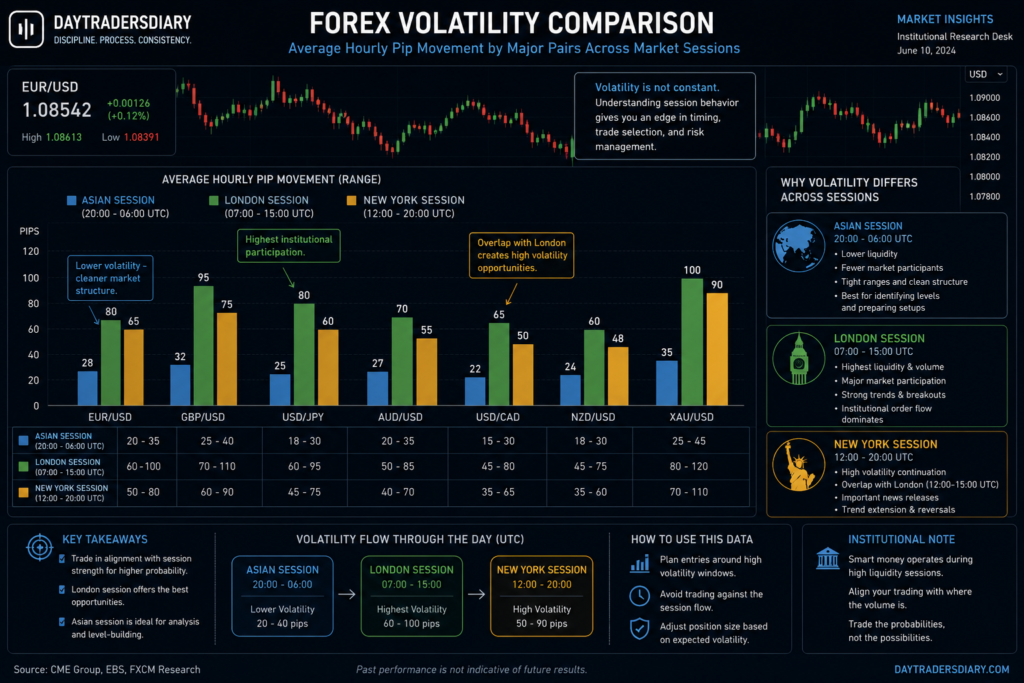
The Bank for International Settlements’ Triennial Central Bank Survey estimates that the global currency market processes trillions of dollars in volume every day. However, liquidity is not constant during the trading day. The bulk of activity is still concentrated in the London and New York overlap.
What does this signify for day traders?
This leads to the Asian session being less volatile, with tighter trading ranges and slower price action than the later sessions.
The Bank for International Settlements and prominent institutions such as JPMorgan and the CME Group have produced liquidity studies in the market that regularly reveal that the market participation changes widely during the day.
This is both good and bad for traders.
The downside is evident. Large directional moves are not as prevalent.
Often the advantage is overlooked. When volatility contracts, market structure tends to be cleaner, false breakouts can become easier to recognise, and support and resistance levels often have greater significance.
Why Many Traders Struggle During the Asian Session
The biggest mistake traders make is expecting movement that does not fit the session.
A trader accustomed to London volatility may expect GBP/USD to travel 80 or 100 pips overnight. When the pair moves only 20 pips, frustration begins to build.
This frustration leads to poor decisions.
Stops become tighter. Entries become impulsive. Patience disappears.
The reality is that the Asian session rewards traders who understand probability rather than excitement.
Instead of hunting for major trends, successful Asian session traders often focus on range behavior, liquidity zones, session highs and lows, and preparation for future market opens.
The session is often more about positioning than prediction.
The Currency Pairs That Work Best
Not all forex pairs behave in the same way during Asian hours.
The session naturally favours currencies tied to the region.
The most interesting activity usually involves pairs with the Japanese yen, Australian dollar and New Zealand dollar.
Japanese institutional participation regularly puts the USD/JPY in the spotlight.
AUD/USD is susceptible to Australian economic releases and fluctuations in regional mood.
NZD/USD can spike on New Zealand data releases.
Meanwhile, pairs such as EUR/GBP may spend significant portions of the session moving sideways as European participants remain absent.
Understanding this difference alone can dramatically improve trade selection.
A Practical Framework for Trading the Asian Session
When I read journals of consistently profitable traders, I see that their thinking going into the Asian session is a totally different perspective than they had going into London.
Their process usually begins before Tokyo opens.
First, they examine the previous day’s high and low. These levels frequently influence overnight trading activity.
Next, they identify major support and resistance zones on higher timeframes.
Then they assess whether the market is likely to remain range-bound or whether a catalyst exists that could create unusual volatility.
This creates a working hypothesis.
For example, if USD/JPY has spent three consecutive sessions trading inside a narrow range while no major economic events are scheduled, a trader may anticipate continued consolidation.
In this scenario, buying near support and selling near resistance often offers a better probability than chasing breakouts.
The opposite can occur when important Australian employment data or a Bank of Japan announcement is scheduled.
Under those conditions, breakout opportunities become more attractive.
The key is adapting to the environment rather than forcing a preferred strategy.
The Asian Range Strategy
One of the most effective approaches involves trading the established session range.
Price frequently develops a clearly defined upper boundary and lower boundary during Asian trading hours.
Instead of predicting direction, traders focus on reactions at these extremes.
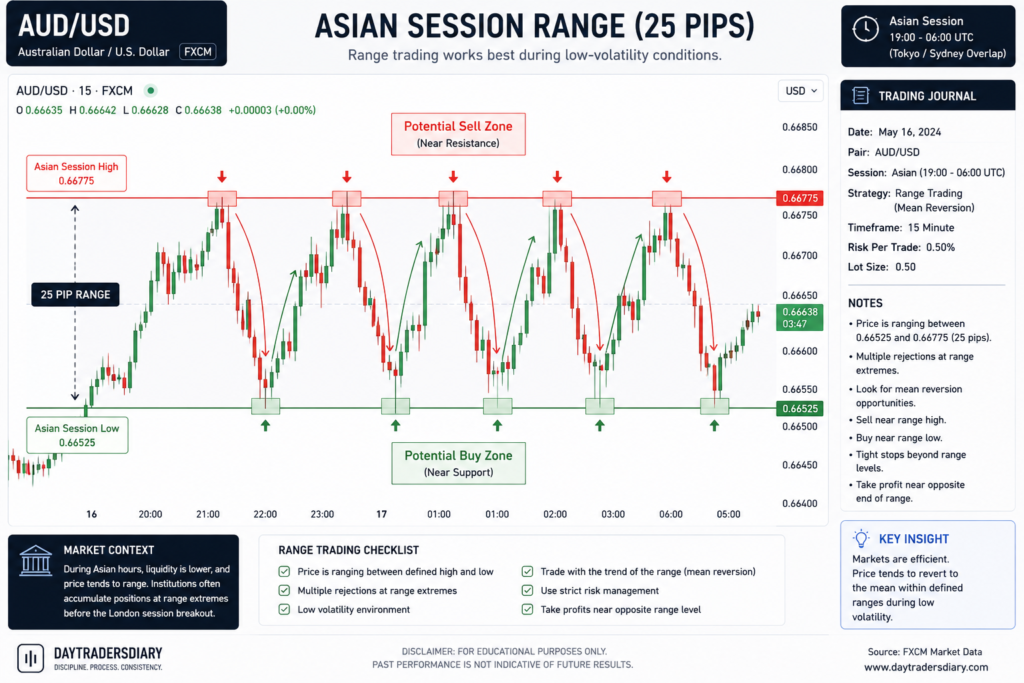
Imagine AUD/USD trading inside a 25-pip range for several hours.
When price approaches resistance, traders look for evidence of rejection.
When the price approaches support, traders look for signs of buying pressure.
The strategy works because lower volatility often encourages mean reversion rather than aggressive trend expansion.
However, this approach fails when significant news enters the market.
Range traders who ignore economic catalysts often find themselves trapped in genuine breakouts.
This is why understanding the economic calendar remains essential regardless of the session.
Trading Asian Session Breakouts
Breakouts do occur during the Asian session, but they require different evaluation criteria.
Many traders make the mistake of treating every range breach as a valid breakout.
Professional traders see past.
They analyse volume involvement, momentum strength, market context, and higher-time-frame structure.
A breakout after hours of consolidation at a key daily resistance level is more meaningful than a random price increase within a bigger trading range.
One of the most useful questions you can ask is simple:
Is this breakout creating new information for the market?
If the answer is yes, continuation becomes more likely.
If the answer is no, the move often fades quickly.
How the Asian Session Sets Up London Trades
One of the most overlooked aspects of Asian trading is its relationship with the London open.
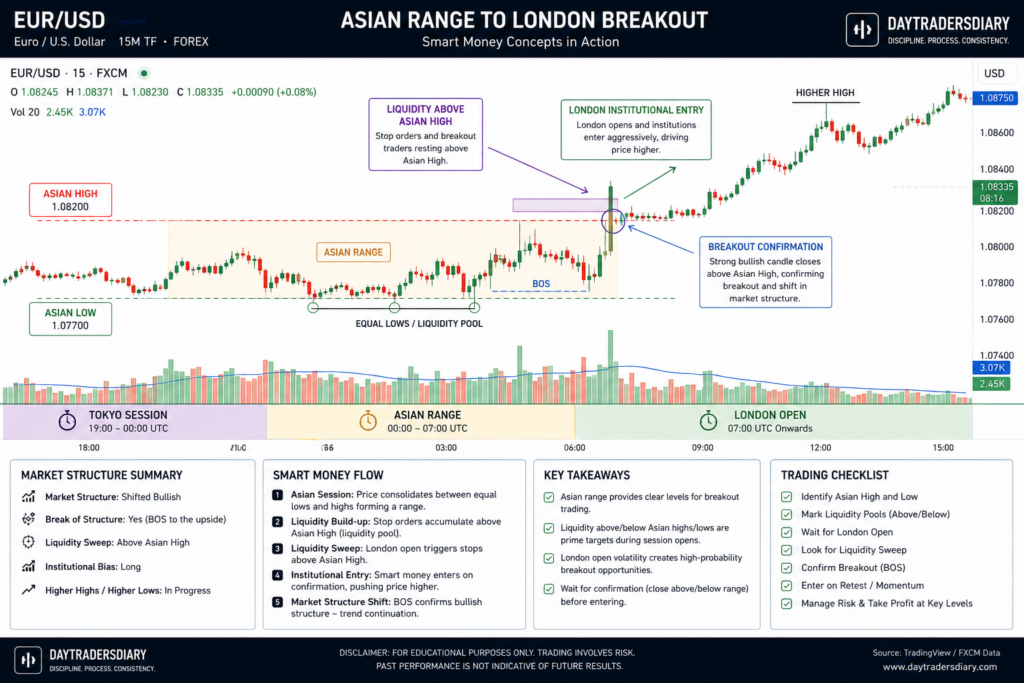
Many institutional traders use Asian session highs and lows as reference points.
These levels frequently become liquidity targets once European traders enter the market.
This means the Asian session is not always about finding trades.
Sometimes it is about collecting information.
If London opens above the Asian high with strong momentum, it can signal directional intent.
If London immediately rejects an Asian breakout, it may reveal a false move.
Understanding this relationship helps traders think beyond a single session and view the market as a continuous auction process.
For traders interested in improving this skill, our market structure trading guide provides additional context on how session highs and lows influence larger directional moves.
Risk Management During the Asian Session
One of the hidden dangers of Asian trading is overconfidence.
Because volatility is lower, traders often reduce stop distances excessively.
A five-pip stop may appear logical in a quiet market, but even low-volatility environments produce normal fluctuations.
This creates a dangerous cycle where traders experience repeated stop-outs despite having the correct market direction.
The solution is not wider stops.
The solution is to calculate the position size relative to the stop distance properly.
It is here where most traders underestimate risk. A Position Size Calculator takes the uncertainty out of trading and guarantees each trade is in accordance with account risk parameters regardless of the volatility of the session.
The aim is to be consistent, not to capitalise on every opportunity.
Journaling Asian Session Performance
One exercise transformed my own understanding of session trading.
I began separating trades by session.
Instead I looked at London transactions, New York trades and Asian trades individually, rather than the aggregate performance.
Eye-popping outcomes.
Some configurations did quite well during Asian hours. Some did poorly all the time.
Without session-specific journaling, those patterns remained hidden.
Using a Trade Journal Template allows traders to identify whether profitability comes from strategy quality or simply from trading the right environment.
The best traders do not just track wins and losses.
They track context.
Scaling an Asian Session Edge
Developing a profitable strategy is only one part of the equation.
Capital matters.
A trader consistently generating returns from Asian session opportunities may eventually discover that account size becomes the primary limitation rather than strategy quality.
This is one reason many experienced traders explore evaluation programs offered by firms such as The5ers, FTMO, and FundedNext.
These programs are not shortcuts to profitability.
They are opportunities to access larger capital allocations after demonstrating consistency and risk discipline.
A trader who can repeatedly execute a proven Asian session strategy often possesses exactly the qualities these evaluations seek.
If your process is consistent but your account size limits growth, exploring a The5ers evaluation account may be a logical next step.
Common Mistakes That Destroy Asian Session Performance
The largest errors are amazingly predictable.
A low-volatility environment with London-style breakout expectations dictated by traders.
They ignore session properties.
They trade unsuitable currency pairs.
They fail to adjust risk management.
Most importantly, they become impatient.
Patience is not simply a psychological advantage during the Asian session.
It is part of the edge itself.
The traders who succeed understand that slower movement does not mean lower opportunity. It simply requires a different approach.
Final Thoughts
The Asian session is not a smaller version of London.
It is a completely different market environment with its own strengths and weaknesses.
Once you stop expecting explosive movement and start focusing on structure, liquidity, and session behavior, opportunities become easier to identify.
For your next week of trading, try a simple experiment.
Spend less time searching for big moves and more time studying how the price reacts around the Asian session high and low. Record your observations in a journal and review them after ten trading days.
You may discover that some of the market’s most valuable information appears during its quietest hours.
As a next read, explore our guide on Forex Market Structure to understand better how session highs, lows, and liquidity zones shape price movement throughout the trading day.
FAQs
What is the Asian session in forex trading?
The Asian session is when the major Asian financial markets are open, notably Tokyo. It is typically less volatile than London and New York.
Which forex pairs are best for the Asian session?
USD/JPY, AUD/USD, NZD/USD, AUD/JPY, and NZD/JPY are among the most actively traded pairs during Asian hours.
Is the Asian session good for day trading?
Yes, but it requires a different approach. Range trading, support and resistance strategies, and session-based analysis often perform better than aggressive breakout strategies.
What time does the Asian forex session start?
The Asian session often starts with the Sydney market and picks up speed when Tokyo opens. The exact times depend on timezone and daylight-saving changes.
Can beginners trade the Asian session?
In fact, many newcomers find the Asian session to be easier as the volatility is frequently lower and the price action can be more structured. That said, adequate risk management still remains a must.
Why are Asian session highs and lows important?
These levels are often used as liquidity zones and reference points for traders entering the market throughout the London session so it’s good to keep an eye on them.