
Inside bars look simple.
Too simple.
That’s exactly why most traders lose money trading them.
You see a small candle inside a larger one, mark the high and low, and wait for a breakout. Price breaks, you enter, and within minutes it reverses and stops you out.
After a few losses, you start thinking inside bars don’t work.
The truth is they do work. But not in the way most traders use them.
Inside bars are not breakout signals. They are compression signals. If you treat them like confirmation instead of context, you end up trading noise instead of opportunity.
This guide breaks down how experienced traders actually use inside bars in day trading, when they matter, and when they should be ignored.
What the Data Actually Tells You About Inside Bars
Most retail material sees within bars as separate patterns. Research done by institutions suggests something entirely different.
The Bank for International Settlements says that currency markets are not based on discrete patterns, but on order flow and liquidity cycles. An inside bar usually means that people are taking a break from trading instead of making a decision about which way to go.
CME Group data on intraday volatility shows that periods of compression tend to precede expansion, especially during high-volume sessions. Inside bars are one visual representation of that compression.
Barclays FX strategy research has also pointed out that breakouts from low-volatility ranges are more likely to succeed when they align with broader market positioning and session flows.
For a trader, this changes everything.
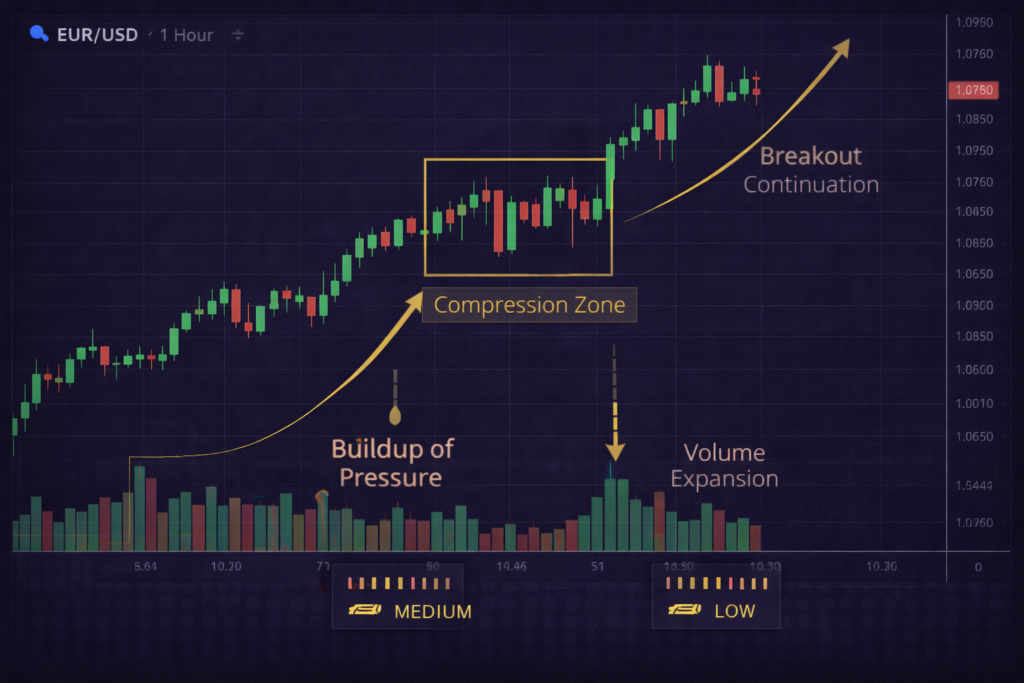
An inside bar is not telling you where price will go. It is telling you that the market is building energy. Your job is to understand where that energy is likely to be released.
What an Inside Bar Really Represents
When you strip it down, an inside bar is simply a range within a range.
The previous candle sets a boundary. The inside bar shows hesitation within that boundary.
But hesitation can mean different things depending on context.
In a strong trend, it often signals continuation. The market pauses, absorbs liquidity, and then pushes further in the same direction.
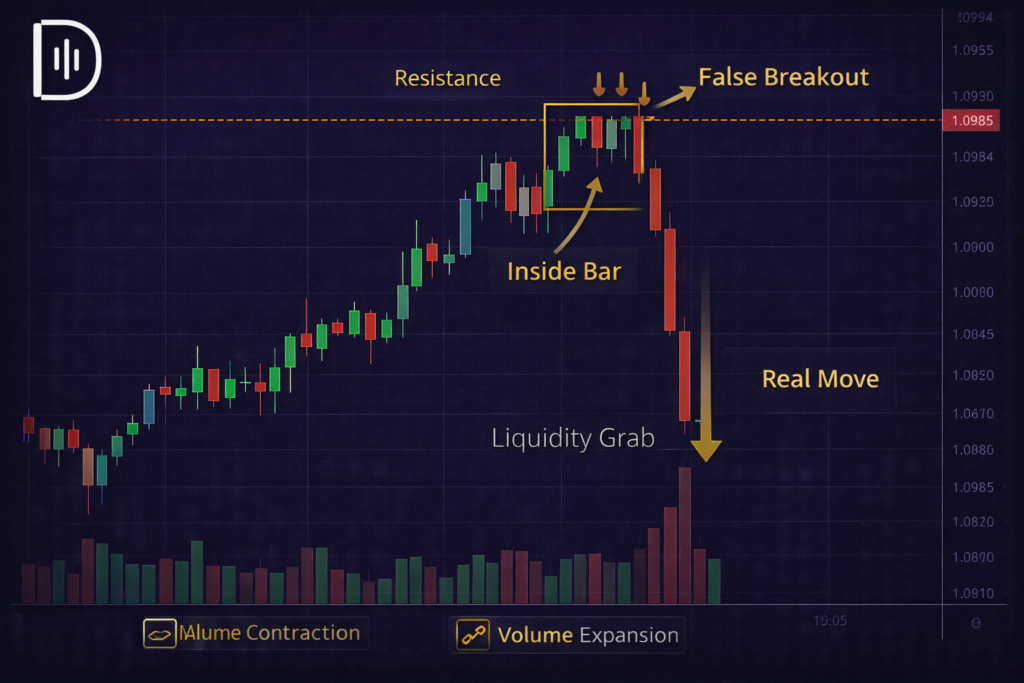
At key levels, it can signal indecision before a reversal or a fake breakout.
In low liquidity environments, it can mean nothing at all.
The mistake most traders make is assuming every inside bar has equal importance. It doesn’t.
A Practical Framework for Trading Inside Bars Intraday
Start by ignoring the inside bar itself.
Instead, focus on where it forms.
If an inside bar appears in the middle of a random range, it has no edge. It is just noise. But if it forms after a strong move or at a key level, it becomes meaningful.
In a trending market, an inside bar often acts as a continuation setup. Price moves strongly, pauses with an inside bar, and then breaks in the direction of the trend. The key here is alignment. You are not trading the pattern. You are trading the trend resuming.
Now consider a different scenario.
Price reaches a clear support or resistance level, prints an inside bar, and then breaks one side aggressively before reversing. This is where many traders get trapped. The initial breakout is often a liquidity grab.
The real move starts after that failure.
So instead of blindly trading breakouts, you start asking better questions. Where is liquidity sitting? Who is likely to get trapped? What happens if the breakout fails?
That shift in thinking is what separates pattern traders from decision-based traders.
Entry Logic That Actually Works
The biggest upgrade you can make is changing how you enter.
Most traders place pending orders above and below the inside bar and hope for the best. That approach works in clean trends but fails badly in choppy or manipulated conditions.
A more controlled approach is to wait.
If price breaks the inside bar high in an uptrend, you don’t have to chase it. Let the market show follow-through. If momentum continues, you can enter on a small pullback or continuation pattern.
If the breakout fails and price returns inside the range, that is valuable information. It tells you the breakout was weak. In some cases, it can even set up a reversal trade.
This is where your understanding of market structure becomes critical. If you are unsure about this, revisit your study of trend continuation setups and structure-based trading approaches.
Why Session Timing Changes Everything
Inside bars behave very differently depending on when they form.
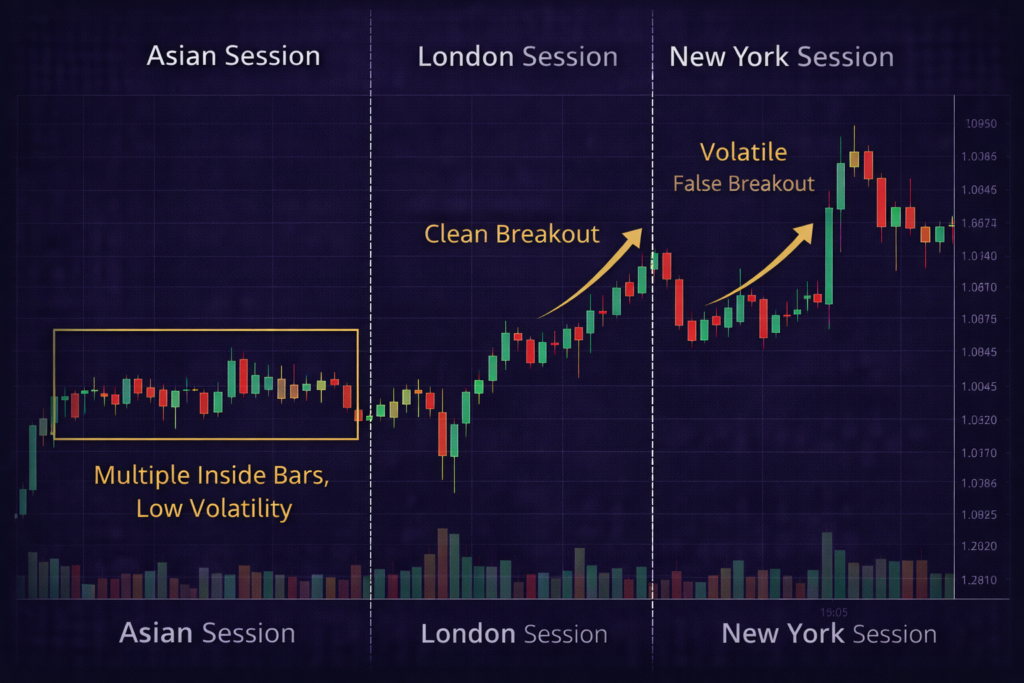
During the Asian session, inside bars are common because volatility is low. Most of them do not lead to meaningful moves.
During the London session, inside bars can act as continuation patterns after the initial volatility spike. This is where clean breakouts often happen.
During the New York session, inside bars can precede sharp moves driven by news or institutional flows. But they can also lead to false breakouts due to increased volatility.
If you have already explored session-based strategies like trading the London session or New York session, you will notice how the same pattern behaves differently across time.
Ignoring session context is one of the fastest ways to lose consistency.
When Inside Bars Fail
Inside bars fail most often in sideways markets.
If the market is ranging and you trade every breakout, you will get chopped up. Price will break one side, reverse, break the other side, and repeat.
They also fail when traders enter too early without confirmation. A small range breakout in a weak environment does not have the strength to sustain a move.
Another common failure comes from ignoring higher timeframe direction. Trading an inside bar against a strong higher timeframe trend reduces probability significantly.
The key lesson is simple. The pattern is not the edge. The context is.
Risk and Execution: The Hidden Edge
Even with a solid setup, execution determines your outcome.
Inside bar trades often have tight ranges, which can make position sizing tricky. Traders either overleverage because the stop looks small or widen stops when price moves against them.
This is where most traders miscalculate risk.
Using a position size calculator removes emotion from the equation. It ensures that every trade is sized based on risk, not confidence.
Inside bar setups can offer excellent risk to reward when traded correctly, but only if your execution remains consistent.
Journaling Inside Bar Trades for Real Improvement
If you want to get better at trading inside bars, you need to track more than just outcomes.
Start paying attention to the context of each trade.
Where did the inside bar form?
Was the market trending or ranging?
Which session did it occur in?
Did the breakout show follow-through or immediate rejection?
Over time, these details will show you where your edge actually lies.
This is where a structured trade journal template becomes powerful. It allows you to turn experience into data and refine your strategy based on evidence rather than memory.
Scaling the Strategy With Capital
Once you develop consistency with inside bar setups, the next limitation is usually capital.
This is where many traders consider prop firm models.
Firms like The5ers, FTMO, and E8 Funding provide access to larger capital while enforcing strict risk rules. These rules actually benefit traders who rely on structured setups like inside bars.
Because inside bar trading requires patience and selectivity, it fits well within evaluation models.
If your data shows a repeatable edge, exploring a The5ers evaluation account can be a logical step. It lets you expand without putting yourself at more danger, which is how a lot of skilled traders do it.
FAQs
Are inside bars good for day trading?
Yes, but only in the appropriate circumstances. They give you good setups when the market is trending or at important levels. They commonly fail in ranges.
What timeframe is best for inside bars?
Lower time frames are good for day trading, but using them with larger timeframes makes them more accurate.
Should I trade every inside bar breakout?
No. Selectivity is key. Most inside bars are noise unless they form in meaningful locations.
Do inside bars work better in trends or reversals?
Continued patterns are more trustworthy, but they can also indicate traps around critical levels.
Closing: The Shift That Changes Your Results
Bars on the inside don’t mean you should do anything.
They tell you to pay attention.
If you stop thinking of them as automatic breakout trades and start thinking of them as compression in a bigger story, your choices will change radically.
For your next 20 trades, only use inside bar setups that fit with a clear trend or form at a critical level. Forget everything else.
Keep an eye on the results.
You will start to see that fewer trades, taken with better context, outperform constant activity.
As your next step, revisit your approach to scalp setups in forex or trend continuation strategies so you can integrate inside bars into a broader, more complete trading system.