
Most traders think volatility creates opportunity.
In reality, volatility only creates opportunity if you know how to measure it.
I’ve seen traders increase position size because the market “looks slow,” only to get caught in an unexpected expansion. I’ve also seen traders avoid perfectly good setups because they mistake healthy volatility for randomness. Neither problem comes from poor technical analysis. It comes from misunderstanding what volatility is actually telling you.
This is where the Average True Range (ATR) becomes much more than another indicator sitting below your chart.
Used correctly, ATR helps you understand how much the market is moving. Combined with volatility analysis, it helps answer the questions that matter most before every trade:
Can this market realistically reach my target?
Is my stop too tight for today’s conditions?
Should I even be trading this session?
Professional traders rarely think in fixed numbers. They think in probabilities and market conditions. ATR is one of the simplest ways to quantify those conditions without adding unnecessary complexity.
This guide will show you how seasoned day traders integrate ATR with volatility to better identify, execute and manage trades in FX, indices, stocks, and futures.
Why ATR Still Matters in Modern Markets
Many indicators attempt to predict direction.
ATR does something more useful.
It measures how much the price is actually moving.
Unlike oscillators that constantly generate buy or sell signals, ATR provides context. Context is often what separates disciplined traders from impulsive ones.
Suppose EUR/USD normally produces an intraday ATR of 65 pips.
Today, after the London open, ATR is already approaching 55 pips before New York begins.
That immediately tells you something important.
Much of today’s expected movement has already occurred.
Instead of chasing breakouts, an experienced trader becomes more selective because the remaining opportunities may be limited.
The opposite scenario is equally valuable.
If ATR remains unusually compressed halfway through the session, it may indicate that volatility expansion is still likely ahead.
ATR does not forecast direction.
It helps to estimate opportunities.
What Research Says About Volatility
Volatility has been studied extensively because it directly affects market behavior, liquidity, and risk.
At CME Group we often discuss the impact of volatility on price, liquidity, and trading choices in the futures market. Their research consistently shows that volatility affects position sizing far more than it affects direction bias.
The CBOE Volatility Index (VIX) has long shown that volatility itself is cyclical. Low volatility regimes tend to evolve into expansion phases and panic spikes tend to calm down with time.
Research published by J.P. Morgan Asset Management also highlights volatility clustering. Large moves tend to be followed by additional large moves, while quiet periods often remain quiet until a catalyst appears.
For day traders, this has practical implications.
Markets rarely behave randomly from one hour to the next.
Instead, they alternate between contraction and expansion.
ATR is one of the easiest ways to identify which environment you’re trading in.
Instead of asking if the market is bullish or bearish, veteran traders would usually ask a different question first:
Is there enough movement to warrant taking this trade?
That little adjustment of mindset makes all the difference.
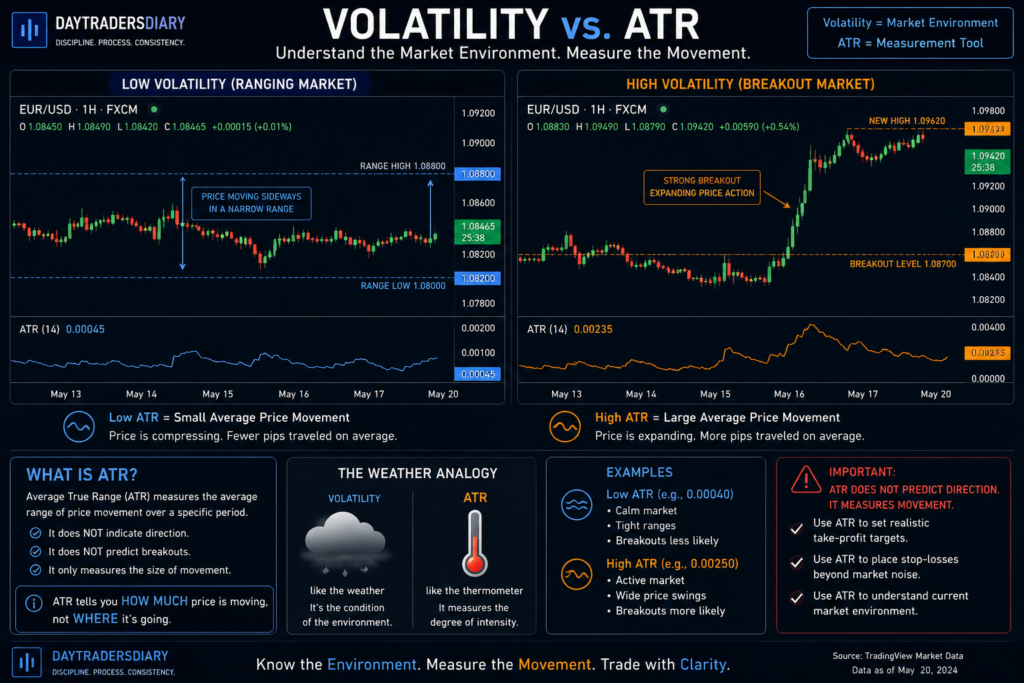
ATR Measures Movement. Volatility Explains the Environment
Many traders incorrectly use these terms interchangeably.
They’re related, but they’re not identical.
Volatility describes the overall behavior of the price.
ATR measures the average size of recent price movement.
Think of volatility as weather.
Think of ATR as the thermometer.
The weather tells you whether conditions are changing.
The thermometer tells you exactly how hot or cold those conditions are.
When both align, trading decisions become far more objective.
The Three-Step ATR and Volatility Framework
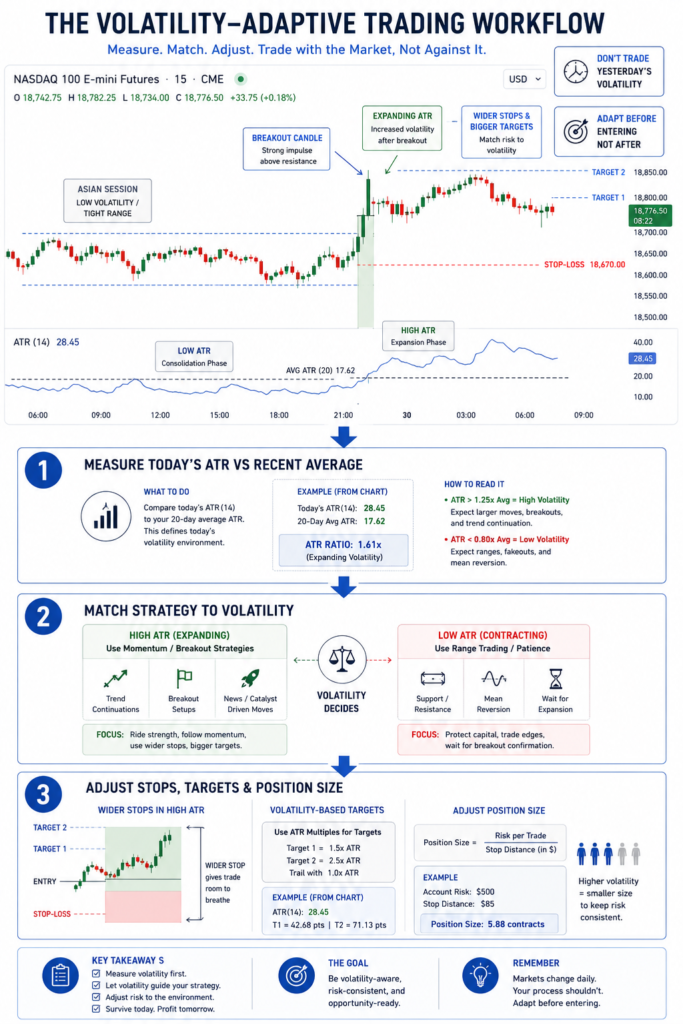
Instead of checking ATR after entering a trade, professional traders evaluate it before making any decision.
The first step is measuring today’s volatility against recent history.
If today’s ATR is significantly below its recent average, expect slower conditions. Breakout strategies may struggle, while range trading tends to perform better.
In general, when the ATR expands fast, the probability of momentum methods is high.
Step 2: Align your plan with existing volatilities.
In high ATR conditions, scalping may need larger stops and faster execution.
Swinging intraday positions during compressed volatility often requires more patience, as targets may take longer to develop.
Many traders lose money simply because they apply yesterday’s strategy to today’s market.
The third step is adjusting expectations.
If GBP/USD has already completed nearly all of its daily ATR before lunchtime, expecting another full-session trend becomes statistically less likely.
ATR helps traders avoid unrealistic profit targets.
Using ATR in Intraday Trading
Many traders search for “How to use ATR in intraday trading,” expecting another indicator setup.
The real advantage lies in decision-making rather than in signals.
Imagine the Nasdaq opens after major economic data is released.
ATR doubles its recent average in thirty minutes.
Instead of just raising their trade frequency, experienced traders ask:
Are the stops too narrow?
Should position size go down?
Is it better to collect some earnings sooner?
ATR answers these questions objectively.
Markets don’t become easier because volatility increases.
They become faster.
Execution quality becomes more important than prediction.
If you already trade opening ranges, you’ll notice this concept aligns well with our guide on opening range breakout strategies, where volatility often determines whether breakouts continue or quickly reverse.
ATR Helps Build Better Stop Losses
One of the most typical mistakes beginners make is putting stops at unreasonable distances.
Five pips.
Ten points.
Twenty cents.
Markets don’t care.
Stops should reflect market behavior rather than personal comfort.
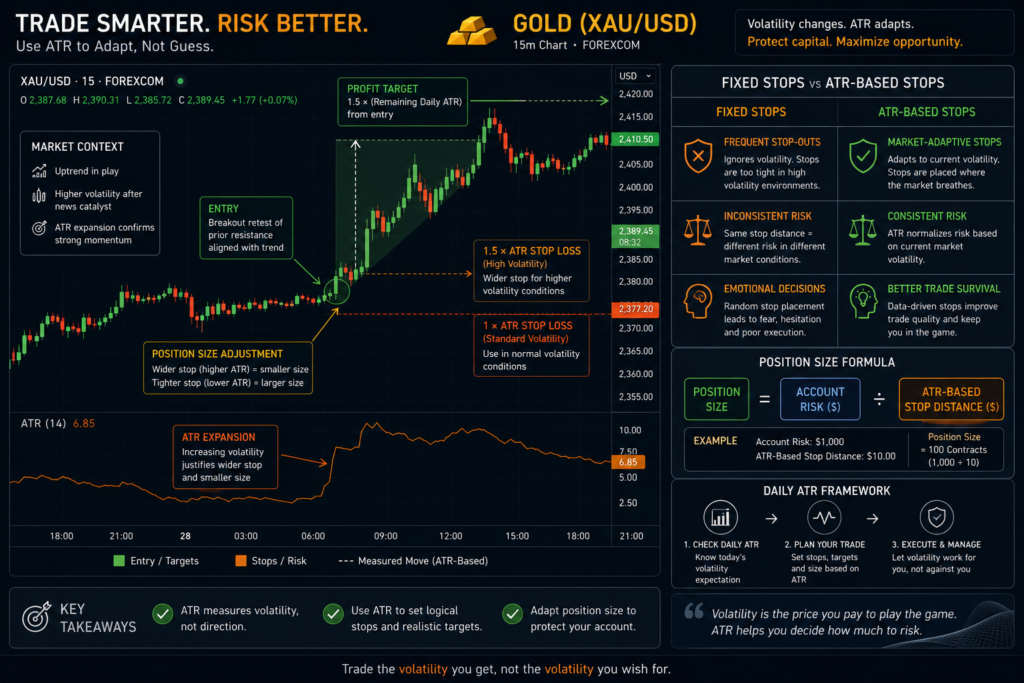
Many experienced traders build stops using multiples of ATR.
For example:
A quiet market may justify a stop near one ATR.
A highly volatile news session may require one-and-a-half or even two ATR.
The objective isn’t making stops larger.
The objective is to prevent normal market noise from stopping out otherwise valid trades.
If your stop consistently gets hit before price moves in your direction, ATR often explains why.
ATR Also Improves Profit Targets
Risk management is not only about limiting losses.
And it’s also about managing expectations.
Assume Gold’s average daily ATR is $45.
If the price has already risen by $40 before your entry, then predicting a further $50 move may not be reasonable without fresh catalysts.
ATR doesn’t eliminate winning trades.
It prevents unrealistic ones.
Professional traders frequently avoid low-probability trades simply because expected movement has already been exhausted.
Volatility Expansion Is Often More Valuable Than Direction
Many traders obsess over whether the price will rise or fall.
Professionals often focus first on whether the price will move enough.
A breakout with expanding ATR usually attracts momentum traders.
The same breakout with declining ATR often fades quickly.
Direction counts.
Participation is very important.
Expansion of volatility invites participation.
Participation keeps trends going.
When ATR Can Mislead Traders
Like every indicator, ATR has limitations.
ATR responds.
It does not forecast.
ATR might remain high long after the market has calmed down from big news releases.
This can lead traders to overestimate opportunities in the future.
ATR also suffers during sudden volatility shocks as averages are by definition lagging.
That’s why experienced traders combine ATR with market structure, session timing, liquidity, and price action instead of using it in isolation.
If you’re already studying volatility-based trading, our article on avoiding common scalping mistakes explains why ignoring changing market conditions often leads to repeated stop-outs.
Risk Management Is Where ATR Creates the Biggest Edge
Most losses in trading are not due to bad entry points.
These are due to improper sizing.
If volatility doubles, and position size stays the same, risk quietly doubles too.
Professional traders understand this.
This is why position sizing should adapt to ATR rather than remain fixed.
Instead of risking the same lot size on every trade, calculate your position based on the stop distance and your account risk.
This is where most traders miscalculate risk. Using the Position Size Calculator removes much of the guesswork while keeping risk consistent across changing volatility environments.
Consistency matters far more than finding the perfect entry.
Building an ATR Review Process
Most traders record wins and losses.
Very few record market conditions.
That makes improvement difficult.
Start tracking ATR alongside every trade.
Record whether volatility was expanding, contracting, or average.
Review your journal after every fifty deals.
Patterns generally show up.
Your breakout trades will thrive under expanding ATR.
Your reversals may only succeed after ATR achieves depletion.
Such observations are rarely the result of recollection alone.
Using the Trade Journal Template makes these reviews more objective than emotional.
Your journal should reveal where your strategy naturally performs best.
ATR Alone Doesn’t Scale Careers
Many traders eventually discover they have a repeatable edge.
Then they encounter another limitation.
Capital.
A strategy generating 2% monthly returns behaves very differently on a $2,000 account than on a six-figure account.
This explains why many consistently profitable traders eventually explore evaluation programs offered by proprietary trading firms.
Firms such as The5ers, FTMO, Topstep, and FundedNext all provide structured evaluation models designed to assess consistency before allocating larger trading capital.
The 5ers, in particular, appeal to many forex traders because their programs emphasize long-term consistency rather than short-term gambling.
Evaluation accounts are not shortcuts.
They provide access to greater capital once discipline has already been demonstrated.
If your ATR-based risk management produces stable results over several months, exploring a The5ers evaluation account can become a logical next step toward scaling your trading business.
Frequently Asked Questions
What does ATR measure in trading?
ATR is the average size of recent price fluctuation. It can go up or down in price and it doesn’t say. Instead, it gives traders a sense of what’s going on in the market right now so they may manage their risk accordingly.
How do traders use ATR in intraday trading?
Intraday traders utilise ATR to gauge probable price movement, set stop losses, create realistic profit goals and alter position size as volatility changes during the session.
Is ATR useful for forex trading?
Yes. ATR is popular in Forex because currency pairs are continually altering volatility from session to session. It helps traders adapt to the conditions of London, New York and Asian markets.
Should ATR be used alone?
No, ATR is best used with price movement, market structure, support and resistance and session analysis. It gives context, not trade signals.
What ATR setting is most common?
The most frequent option for the 14-period ATR, remains the most common setting since it is the best mix of responsiveness and stability in most markets and time frames.
Final Thoughts
The biggest lesson ATR teaches isn’t where price will go.
It’s whether your expectations match reality.
Many trading mistakes happen because traders expect yesterday’s movement to repeat today. Markets don’t operate that way.
Volatility expands.
Volatility contracts.
Successful traders adapt.
The next time you prepare for a trading session, don’t begin by asking where the price might move.
Ask whether today’s volatility supports your strategy in the first place.
That single habit can improve entries, exits, position sizing, and overall consistency more than adding another indicator ever will.
For your next read, explore our in-depth guide on How to Avoid Common Scalping Mistakes, where many of these volatility concepts are applied to real intraday execution.