
Every trader remembers the first time they got stopped out by a move that made absolutely no sense.
Price breaks above resistance, triggers your buy entry, moves a few pips higher, then suddenly reverses and drops straight through your stop loss. Ten minutes later, it continues in the original direction without you.
Most traders blame manipulation.
Others blame bad luck.
In reality, many of these moves are driven by liquidity.
After years of trading currencies, one lesson becomes impossible to ignore: price rarely moves randomly. Markets constantly seek liquidity because large participants need counterparties to execute substantial positions.
The traders who understand liquidity start seeing the market differently. They stop viewing support and resistance as simple lines on a chart and begin viewing them as areas where orders are concentrated.
That shift can completely change how you approach entries, exits, stop placement, and risk management.
This guide explains what forex market liquidity is, how liquidity zones develop, why liquidity sweeps occur, and how active traders can use these concepts to improve decision-making.
Why Liquidity Matters More Than Most Traders Realize
A lot of retail traders just look at indicators.
The professional traders trade order flow, positioning and liquidity.
It’s simple.
Liquidity is essential for markets to function.
The worldwide foreign exchange market is the largest financial market in the world with trillions of dollars traded daily, according to the Bank for International Settlements (BIS) Triennial Survey.
That volume creates opportunities for traders because large buyers and sellers can generally execute orders without causing excessive price disruption.
The key takeaway is not the size of the forex market itself.
The important lesson is understanding that institutional participants constantly need access to liquidity pools where sufficient orders exist to fill large positions.
Price often moves toward those pools.
Understanding that concept helps explain many market behaviors that seem confusing to newer traders.
What Is Forex Market Liquidity?
Liquidity is the ease with which you can buy or sell a currency pair without it having a substantial impact on the price.
In a very liquid market there are lots of buyers and sellers making orders.
A low-liquidity market contains fewer participants and often experiences wider spreads, slower execution, and more erratic price behavior.
Pairs such as EUR/USD, GBP/USD and USD/JPY tend to have the most liquidity as they experience significant institutional activity during the trading day.
Exotic currency pairs tend to have less liquidity as there are less people trading them on a regular basis.
For day traders, liquidity directly translates into deal quality.
More liquidity typically means narrower spreads, smoother execution and more predictable price action.
Less liquidity typically means more slippage and unpredictable volatility.
Understanding Liquidity Zones in Forex
One of the major fallacies in retail trading is that liquidity occurs everywhere equally.
It doesn’t.
Liquidity tends to cluster around obvious areas.
These areas are commonly called liquidity zones.
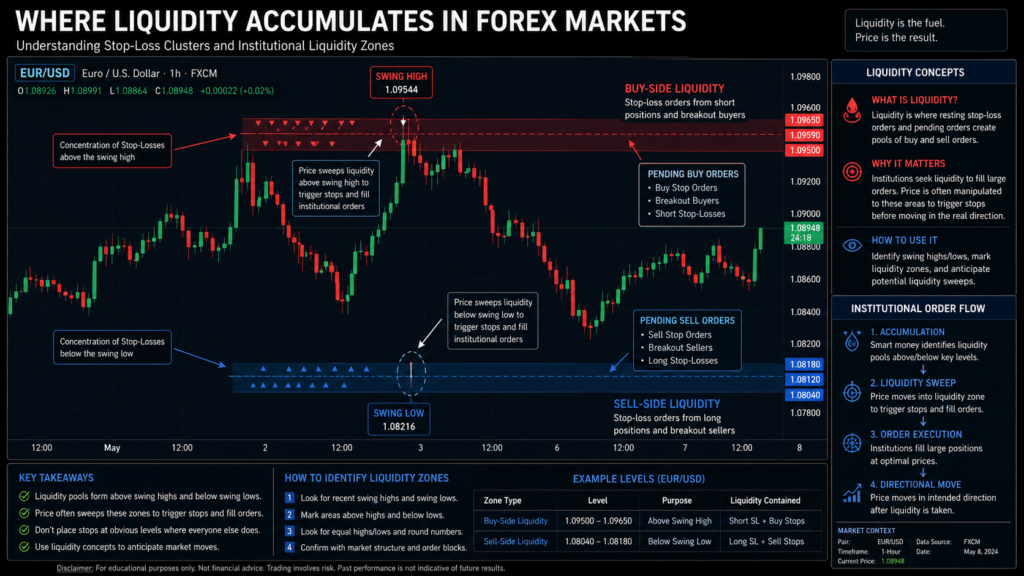
A liquidity zone is simply an area where large numbers of pending orders are likely concentrated.
Think about where most traders place stop losses.
Many place them:
Above recent highs
Below recent lows
“Support levels broken”
Above resistance levels
At round-number pricing levels
When thousands of traders are placing orders in similar places those become good targets for bigger market players looking for liquidity.
This is why price often accelerates when reaching obvious highs and lows.
The market is accessing available liquidity.
Types of Liquidity in Forex
Understanding different forms of liquidity can help traders interpret market behavior more accurately.
Buy-side liquidity generally exists above recent swing highs where buy stop orders and short-seller stop losses accumulate.
Sell-side liquidity typically exists below recent swing lows where sell stop orders and long-position stop losses accumulate.
There is also resting liquidity around psychological price levels.
Round numbers such as 1.1000, 1.2000, or 150.00 frequently attract significant order activity because traders naturally gravitate toward these levels.
Traders know how the market could react, knowing where these liquidity clusters are.
What Is a Liquidity Sweep in Forex?
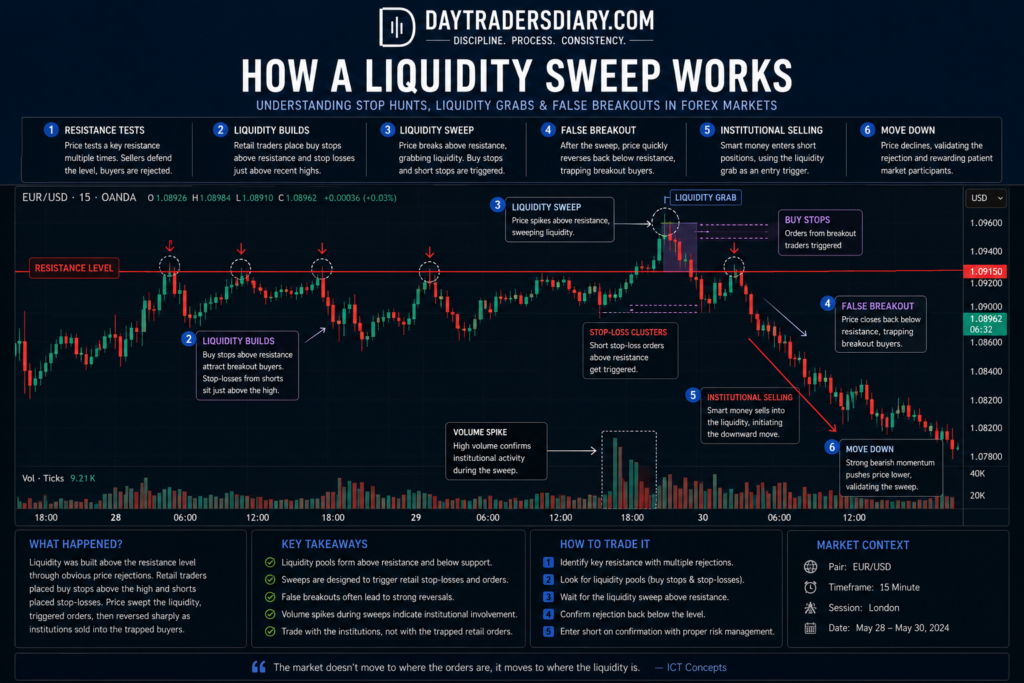
A liquidity sweep occurs when price briefly moves into a liquidity zone, triggers clustered orders, and then reverses direction.
This is one of the most misunderstood concepts in day trading.
Many traders assume the breakout is genuine.
Professional traders often wait to see whether the breakout can sustain itself.
Consider a practical example.
EUR/USD has failed multiple times near a resistance level.
Traders identify the level and place buy stop orders above it.
Short sellers place stop losses in the same area.
Eventually price breaks above resistance.
The breakout triggers those orders.
A large amount of liquidity suddenly becomes available.
Institutional participants can now execute larger positions.
If genuine buying interest does not exist beyond that level, price may reverse sharply.
This creates what many traders call a fake breakout.
In reality, the market simply collected liquidity before moving elsewhere.
Why Most Traders Misinterpret Liquidity Sweeps
Many traders view every breakout through a binary lens.
Either the breakout works or it fails.
Liquidity-based traders look deeper.
They ask:
Where are the stops located?
Who benefits from this move?
Has sufficient liquidity been collected?
What happens after the sweep?
The answer to those questions often provides more useful information than the breakout itself.
Some of the strongest reversals begin with aggressive liquidity grabs.
Likewise, some of the strongest trends begin only after liquidity has been cleared from one side of the market.
A Practical Liquidity Trading Framework
Have a plan instead than jumping on every breakthrough.
The first step is to find evident highs and lows on your timeframe of trading.
Second, identify probable locations for stop-loss clusters.
Third, monitor how price behaves when reaching those areas.
Fourth, watch for rejection, acceptance, or continuation after liquidity is taken.
Imagine GBP/USD trading in a range during the London session.
Price moves over range high.
Volume goes up.
A few moments later, the market is back in the range.
That reaction is a narrative.
The breakout drew buying but did not hold participation.
The failed breakout becomes more informative than the breakout itself.
This framework works particularly well when combined with articles on market structure, support and resistance, and breakout trading strategies available throughout DayTradersDiary.com.
The Relationship Between Liquidity and Trend Trading
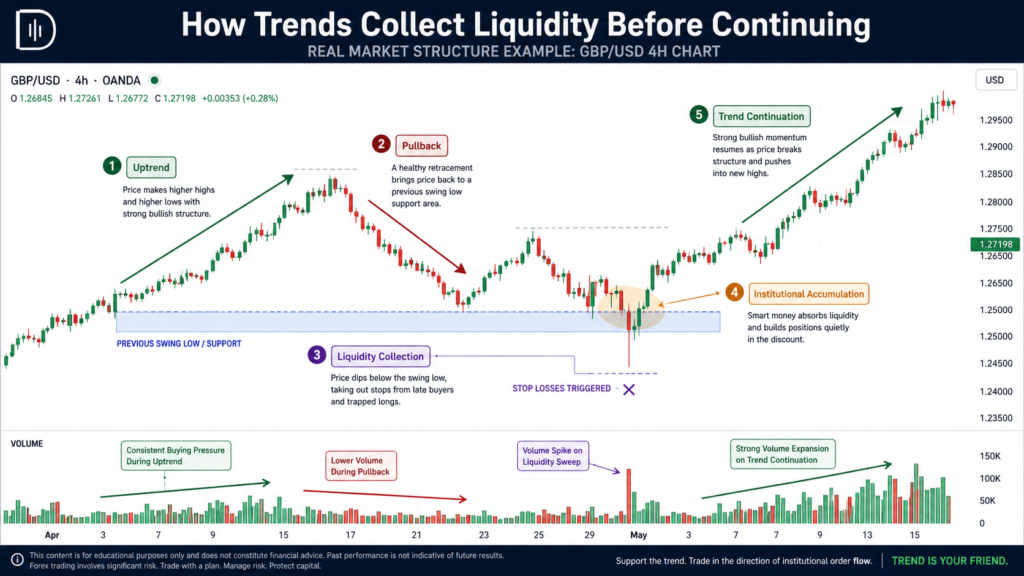
There are many pullbacks as the market looks for orders available before it continues in the main direction.
That is a fair argument for experienced traders to stay out of the way after big changes.
They recognise that continuation generally leads to liquidity gathering.
This is one reason experienced traders avoid entering after extended moves.
They understand that liquidity collection often precedes continuation.
When viewed through this lens, pullbacks become easier to understand.
They are not always signs of weakness.
Sometimes they are simply the market seeking fuel for the next move.
Risk Management Around Liquidity Events
One of the most common trading mistakes is placing stop losses exactly where everyone else places them.
The market does not know your stop location specifically.
But it does know where clusters of orders are likely concentrated.
This is where risk management becomes critical.
A trader risking 1% per trade while accounting for liquidity zones is often better positioned than a trader risking 3% while placing stops at obvious levels.
This is where many traders miscalculate risk. Using a Position Size Calculator removes guesswork and helps ensure position size remains aligned with account risk, regardless of stop placement.
Good risk management allows you to survive the inevitable periods when liquidity-driven moves create unexpected volatility.
Journaling Liquidity-Based Trades
Liquidity trading is an observational exercise.
Many lessons are not clear until after you have seen dozens of examples.
In recording trades, write down:
The liquidity zone we found
The sweep location
The market reaction afterward
Whether the move led to continuation or reversal
Over time, patterns begin emerging.
Some currency pairs react differently than others.
Certain sessions produce more reliable liquidity sweeps.
Specific market conditions create higher-probability opportunities.
Using a Trade Journal Template makes this process far more structured and easier to analyze over the long term.
Scaling an Edge Beyond Personal Capital
Liquidity understanding can improve entries, exits, and trade selection.
But eventually many traders encounter a different challenge.
Capital.
Even a strong strategy can generate limited dollar returns on a small account.
This is why many experienced traders explore evaluation programs offered by firms such as The5ers, FTMO, and TradeThePool.
These programs are not shortcuts to profitability.
They are opportunities to access larger capital allocations after demonstrating consistency and risk discipline.
The traders who succeed in these environments are usually the ones who already understand concepts like liquidity, market structure, and risk management.
If you’ve developed a repeatable edge and can execute it consistently, a The5ers evaluation account may be worth considering as a professional pathway for growth.
Final Thoughts
Liquidity is one of the most crucial principles in forex trading, but also one of the least understood.
Most traders learn the ins and outs of indicators over years but never learn the dynamics that move the market.
Once you begin viewing charts through a liquidity lens, many confusing market behaviors start making sense.
Breakouts, reversals, stop hunts, and pullbacks often become easier to interpret because you understand what price may be seeking.
For the next two weeks, spend less time searching for new indicators and more time marking potential liquidity zones before each trading session.
You may discover that the market has been leaving clues in plain sight all along.
As your next read, check out our article on market structure and trend trading to discover how liquidity plays a role in the larger picture of expert trade execution.
FAQs
What is forex market liquidity?
Forex market liquidity refers to how easily currency pairs can be bought or sold without causing major price changes. Higher liquidity generally leads to tighter spreads and smoother execution.
What is a liquidity zone in forex?
A liquidity zone is an area where large numbers of orders are concentrated, often around swing highs, swing lows, support, resistance, or psychological price levels.
What is a liquidity sweep in forex?
A liquidity sweep occurs when price moves into an area containing clustered orders, triggers those orders, and then often reverses direction.
Are liquidity sweeps the same as stop hunts?
Not exactly. Many traders refer to liquidity sweeps as stop hunts, but liquidity sweeps are simply the market accessing concentrated orders. They are a normal part of market function.
Which forex pairs have the highest liquidity?
Major currency pairs such as EUR/USD, USD/JPY, GBP/USD, and USD/CHF often offer the best liquidity.
How can day traders use liquidity concepts?
Day traders can use liquidity analysis to identify potential reversal zones, improve stop placement, avoid false breakouts, and better understand market behavior.