
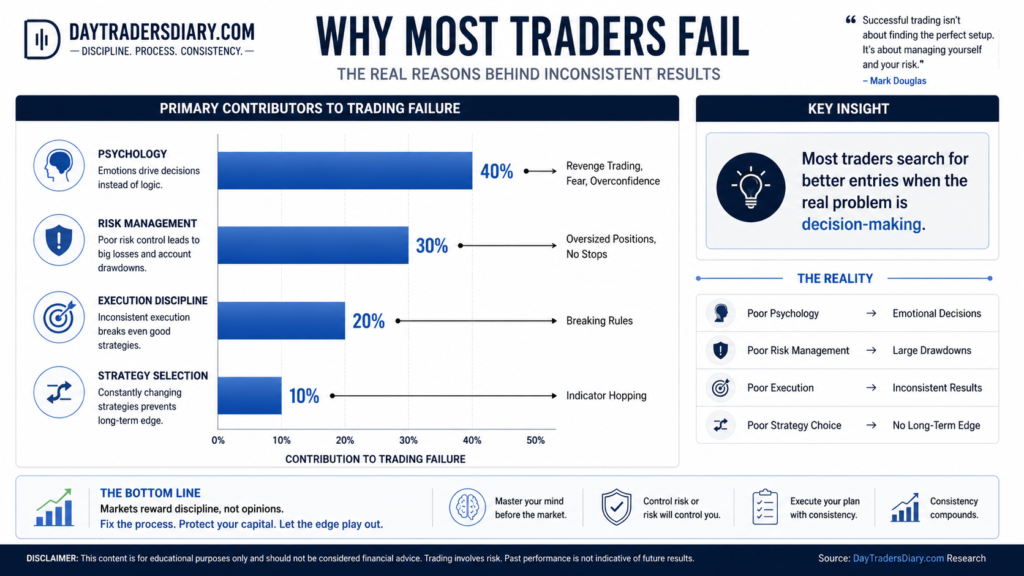
One of the biggest mistakes traders make is believing that better results come from finding a better indicator.
I’ve seen traders spend months jumping from one strategy to another, testing countless indicators, watching endless YouTube videos, and chasing every new trading trend. Yet their results never improve.
The reason is simple.
Most trading problems are not strategy problems.
They’re decision-making problems.
They’re psychology problems.
They’re risk management problems.
They’re experience problems.
The irony is that many of the lessons traders spend years learning through painful losses have already been documented by traders, psychologists, hedge fund managers, and market veterans who have lived through multiple market cycles.
The right trading book can save you months of frustration and sometimes thousands of dollars in avoidable mistakes.
This guide covers the top day trading books you must read, why they matter, and how to use them to accelerate your development as a trader.
Why Most Traders Read the Wrong Books
Many beginners look for books that promise a perfect strategy.
They search for the holy grail.
The problem is that markets constantly evolve.
A strategy that works in one environment may struggle in another.
What tends to remain valuable over time are books that teach:
Market behavior
Trader psychology
Decision-making
Probabilistic thinking
Research published by the CFA Institute and educational studies from the CME Group Education Center show that successful market participants typically focus on method, discipline and risk management rather than prediction.
That lesson appears repeatedly throughout the best trading books ever written.
The traders who improve fastest are usually the ones who focus on mastering principles rather than collecting strategies.
Trading in the Zone
Author: Mark Douglas
If I could recommend only one trading psychology book, this would probably be it.
Many traders believe their problem is technical analysis.
In reality, they often know exactly what they should do but fail to do it consistently.
They cut winners short.
They move stop losses.
They revenge trade.
They overtrade after a winning streak.
Trading in the Zone explains why these behaviors occur.
Douglas focuses heavily on probabilities and uncertainty.
His core message is simple.
No individual trade matters.
What matters is executing your edge consistently over a large sample size.
That mindset shift alone can transform a trader’s performance.
Market Wizards
Author: Jack D. Schwager
This book remains one of the most influential trading books ever published.
Instead of teaching a single strategy, Schwager interviews some of the most successful traders in the world.
What makes the book valuable is the diversity of approaches.
Some traders are trend followers.
Others are discretionary traders.
Some are macro traders.
Others focus on short-term opportunities.
Yet despite their differences, they share several common traits.
Strong risk management.
Discipline.
Patience.
Adaptability.
The book teaches an important lesson that many traders overlook.
There is no single path to profitability.
The Daily Trading Coach
Author: Brett Steenbarger
Most traders spend more time analyzing charts than analyzing themselves.
That imbalance creates problems.
The Daily Trading Coach focuses on performance improvement and self-development.
Steenbarger approaches trading from a psychological and performance coaching perspective.
The book is packed with practical exercises to develop your focus, discipline and emotional control.
For traders struggling with consistency, this book often provides more value than another strategy guide.
Reminiscences of a Stock Operator
By Edwin LeFevre
Written decades ago, the lessons are surprisingly pertinent.
The book is the story of great trader Jesse Livermore and the themes are ones that every modern trader will recognise.
Greedy.
Greed.
Scared.
Patience.
Speculation on the market.
Mistakes of the heart.
Technology is changing.
Human nature does not.
Hence, the book is still referenced by traders today.
Best Loser Wins
Author: Tom Hougaard
This book challenges many conventional beliefs about trading.
Hougaard argues that successful traders think differently about losses.
Most traders try to avoid losing.
Professional traders learn how to manage losses effectively.
The distinction sounds small.
In practice, it is enormous.
The book offers valuable insights into mindset, execution, and psychological resilience.
For active day traders, the lessons are particularly relevant.
One Good Trade
Author: Mike Bellafiore
Written from the perspective of a proprietary trading firm, One Good Trade provides a realistic look at professional trading environments.
What stands out is the emphasis on process.
Rather than chasing home runs, traders are encouraged to focus on executing quality trades consistently.
This aligns closely with how professional trading desks evaluate performance.
The book is especially useful for traders interested in developing institutional-level habits.
The PlayBook
By Mike Bellafiore
Many traders maintain trading diaries.
Not many make playbooks.
A playbook is a compilation of your best configurations. It contains the rules, screenshots, and execution details.
Bellafiore shows traders how to identify and refine their best opportunities.
This approach can significantly accelerate skill development because it encourages deliberate practice rather than random trading.
How to Actually Learn From Trading Books
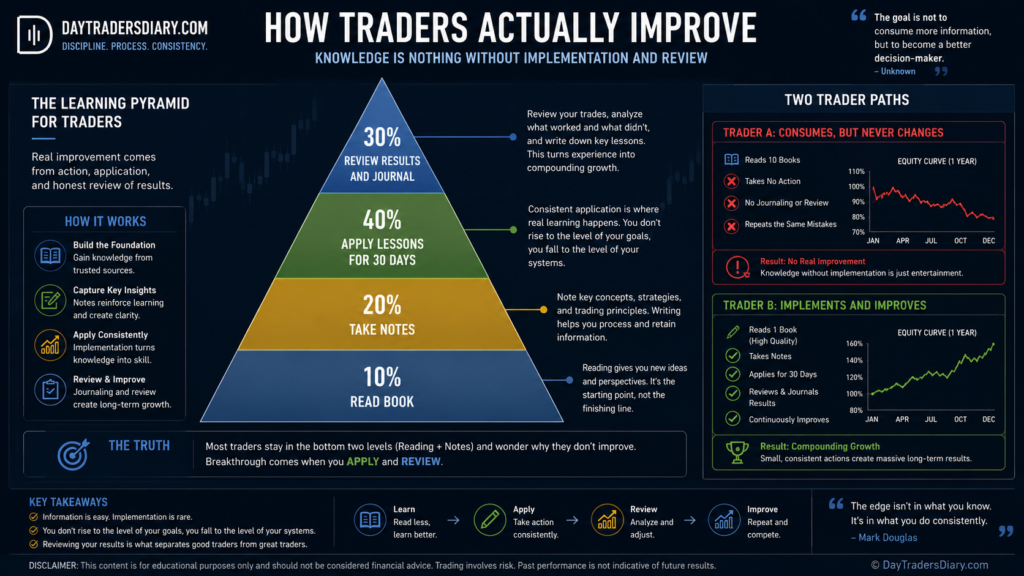
Reading books is easy.
Applying what you learn is difficult.
One mistake I see repeatedly is traders reading five books simultaneously and implementing nothing.
The easier way is simple.
Read a book.
Take three lessons of action.
Use them for thirty days.
Measure results.
Then go on to the next book.
We learn by doing, not by learning concepts. Doing multiplies learning.
Creating a Trading Education Framework
The finest traders don’t learn by accident.
They produce organised knowledge.
Make your education a trade.
Start with psych.
Move to risk management.
Study market structure.
Explore execution.
Develop performance review habits.
Many traders naturally complement their reading with DayTradersDiary.com resources covering trading psychology, market structure, risk management, and trade execution.
The goal is to build a complete framework rather than collect isolated tips.
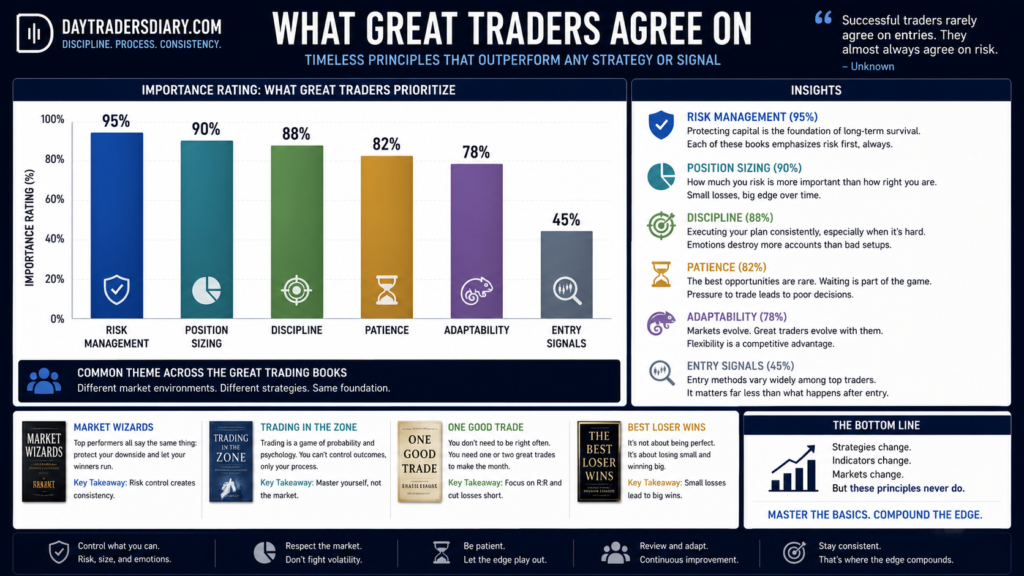
Risk Management Remains the Common Theme
After reading dozens of trading books, one pattern becomes impossible to ignore.
Successful traders rarely agree on entries.
They almost always agree on risk.
Different traders use different strategies.
Different timeframes.
Different markets.
Yet they consistently emphasize position sizing and capital preservation.
This is where many traders miscalculate exposure. Using a Position Size Calculator removes guesswork and helps ensure every trade aligns with your predefined risk limits.
The longer you trade, the more important this lesson becomes.
Using a Trade Journal to Capture Book Lessons
Most traders only journal trades.
Few journal ideas.
That is a missed opportunity.
Whenever you read a trading book, document:
The key lesson
How it applies to your trading
Specific actions you will take
Performance changes over time
Combining trade reviews with educational notes creates a much richer learning process.
A structured Trade Journal Template makes it easier to track both execution improvements and mindset development.
Over time, you’ll create your own personalized trading manual.
Scaling Beyond Knowledge
At some point, most traders realize that knowledge alone is not enough.
Execution matters.
Consistency matters.
Capital matters.
A trader with a genuine edge may still face growth limitations if account size remains small.
This is one reason evaluation programs have become increasingly popular among serious traders.
Firms such as The5ers, FTMO, and TradeThePool provide opportunities for disciplined traders to access larger capital allocations.
The common thread is accountability.
These firms reward traders who can demonstrate consistent execution and risk management.
If you’ve spent time developing your edge and proving it through disciplined trading, a The5ers evaluation account may be worth considering as a logical next step toward scaling your performance.
Final Thoughts
The best trading books won’t make you a profitable trader overnight.
What they can do is make your learning curve shorter.
They can save you from making the mistakes thousands of traders have made already.
They provide models for thinking more clearly, managing risk better and having more professional markets.
For the next month, choose one book from this list.
Read it slowly.
Take notes.
Apply what you learn.
Then measure the impact on your trading.
You may discover that the biggest improvement doesn’t come from finding a new strategy.
It comes from improving the trader behind the strategy.
For your next read, explore our articles on trading psychology and risk management to reinforce the lessons found in these timeless books.
FAQs
What is the best day trading book for beginners?
Trading in the Zone and Market Wizards are good first stops because they deal with psychology, discipline and real world trading lessons.
Which trading book helps most with psychology?
Mark Douglas’s Trading in the Zone is probably the greatest book on the psychology of trading.
Are old trading books still relevant today?
Yes. Markets change, but human nature remains strikingly the same. Many classic trading books provide timeless lessons on risk and psychology.
How many trading books should I read each year?
Quality matters more than quantity. Applying lessons from a few great books often produces better results than reading dozens without implementation.
Can books replace trading experience?
No. Books accelerate learning, but experience is still necessary. The combination of study, journaling, and live market observation creates the best results.
Should day traders focus on strategy books or psychology books?
Most developing traders benefit more from psychology and risk management books because execution and discipline are often bigger obstacles than strategy selection.