
Most traders open Level 2 data for the first time and immediately feel overwhelmed.
Numbers flash constantly. Orders appear and disappear in seconds. Bid and ask sizes shift rapidly. The screen looks important, but very few traders actually understand what they are supposed to be looking for.
So they do what most traders do.
They start guessing.
Some believe large orders automatically mean support or resistance. Others think Level 2 is a prediction tool that reveals where price is going next. Many stare at the order book all day without understanding that experienced traders are not reading static numbers.
They are reading behavior.
That distinction changes everything.
Level 2 data is not magic. It will not predict every breakout or reversal. But when understood properly, it gives traders something most retail strategies completely ignore:
Real-time insight into liquidity, aggression, and market intent.
After years of watching intraday traders misuse order flow tools, one thing becomes obvious:
Most traders fail with Level 2 because they focus on what they see instead of how participants are behaving around key prices.
This guide discusses how experienced traders use Level 2 data day trading, where it’s valuable, where it can be misleading and how to create relevant execution frameworks around it without falling into the information overload trap.
If you already understand charts and price action, this is the layer that starts connecting market movement with participant behavior underneath it.
What Level 2 Data Actually Shows
Most retail traders misunderstand Level 2 data because they think it is simply a list of buyers and sellers.
It’s more complex than that.
Level 2 shows the order book around current price levels with bid and ask liquidity from market participants on the wait. In stocks this comprises ECN and market maker activities. In futures it is a measure of depth-of-market liquidity. As the forex market is decentralized, Level 2 data is more fragmented although many brokers and institutional feeds still deliver relevant liquidity depth information .
The main point to this is:
Level 2 doesn’t tell you where the price has to go.
It displays where liquidity is at the moment and how participants react when price gets to specific locations.
Research provided by NASDAQ Market Structure Research always reveals that liquidity concentration has a material impact on short-term price movement, especially during very active intraday sessions.
Meanwhile, research on market microstructure (by the CFA Institute) suggests that institutional order flow has a much greater impact on short-term volatility and execution efficiency than most retail traders appreciate.
Another crucial insight comes from research provided by Chicago Mercantile Exchange (CME Group) which emphasizes how order book imbalances are often responsible for short-term momentum or liquidity-driven reversals under active market situations.
For traders, this matters because Level 2 is less about prediction and more about understanding participation quality.
That is where the edge exists.
Why Most Traders Use Level 2 Incorrectly
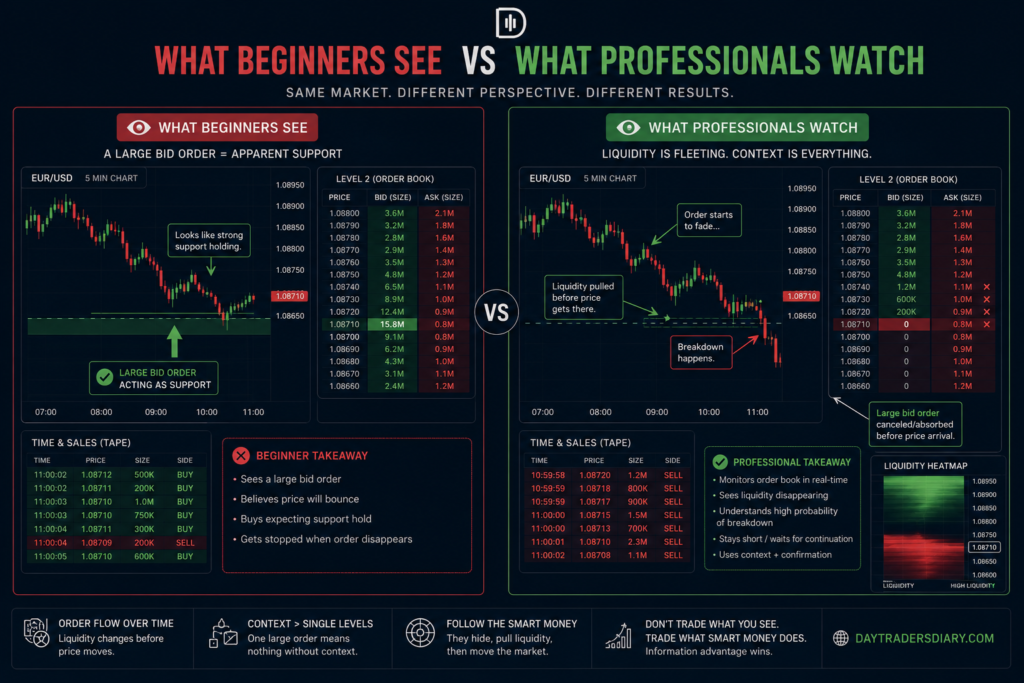
The biggest mistake traders make with Level 2 data is treating visible orders as guaranteed support or resistance.
Veteran traders know that what’s on display for liquidity is often not what it appears to be.
Large orders can be real purchasing or selling interest.
Sometimes they are only there to affect behavior for a while before being eliminated.
This is where newer traders get trapped.
They see a large bid sitting below price and assume support is strong. Then the order suddenly disappears the moment price approaches it. The trader gets caught in the wrong position because they focused on static liquidity instead of participant behavior.
Professional traders care less about the magnitude of the liquidity and more about what occurs when price interacts with that liquidity.
Does the bid soak up aggressive selling?
Does the ask keep reloading again and again under rising pressure?
Does liquidity vanish in surges in volatility?
Those reactions are significantly more important than the basic numbers.
Level 2 becomes useful when traders stop thinking of it as a prediction screen and start thinking of it as a real-time behavioral map.
The Difference Between Passive and Aggressive Participants
One of the most valuable things Level 2 teaches traders is the difference between passive liquidity and aggressive market participation.
Passive participants place resting limit orders.
Aggressive participants go through the spread on market orders.
This interplay impacts the way momentum is perceived by traders.
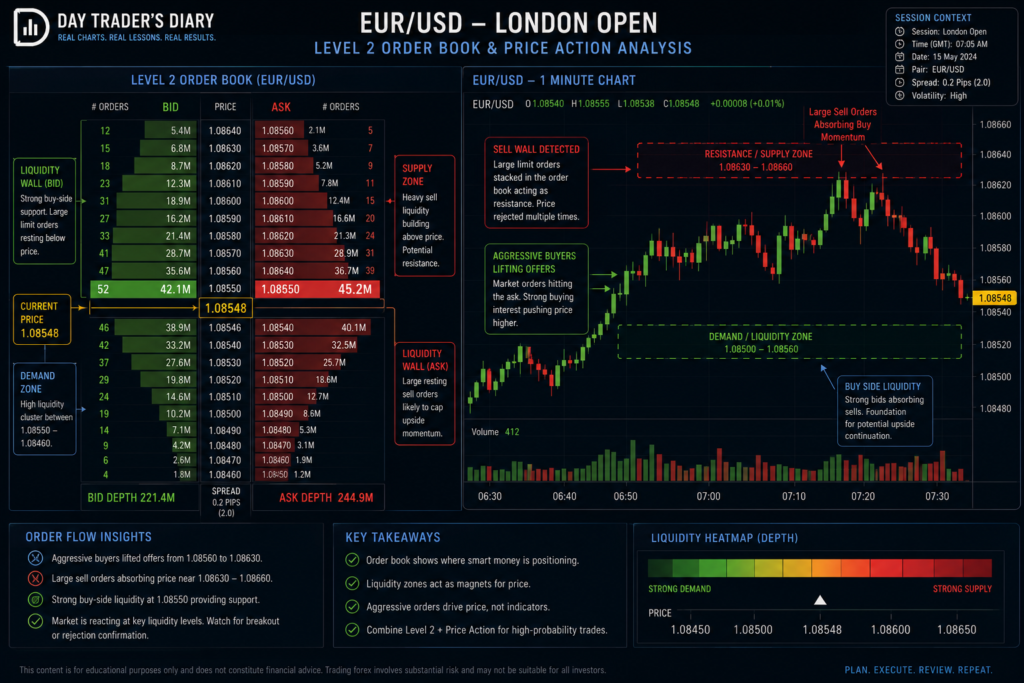
Say for example EUR/USD pushes strongly higher on London open. Price activity appears bullish on the surface. But on Level 2, big sellers are just absorbing the buying pressure around a crucial level without the price moving up too much.
“Now we have a whole different reading.
Price is moving but buyers are trying to absorb the available liquidity.
That is why experienced traders never make momentum judgments based on candles alone.
They see whether antagonism is really making progress.
If aggressive buying fails repeatedly despite heavy participation, exhaustion often follows.
The same logic applies during breakdowns.
This type of market reading is difficult to learn initially because it requires observation rather than mechanical indicators. But once traders understand how liquidity reacts around important levels, many fake breakouts become easier to identify.
How Experienced Day Traders Actually Use Level 2 Data
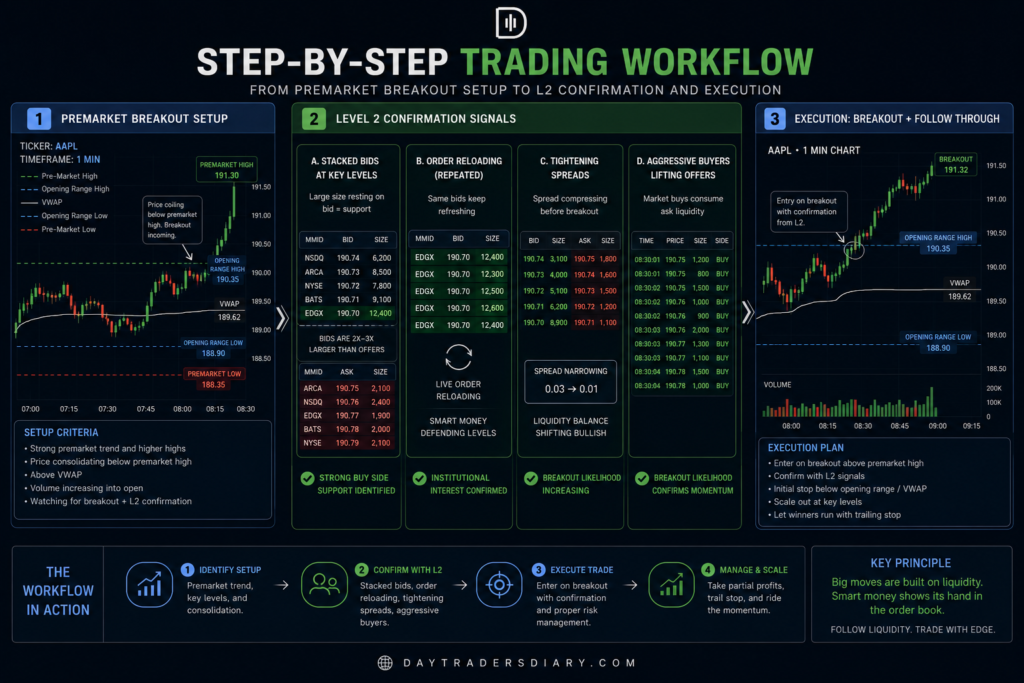
The most profitable traders employ Level 2 as a confirming tool, not as a strategy itself.
And that distinction is important.
A trader might have already:
A key resistance level.
A session high.
A liquidity sweep setup.
A premarket breakout level.
Level 2 helps answer the next question:
Is real participation supporting the move?
Experienced traders often look for:
Liquidity squeeze.
Repeated reloading of order.
Buyers or sellers jumping in aggressively.
Spread expanding or narrowing.
Attempts to continue failed.
Imagine a stock breaking out over resistance, but Level 2 instantly shows offers building up aggressively as upward momentum slows.
That tells a very different story than a clean breakout with aggressive buyers lifting offers continuously.
This is why many experienced traders combine Level 2 with price action and volume rather than relying on any single tool in isolation.
Related DayTradersDiary.com articles on breakout trading and liquidity sweeps connect closely with this concept because order flow behavior often explains why many chart patterns fail.
Why Level 2 Data Matters More During Specific Market Conditions
Level 2 becomes far more useful during high-liquidity periods.
This is something many traders misunderstand.
During slow sessions, the order book can become thin and unreliable. Small orders influence movement more easily, which creates misleading signals.
But during active periods such as:
London open.
New York open.
Major news releases.
Premarket and opening bell volatility.
Liquidity behavior becomes far more meaningful.
This is where professional traders often identify:
Absorption.
Exhaustion of momentum.
Liquidity trap.
Breakouts didn’t work.
Aggressive push on.
Context is everything.
A big bid resting quietly at low volume, implies virtually nothing.
That’s a whole other situation when you see a strong bid absorbing considerable selling pressure with active market activity.
That is why experienced traders never separate Level 2 interpretation from broader market context.
The Psychological Trap of Watching Level 2 Too Closely
One of the hidden dangers of Level 2 trading is overstimulation.
The screen updates rapidly. Information changes every second. Traders start feeling like they must react constantly.
That environment quietly encourages impulsive execution.
Many traders become so focused on every flicker in the order book that they lose sight of the broader setup entirely.
Experienced traders learn to filter noise.
They are not reacting to every order.
They are waiting for meaningful behavior around meaningful levels.
That patience is difficult at first because Level 2 creates the illusion that every change matters.
It does not.
The best traders usually simplify what they focus on:
Key levels.
Liquidity reactions.
Aggressive participation.
Continuation or rejection behavior.
Everything else becomes background noise.
Risk Management Matters Even More With Order Flow Trading
Level 2 trading can create false confidence.
A trader sees aggressive buyers stepping in and assumes the move must continue. Then liquidity shifts suddenly and the market reverses sharply.
This is why risk management is much more crucial when trading order flow.
No liquidity signal is without fault.
Even institutional involvement can evaporate in the volatility.
Professional traders deal with this by normalizing their exposure no matter how strong the setup looks.
This is where a lot of traders get it wrong on risk, getting emotionally tied to what they think the order book is telling them. A structured position size calculator can remove any guesswork from your trading and ensure your risk exposure remains consistent even during high-speed market situations.
It’s not about guessing every step right.
The goal is to live long enough that statistical edge becomes relevant.
Why Journaling Is Critical for Level 2 Traders
Most traders struggle with Level 2 because they never review their own interpretations objectively.
They remember the times liquidity behavior worked and forget the times they misread the order book completely.
That is dangerous.
A proper trading journal should document:
What the Level 2 showed.
How liquidity behaved near key levels.
Whether absorption appeared.
Whether aggression produced continuation.
How the trader reacted emotionally.
Over time, patterns become clearer.
Some traders discover they overreact to large orders. Others realize they anticipate reversals too early instead of waiting for confirmation.
Using a structured Trade Journal Template helps traders review execution quality objectively instead of relying on memory after emotionally intense trading sessions.
The traders who improve fastest with Level 2 are usually the ones willing to study their own misinterpretations honestly.
Why Serious Traders Combine Level 2 Skill With Capital Access
It takes time to learn order flow and Level 2 execution.
But when traders are truly consistent, then the difficulty becomes capital restrictions.
A trader may develop strong execution skill but still face restricted growth because personal account size limits scalability.
This is one reason many disciplined traders eventually explore evaluation programs and funded accounts.
Not because they want shortcuts.
Because larger capital allows skilled execution to scale more efficiently.
Firms like The5ers, FTMO, and TradeThePool provide traders with opportunities to access larger buying power while operating inside structured risk frameworks.
The main difference is attitude.
Order flow setups are not gambled aggressively with funded accounts by professional traders.
They use it to drive disciplined execution at greater scale.
If you have already learned about liquidity behavior and structured risk management, a The5ers assessment account can be the natural next step to long-term growth for traders.
The Real Purpose of Learning Level 2
The goal of Level 2 trading is not predicting every market move.
It is understanding how participants behave around important prices.
That changes how traders see the market entirely.
Traders learn to look at candles and not to respond emotionally to them:
Where the liquidity is.
Reactions to pressure by participants.
If momentum is real.
Whether aggression makes any real progress.
Often that increased understanding increases patience more than anything.
This week, just watch one item.
Perhaps look at how liquidity responds to breakouts.
Examine absorption near session highs.
Maybe review failed continuation attempts more carefully.
Small observations build to a much stronger market understanding over time.
For your next read, check out more related DayTradersDiary.com material on order flow trading, liquidity sweeps and breakout psychology. Those themes are directly relevant to effective Level 2 interpretation.
FAQs
What is Level 2 data in trading?
Level 2 data shows market depth around current prices, including pending bid and ask liquidity from participants in the order book.
Is Level 2 data useful for forex trading?
Forex Level 2 data is more fragmented than stocks or futures because forex is decentralized, but institutional liquidity feeds can still provide valuable insight into short-term market behavior.
Can Level 2 predict market direction?
No. Level 2 does not predict pricing with certainty . It assists traders to comprehend the liquidity behavior, the participation strength, and the short-term order flow dynamics.
What do professional traders look for on Level 2?
Experienced traders often focus on liquidity absorption, aggressive participation, order reloading, failed continuation attempts, and how price reacts around key levels.
Is Level 2 better than technical analysis?
Not always. Most professional traders use Level 2 in conjunction with price action, volume, and overall market structure, not alone.
How do funded trader programs help Level 2 traders?
Programs like The5ers and FTMO allow disciplined traders to scale structured execution strategies using larger capital allocations while maintaining professional risk parameters.