
Most traders do not lose because their market bias is wrong.
They lose because their timing is terrible.
You can correctly identify a bullish EURUSD trend, wait for a breakout, and still lose money because you entered after the move was already exhausted. The opposite happens on exits. Traders close winning trades too early because they fear giving profits back, then sit through full stop losses on bad trades because they “believe” the setup will recover.
Timing is where psychology, execution, and market structure collide.
After years of trading intraday forex sessions, one thing becomes obvious: professional traders are not obsessed with predicting direction. They are obsessed with entering where risk is compressed and exiting where probabilities shift.
That is a very different mindset.
This guide breaks down how experienced traders time entries and exits in forex day trading, how liquidity and volatility affect execution, and why most retail traders focus on the wrong candles, wrong sessions, and wrong confirmations.
You will also learn how to build a repeatable entry and exit framework that survives losing streaks, changing market conditions, and prop firm evaluation pressure.
Why Most Entry and Exit Advice Fails
There’s a lot of internet trading instruction that over-simplifies entries.
Buy support
Refusal to sell.
Hold for confirmation.
Use RSI oversold signals.
The problem is that markets are dynamic. The timing that works in low volatility Asian sessions often falls apart during the London or New York overlap periods. A breakout that works in a trending market becomes a trap inside a tight range.
Research from the Bank for International Settlements demonstrates that forex liquidity and volatility tend to cluster around big session overlaps and macroeconomic announcements. This is important since timing quality is directly connected to liquidity situations.
CME Group’s market research has shown that failure breakouts are considerably more likely when liquidity is limited, especially before key economic releases and between sessions.
Data from DailyFX trader sentiment research has also repeatedly shown that retail traders often enter late into momentum moves and exit profitable trades prematurely. The issue is not just strategy. It is execution behavior.
For active day traders, this creates an important insight:
Good entries are usually uncomfortable.
Bad entries usually feel emotionally easy.
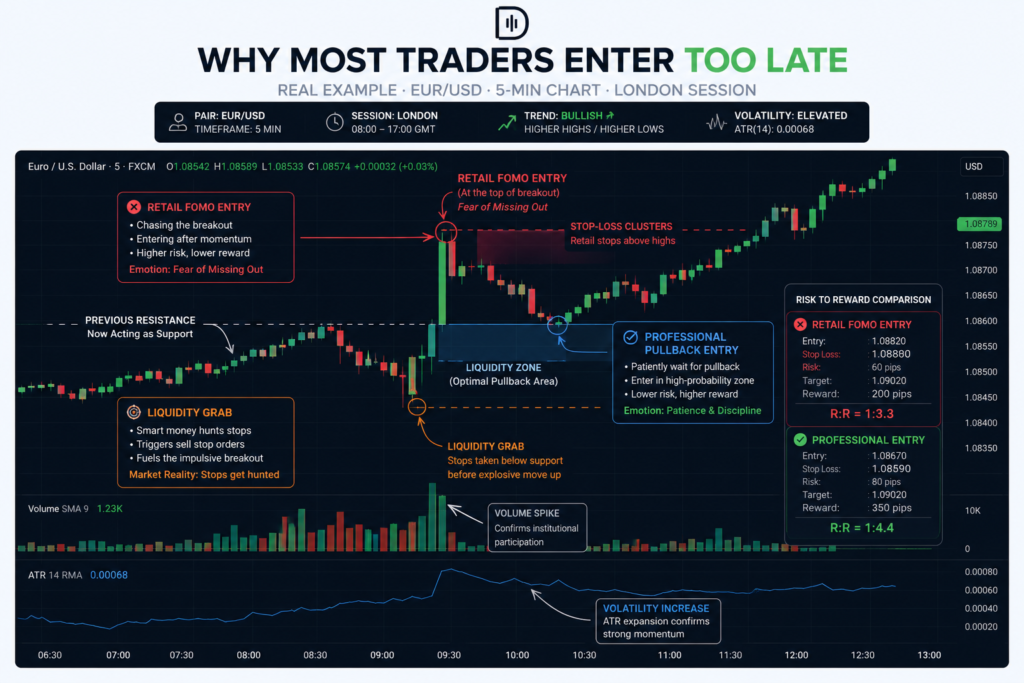
The best entries often happen near temporary pullbacks, liquidity grabs, failed breakdowns, or moments where weaker traders are exiting emotionally.
The worst entries happen after extended candles, social media hype, and emotional FOMO.
That distinction changes everything.
The Real Purpose of Entry Timing
Most traders think entries exist to maximize profits.
Professional traders think entries exist to minimize uncertainty.
That is why experienced traders spend more time analyzing context than finding patterns.
A good entry does three things:
It keeps stop loss distance efficient.
This matches the higher timeframe structure.
It arrives before the crowd’s emotion gets too out of hand.
That’s why many experienced forex traders often look at liquidity zones instead of just indicators.
For example, imagine GBPUSD rallies aggressively during London open. Retail traders often buy the breakout candle itself because momentum looks strong. Professionals frequently wait for the pullback into prior liquidity because they know breakout traders often provide the liquidity for smarter entries.
The direction may be identical.
The timing is completely different.
The Three-Layer Entry Framework
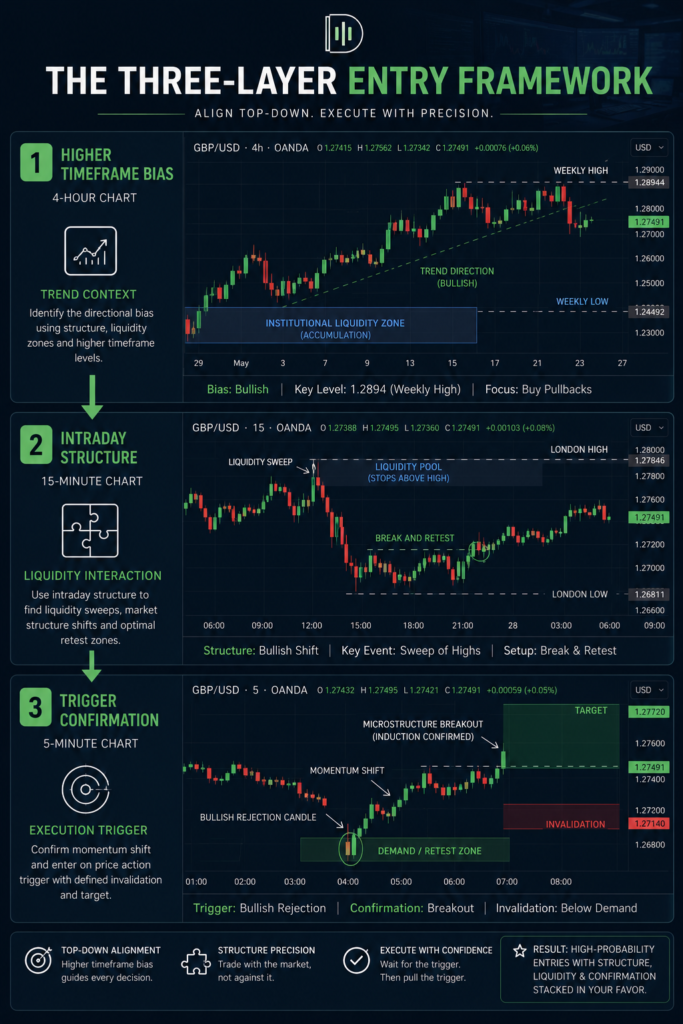
One of the most practical ways to improve forex entry timing is separating analysis into three layers.
Layer One: Higher Timeframe Bias
Before entering any intraday trade, define directional context.
This is where multiple timeframe analysis becomes critical.
A trader using the 5-minute chart alone usually becomes reactive. A trader using the 4-hour and 1-hour charts first becomes selective.
What do the pro traders ask first?
Are we in a trending or ranging market?
Where is the primary liquidity?
Is the price close to weekly highs, lows, or session extremes?
Is it an area likely to be defended by institutions?
This is why many traders combine this process with a multiple timeframe analysis routine before London open.
Without higher timeframe alignment, entry timing becomes random.
Layer Two: Intraday Structure
Once directional bias is present, intraday structure is the execution map.
These include:
Session highs/lows
Previous day’s high and low
Liquidity sweeps
Break and Retest Behaviour
Consolidation Of Trend Continuation
False breakouts
One of the biggest mistakes traders make is entering in the middle of intraday ranges.
“Professionals tend to wait for price to interact with meaningful structure first.
For example, if EURUSD breaks the London low but quickly recovers the range, experienced traders know that trapped sellers could push the market higher.
It’s not an entry of optimism.
It is based on the imbalance of position.
Layer Three: Trigger Confirmation
This is where lower timeframe execution matters.
Professional traders do not blindly enter because price touched support.
They wait for evidence.
That evidence may include:
Strong rejection candles
Shift in momentum
Failed continuation attempts
Volume acceleration
Order flow imbalance
Microstructure breakouts
This is where many traders misuse indicators.
Indicators should confirm behavior, not replace market understanding.
The Best Entry Locations in Forex Day Trading
Certain entry points always work better than others because they fit with the liquidity behaviour.
Pullbacks Inside Strong Trends
It remains one of the most reliable entrance settings.
Strong trends often retrace to moving averages, previous breakout zones or liquidity pockets before they continue.
Here is the important insight:
Healthy trends seldom travel in straight lines.
Traders that chase breakout candles typically have bad risk to reward ratios, and emotional exits.
Pro traders look for retracement compression before taking continuation trades.
Failed Breakouts
One of the highest probability intraday setups occurs when price breaks a key level but fails to continue.
This creates trapped traders.
Trapped traders create momentum.
For example, USDJPY breaks above resistance during New York open, attracts breakout buyers, then quickly reverses back below the level.
That failed breakout often creates aggressive downside momentum because trapped longs rush to exit.
This is one reason experienced traders pay attention to liquidity sweeps instead of obvious breakout entries.
Session Reversal Zones
Opening of the London and New York sessions is often a time of surges in emotional volatility.
Retail traders often confuse volatility with trend confirmation.
But professionals are watching to see if the move sticks.
Sometimes the best entry occurs after the initial emotional move fails.
This concept becomes especially useful when trading pairs like GBPUSD and XAUUSD during high volatility sessions.
Exit Timing Is More Important Than Most Traders Realize
Many traders obsess over entries while completely ignoring exit logic.
But long-term profitability is often determined more by exits than entries.
Poor exits destroy expectancy.
There are three primary exit mistakes traders repeat constantly.
The first is taking profits too early because they fear reversals.
The second is moving stop losses emotionally.
The third is holding trades after the original setup conditions disappear.
Professional exits are based on changing probabilities, not emotions.
The Professional Exit Framework
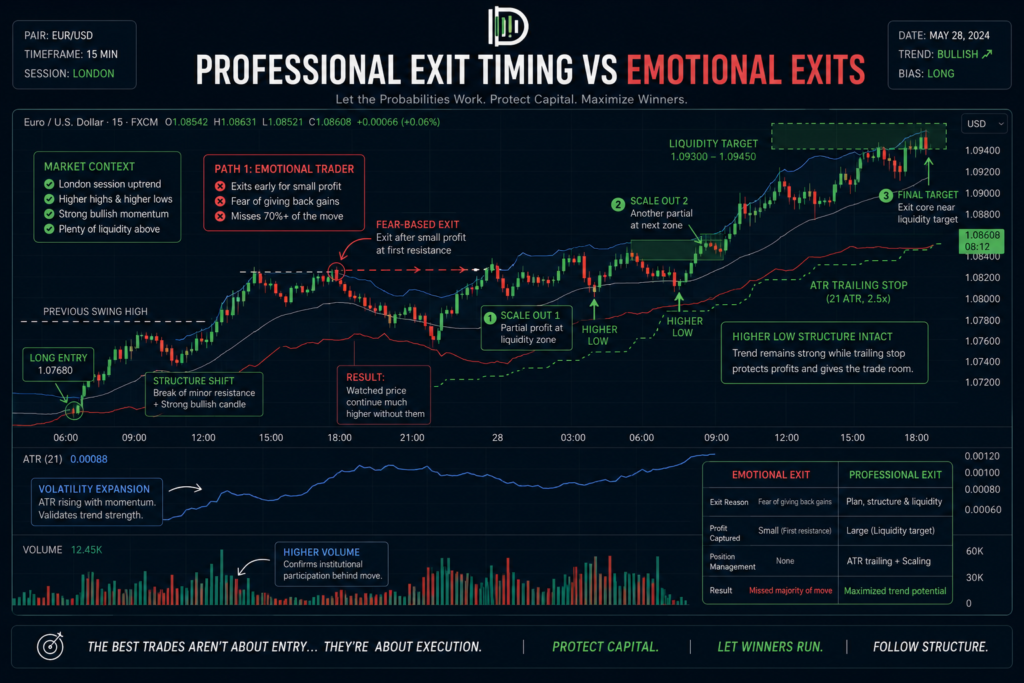
Exit Based on Market Structure
One of the cleanest ways to manage exits is using structure instead of fixed pip targets.
For example:
If a bullish trend continues creating higher lows, there is no logical reason to exit simply because price moved 20 pips.
But if structure breaks aggressively, momentum weakens, and liquidity shifts, the trade thesis changes.
This is why structure-based exits outperform arbitrary targets over long periods.
Exit Into Liquidity
Experienced traders understand where reactions are likely.
Those areas include:
Previous highs and lows
Psychological levels
Session extremes
Weekly range boundaries
Major supply and demand zones
This does not mean price cannot continue further.
This means the probability of reaction increases.
Professional traders would often scale partial profits into these locations instead of taking an impulsive exit from full positions.
ATR-Based Exit Logic
Average True Range remains one of the most practical volatility tools for exits.
Instead of using fixed stops or targets, ATR helps traders adjust expectations based on current volatility conditions.
During high volatility environments, tight stops become vulnerable to noise.
During low volatility environments, oversized stops destroy reward efficiency.
A lot of skilled traders would use ATR trailing stops in combination with structure confirmation for more flexible trade management.
Timing Mistakes That Destroy Day Traders
The most costly trading mistakes are time faults disguised as strategy flaws.
Entering Late
Late entrances produce horrible emotional posture.
When entering on stretched candles, traders often use larger stops and less payoff potential.
This creates negative expectancy even if win rates remain decent.
Exiting Early After Small Profits
This usually happens after losing streaks.
Traders become psychologically conditioned to protect gains quickly.
The problem is that small wins rarely offset full stop losses.
Over time, this creates a mathematically broken system.
Trading During Dead Liquidity Hours
Many newer forex traders force trades during slow sessions.
The result is usually:
Random movement
Poor follow-through
False breakouts
Low momentum
Timing matters just as much as setup quality.
The Psychology Behind Elite Timing
Professional timing is not just technical.
It’s emotional regulation with ambiguity.
Most retail traders want to know for sure before they deal.
Pros know clarity frequently comes late in movements.
That makes for an awkward paradox.
The best trades often feel psychologically difficult at entry and emotionally easy near exit.
The worst trades feel emotionally exciting at entry and stressful afterward.
That emotional inversion is one of the biggest mindset shifts serious traders must develop.
Risk Management and Execution Discipline
Great timing becomes meaningless without proper risk execution.
This is where many skilled analysts still fail.
A trader can identify excellent entries consistently but destroy performance through oversized positions or emotional stop adjustments.
This is why competent traders look at risk before entry, not after.
A Position Size Calculator takes the guess work and emotion out of your trading and makes your risk exposure consistent regardless of market conditions.
This becomes even more important when volatility expands unexpectedly around news releases or session overlaps.
One hidden advantage of strong entry timing is smaller stop placement.
Smaller stops allow better reward asymmetry without increasing account risk.
That is one reason elite traders obsess over execution precision.
How to Journal Entry and Exit Timing
Most traders journal outcomes.
Few journal decision quality.
That is a major mistake.
If you want to improve timing, your journal should track:
Where it enters relative to the structure
Session length
Market volatility circumstances
Emotional mood at entry
Reason for leaving
profit lost on exit
Execution quality rating
Patterns do emerge.
You may discover:
You make your greatest trades during London open.
Post vengeance trading is your worst trades
Your exits are always too early to try and get back on a winning streak
That is why performance optimisation requires the use of a structured Trade Journal Template.
The goal is not just recording trades.
The goal is identifying recurring execution behaviors.
Why Serious Traders Eventually Need More Capital
One difficult reality in trading is this:
A good edge with limited capital still produces limited income potential.
Eventually most traders learn that responsible scaling is more important than chasing unrealistic gains on small accounts.
This is why evaluation based prop businesses became popular with disciplined traders.
Firms like The5ers, FTMO and Topstep offer traders access to higher capital allocations, but with organised risk discipline.
The primary advantage isn’t “make money quick”.
It’s being able to execute on a proven structure with considerable capital without over-leveraging personal funds.
For traders with strong entry and exit consistency, evaluation programs can create a more professional growth path than trying to compound aggressively from undersized retail accounts.
If your execution framework is already producing stable results on demo or small live accounts, considering a The5ers evaluation account may be a logical next step.
FAQs
What is the best timeframe for forex entries?
Many expert traders trade the 1-hour or 4-hour chart for larger timeframe bias and use 5-minute or 15-minute chart for execution entries.
Why do most traders enter too late?
Most traders are looking for emotional validation. By the time a move appears evident, much of the short-term momentum is already gone.
Should I use indicators for entry timing?
Indicators are great for confirmation, not a decision maker. Less important than the metrics is the environment of structure, liquidity and volatility.
How do professionals exit winning trades?
Pro traders profit on changes in market structure, liquidity zones or tracking volatility models, not fixed pip targets.
What sessions are best for forex day trading?
The London session and New York overlap typically provide the highest liquidity and strongest intraday movement for major forex pairs.
How can I improve my forex timing?
Focus on journaling execution quality, not just profit and loss. Reviewing timing mistakes repeatedly is one of the fastest ways to improve.
Final Thoughts
Intelligence is rarely the difference between average traders and consistently profitable traders.
It’s the execution in pressure situations.
Professional timing is when you know the liquidity, structure, volatility and psychology all at the same time. Not by memorising candle patterns or following signs.
This week, focus on improving one thing:
Don’t enter late on emotional breakout candles.
Wait for structure.
Wait for liquidity interaction
Hold for confirmation.
See if your timing was better, even if the result wasn’t.
Because long-term trading success is built on process quality first.
For your next read, study how multiple timeframe analysis changes execution precision and helps traders filter low-quality setups before they ever enter the market.