
Most traders think demo trading is where you learn strategy.
In reality, demo trading is where your bad habits begin.
A trader opens a forex demo account, catches a few winning trades, doubles position size because the money is fake, and suddenly feels like they have figured the market out. Then they switch to a live account and everything changes almost overnight.
Entries become hesitant.
Losses suddenly feel personal.
Trades that looked easy on demo become emotionally difficult the moment real money is involved.
That transition frustrates almost every trader at some point because the problem usually is not technical knowledge. Most traders already understand basic setups, support and resistance, trend structure, or breakout concepts.
The real issue is that demo trading often teaches unrealistic behavior if it is approached the wrong way.
After years of watching traders move from demo accounts into live trading, one thing becomes obvious:
A forex demo strategy only works if it trains behaviors that survive emotional pressure later.
That is the part most trading content completely ignores.
This guide is not about fantasy account growth or unrealistic demo profits. It is about building a forex demo strategy that actually prepares traders for live execution, real decision-making, and the psychological pressure that eventually shows up once money becomes real.
Because demo trading is not supposed to prove you are profitable.
It is supposed to prepare you to stay disciplined when trading stops feeling comfortable.
Why Most Demo Traders Struggle Once They Go Live
Almost every trader has experienced this at some point.
They perform well on demo for weeks or even months, then lose control once they start trading live.
At first, it feels confusing.
The setups are the same.
The charts are the same.
The strategy is the same.
But the behavior changes completely.
Research published by the CFA Institute on behavioral finance shows that traders make very different decisions once real financial consequences become involved. Risk perception changes immediately under emotional pressure.
Yet another MIT Sloan School of Management study shows how stress and financial exposure dramatically impact short-term decision-making and emotional control. This is why traders throw in the towel too quickly on wins, miss potential setups or revenge trade after losses when real money is involved.
Even the quality of execution is different.
Even execution quality changes.
Data from NASDAQ Market Research continues to show how real market conditions involving slippage, spread expansion, and liquidity shifts affect live execution differently than many demo environments.
That matters more than most traders realize.
A strategy that looks smooth on demo during normal conditions can behave very differently around volatile session opens or major forex news releases.
This is why experienced traders stop treating demo accounts like a place to prove profitability.
Instead, they treat them like a training ground for discipline and execution.
That mindset changes everything.
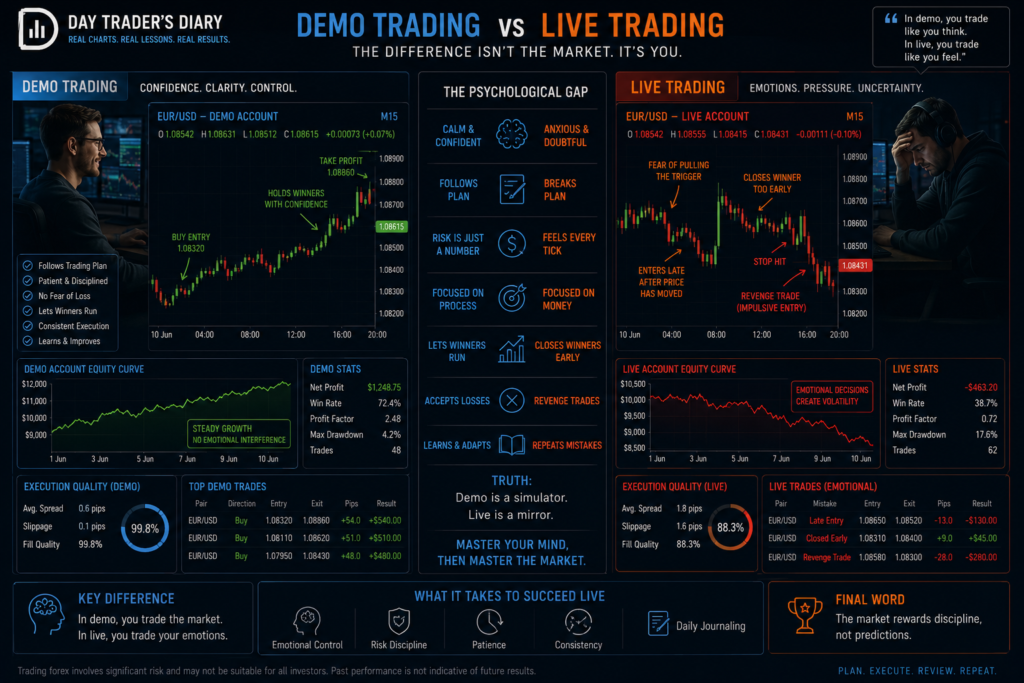
The Biggest Mistake Traders Make on Demo Accounts
Most demo traders are not practicing.
They are experimenting emotionally without consequences.
That is a huge difference.
A trader opens a demo account with $100,000 even though they plan to fund a live account with $1,000 later. Then they start risking oversized positions because losses feel meaningless.
The dangerous part is that these habits slowly become normal.
By the time the trader switches to a live account, they have already trained themselves to trade emotionally.
Professional traders approach demo accounts differently.
They try their best to make the experience as real as possible:
Realistic account size
Practical risk exposure.
Realistic session timing.
Reasonable frequency of trade.
Realism is important since consistency is a matter of repetition in stable settings.
If a trader plans to risk 1% per trade on a future live account, the demo account should reflect that exact behavior from the beginning.
Otherwise the transition into live trading becomes psychologically chaotic.
The goal is not making impressive demo profits.
The goal is building habits that still function when pressure appears.
What a Forex Demo Strategy That Works Actually Looks Like
Most working forex demo strategies are surprisingly simple.
That may sound disappointing at first, but simplicity is usually what survives emotional pressure.
Experienced traders often narrow their focus instead of constantly expanding it.
They trade fewer currency pairs.
They focus on specific sessions.
They specialize in a small number of setups they deeply understand.
That familiarity improves execution quality dramatically.
For example, many traders eventually perform better once they stop jumping between every forex pair on the platform and focus primarily on EUR/USD or GBP/USD during active London or New York sessions.
They start to figure out how those markets act around liquidity sweeps, session opens, and momentum shifts.
The repetition builds confidence on observation, not emotion.
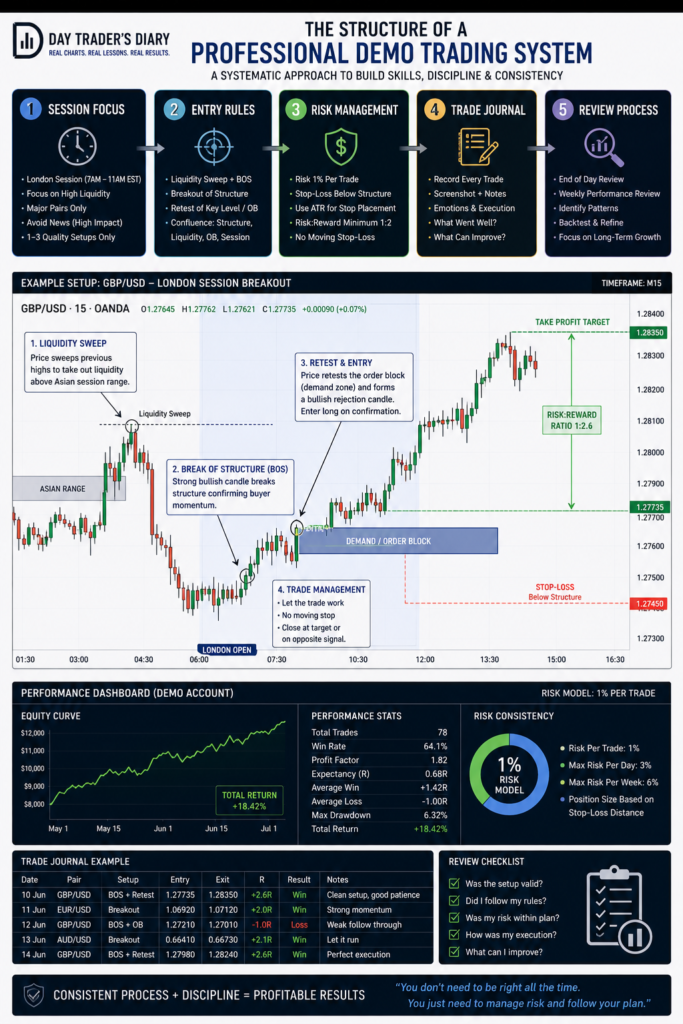
A strong demo strategy usually includes:
Clear entry criteria.
Stop placement defined.
Consistent risk management.
Certain trade sessions.
Trade review.
Nothing fancy .
Just consistent execution.
The long term survivors in trading are almost never employing the most intricate systems. It is them who can usually perform simple operations consistently without emotional interruption.
Why Demo Traders Often Overtrade Without Realizing It
One of the biggest problems with demo trading is that there is no financial consequence attached to impulsive behavior.
So traders start taking trades constantly.
All modest breakouts seem to be marketable.
Every moving candle seems to matter.
Every session seems like a chance.
That makes for bad habits.
Veteran traders are aware that pro trading is typically more selective than active trading.
In fact, many profitable traders spend most of their session waiting.
That patience feels uncomfortable to newer traders because inactivity feels unproductive. But waiting is often what protects traders from emotional mistakes and low-quality setups.
A useful habit during demo trading is asking yourself one question before every trade:
“Would I still take this setup if real money were involved?”
That single question filters out a huge amount of emotional trading.
Why Risk Management Matters Even More on Demo
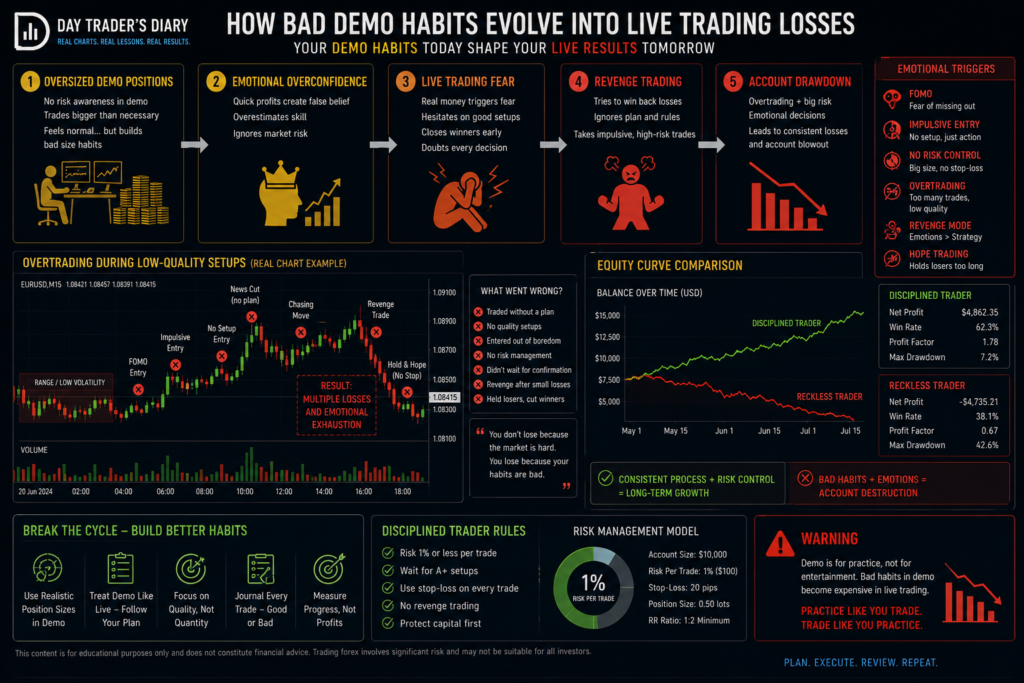
Most traders ignore risk management on demo because the losses are not real.
That completely defeats the purpose of practicing.
The habits built on demo accounts usually carry directly into live trading later.
A trader risking 10% or 15% per trade on demo rarely becomes disciplined automatically once real money gets involved. Usually the same emotional behavior continues, only now fear becomes stronger because actual money is at risk.
Experienced traders understand they are not simply testing strategies on demo.
They are training emotional habits.
This is where many traders miscalculate risk exposure entirely. Using a structured position size calculator removes emotional guesswork and creates consistency across different market conditions and volatility environments.
That consistency becomes one of the biggest advantages a trader can build early.
The Problem With Constantly Changing Strategies
Most traders never stay with one demo strategy long enough to understand whether it actually works.
They lose a few trades, become frustrated, and immediately switch indicators, sessions, or trading styles.
This cycle can continue for years.
Professional traders understand something most beginners do not:
Every strategy experiences losing periods.
The goal is not finding a strategy that never loses.
The goal is finding a process that maintains edge over large sample sizes.
That requires patience and data.
Not emotional reactions.
One of the best things traders can do during demo development is commit to reviewing performance over meaningful trade samples instead of judging the strategy after every individual session.
That shift alone creates far more clarity.
Why Journaling Becomes the Real Edge
Most traders assume journaling is a choice.
It isn’t.
Without documentation traders repeat the same mistakes as emotional memory becomes selective after stressful sessions.
A good trading journal captures:
Why the trade was made.
The state of mind of the merchant.
If they played by the rules.
How the danger was managed.
Exit of commerce.
Patterns emerge over time.
Many traders eventually discover their worst trades happen after consecutive losses, during low-volume sessions, or immediately after missing a setup earlier in the day.
These patterns are difficult to notice without review.
Using a structured Trade Journal Template helps traders analyze behavior objectively instead of emotionally reacting to short-term outcomes.
The traders who improve fastest are usually not the smartest.
They are the most honest with themselves.
Why Some Traders Stay on Demo Too Long
This part rarely gets discussed honestly.
Some traders become comfortable on demo because there is no emotional pain attached to mistakes.
Demo accounts are safe.
But in the end, true growth demands emotional exposure.
Live Trading Has Elements That Demo Accounts Can’t Replicate:
Fear of.
The greed.
Hesitating.
Stress.
Emotional investment in results.
At some point, traders need to experience those emotions directly.
The smartest transition is usually gradual.
Trade very small.
Use micro lots.
Focus on execution quality instead of income.
The goal is not making large profits immediately.
The goal is to understand how real money can impact the role of emotion in decision-making.
That step is more important than most traders realize.
Why Serious Traders Eventually Explore Evaluation Accounts
One reason many disciplined traders eventually look at evaluation programs is because they provide structured trading environments without requiring massive personal capital upfront.
Firms like The5ers, FTMO, and TradeThePool allow traders to operate with larger capital while following strict risk and consistency rules.
The key point is what do the professionals think about these programs.
Not as short cuts.
As constructed performance settings.
Usually a trader that already has formed disciplined habits by realistic demo trading adjusts much better to sponsored evaluations than a trader that spent years gambling emotionally on demo accounts.
For disciplined traders with consistent execution, a The5ers evaluation account can become a logical next step toward scaling responsibly without unnecessary personal financial pressure.
The Real Purpose of a Forex Demo Strategy
The main aim of demo trading is not about making phony money.
It is learning to do things consistently before the emotional pressure really starts.
It affects the way serious traders look at practice.
Instead than chasing utopian profits, they focus on:
Have patience.
Risk management.
Consistency. Consistency.
Emotional mastery
Quality of execution.
Those skills apply a lot better to live trading than aggressive account growth ever could.
This week, do one thing.
Maybe cut back on unneeded exchanges.
Maybe be more consistent with risk rules.
Maybe quit changing the game plan so much.
Maybe look at lost deals more honestly.
Small improvements in behavior compound much faster than most traders realize.
For your next read, check out related DayTradersDiary.com articles on trading psychology, risk management and funded trader discipline. Those topics directly impact long-term trading consistency.
FAQs
What is the best forex demo strategy for beginners?
Endless experimentation is often not the ideal strategy. Rather a simple and repeatable plan with defined principles, reasonable risk management and a consistent session focus is the best approach.
Why do traders succeed on demo but fail live?
Most traders will behave differently when real money is on the line. Fear, greed, reluctance and emotional pressure influence execution quality dramatically.
Should demo trading use realistic account sizes?
Yes. Demo accounts become much more useful when traders match realistic account size, position sizing, and risk exposure to their future live trading conditions.
How long should traders stay on demo before trading live?
There is no such thing as a perfect timeframe, but the trader should be working on getting into consistent habits and steady execution before slowly migrating to live trading.
Is risk management important on demo accounts?
Yeah, totally. Demo trading creates traders habits. If you do not pay attention to risk management in your demo trading, you will typically develop some emotional problems when you go to actual trading.
How do funded trader programs help developing traders?
“Disciplined traders can also access larger capital if they are trading on programs like The5ers and FTMO that have structured risk parameters and consistency rules.