
Most traders give up on the Ichimoku Cloud for the wrong reason.
They load it on their chart, see five lines, a shaded cloud, and immediately think it is too complex. So they go back to simple moving averages, even though those often give weaker signals.
The truth is the opposite.
Ichimoku is not complicated. It is condensed.
It combines trend, momentum, support and resistance, and timing into one framework. Once you understand how to read it properly, it becomes one of the few tools that can guide both direction and execution without needing five extra indicators.
This guide is not about memorizing lines. It is about learning how to think with the Ichimoku Cloud so you can make better intraday decisions in real market conditions.
What the Ichimoku Cloud Really Represents
Ichimoku was designed by Goichi Hosoda to give traders a complete market view at a glance.
Most traders learn the names. Very few understand the logic.
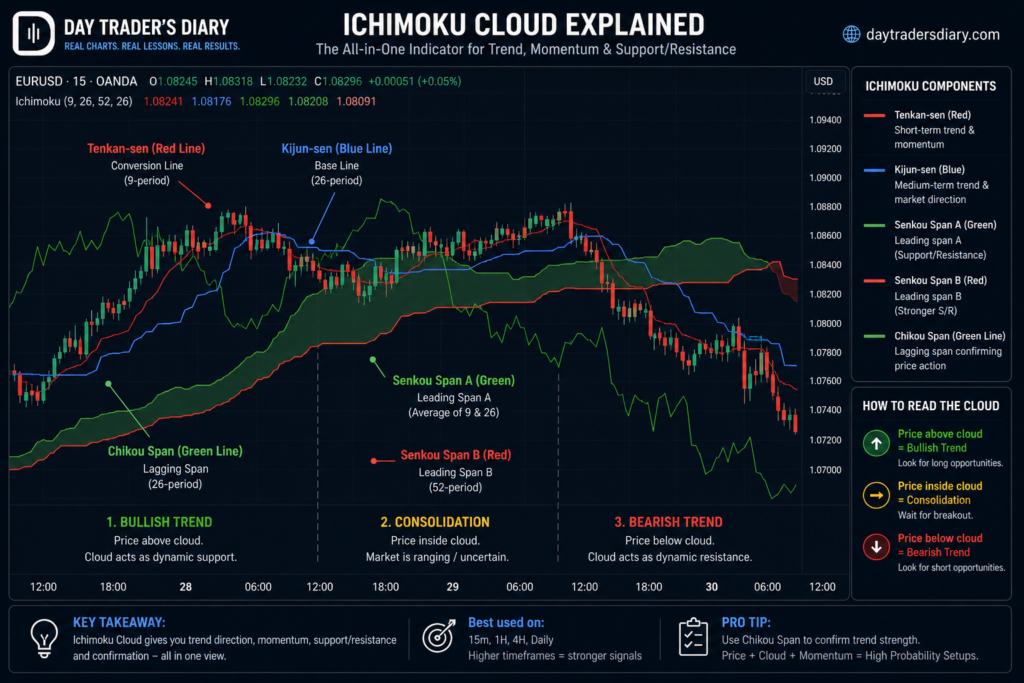
The cloud, also called Kumo, is not just a visual zone. It represents equilibrium. When price is inside the cloud, the market is balanced. When price breaks out, imbalance begins.
The Tenkan-sen is short term momentum. The Kijun-sen is medium term equilibrium. Their interaction reflects shifts in control.
The Senkou Span lines project future support and resistance based on current structure. That forward projection is what makes Ichimoku different from most indicators.
Ichimoku is effective in trending environments where structure is paramount, as indicated in training materials from sources like the CMT Association and literature from major trading platforms like TradingView and MetaTrader.
For a day trader, that means one thing.
Stop treating it as a signal generator. Start treating it as a decision framework.
Why Most Traders Misuse Ichimoku
The common mistake is looking for a single signal.
A Tenkan-Kijun cross. A cloud breakout. A lagging span confirmation.
Used in isolation, these signals are weak.
Ichimoku only works when you read alignment.
For example, a bullish cross below the cloud is not the same as a bullish cross above the cloud. Context changes everything.
This is similar to what we discussed in How to Identify Trend Reversals Intraday, where the same pattern can mean continuation or reversal depending on location.
Ichimoku forces you to think in layers instead of reacting to one event.
A Practical Framework for Trading Ichimoku Intraday
You should be able to understand the chart easily, without too much thought.
Begin with three questions.
Relative to the cloud, where is price?
Is the cloud getting thinner or thicker
Are Tenkan and Kijun aligned with direction
If price is above the cloud, the bias is bullish. If price is below, the bias is bearish. Inside the cloud means indecision.
Then look at cloud structure.
A thick cloud suggests strong support or resistance. A thin cloud suggests weakness and higher probability of breakout.
Now look at momentum.
Tenkan above Kijun in an uptrend favours continuation momentum. If it crosses against the trend it may be a hint for a pullback and not a full reversal.
This multi-layered technique prevents overtrading.
The Only Ichimoku Setups That Matter for Day Traders
Not every signal is worthy of trading.
The setups of best quality are from the alignment in structure and momentum.
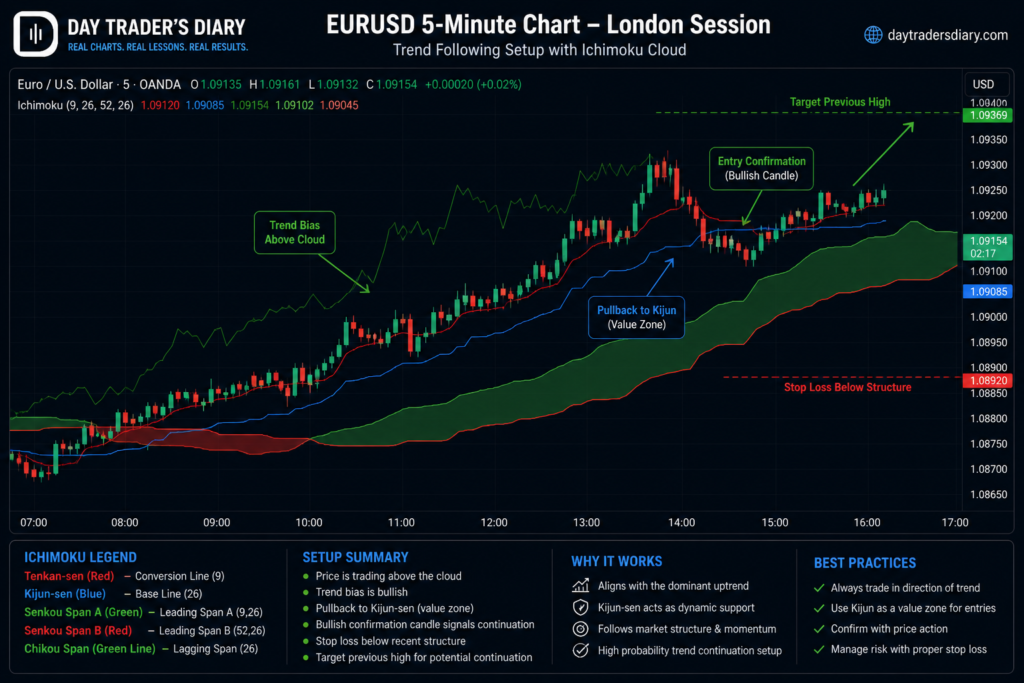
The most trusted one is the pullback continuation. Imagine EURUSD trading above the cloud during London session. Price pulls back toward the Kijun-sen without breaking the cloud. Then momentum shifts back upward as Tenkan turns higher.
Visualise EURUSD trading above cloud during London session. Price retraces towards Kijun-sen without breaking cloud. Then momentum resumes higher as Tenkan turns higher.
This is not just a symbol. This continues an established trend.
This is consistent with ideas we’ve addressed in How to Trade the EURUSD Daily Range, where breakouts of compression zones generally signal the session move.
When Ichimoku Fails
No indicator works in all conditions.
Ichimoku struggles in choppy markets where price constantly moves in and out of the cloud. In those conditions, signals conflict and whipsaws increase.
It also fails when traders ignore higher timeframe context.
Bullish setups on 5 minute charts within bearish 1 hour structures generally fail to follow through.
This is where the combination of Ichimoku and simple price structure makes a difference.
If both agree likelihood improves . If they clash, you get smaller or you get away.
Intraday Execution That Actually Works
One of the biggest improvements you can make is slowing down your execution.
Instead of entering immediately on a signal, wait for confirmation.
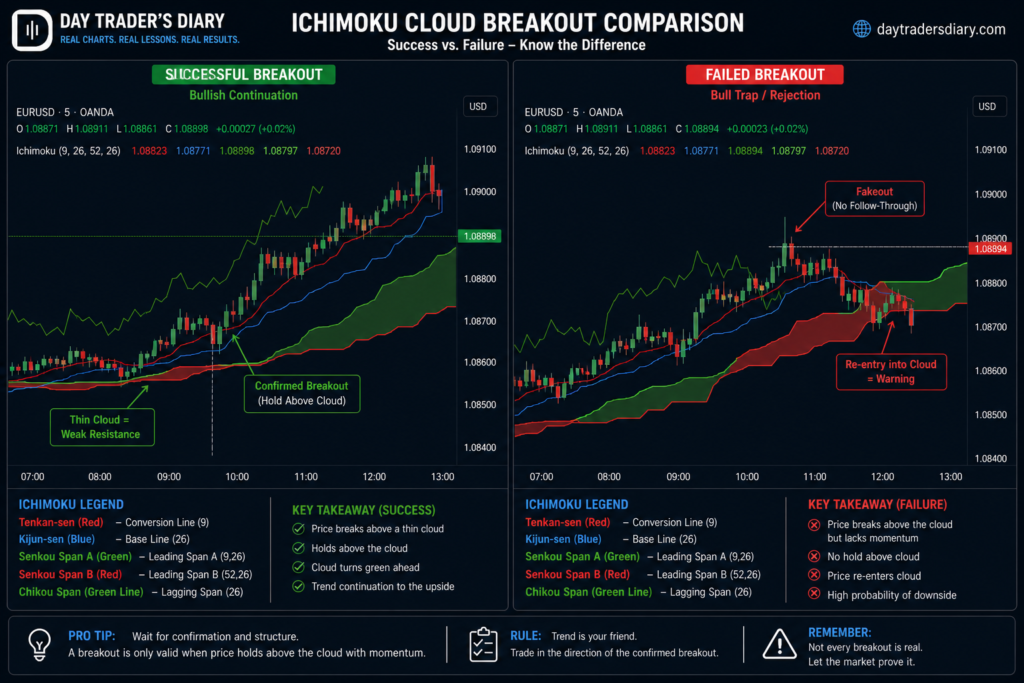
For example, if price breaks above the cloud, wait for a candle close above it. Then watch for a small pullback that holds above the cloud before entering.
This reduces false breakouts.
Another practical approach is using Kijun-sen as a dynamic reference.
In trending markets, price often respects Kijun as a mean reversion level. Entries near that line with trend alignment tend to offer better risk to reward.
Best Risk/Reward Ratios for Day Trading This flows right into the above. The closer your entrances are to structure, the more efficient your trades are.
Risk Management and Position Sizing with Ichimoku
Ichimoku gives you structure. Risk management gives you survival.
Your stop placement should reflect invalidation, not comfort.
If you are buying above the cloud, your stop should usually be below the cloud or below the recent structure that defines the trend.
This naturally creates variable stop distances.
This is where most traders miscalculate risk. Using a Position Size Calculator removes guesswork and ensures your lot size adjusts based on stop distance.
A wider cloud means a wider stop, which means smaller position size.
Professionals adapt. Retail traders often ignore this and overexpose themselves.
How to Journal Ichimoku Trades for Real Improvement
If you follow it properly, Ichimoku rewards consistency.
Your journal should capture context, not simply results.
Record where pricing was versus the cloud
Thickness and orientation of clouds
Tenkan-Kijun relationship
Entry type such as breakout or pullback
Session traded
Outcome and trade management decisions
Using your Trade Journal Template helps standardize this process.
After a series of trades, patterns emerge.
You may find that you perform best on continuation setups rather than breakout attempts, or that certain pairs respect the cloud more cleanly.
That is where real edge develops.
The Psychological Shift Ichimoku Forces
Ichimoku changes how you think about trading.
Instead of chasing signals, you start waiting for alignment.
That patience is uncomfortable at first. You will see moves happen without you.
But over time, you realize you are filtering out low quality trades.
That is the difference between activity and execution.
The traders who succeed with Ichimoku are not the ones who trade the most signals. They are the ones who wait for the cleanest conditions.
Scaling an Ichimoku-Based Strategy
Once your approach is consistent, the next limitation is capital.
A well executed Ichimoku strategy can produce steady returns, but small account size limits absolute growth.
This is why many disciplined traders explore evaluation programs from firms like The5ers, FTMO, or similar prop firms.
It’s not the firm that matters. The process.
If your journaling demonstrates repeatable performance with manageable drawdowns a The5ers evaluation account is a reasonable next step to scale your technique with increased buying power. Used correctly, it is a professional pathway, not a shortcut.
What Most Traders Miss About Ichimoku
The real power of Ichimoku is not the signals.
It is the ability to see market structure instantly.
You know whether the market is trending, consolidating, or transitioning without switching indicators or timeframes.
That clarity cuts down on decision fatigue.
And less misunderstanding frequently translates into greater execution in day trading.
Final Takeaway
Ichimoku is only complicated until you stop memorising it and start reading it.
If you want to improve your results, focus on one thing this week.
Trade only in the direction of the cloud and ignore everything else.
That single filter will remove a large number of low quality trades and force you to think like a structured trader.
Next read: How to Trade with Heiken Ashi Charts or Best Forex Chart Patterns for Day Traders.
FAQs
Is Ichimoku good for day trading forex?
Yes, especially in trending conditions. It provides structure, momentum, and dynamic support and resistance in one view.
What timeframe works best with Ichimoku?
It works on all timeframes, but many day traders use 5-minute and 15-minute charts for execution with higher timeframe context.
What is the best Ichimoku strategy?
There is no single optimum strategy but trend continuation setups with cloud alignment appear to be the most reliable.
Can beginners use Ichimoku Cloud?
Yes, but they should focus on basic concepts like cloud direction and price position before using advanced signals.
Do I need other indicators with Ichimoku?
Not necessarily. Many traders use it as a standalone system, but combining it with price structure can improve decision-making.