
Most traders don’t lose because their strategy is bad. They lose because they’re trading the right setup in the wrong direction.
You see a clean breakout on the 5-minute chart, you enter confidently, and within minutes price reverses hard. It feels random, but it’s not. You just traded directly into higher timeframe resistance or against a dominant trend you never checked.
That’s the real problem.
Multiple time frame analysis is not about adding complexity. It’s about removing blind spots. When done right, it gives context to every trade you take. When done poorly, it creates analysis paralysis and hesitation.
This guide is built from real trading experience and data-driven understanding, not theory. The goal is simple. Help you align your entries with what the market is actually doing across timeframes.
What the Data Says About Multi Time Frame Analysis
Professional traders don’t use one single period. Institutional research and trading education from organisations such as the CMT Association, CME Group, and even broker level studies from firms such as IG all point to one thing, context increases decision quality.
According to the CMT curriculum, one of the key principles of technical analysis is to synchronise trends across timeframes. The volatility and order flow education from CME Group illustrates how higher timeframes influence intraday price action. IG’s retail trader statistics will often reveal traders losing money when they trade counter trend moves without context.
What does that mean for you as a day trader?
It means your 5-minute setup is not independent. It is reacting to forces from the 1-hour and 4-hour charts. Ignoring that is like trading with half the information.
Why Most Traders Misuse Multiple Time Frame Analysis
The usual mistake is overcrowding the charts.
Traders load up 1-minute, 5-minute, 15-minute, 1-hour and 4-hour charts all at the same time. They get mixed signals and freeze instead of getting clarity. The second mistake is treating all timeframes equally.
They are not equal.
Higher timeframes define context. Lower timeframes define execution.
If you flip that, your trading becomes reactive instead of structured.
A Practical Framework That Actually Works
You do not need five timeframes. You need three.
Think of it as a top-down process.
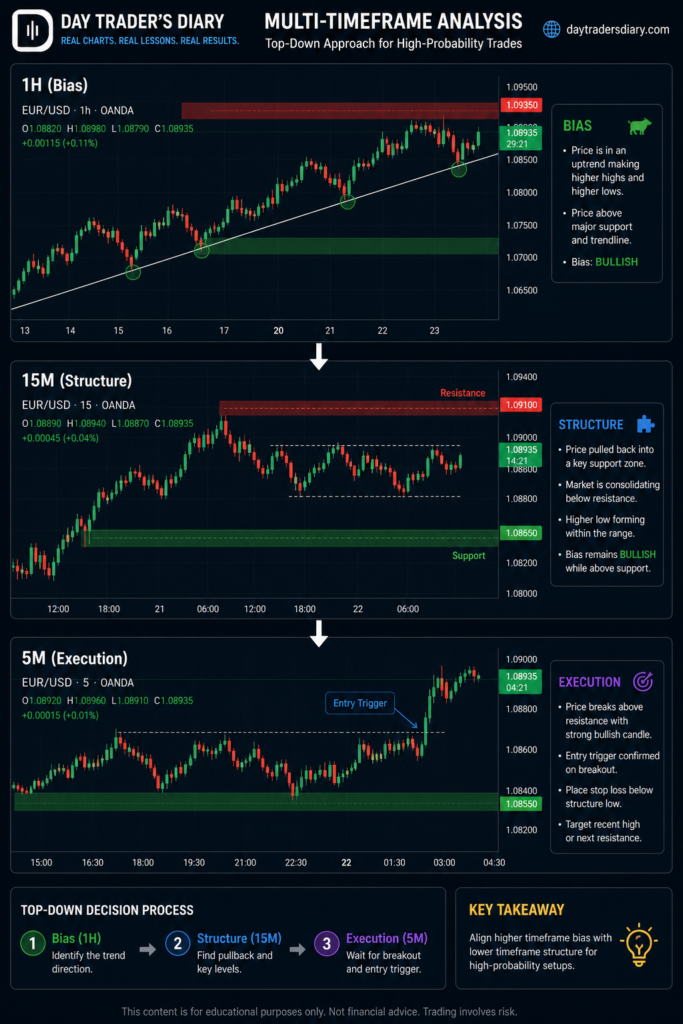
Start with the higher timeframe. This is where you define bias.
If you are trading intraday, your higher timeframe is usually the 1-hour or 4-hour chart. Here you are asking:
Is the market trending or ranging?
Where are the key support and resistance zones?
Is price approaching a major level or moving away from it?
This step answers one question. Should I be looking for buys or sells?
Go to the middle timeframe. This is your structure layer.
Generally the 15-minute chart for day traders. Here you set your bias:
Is the trend still intact or is it weakening?
Are we witnessing pullbacks or consolidations forming?
Is momentum slowing into higher timeframe levels?
This is where you avoid bad trades. If higher timeframe is bullish but the 15-minute shows exhaustion into resistance, you wait.
Finally, drop to the execution timeframe.
This is usually the 5-minute or even 1-minute chart depending on your style. Now you look for triggers:
Breakouts
Pullback entries
Candlestick confirmations like pin bars or inside bars
If you have read our guides on How to Trade Pin Bars in Forex or How to Trade Inside Bars in Forex, this is exactly where those patterns become meaningful. Not in isolation, but in alignment with higher timeframe context.
How Alignment Changes Trade Outcomes
Let’s use a real-world example.
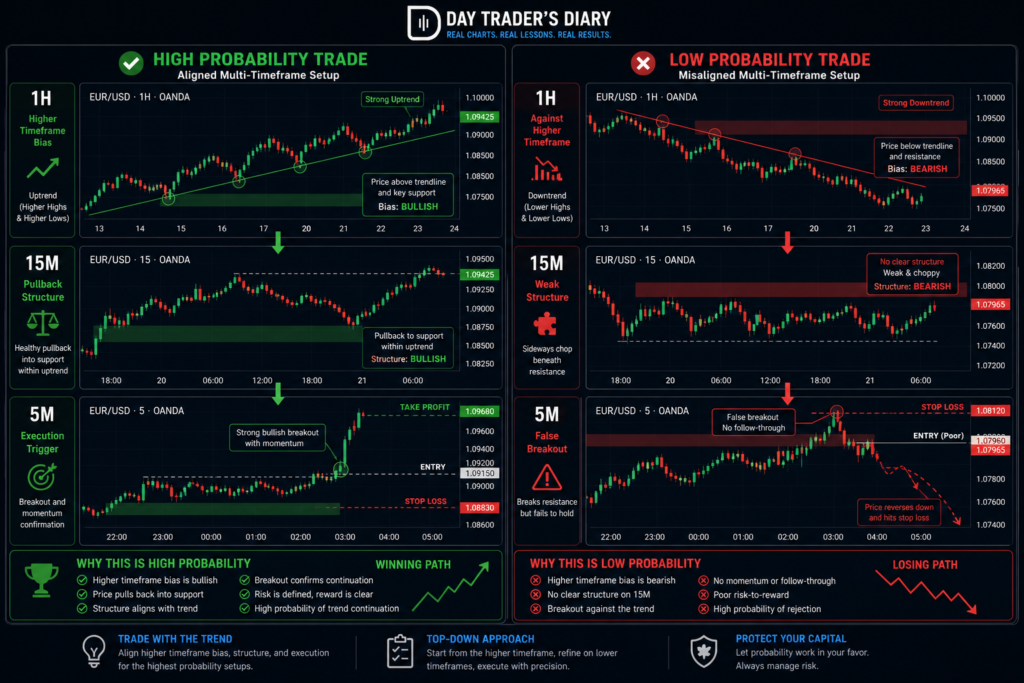
EURUSD is moving upward on 1 hour chart. Price retraces into a previous support area.
Instead of significant selling you see consolidation on the 15 minute chart building. On the 5-minute chart, you get a breakout above a minor range.
This is alignment.
Now compare that to the opposite situation.
EURUSD is trending down on the 1-hour chart. You see a small bullish breakout on the 5-minute chart and go long.
You are trading against pressure.
That is why your win rate feels random.
Multiple Time Frame Analysis for Scalping
Scalpers often think they do not need higher timeframes. That is a costly assumption.
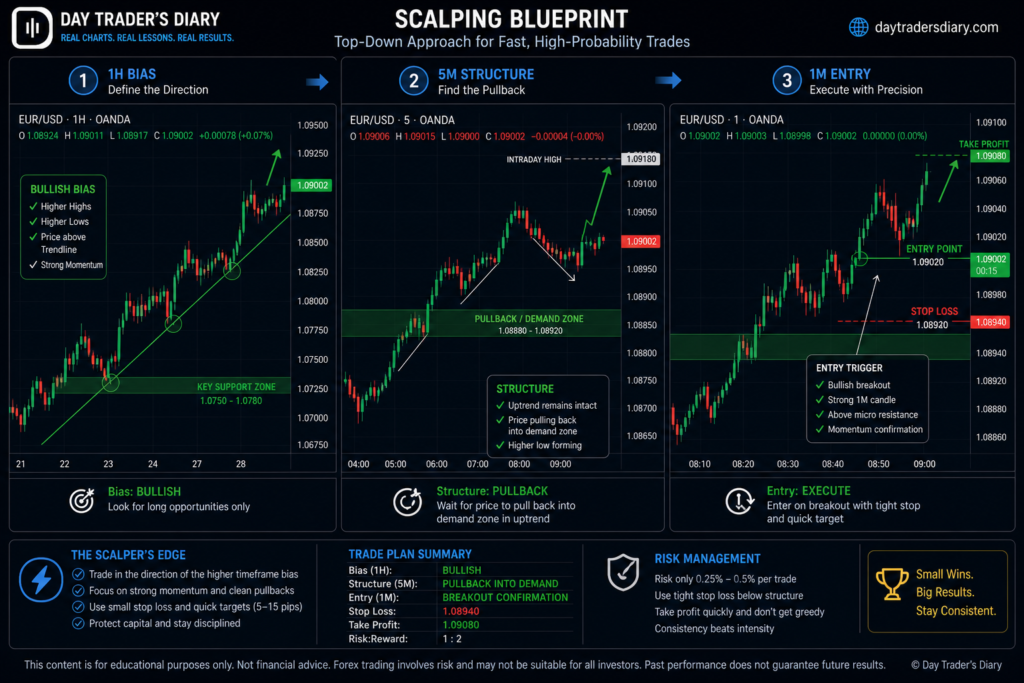
Even if you trade the 1-minute chart, you should still anchor to at least the 15-minute or 1-hour bias.
For scalping, simplify the process.
Use the 1-hour chart for directional bias.
Use the 5-minute chart for structure.
Use the 1-minute chart for execution.
You are not trying to predict large moves. You are trying to avoid trading against them.
When Multiple Time Frame Analysis Fails
It fails when traders expect perfect alignment.
Markets are not always clean.
There will be times when higher timeframe is bullish but lower timeframe is choppy. There will be mixed signals.
This is where discretion comes in.
Sometimes the best trade is no trade.
Another failure point is late entries.
If higher timeframe move is already extended, aligning with it too late can give poor risk to reward. This is where understanding Best Risk/Reward Ratios for Day Trading becomes critical.
Risk and Execution Still Decide Everything
Increased timeframes analysis increases probability. It doesn’t guarantee results.
It won’t save you if your risk is inconsistent.
Here is where most traders get risk wrong. A Position Size Calculator removes the guesswork in position sizing and guarantees your trade size meets your stop distance and account risk.
A well-aligned trade with poor sizing still damages your account. A slightly imperfect trade with solid risk control can still work.
How to Journal Multi Time Frame Trades
If you are serious about improving, you need to track alignment.
Inside your Trade Journal Template, record:
Higher timeframe bias
Middle timeframe structure
Entry timeframe trigger
Was the trade aligned or counter-trend
Outcome and notes on execution quality
After reviewing 20 to 30 trades, you will notice something quickly.
Your best trades come from alignment.
Your worst trades often come from forcing setups against context.
That awareness alone can transform your consistency.
Scaling This Edge Into Real Capital
Once you start executing with alignment and discipline, a different problem appears.
Capital restrictions.
Account size limits your gains but you may be consistent. At this point many traders will look at evaluation systems.
Firms like The5ers, FTMO and other comparable prop firms give organised pathways to trade larger capital if you can demonstrate consistency under guidelines.The key is mindset.
The mindset is everything.
These are not hacks. They are sieves.
If your multiple time frame analysis is on point and your risk is controlled and your journaling is constant then looking at a The5ers evaluation account can make sense as a method to scale what already works!
If those things are not in place, no funding will fix that.
The Insight Most Traders Miss
Multiple time frame analysis is not about confirmation. It is about context.
You are not looking for three charts to agree perfectly. You are trying to understand where pressure is coming from.
Higher time frame implies intent.
Timing on lower timeframe.
When you mix both you stop reacting and start placing.
Final Takeaway
If your trading feels inconsistent, it is rarely because you need a new indicator.
It is usually because you are trading without context.
For the next five trading days, try this.
Before every trade, write down your higher timeframe bias. If you cannot define it clearly, do not take the trade.
It sounds simple, but most traders never do it consistently.
That one habit can clean up half your losing trades.
Next read: How to Identify Trend Reversals Intraday or Best Forex Chart Patterns for Day Traders.
FAQs
What is multiple time frame analysis in forex?
It is the process of analyzing price across different timeframes to align trend, structure, and entry for higher probability trades.
Which timeframes should day traders use?
A common combination is 1-hour for bias, 15-minute for structure, and 5-minute for execution.
Is multiple time frame analysis good for scalping?
Yes. Even scalpers benefit from aligning with higher timeframe direction to avoid trading against momentum.
How many timeframes should I use?
Three is nice. More often than not, this leads to confusion rather than improved judgements.
Does multiple time frame analysis guarantee better results?
No, but it improves trade selection and reduces low-quality setups when combined with proper risk management.