
Most traders don’t lose money because they pick the wrong direction on EURUSD. They lose because they expect the market to move more than it realistically can in a single day.
You’ve probably seen it. Price has already moved 70 or 80 pips, but you enter late expecting another 100. Or worse, you short the low or buy the high because you think “this is the breakout.”
What you’re actually doing is ignoring the daily range.
This guide is not about predicting where EURUSD will go. It’s about understanding how far it can go, when that movement typically happens, and how to position yourself inside that structure. This is where consistency starts to show up.
What the Data Says About EURUSD Daily Range
One thing is clear if you look at historical volatility statistics from places like the Bank for International Settlements, the CME Group, and Myfxbook.
Compared to other pairings, EURUSD has a fairly consistent average daily range. It gets bigger during big events, but most days it stays within a certain range.
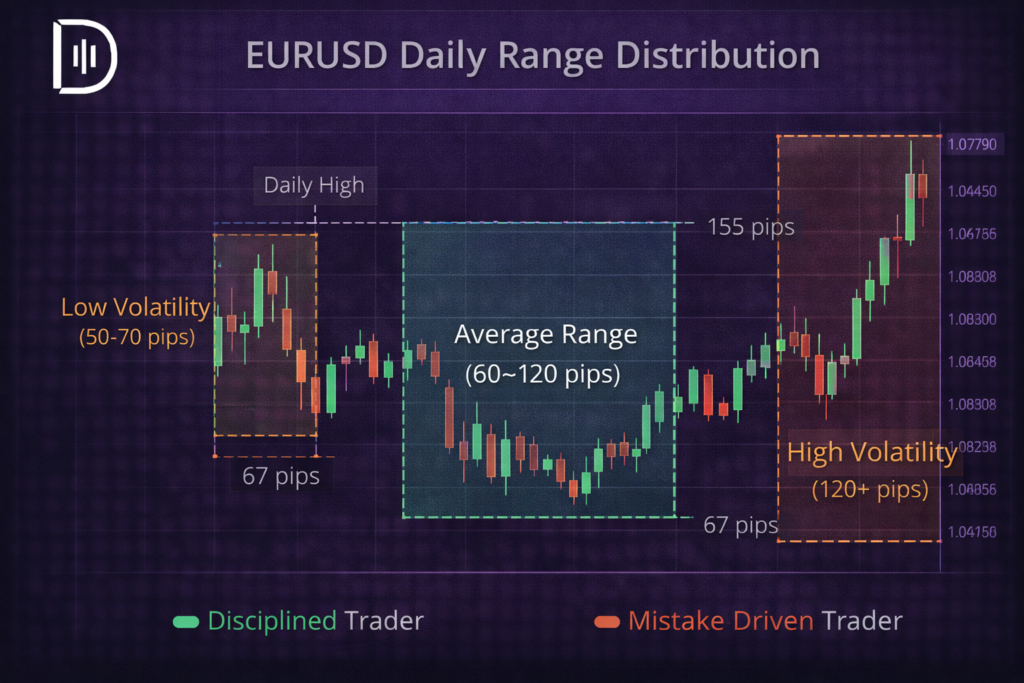
Depending on the market cycle, EURUSD typically moves between 60 to 120 pips per day. During quieter periods, it compresses closer to 50 to 70. During high volatility environments, it stretches beyond 120.
The key insight most traders miss is not the number itself. It’s how that range gets distributed.
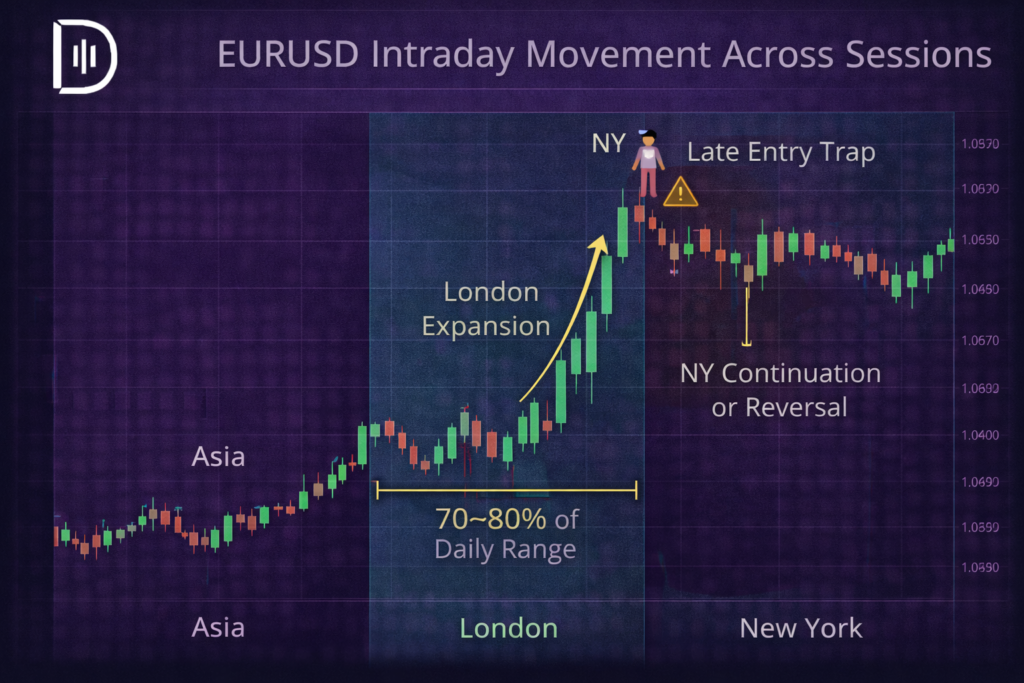
A large portion of the daily range is often completed during the London and New York sessions. By the time New York is halfway through, the pair has already printed a significant part of its move.
This changes how you should approach entries. You are not trading infinite potential. You are trading within a limited statistical box.
Thinking in Ranges Instead of Targets
Most traders approach EURUSD with fixed targets. They aim for 1:2 or 1:3 without asking whether the market has room to deliver that.
A more professional approach is to think in terms of remaining range.
Start your day by asking a simple question. How much has EURUSD already moved relative to its average daily range?
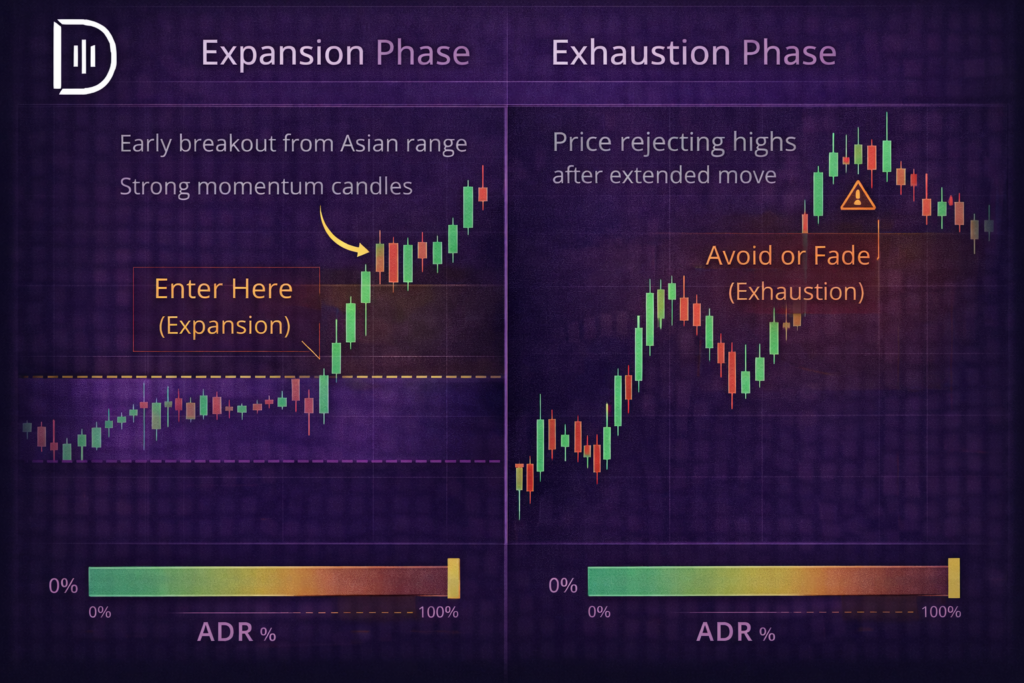
If the pair has already covered 80 percent of its typical move, you should not be chasing continuation trades. You should be thinking about exhaustion, mean reversion, or standing aside.
On the other hand, if London has only produced a 30 pip move and volatility is low, there is still room for expansion. That’s when continuation setups make more sense.
This simple shift changes your entire decision-making process.
A Practical Framework You Can Apply Daily
Start each trading day with context, not setups.
First, write down the high and low from the day before. These levels often pull people in or push them away at the start of the session.
Then look at how the range has changed since the last day. If you trade during London, you’re probably trading during the expansion period. When you trade late in New York, you’re usually in the completion phase. Now layer in session behavior.
London tends to initiate moves. New York tends to either extend or reverse them.
A common scenario looks like this. London breaks above the Asian range and pushes aggressively. By the time New York opens, EURUSD has already covered a large portion of its average range. If New York fails to continue, the probability of a pullback increases.
This is where many traders get trapped. They enter late breakout trades right into exhaustion.
Instead, you should be asking conditional questions.
If price has already extended beyond 80 percent of its average range and shows rejection at a key level, fading the move becomes logical.
If price is still within the lower half of its range and volatility is building, continuation setups become more attractive.
This is not about indicators. It’s about positioning yourself relative to what the market has already done.
Where Most Traders Misread the Daily Range
The biggest mistake is treating the average daily range as a guarantee instead of a guideline.
Some days will exceed it. Some days will fall short.
The real edge comes from understanding when the market is likely to expand and when it is likely to stall.
Another common mistake is ignoring timing.
A 40 pip move during Asia is not the same as a 40 pip move during London. The same number means different things depending on when it occurs.
This is why combining range analysis with session timing gives you a much clearer edge than using either one alone.
If you’ve read our breakdown on session-based strategies, you’ll recognize how this aligns with understanding volatility cycles throughout the day.
Connecting Range to Execution and Risk
Range analysis is useless if your execution doesn’t reflect it.
This is where most traders miscalculate risk. They place stops and targets without considering how much the market can realistically move.
If EURUSD has already exhausted most of its daily range, your stop placement needs to tighten and your expectations need to adjust. Wide stops in a low remaining range environment don’t make sense.
This is where using a position size calculator removes guesswork. It forces you to align your risk with actual market conditions rather than arbitrary numbers.
Your trade size, stop distance, and expected move should all be based on the same underlying logic.
Tracking Your Range-Based Performance
If you’re not journaling how EURUSD behaves relative to its daily range, you’re missing the feedback loop that improves decision making.
Start tracking simple things.
How much of the daily range was completed before your entry
What session you traded
Whether the trade aligned with expansion or exhaustion
Over time, patterns start to show up.
You’ll notice that your best trades often occur when you enter early in the range expansion or when you correctly identify exhaustion.
This is where using a structured trade journal template becomes valuable. It helps you move from random outcomes to repeatable insights.
Scaling Beyond Retail Limitations
Even if you master trading the EURUSD daily range, capital becomes the next constraint.
You can have a solid edge, but if you’re trading a small account, your growth will always be limited.
This is why many serious traders move toward evaluation-based funding models.
Firms like The5ers, FTMO, and others provide access to larger capital once you demonstrate consistency. The main distinction is that they reward following the rules, not taking risks.
These techniques work well with trading within a set daily range since it naturally keeps people from trading too much and taking too much risk.
If you always use range-based thinking and manage risk well, the next step is to look into a The5ers evaluation account. There is no shortcut. It’s a technique to make a process that has previously worked bigger.
Final Thoughts
Trading EURUSD without understanding its daily range is like driving without a fuel gauge. You might move in the right direction, but eventually you’ll run into problems you could have avoided.
Your goal is not to catch the entire move. It’s to position yourself within the part of the move that makes sense.
Start tomorrow with one adjustment.
Before taking any trade, ask how much of the daily range is already done.
That one question will filter out more bad trades than any indicator ever will.
For your next step, go deeper into how session timing affects volatility. That’s where range and timing come together to create real edge.
FAQs
What is the average daily range for EURUSD?
It typically ranges between 60 to 120 pips depending on market conditions, with lower ranges in quiet periods and higher during volatile phases.
Is trading the daily range better than using indicators?
It’s not about better or worse. Range gives you context. Indicators without context often lead to poor timing and unrealistic expectations.
Can EURUSD exceed its daily range?
Yes, especially when there are big news stories or strong trends. That’s why range should be a recommendation and not a hard restriction.
What is the best time to trade the EURUSD range?
The London and New York sessions provide the most reliable movement, with London often initiating and New York either extending or reversing moves.
How do I combine daily range with scalping?
Focus on entering early in the expansion phase or fading exhaustion near the end of the range. Scalping works best when aligned with where price sits within the daily structure.