
One of the most expensive mistakes I see day traders make has nothing to do with their strategy.
It’s their timing.
A trader spends weeks refining entries, testing indicators, and building a solid risk management plan. Then they take the same setup during a quiet period of the trading day when liquidity has almost disappeared—the breakout stalls. Price drifts sideways. A few random candles trigger the stop-loss, only for the market to move cleanly hours later when institutional participation returns.
The trader blames the strategy.
In reality, the market environment was the problem.
After watching thousands of charts, one lesson becomes impossible to ignore. A good setup traded during poor liquidity often performs worse than an average setup traded during peak participation.
That is why professional traders don’t just ask, “Is this a valid setup?”
They also ask, “Is this the right time to trade it?”
Understanding when liquidity enters the market can dramatically improve execution, reduce frustration, and eliminate many trades that never had much chance of succeeding.
Why Liquidity Matters More Than Most Traders Realize
Liquidity is the ability to match purchase and sell orders easily.
High liquidity means that big orders can be absorbed with relatively little interruption to price. Trends tend to be more gradual, spreads are tighter, and technical levels are more predictable.
The opposite is true in low liquidity cases.
Small orders can move pricing in unexpected directions. Spreads are wide. There are more false break-outs. The momentum isn’t there. There just aren’t enough invested participants to support the trend.
This is why the same chart pattern can yield completely different outcomes at different times of day.
Research Supports Trading During Active Sessions
According to the Bank for International Settlements (BIS), the forex market is most active during the overlap of major financial centers, particularly during the London and New York sessions. These hours see the most trade volume and institutional activity on a consistent basis.
“Liquidity impacts execution quality, bid-ask spreads and market efficiency across futures and currency markets,” the CME Group says.
The Federal Reserve Bank of New York periodically publishes studies indicating how trade activity tends to concentrate around key market sessions and economic developments, reaffirming the fact that timing is as important as technical analysis.
For active day traders, the message is straightforward.
Market participation is not evenly distributed throughout the day. Knowing when liquidity naturally increases gives your strategy a better environment in which to perform.
Identify the Hours When Institutions Are Active
Many retail traders build strategies around chart patterns without considering who is actually participating in the market.
Institutional traders create much of the liquidity that drives meaningful price movement.
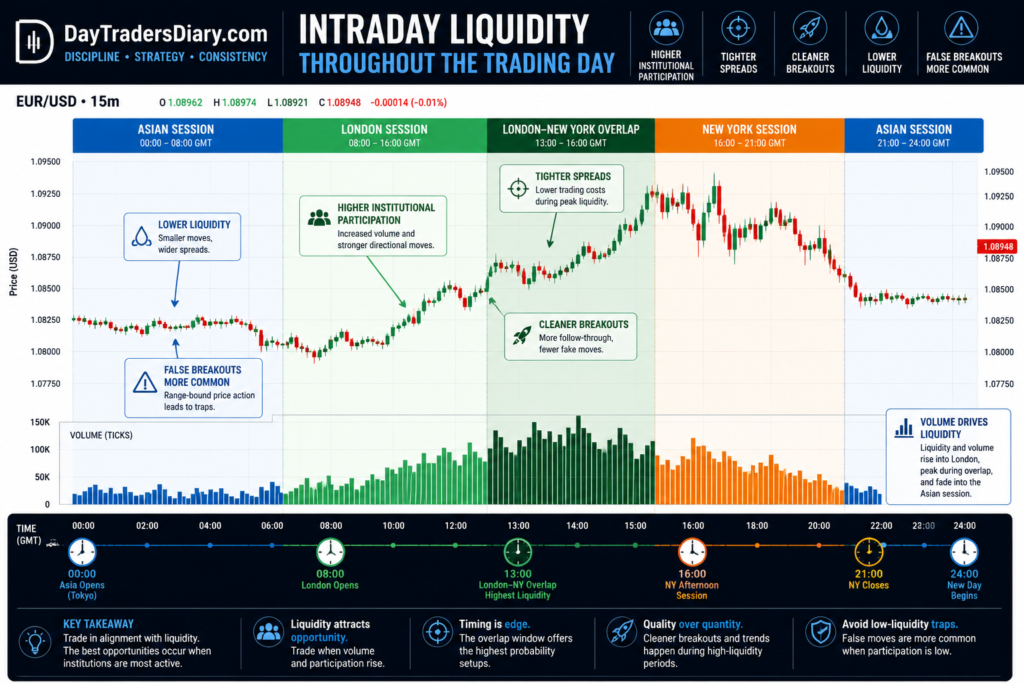
The London session often delivers strong directional moves as European banks and funds become active.
The overlap between London and New York typically provides the deepest liquidity of the trading day because two major financial centers are operating simultaneously.
By contrast, the period between the New York close and the Asian session often produces slower, less reliable price action for many major currency pairs.
The goal is not to trade every active session.
The goal is to align your strategy with the periods when your preferred market historically performs best.
Match Your Setup to the Market Session
Not every strategy belongs in every session.
Momentum breakouts often perform best when participation is increasing and fresh capital is entering the market.
Pullback strategies tend to work better once an established trend has developed and liquidity remains healthy.
Range trading can be more suitable during naturally quieter sessions, provided volatility remains predictable.
The mistake many traders make is forcing one setup into every market condition.
A breakout strategy designed for the London open will rarely behave the same way during the final hours of the New York session.
Good traders adapt.
Great traders prepare.
Watch Volume Before You Watch Price
Volume frequently indicates whether a move deserves your confidence, but price can catch your attention first.
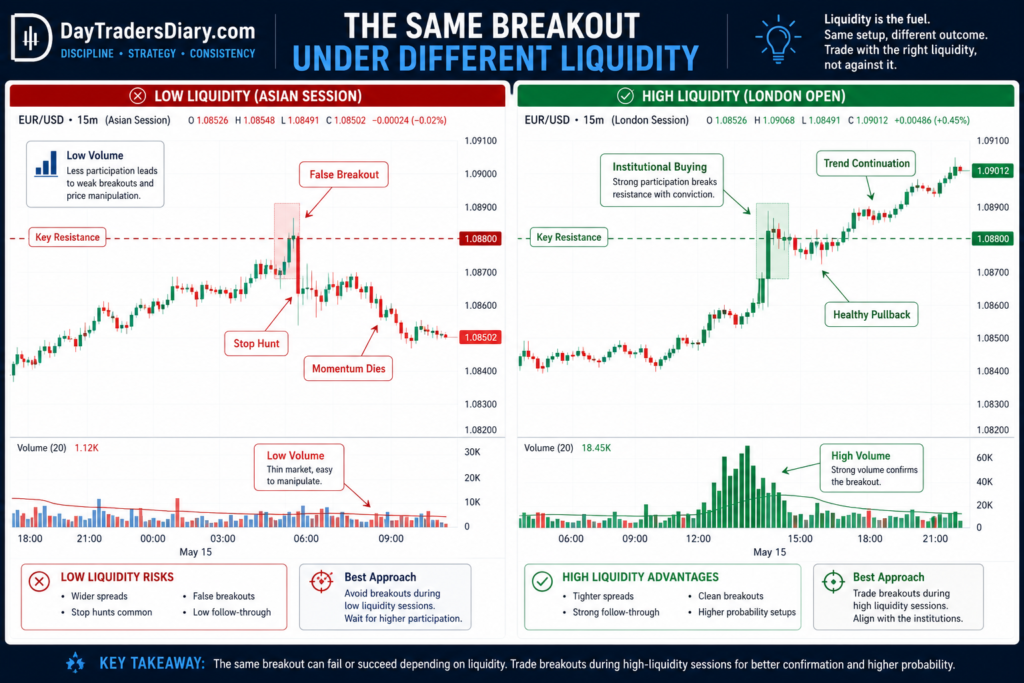
If EUR/USD breaks resistance thirty minutes before the London open.
The breakout looks convincing.
Then the volume remains below average.
Momentum fades almost immediately.
Now picture the same breakout occurring shortly after London opens with expanding volume and increasing participation.
The probability of continuation immediately improves.
The chart pattern did not change.
The market participation did.
Avoid Trading During Market Transitions
One overlooked period is the transition between active and inactive sessions.
Markets typically run out of steam before most players head home for the day.
This makes for turbulent price activity that can tempt traders to force entries.
Candles shrinking, volatility shrinking and momentum vanishing, if you see this, the market may be waiting for the following session.
Experienced traders recognize these conditions quickly.
Sometimes the highest-quality trade is the one you never take.
Use Higher Time Frame Context
Low-liquidity trading becomes even more dangerous when it conflicts with the broader market structure.
Suppose a five-minute breakout appears during a quiet session while the hourly chart remains trapped inside a larger consolidation.
There is little reason to expect sustained momentum.
Now imagine that same breakout occurring during the London-New York overlap after price has already established a strong higher-timeframe trend.
The probability improves because multiple factors align.
This idea complements our guide How To Measure Trend Slope Properly, where trend quality becomes far more important than isolated chart patterns.
Build a Time-Based Trading Routine
A habit that always helps to improve decision making is to write a session checklist before each trading day.
Get notified when big sessions open.
Scheduled economic releases Mark
Identify the periods when your preferred currency pairs historically become most active.
Then ask one simple question before entering any trade.
“Is the market active enough for my setup?”
That question alone can eliminate many low-quality trades.
Understand When Low Liquidity Can Still Work
Not avoiding low liquidity hours means those times never present possibilities.
Some traders look to range-bound markets in quieter sessions.
Others focus on specific Asian session currency pairs where liquidity naturally improves.
The important point is matching the strategy to the environment.
Problems arise when traders use a momentum strategy in conditions that rarely support momentum.
Context always comes before execution.
Risk Management Starts With Market Conditions
Many traders reduce their position sizes during volatile news events but forget to adjust their expectations during low-liquidity periods.
Poor liquidity increases the chance of erratic price movement and inconsistent execution.
This is where most traders miscalculate risk. Using the Position Size Calculator removes guesswork by helping determine the appropriate trade size based on the stop-loss distance rather than confidence alone.
Good risk management begins before the trade, not after it.
Track Performance by Trading Session
One of the simplest ways to improve your strategy is to organize your trading journal by session.
Separate trades taken during London, New York, the overlap, and quieter market hours.
After a few months, you’ll discover patterns that are impossible to see by looking only at profits and losses.
You may find that your breakout strategy performs exceptionally well during London but consistently struggles during late New York.
That insight is worth far more than adding another indicator to your chart.
The Trade Journal Template is an excellent tool for recording session data, execution quality, and market conditions alongside every trade.
The goal is not just to know whether you won or lost.
The goal is to understand why.
Scaling Your Trading Requires Consistency
Trading with larger capital demands more than finding profitable entries.
It requires consistent execution under repeatable market conditions.
This is one reason evaluation firms such as The5ers, FTMO, and FundedNext emphasize discipline over occasional spectacular gains.
A trader who consistently avoids poor liquidity environments is often more reliable than one who constantly chases volatility.
If your journal demonstrates consistent execution, disciplined risk management and a clear understanding of market timing then a The5ers assessment account can be a reasonable next step to access more cash without the continued need to increase your personal investment.
Common Mistakes Traders Make During Low-Liquidity Hours
Many traders think every breakout gets some attention, regardless of when it occurs.
Some others do not worry about widening spreads and instead care about chart patterns.
Some confuse random price moves with true momentum.
The most prevalent misunderstanding is to think that patience means you are missing opportunities.
In fact, waiting for improved market circumstances usually means better execution and more confidence.
Trading less can produce better results.
Final Thoughts
The market doesn’t reward traders simply for finding good setups.
It rewards those who understand when those setups have the highest probability of working.
Timing is not a small detail.
It is part of the edge.
For the next month, don’t change your strategy.
Instead, change when you trade it.
Track your results by session, compare execution quality across different liquidity environments, and look for patterns instead of isolated wins and losses.
You may discover that your biggest improvement comes not from finding a new strategy but from trading your existing one at the right time.
For your next read, continue with How To Judge News Strength Before Release to learn how scheduled economic events can further improve your timing and trade selection.
Frequently Asked Questions
What are low-liquidity hours in day trading?
Hours of low liquidity are those in which there are fewer market participants. Spreads tend to widen, volatility becomes erratic and technical setups are usually less accurate during these times.
Why should intraday traders avoid low-liquidity periods?
Less liquidity means a greater chance of false breakouts, erratic price movements, and poor trade execution. The price action is usually cleaner when you trade during active sessions.
Which forex session has the highest liquidity?
The overlap between the London and New York trading sessions usually has the highest liquidity because major financial institutions from both regions are actively trading.
Can profitable trades still occur during low-liquidity hours?
Yes. Some tactics such as range trading can work well in the less volatile markets. The idea is to align your strategy with the market situation, rather than utilizing the same technique all day long.
How can I identify if liquidity is decreasing?
Watch for narrowing candle ranges, falling volume, widening spreads, slowing momentum and repeated failures to break major support or resistance levels.
Should I include trading session data in my journal?
Absolutely. Record the session (market circumstances, execution quality with each transaction) to see when your strategy works best and where you are losing unnecessarily.