
You find a clean bullish move on EUR/USD. Price keeps making higher highs, the pullbacks look controlled, and the chart seems to be giving you an easy opportunity. You draw a small trend channel and wait for the price to touch its lower boundary.
It gets there. You buy.
Then price slips below the channel, takes out your stop, and moves higher without you.
If this has happened to you, you already know the frustrating part. Your overall market direction might have been right, but your entry was poorly timed.
This is where micro trend channels can help. They give you a closer look at the rhythm of short-term price action. You can use them to study pullbacks, judge whether momentum is holding up, and recognize when a small trend is starting to weaken.
The trick is not to trade every touch of a line. It is to understand what price is doing when it reaches that line.
What Are Micro Trend Channels?
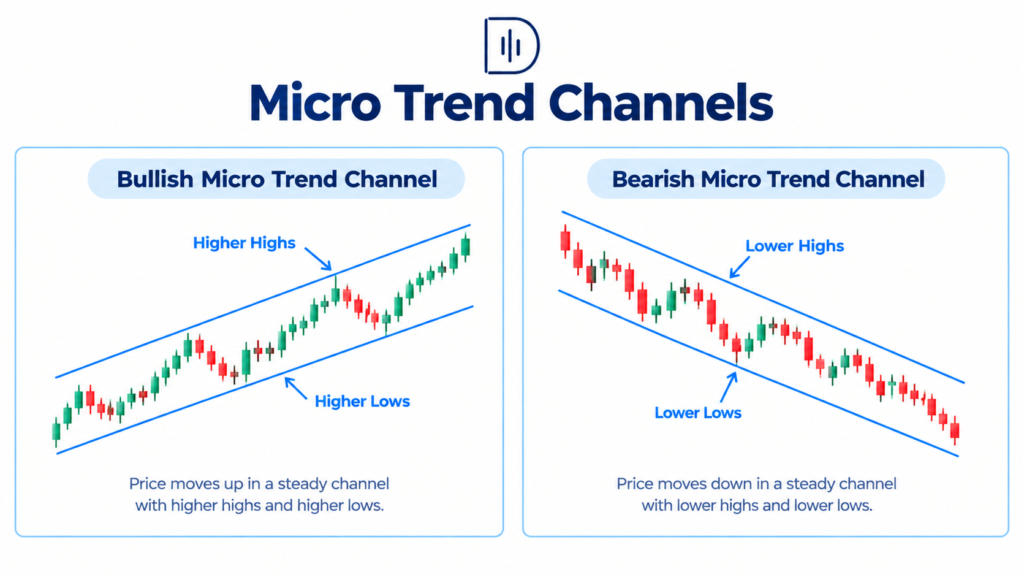
A micro trend channel is a narrow channel drawn around short-term price swings. It helps traders follow the small trends that develop inside a larger move.
Markets in bullish channels have higher highs and lows. Bottom barrier links rising swing lows, while top boundary frames progress. With lower highs and lows, a bearish channel is opposite
You will often see these structures on one-minute, three-minute, or five-minute charts. The right timeframe depends on the currency pair, the session, and how quickly you want to trade.
If EUR/USD rises on the 15-minute chart. While that provides context, it does not indicate when to enter. Whether buyers are still controlling smaller swings or the advance is uneven can be seen with a five-minute micro channel.
That extra detail is useful, but it can also tempt you to overtrade. A small channel appears on almost any chart if you look hard enough. The goal is to find a channel that reflects a genuine move, not to draw lines around every candle collection.
What Research Tells Us About Trend Channels
The CME Group’s guide to trend and continuation patterns explains how pauses and retracements can develop within an existing trend. For day traders, the useful lesson is that a pause does not automatically mean a trend has ended, but continuation is never guaranteed.
Its guide to support and resistance also provides a useful foundation for reading price levels. Previous highs, lows, and trend boundaries can help traders identify areas where the price may react. Those areas should be treated as zones of interest rather than exact lines that the price must respect.
The Bank for International Settlements discusses changes in FX market activity and volatility in its analysis of the foreign exchange market. This broader market research is not a test of micro trend channels themselves, but it reinforces an important point: trading conditions change. A pattern that behaves neatly during a quiet session may break quickly when volatility increases.
Put these ideas together, and the approach becomes clearer. Use the channel to organize what you see, pay attention to important price levels, and adjust your expectations when market conditions change. No research establishes that drawing a micro channel alone creates a profitable trading edge. That has to be tested against your own trading data.
How To Read a Micro Trend Channel
Before drawing a channel, look at how the price reached its current position.
A bullish channel is more useful when the market has been making a series of higher highs and higher lows. Each pullback should leave the broader short-term structure reasonably intact. If candles keep crossing the proposed boundaries and the price repeatedly breaks both sides, the market may be ranging rather than trending.
You do not need perfect parallel lines. Price rarely moves with that kind of precision. The channel needs to capture the general direction and boundaries of the recent swings.
Pay attention to the slope, too. A steep bullish channel can show strong buying pressure, but it may also be difficult to sustain. If the price starts struggling to make new highs or begins breaking minor swing lows, buyers may be losing their grip.
That does not mean you should immediately sell. It means the original bullish setup needs another look.
A channel is most useful when it helps you notice a change in behavior before you commit to a trade.
A Practical Micro Trend Channel Strategy
Start with the bigger picture.
First, check the 15-minute chart or a higher time frame. Is the trend clear, or is the market going sideways or approaching an important support or resistance zone?
Suppose EUR/USD is making higher highs and higher lows on the 15-minute chart. You can then look for a bullish micro channel on the five-minute chart and wait for a pullback that offers a potential continuation entry.
If the higher timeframe is stuck in a range, be more careful. A small bullish channel may look convincing for a few candles, only to reverse as the broader market lacks clear direction.
The bigger picture will not predict the next move, but it can help you avoid taking a short-term pattern out of context.
Draw the channel around real price swings.
Connect the relevant swing lows in a bullish move or swing highs in a bearish move. Use the opposite boundary to frame the channel where the structure allows it.
Do not keep adjusting the lines until every candle fits. If you have to force the channel into place, the price structure may not be clear enough to trade.
A useful question is simple: would you have drawn roughly the same channel before knowing what happened next? If the answer is no, you may be seeing the pattern with hindsight.
Wait for the price to react.
This is where many traders enter too early.
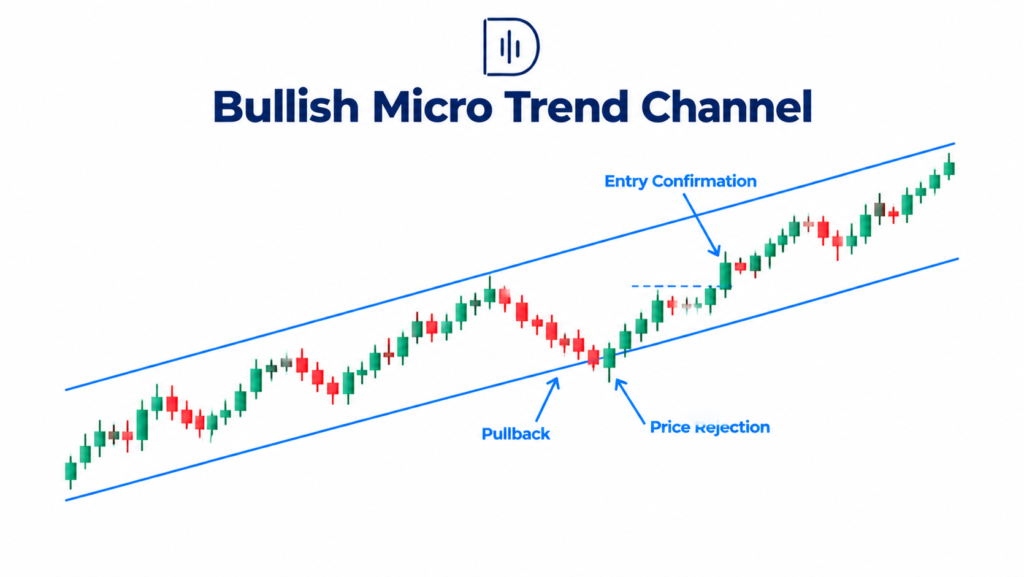
In a bullish channel, price may return to the lower boundary, but that alone does not mean buyers are ready to step in. Selling pressure could continue, pushing the price below the channel.
Instead, watch how the price behaves around the boundary. Does it stop making lower lows? Does a rejection candle appear? Does price break a nearby minor swing high?
These are possible signs that buyers are returning. They do not guarantee a successful trade, but they give you more information than a simple line touch.
For a bearish channel, apply the same reasoning in reverse. When price rallies toward the upper boundary, look for signs that the rally is stalling and sellers are regaining control.
Understand what a channel break is telling you.
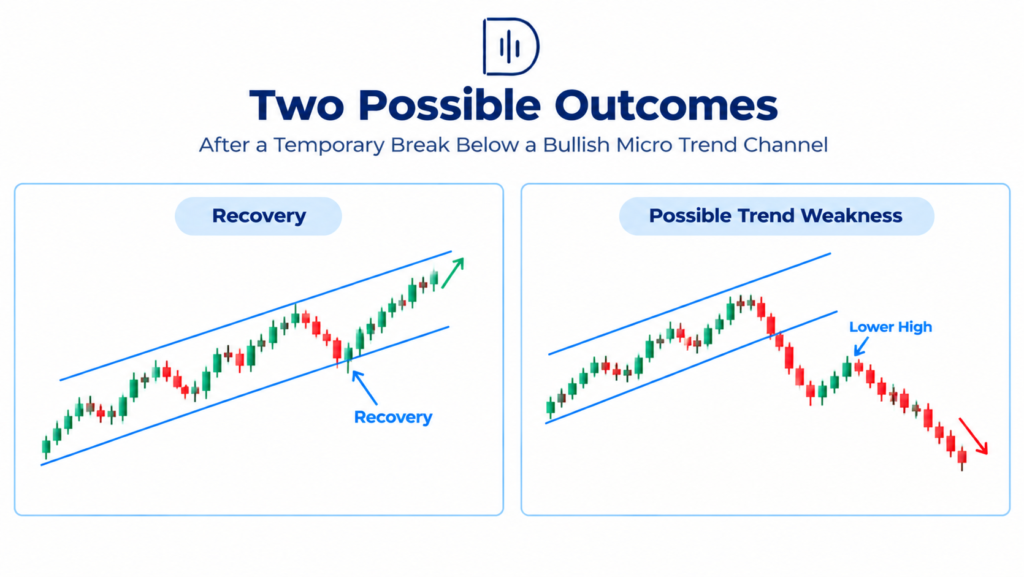
A break below a bullish micro channel often prompts traders to consider a reversal. Sometimes that is exactly what follows. Other times, the price dips below the boundary, recovers, and continues higher.
Imagine EUR/USD rising from 1.0800 to 1.0840 in a five-minute channel. Price drops below the lower limit.
It may have lost structure temporarily if it immediately returns to and reclaims a neighboring swing region. If the price stays below the channel, makes a lower high, and breaks a big swing low, a deeper correction is anticipated.
Notice the difference. You are not making a decision based on the line alone. You are watching how the market responds after the break.
The same principle applies to a bearish channel. A break above the upper boundary deserves attention, but the follow-through helps determine whether it signals a genuine shift or just a brief interruption.
Plan the trade before clicking buy or sell
Once the setup looks reasonable, decide where your trade idea becomes invalid. In a bullish setup, that might be below the latest structural low. In a bearish setup, it might be above the relevant swing high.
Then consider the potential target and the distance to your stop. If the trade requires an uncomfortably wide stop, do not squeeze it into a random location to make the position size larger.
Sometimes the best decision is to wait for another pullback. There will always be another chart to analyze.
When Micro Trend Channels Stop Being Useful
Micro channels are usually weak when the market is directionless. In a choppy session, pricing can churn between two boundaries without making meaningful progress. Every touch looks like an opportunity, but the follow-through is terrible.
They can also be fickle around big economic releases. Market expectations can shift in seconds due to an inflation statement or a central bank action. A channel that seemed to be well organized before the announcement can be rendered useless nearly overnight.
Another trap is chasing an extended move. If price has already traveled far inside a steep channel, entering near the end of the move can leave you with limited upside and a distant structural stop.
Ask yourself whether you are entering because the setup is still attractive or because you are afraid of missing the move. Those are very different reasons to place a trade.
Risk Management and Execution
Refined entries using microtrend channels do not assure price follow-through. Because short-term charts are noisy, a halt may be achieved even if the trend continues.
Decide how much you are prepared to lose before placing the trade. Calculate the position size using your entry price, stop distance, and the specifications of the instrument you are trading.
The DayTradersDiary.com is the place to look for its trading tools, including the Position Size Calculator if available. Using a calculator helps keep your exposure consistent, rather than letting the apparent quality of a setup influence how much you risk.
Remember that a tight stop is not always a safer stop. If it falls within the channel’s normal fluctuations, the price may hit it before the setup has a fair chance to develop. Equally, a wide stop does not justify risking more money.
Your position size should adapt to the trade. Your risk limit should not.
How To Improve Through Journaling
You will learn more from reviewing your own channel trades than from collecting dozens of chart examples without recording the results.
For each trade, you should specify the currency pair, session, time frame, channel direction, entry trigger, stop location, and whether the higher time frame supported the setup. Take a screenshot of the chart before you add the entry so you can see what the chart truly looked like at the time.
Also, note whether you entered on the first border touch or waited for confirmation. Test those two methods on a realistic sample and compare the outcomes after costs. You may find that confirmation enhances your submissions, or that waiting too long often means you miss the best part of a move.
Neither outcome should be assumed in advance. Let your records answer the question.
You can check DayTradersDiary.com for the downloadable Trade Journal Template if available. Use a consistent format so that you can compare similar setups rather than relying on memory, which tends to remember the frustrating losses and the exciting wins more clearly than the ordinary trades in between.
Can Micro Trend Channels Help You Scale?
Once your strategy becomes consistent, you may start thinking about trading with more capital. That is a separate decision from proving that the setup works.
Proprietary trading evaluations are one route some traders consider. The5ers offers evaluation programs with defined objectives and risk limits. FTMO provides a different evaluation model with its own conditions.
Neither firm removes the need for a tested strategy. Before paying for an evaluation, understand its current fees, daily-loss rules, overall drawdown limits, trading restrictions, and payout terms.
Micro trend channels can produce frequent entry opportunities, particularly on lower timeframes. That frequency can become a problem if you start taking every possible setup to reach an evaluation target. A better approach is to trade only the conditions your journal has shown to be worthwhile.
Think of an evaluation where you can follow your guidelines in both winning and losing situations. The goal is to show a repeatable procedure that doesn’t require taking more risks than you usually would.
FAQs
What timeframe is best for micro trend channels?
Usually 1, 3, or 5 mins. Traders can toggle between a higher and lower timeframe to find a direction and improve entries. Assuming faster charts are better, try the combo on your instrument.
Are micro trend channels useful for forex scalping?
They can help scalpers coordinate short-term price action and find possible pullback entries. But for small targets, the spreads, execution costs, and fast price swings are more important. A pattern that looks profitable before costs may not do well in live trading.
Should I enter whenever the price touches the channel boundary?
Nope. A boundary touch tells you where to pay attention, not when to enter. Look for a reaction that meets your trading rules – short-term structural break, or an unsuccessful attempt to continue against the trend.
Does a break of the channel mean the trend has reversed?
Not necessarily. It may signal a deeper pullback, a transition into a range, or a reversal. Watch the follow-through and whether important swing points hold or break before deciding that the trend has changed.
Can micro trend channels be used with support and resistance?
Yes. A channel boundary near an important support or resistance zone may provide useful context. Still, several signals pointing in the same direction do not guarantee a winning trade. Define your entry, invalidation point, and risk before entering.
Final Thoughts
The greatest advantage of micro trend channels is not that they make the next move easier to predict. They provide you with a clearer means to judge the minor swings in price that often determine whether an entry is well-timed.
In the next 20 setups, draw the channel before moving. Note the price at the border, the confirmation you wait for, and whether the channel break continues or corrects.
Do not change your rules after every loss. Review the evidence first, then adjust only when your records support a change.
For your next read, explore the trading education and tools available at DayTradersDiary.com and focus on improving one measurable part of your process: the quality of your entry after a pullback.