
Trader sees CPI coming out at 8:30 AM. Trader sees a clean setup forming at 8:27 and thinks, “If I get in now, I’ll already be in the move when it starts.”
Three minutes later, the market jumps 20 pips; the spread widens; the order fills worse than predicted, and the stop is struck nearly instantly.
The trader blames the news.
But the main error occurred before the announcement.
The trader saw scheduled news as a directional opportunity rather than an execution-risk event.
High-impact economic releases aren’t just about volatility. They can influence the speed of price movement, available liquidity, spread conditions, order execution and distance needed for a reasonable stop.
That is why I prefer to think about scheduled slippage risk before the release rather than discovering it after the trade.
The objective is not to predict whether CPI, NFP, FOMC, PPI, or another announcement will move the market higher or lower. The objective is to know when your normal execution assumptions stop being reliable.
What Scheduled Slippage Risk Actually Means
Scheduled slippage risk is the chance that an order placed around a known economic event may be filled at a price considerably different from the price that was anticipated at the time the order was entered.
The important word is scheduled.
A surprise geopolitical headline can create unexpected slippage. A central-bank decision published at a predetermined time is different because the risk window is visible in advance.
That gives the day trader something valuable: preparation time.
The question becomes:
How close to the release can my strategy operate before the expected execution quality deteriorates?
That is a much better question than simply asking whether news trading is profitable.
Why News Changes The Trading Environment
CME Group research on economic announcements indicated that scheduled releases can have a considerable impact on both trading volume and volatility. Its study especially recorded increased activity around key announcements, including FOMC days.
This is another crucial element in a research by the BIS. The 2025 evaluation of the FX market noted that FX trading volumes had expanded, with volatility spiking around major policy decisions but liquidity conditions had been unequal across market segments.
The practical lesson is straightforward.
More activity does not automatically mean better execution.
A market can become extremely active while the price available to you changes faster than your order can be filled.
That is the environment where a normal stop-loss assumption becomes dangerous.
The First Rule: Mark The News Before You Mark The Entry
Before looking for a setup, identify the day’s high-impact releases.
Then construct a news risk window for each occurrence.
For example, if a release is set at 8:30, you might define 8:20 to 8:40 as a high-risk execution window for a strategy based on steady spreads and reliable fills.
The exact window should come from your own data.
A scalper may need a wider exclusion period than a trader holding for an hour.
A news-specific strategy may deliberately operate inside that window.
The important part is that the timing rule is established before the chart starts moving.
Build A Slippage Expectation
Scheduled slippage can be measured.
Write down the target entry price and the actual fill for each news trade.
Then calculate:
Slippage = Actual Entry Price – Preferred Entry Price
For a short position, reverse the sign convention so that adverse execution is consistently recorded as a positive cost.
After 30 to 50 trades, group the results by time before the announcement.
You might discover that trades entered 15 to 30 minutes before major releases have almost normal execution, while trades entered within five minutes experience much larger adverse fills.
That is the information you need.
Your goal is not to find a universal “safe” number of minutes.
Your goal is to discover when your strategy’s execution quality begins deteriorating.
Think In Terms Of A News Countdown
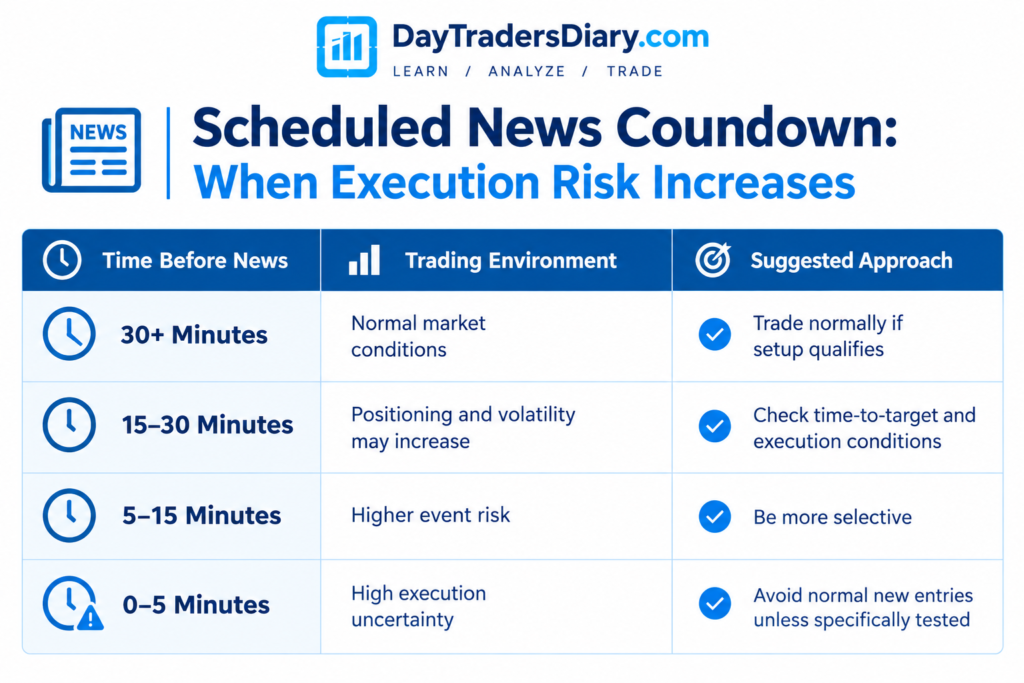
So I like a basic countdown format.
Trade normally if the setup qualifies and the release is more than 30 minutes away.
Start watching after 15 to 30 minutes to check if the offer can actually accomplish its goal before the event.
Within 5 to 15 minutes, become much more selective because the market may already be positioning for the release.
Inside the final few minutes, a normal discretionary setup can become an event-risk trade without you changing anything on the chart.
That last point catches traders constantly.
The setup did not change.
The clock changed.
The Hidden Risk Is Not Always Slippage
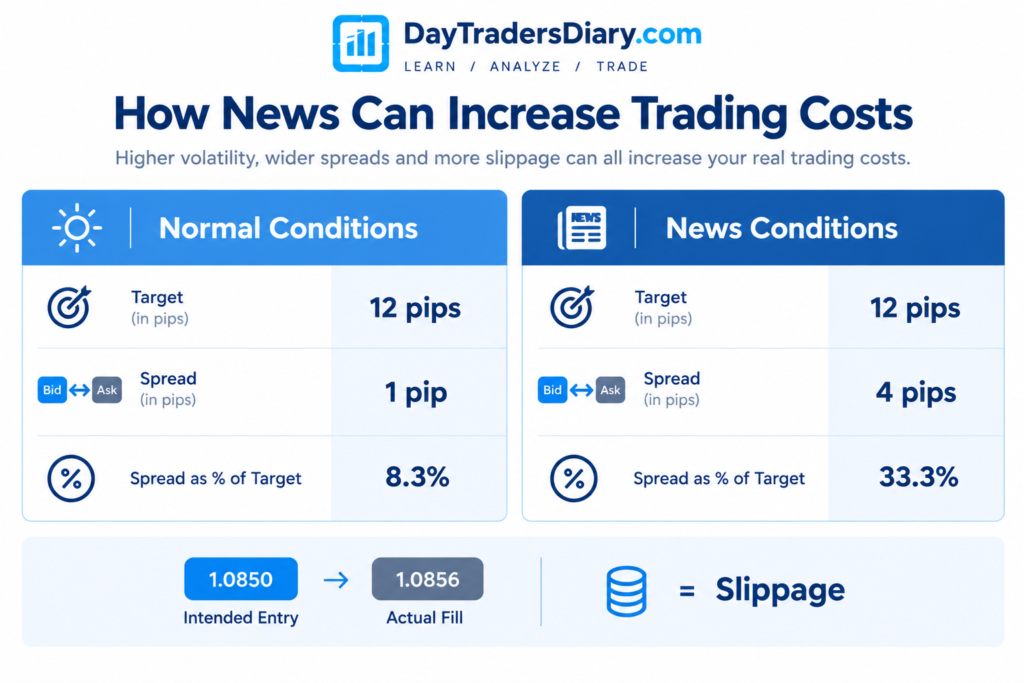
Slippage gets most of the attention, but spread expansion can damage a trade before slippage even occurs.
Suppose your target is 12 pips.
Under normal conditions, the spread is 1 pip.
That is roughly 8.3% of your target.
If the spread expands to 4 pips, the economics of the trade are completely different.
DayTradersDiary’s guide on trading only when spread advantage occurs This link is examined, and it is shown how the spread should be calculated in relation to the trade’s aim rather than being considered a set transaction cost.
Around scheduled news, that measurement becomes even more important.
The Stop-Loss Problem
A common mistake is placing a normal stop immediately before a major release.
Imagine your normal EUR/USD stop is 10 pips.
The market typically moves 4 to 6 pips during the relevant five-minute period.
Then CPI arrives.
The first price reaction moves 15 pips in seconds.
Your stop was technically correct according to the pre-news chart.
But the market regime changed.
This is where session-specific stop-loss planning becomes useful. The stop should reflect the trade thesis and current market conditions, while position size should adapt to the resulting stop distance.
Do not make the common mistake of tightening the stop simply because the wider stop makes the position too expensive.
Reduce the position size instead, or reject the trade.
The News Distance Test
Before entering the news, ask one question:
How much price movement does my trade need before the news arrives?
Suppose your entry is 1.0850, your target is 1.0870, and CPI arrives in eight minutes.
You need 20 pips.
Your recent average movement during this period is only 6 pips.
You are effectively asking the market to complete an unusually large move before the clock runs out.
That trade should be treated differently from the same setup when the release is 90 minutes away.
Time is part of the risk calculation.
Entry Delay Makes News Risk Worse
News risk is particularly serious when traders are reluctant.
The trader sees a breakout at 1.0850 but waits.
Price touches 1.0858.
The setup still appears to be there.
Enter the trader.
Then the news hits.
Now the entry is worse, the remaining reward is smaller, and volatility is higher.
This connects directly with DayTradersDiary’s article on entry delay risk in forex, which treats the deterioration between planned and actual entry as something that can be measured rather than dismissed as bad luck.
Around scheduled news, delay risk and event risk can compound.
Use A News-Adjusted Position Size
This is where most traders miscalculate risk.
Suppose your normal stop is 15 pips.
Your news-adjusted structural stop is 25 pips.
If you keep the same lot size, your monetary exposure increases.
Instead, calculate the position size from the actual stop.
The DayTradersDiary Position Size Calculator is designed to translate account size, risk percentage, and stop distance into an appropriate position size.
The calculator should not decide whether the trade is worth taking.
It should prevent your position size from quietly increasing your risk.
Three Ways To Handle Scheduled News
There are three broad approaches.
The first is to be flat before the event.
This is appropriate when your strategy has no tested advantage during news and your priority is predictable execution.
The second is to hold an existing position through the event.
This can make sense when the trade was established earlier, and the strategy has been specifically tested for event exposure.
The third is to trade the release deliberately.
That is a different strategy altogether.
It requires separate data because the entry mechanics, spread behavior, slippage, stop placement, and volatility distribution are different.
Do not mix these three approaches in one performance dataset.
A Better News Journal
Your log should record the event name, scheduled release time, minutes between entry and release, intended entry, actual fill, adverse slippage, spread at entrance, stop distance, target distance and whether the position was already open before the event.
Then record the result in R.
The downloadable Trade Journal Template can be used as the base for this research because DayTradersDiary provides Excel and Notion trade-journal templates through its trading toolkit.
After enough trades, you may discover that your performance changes dramatically depending on whether the entry occurred 30 minutes, 10 minutes, or 2 minutes before a release.
That is an edge worth knowing.
The Filter I Would Test
The practical beginning point is to establish three conditions.
The first one is a standard window when your strategy trades without any news limitations.
The second is a warning window where the setup has to meet tougher reward, spread, and execution requirements.
The third is a no-new-entry window immediately surrounding the release.
Do not copy fixed time periods unthinkingly.
Test them.
Your data may show that your strategy deteriorates 12 minutes before major releases. Another strategy may deteriorate 30 minutes before.
The market does not owe every strategy the same timing profile.
News Trading And Professional Capital
This becomes particularly important when trading an evaluation account.
An evaluation is not simply larger personal capital. It introduces another set of rules governing drawdown, execution, and permitted trading behavior.
For example, The5ers currently states that its High Stakes program allows existing positions to remain open through high-impact news, but prohibits executing new orders from two minutes before until two minutes after high-impact news under its published rules.
That distinction matters enormously for a news-based trader.
Your strategy may be profitable around CPI, but if its edge depends on placing a new order inside a restricted window, the strategy and evaluation rules do not fit.
The5ers is not the only evaluation provider traders can research. Firms such as FTMO and other proprietary trading companies use their own drawdown, news, holding, and execution rules.
The serious approach is to compare the rule set with your actual strategy before paying for an evaluation.
If your personal account is too tiny to efficiently represent a proven edge, then the5ers High Stakes program might be considered as a professional capital-allocation pathway (not as a shortcut). The current disclosed structure is a two-step review, daily maximum loss limits, and special restrictions on new orders around high-impact news.
Final Thoughts
Scheduled news does not mean “do not trade” automatically.
That is, you have to adjust the way you measure the trade.
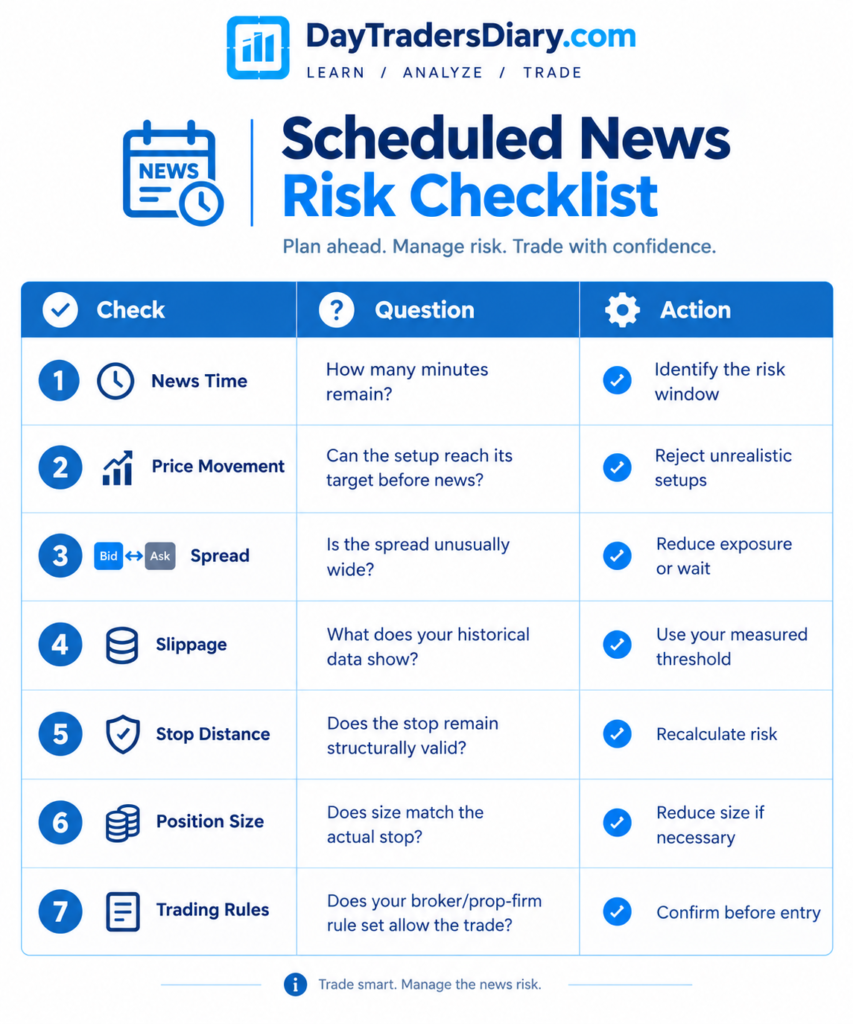
Before you release, ask yourself how much time is left, how much movement you need in the setup, what spread you’re paying, what slippage your historical data reveals, whether the stop is still structurally sound, and if the position size still fits your risk budget.
Then track the answer.
The most useful challenge is simple: for your next 30 news-related trades, stop recording only whether you won or lost. Record exactly how many minutes remained before the release and how much adverse slippage occurred.
You may discover that your strategy does not have a news problem.
It has a timing problem.
For the next read, study How To Quantify News Volatility Before Entry. It complements this framework by focusing on measuring the expected volatility regime before the announcement rather than treating news as a simple calendar event.
FAQs
What is scheduled slippage risk in day trading?
It is the risk of execution around a known economic statement at a considerably worse price than predicted due to rapidly changing price movement and available liquidity.
How long before high-impact news should I stop trading?
There is no universal cutoff. Test your strategy and measure where spread, slippage, and trade expectancy begin deteriorating.
Does high-impact news always cause slippage?
No. Slippage depends on market conditions, instrument, liquidity, order type, broker or venue, and the magnitude and surprise of the announcement.
Should I close trades before CPI or NFP?
That depends on whether your strategy has been tested for holding through the event. If it has not, treating the release as a separate risk regime is more defensible than assuming normal execution conditions continue.
Is news trading a separate strategy?
Yes, usually. The volatility and execution characteristics of trading before, during and after a large release are distinct and should normally be examined independently.
How can I reduce news-related risk?
First, decide on your timing, position size, stop distance, spread exposure and maximum slippage you can tolerate. And the largest benefit is typically not entering during a window where your own data is showing poor performance.
Can a prop firm allow news trading?
Rules vary by employer and program. For example, The5ers now allows keeping existing High Stakes positions through high-impact news but does not allow new order execution around certain high-impact releases. Check the current rules of the particular program carefully before trading.