
You enter a trade with a clear plan. Your entry makes sense, the stop loss is in place, and the setup matches what you have been waiting for. Then the price starts moving against you.
At first, you accept the pullback. A few minutes later, you begin watching every candle more closely. You start wondering why sellers are so aggressive, whether someone is hunting your stop, or whether the market is behaving differently from what you expected. Before long, you are looking for reasons to keep the trade open, even though your original analysis is no longer holding up.
Most traders have experienced some version of this. The problem is not simply losing money. It is how quickly a normal price movement can change the way you see the market.
This is where a pip aggressor bias method can be useful. It provides a way to examine how price movement affects your thinking and whether that thinking leads you away from your trading plan. Rather than treating every adverse pip as a warning, you learn to separate what the chart is showing from what your emotions are telling you.
The method is not a recognised technical indicator with a universal formula. It is a practical framework for improving trade decisions, especially when a position starts moving in the wrong direction.
What Is Pip Aggressor Bias?
Pip aggressor bias describes a situation in which a trader begins interpreting price movement as increasingly hostile when a trade moves against them. Ordinary pullbacks start to look suspicious, normal volatility feels threatening, and a losing position becomes something the trader wants to defend.
For instance, you go long EUR/USD at 1.0850 with a stop loss of 1.0820. Your risk is 30 pips. At 1.0840, you begin to doubt the trade. At 1.0835, you believe the market is too aggressive. You believe the market is on the verge of making a turn, so you take your stop down to 1.0830.
The market has moved 20 pips against you. More importantly, your original rules have started to change.
There may be a valid reason to reassess a trade when new information appears. The problem arises when the only new information is that the position is losing money.
A useful pip aggressor bias method examines three things: how far the price has moved, what you believe that movement means, and what you do because of that belief.
The aim is to recognise when an objective trading decision is becoming an emotional reaction.
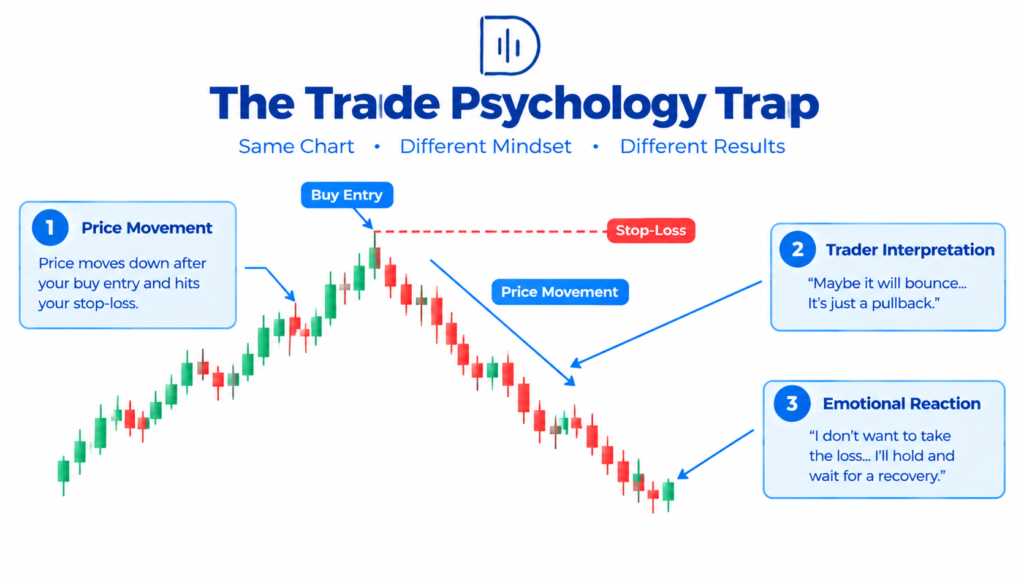
The Psychology Behind Pip Aggressor Bias
Hostile attribution bias and hostile perception bias are a couple of psychological principles that explain why traders may sometimes view the daily movement on a market as a personal affront.
Hostile Attribute Bias (reading hostile intent into neutral actions). In trading, this might mean a trader believes the market moved against their position intentionally, or that they hit a stop-loss to get out of a trade.
Of course, financial markets do not need to know where an individual trader entered. Price can move through a stop level because of order flow, volatility, liquidity conditions, or new information. A stop being triggered does not, by itself, establish that anyone deliberately targeted it.
A close relative is the hostile perception bias. It’s a bias of perceiving an uncertain situation as dangerous prematurely, before there’s enough data to conclude so much. For example, a trader in the buy may think they are betrayed by the appearance of a big bearish candle out of the blue, but the big picture does not change.
Both problems are harder to fix with self-serving bias. Traders may credit analysis for winning trades and blame manipulation, brokers, or market conditions for losing trades. This temporarily boosts confidence but makes it hard to spot plan flaws.
These ideas connect with established research on human judgment. The American Psychological Association’s Dictionary of Psychology describes how humans attribute causes to events using attribution. This reminds traders that our reasoning for a price move may not be correct.
In their influential research on judgment under uncertainty, Amos Tversky and Daniel Kahneman examined how mental shortcuts can influence decisions. The disadvantage is that traders (particularly day traders) are under financial pressure to make hasty decisions and may be narrow-minded.
The CFA Institute’s behavioural finance resources also examine how psychological tendencies affect financial decisions. These concepts do not mean every losing trade is caused by bias. They explain why traders should question their interpretations instead of automatically trusting the first explanation that comes to mind.
How To Build A Pip Aggressor Bias Method
The best time to build this method is before entering a trade. Once you have money at risk, it becomes much easier to justify decisions that you would have rejected while looking at the same chart without a position.
Start With Your Original Trading Plan
Before placing an order, write down why the setup is valid and what would prove your analysis wrong.
Suppose GBP/USD breaks above resistance, and you enter after a retest. Your plan might require the price to hold above the broken level while the market structure remains bullish. If the price closes back below the zone and breaks an important swing low, the setup may no longer be valid.
That is a condition you can observe and test. Saying that the market suddenly looks weak is less useful because it does not explain what has actually changed.
Reviewing historical trades through a structured day trading strategy backtest can help you understand how much adverse movement your setup normally experiences. If a strategy regularly pulls back before continuing, you need to know that before deciding every pullback signals failure.
Your original plan will not always be right. Its purpose is to give you a consistent basis for making decisions rather than allowing every new candle to change your opinion.
Measure How Far Price Moves Against You
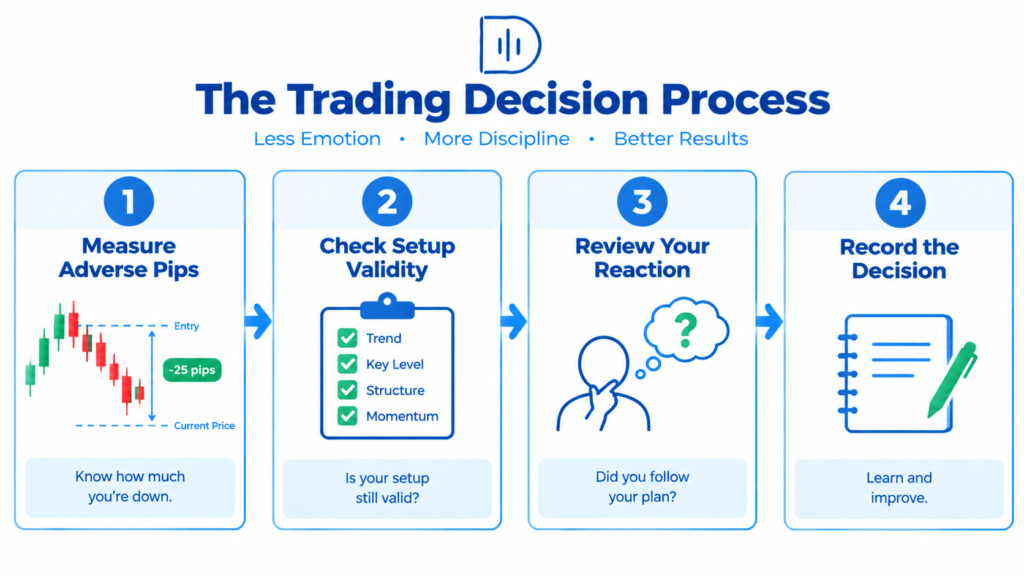
One practical measurement is maximum adverse excursion, commonly shortened to MAE. It records the greatest movement against your position while the trade is open.
For example, if you buy EUR/USD at 1.0850 and the price falls to 1.0838 before you close the trade, your maximum adverse excursion is 12 pips, excluding transaction costs and differences in executable prices.
That number becomes more useful when you compare it with your planned stop distance and the normal behaviour of your setup. Twelve pips might be insignificant for one strategy and a serious warning for another.
Over time, your records can show whether you tend to intervene after a small pullback, whether your stops are too tight for the conditions, or whether you are simply uncomfortable with normal trading losses.
Do not confuse measuring adverse movement with predicting reversals. MAE tells you what happened during a trade. It does not tell you what price must do next.
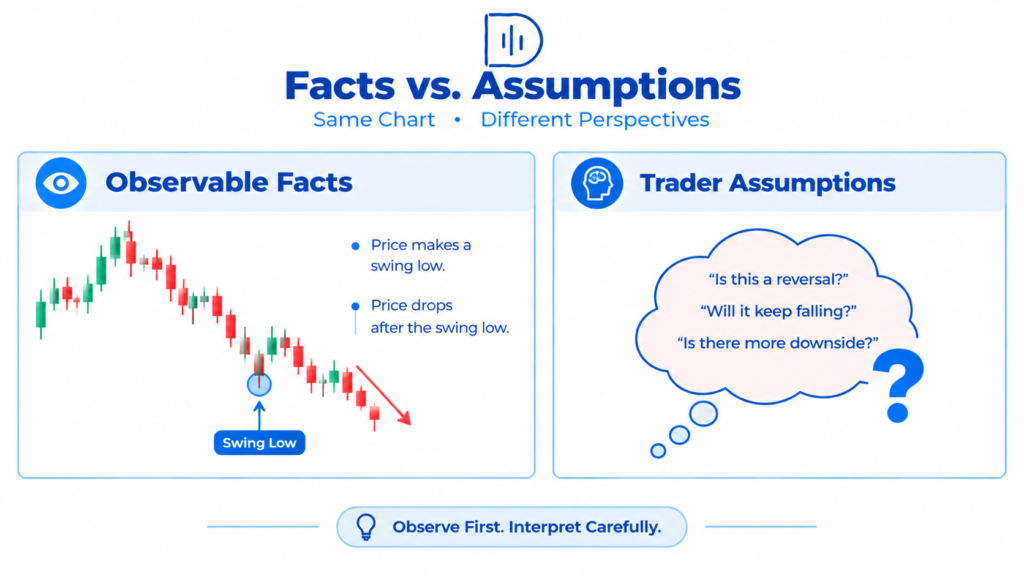
Separate What You See From What You Assume
This is the part of the method that requires the most honesty.
Suppose you are long on gold and the price suddenly drops. Your first thought might be that sellers are hunting your stop. Instead of accepting that explanation, describe the chart without adding a motive.
You might say the price is down $8 from the entry and is testing the prior swing low and has negative momentum. These are things you might validate.
Then you can write that you feel your position is in the sights of the market. That’s your opinion, not a fact.
Once the two are separated, return to your trading plan. Has the setup been invalidated? Has a relevant level failed? Has new information changed the conditions? Or are you reacting mainly because the position is losing money?
You do not need to feel calm before making a good decision. You need a process that stops an uncomfortable feeling from becoming a new trading rule.
Create A Review Point Based On Pip Movement
Some traders find it helpful to set a review point before entering. This does not have to be a signal to close the position. It is simply a reminder to reassess the trade before emotions become stronger.
For example, if you aim to stop out 20 pips away, do your thinking when the trade goes 5 pips against you and again at 10 pips. At each of these points, reconsider the initial setup if it still exists and whether you have a plan of action.
The advantage is that you decide how to respond before the pressure arrives. You are less likely to make a sudden change simply because the unrealised loss has become uncomfortable.
However, these checkpoints should suit your strategy. A short-term momentum setup and a slower pullback strategy will not behave in the same way. Do not use a fixed pip threshold as a substitute for understanding the instrument and setup you trade.
Judge The Quality Of Your Decision, Not Just The Result
A trade can lose money even when you execute it correctly. Another trade can make money even though you ignored your stop and took an unnecessary risk.
So if all of your decisions are based on the naked pound/pence and you’re judging them just on any profit/loss, you will be inadvertently rewarding bad habits. A trader who squeezes out profit from a moving stop can mistakenly think the activity is productive.
Then ask if you met your terms of admission, lived up to the expectations of your degree of involvement, and performed in the position as you hoped. Distinguish the outcome from the quality of the decision.
This distinction becomes increasingly important over a large sample of trades. Your goal is not to win every trade. It is to make decisions that give your strategy a fair chance to perform as expected.
Keep Risk Management Separate From Emotion
The pip aggressor bias ends a losing position without the need to be challenged.
Imagine a 20-pip stop on your position. Now imagine the same scenario with a 35-pip halt. You increased your dollar risk by 75%, without including cost and slippage. You didn’t improve the trade by adding room. You’ve increased your loss.
This is where the Position Size Calculator can help. Calculate your position size using your planned risk, stop distance, and the pip value of the instrument before placing the order.
If the setup requires a wider stop, recalculate the position size. Do not allow the fear of being stopped out to determine how much capital you expose.
Note that the dollar value of a pip is not fixed but depends on the currency pair, position size, and denomination. Movement debrief is nice for behaviour, but dollar risk is a different calculation.
Use Your Trading Journal To Find Patterns
It is difficult to improve a habit that you never record. A trading journal allows you to move beyond remembering the trades that upset you most and start examining what happens repeatedly.
Write down for each trade important to the system your motivation for entering the trade, your planned stop, and maximum unfavourable excursion, what you changed during the course of the deal, and your feelings when the price went against you. Then note whether or not you followed your original rules.
The Trade Journal Template can provide a starting point for organising these observations.
During your weekly review, look for connections between your behaviour and the conditions you trade in. Perhaps you move stops more often after two consecutive losses. Perhaps you exit profitable positions too early after experiencing a difficult morning. You might even find that the problem occurs mainly around news releases, when spreads and volatility can change quickly.
These observations give you something specific to work on. Instead of telling yourself to become more disciplined, you can address the situations in which your discipline tends to break down.
Start with 20 to 30 trades as an initial sample, then keep collecting records. This may reveal obvious habits, although a larger sample is often needed to establish whether a pattern is consistent across different market conditions.
Building Consistency Before Seeking More Capital
Once your trading process becomes more consistent, you may start considering ways to access additional capital. But a larger account does not automatically improve a weak decision-making process. It can make the consequences of emotional mistakes more expensive.
Evaluation programs from firms such as The5ers, FTMO, and TradeThePool offer different routes for eligible traders seeking access to trading capital. They vary by market, fees, criteria, drawdowns, and payout terms—check current terms in advance before depositing money.
If you want a more structured evaluation approach, consider The5ers. The challenge is not if an eval will drive profitability, but if you can make your edge work inside the program’s confines.
A trader who regularly widens stops, increases risk after losses, or abandons a plan under pressure may struggle with strict drawdown limits. Spending money on an evaluation before addressing those habits can add another source of pressure.
Approach the matter as a business decision. When you accept a drawdown, consider the guidelines, reflect on your ability to stick to them, and review your trading journal. An evaluation should be done after you have proven your discipline, not to recover from previous losses or to prove you can trade.
Frequently Asked Questions
Is pip aggressor bias a recognised trading indicator?
No. It is best described as a realistic approach to studying against an undesirable price movement, the mind and gist of the trader. There is no fixed formula or setting for an indicator.
How is hostile attribution bias different from hostile perception bias?
Hostile attribution bias includes making an inference (an assumption) about an unclear occurrence as being intended to hurt. Hostile perception bias is the idea that an unclear event is the starting point of a threat. One has you believing that the market “marked” your stop for trading; the other makes a routine downturn seem risky until there is any evidence.
How can I recognise pip aggressor bias in my own trading?
Look for repeated changes to your plan after a position moves against you. Moving stops without a tested reason, blaming every stop-out on manipulation, and changing your market outlook to justify holding a losing trade are possible warning signs. Review your journal to determine whether these behaviours recur.
Should I close a trade after a certain number of adverse pips?
No, not by default. A pip threshold may trigger a reassessment of the configuration, but it should not trump your rules of entry, exit, and invalidation. The right call will rely on the strategy, the volatility, and the conditions you set before you entered.
Can profitable traders experience this bias?
Certainly, successful traders are not immune to wishful thinking, either, in terms of distorting losses or going into defence mode if the transaction turns against them. Conversely, self-serving bias can lead to overconfidence following a winning streak and a willingness to take an unwarranted risk.
How many trades should I review?
Start with 20-30 trades and search for clear behavioural trends, and then gather more data. Don’t take a definite conclusion from one bad session or a few losses; seek to compare like setups and market situations.
Final Thoughts
And you want an explanation when the pricing turns against you. But the danger occurs when the explanation turns into an excuse to disregard the guidelines you have in place PRIOR to the trade.
The pip aggressor bias method gives you a way to slow that process down. Measure the movement, record your interpretation, and check whether your next action follows your plan. You may discover that your strategy needs adjustment, or you may find that the setup was fine and your reaction was the real problem.
For your next 20 trades, pay particular attention to what you think and do when a position starts losing money. Do not try to eliminate every emotional response. Focus on making sure those responses do not quietly change your risk.
Once you have reviewed those trades, continue with how to find high-probability trading setups. A strong setup matters, but consistent execution is what gives that setup a chance to produce results over time.