
Most losing trades don’t happen because traders lack knowledge.
They happen because traders skip one small step.
You identify the trend correctly. You find a solid setup. You understand your risk. Then, just before entering, excitement takes over. You ignore a nearby resistance level, overlook an economic news release, or increase your position size because the trade “looks too good to miss.”
Ten minutes later, you’re asking why a perfectly good strategy failed.
The strategy may not have failed at all.
Your process did.
After years of reviewing trading journals from both profitable and struggling traders, one pattern appears repeatedly. Consistent traders rarely make better predictions than everyone else. They make fewer preventable mistakes because they follow the same decision-making routine every single time.
One of the most effective ways to build that discipline is through a tick-based day trading checklist.
This is not a list of motivational reminders or generic trading rules. It is a practical decision framework that forces you to verify every important condition before risking capital.
The goal is simple.
If a setup does not satisfy your checklist, it does not deserve your money.
What Is a Tick-Based Day Trading Checklist?
A tick-based day-trading checklist is a structured set of questions that must be answered before entering any trade.
Each condition receives a simple yes-or-no answer.
If all required conditions are met, the trade qualifies.
If even one critical item is missing, the trade is skipped.
Think of airline pilots.
Even after thousands of successful flights, they still complete a checklist before takeoff.
They hadn’t forgotten how to fly.
Because checklists keep little mistakes from turning into costly ones.”
The same thing is true for professional traders.
The checklist removes the emotion and replaces it with consistency.
Why Checklists Improve Trading Performance
The purpose of a checklist isn’t to predict markets.
The objective is to enhance the quality of decision making.
Every trade has its uncertainties.
What a trader can control is whether they are executing their edge consistently.
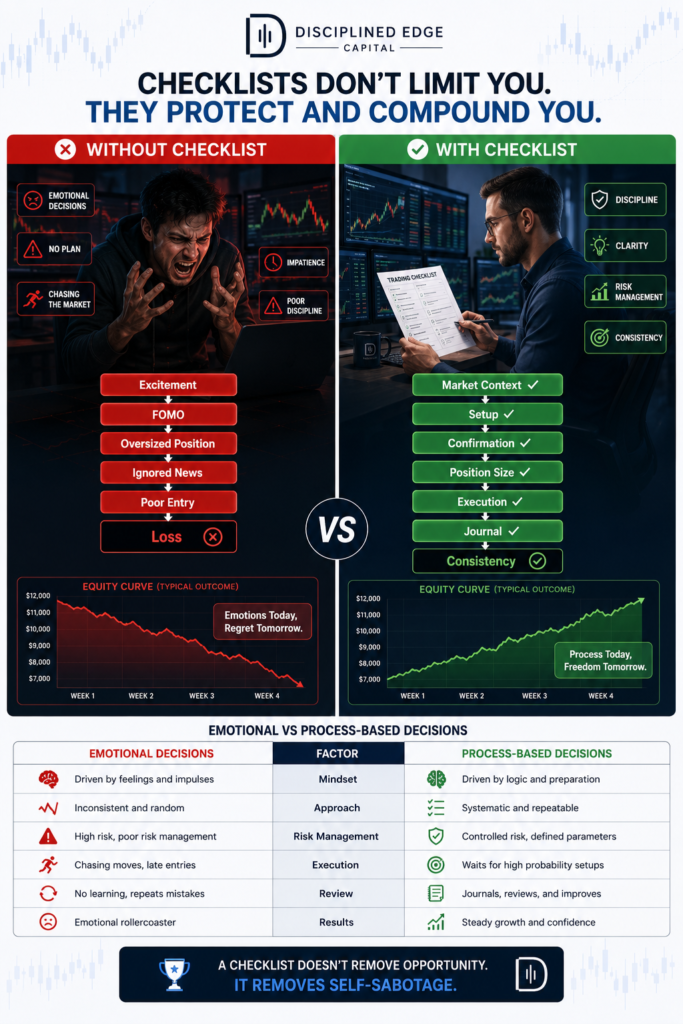
Without a checklist, decisions often change depending on confidence, recent profits, frustration, or fear of missing out.
Using a checklist, every setup is evaluated according to the same standards.
That consistency produces better data, better journaling, and more reliable long-term results.
Research Supports Structured Decision-Making
The value of checklists is well-documented outside financial markets.
The World Health Organization (WHO) introduced surgical safety checklists, which significantly reduced preventable errors in operating rooms worldwide.
In The Checklist Manifesto, surgeon and researcher Atul Gawande demonstrated how structured checklists improve decision quality in complex, high-pressure environments.
Research published by the CME Group also emphasizes that successful futures trading depends on preparation, disciplined execution, and consistent risk management rather than predicting every market move.
For day traders, the lesson is obvious.
Trading is another high-pressure environment where small execution mistakes produce disproportionately large consequences.
The checklist exists to reduce those mistakes.
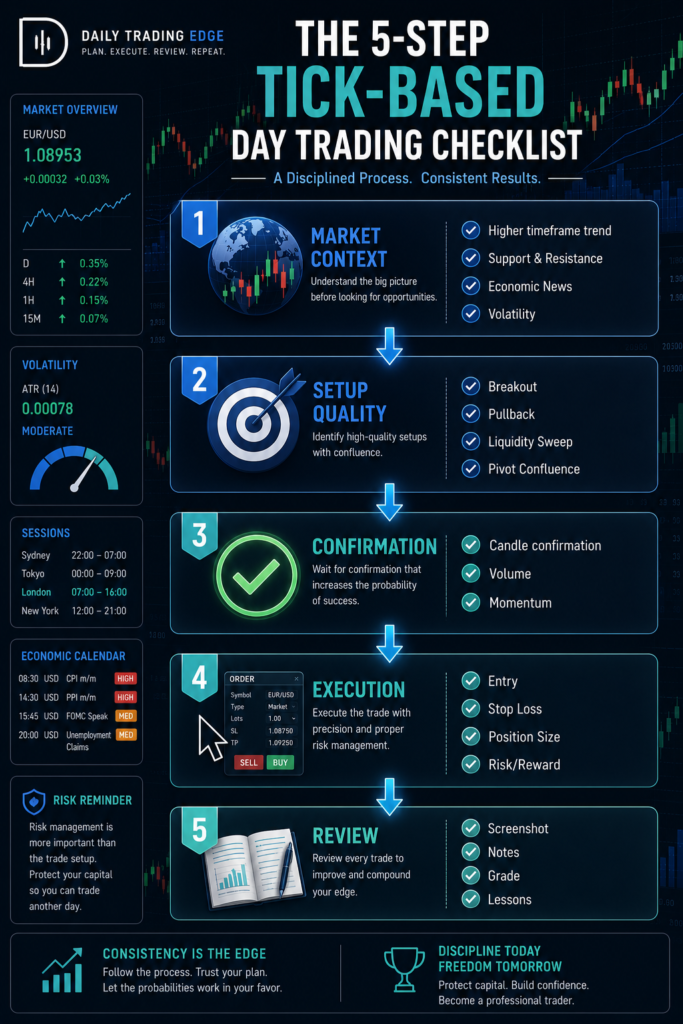
The Five Stages of a Professional Trading Checklist
Instead of creating a checklist filled with random technical indicators, organize it around the natural flow of a trading decision.
The first stage is market context.
Before looking at entries, determine the higher-timeframe trend, important support and resistance levels, overnight highs and lows, scheduled economic events, and expected volatility.
The second stage is setup quality.
Ask whether the trade matches your strategy.
Is this a pullback?
A breakout?
A liquidity sweep?
A pivot confluence setup?
If the setup cannot be clearly classified, there is usually no edge.
The third stage is confirmation.
Has the price actually confirmed your idea?
Many traders confuse anticipation with confirmation.
Professional traders wait for evidence.
The fourth stage is execution.
Determine the exact entry price, stop-loss location, target, and position size before entering.
Nothing should be improvised once the trade begins.
The fifth stage is post-trade review.
Every completed trade becomes feedback that improves future decisions.
Skipping this stage limits long-term growth.
What Should You Actually Tick Before Every Trade?
Your checklist should answer practical questions rather than theoretical ones.
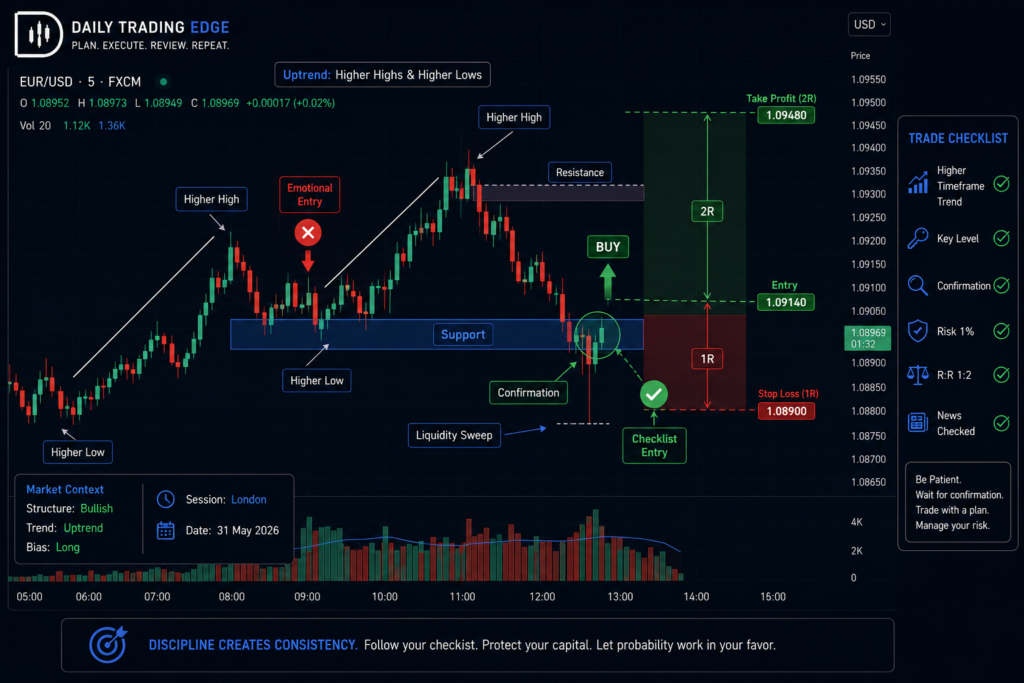
Is today’s market suitable for my strategy?
Does this trade align with the higher-timeframe trend?
Is the price at a key level?
Is there clear verification?
Have I located liquidity pools near me?
Big economic news incoming?
Is the return I intended worth the risk?
Am I size the positions properly?
Can I explain this trade in one sentence?
If you cannot confidently answer those questions, the market is asking you to wait.
The best checklist is not the longest one.
It is the one you actually follow.
Why Simplicity Beats Complexity
A lot of traders compile huge checklists of twenty or thirty conditions.
That’s professional, at first.
It gets tiresome eventually.
If a checklist is too complicated, traders give up on it.
A practical checklist usually contains only the decisions that genuinely improve outcomes.
Ask yourself a simple question.
Has this condition historically separated my winning trades from my losing trades?
If the answer is no, it does not belong on the checklist.
Every item should earn its place through evidence rather than opinion.
Building a Checklist Around Your Own Strategy
A breakout trader should not use the same checklist as a mean reversion trader.
Likewise, a futures trader may prioritize different conditions than a forex trader.
Your checklist should reflect your edge.
For example, traders using liquidity concepts may require confirmation that the price swept a previous high or low before entering.
Traders focusing on pivot confluence may require alignment between higher-timeframe support and daily pivot levels.
Those who trade the London session may include Asian session range analysis before considering any breakout.
This is why our articles Using Pivot Confluence Only With Three Conditions, What Does Liquidity Sweep Look Like on a Chart, and How Many Pips Do London Session Breakouts Average naturally fit together. Each teaches a different filter that can be added to a personalized checklist.
The Psychology Behind Following a Checklist
The biggest challenge is rarely creating the checklist.
It is respecting it.
After several winning trades, confidence grows.
Rules begin to feel optional.
After several losing trades, frustration grows.
Patience disappears.
Ironically, both emotional extremes encourage traders to abandon their process.
The checklist acts as a psychological anchor.
Instead of asking how confident you feel, it asks whether the market has satisfied your predefined conditions.
That change makes trading a matter of professional execution rather than emotional decision making.
Risk Management Belongs on Every Checklist
Risk management is often seen as a separate topic by many traders.
It is not so.
You know, the entry decision itself is risk management.
Before every trade, confirm exactly how much capital is at risk.
Never determine position size after choosing the lot size.
This is where most traders miscalculate risk. Using the Position Size Calculator removes guesswork by calculating the appropriate position size based on your stop-loss distance and predefined account risk.
Risk management is what prevents you from blowing up your account when a good setup goes bad.
Turn Every Trade Into Data
A checklist becomes far more valuable when combined with detailed journaling.
Record whether every checklist item was completed.
If you broke one rule, write it down honestly.
After looking at a hundred trades the patterns become impossible to ignore.
The best trades you ever took were when higher timeframe trends were aligned.
Maybe all lost trades disregarded scheduled economic news.
These observations transform a simple checklist into a measurable trading edge.
Our downloadable Trade Journal Template helps you organize this information so you can evaluate execution quality rather than focusing only on profits and losses.
Scaling a Disciplined Trading Process
One advantage of following a structured checklist is that it creates consistency.
Consistency is exactly what professional evaluation firms are looking for.
Companies such as The5ers, FTMO, and FundedNext are not looking for traders who occasionally double their accounts.
They want traders who repeatedly demonstrate disciplined execution while respecting predefined risk limits.
A trader with a repeatable checklist often adapts more easily to evaluation programs because every trade already follows a documented process.
If you have a journal with consistent positive expectancy and disciplined execution then a The5ers evaluation account may be a practical next step for you to manage larger sums of capital without continuously raising your personal investment.
Common Mistakes Traders Make With Checklists
One mistake is creating a checklist but never reviewing it.
Another is adding conditions after every losing trade until the process becomes impossible to follow.
Some traders also ignore their own checklist whenever a trade “feels different.”
Those are usually the trades that deserve the checklist the most.
Finally, many traders confuse activity with discipline.
Checking boxes without genuinely evaluating the market defeats the entire purpose.
The checklist is meant to improve thinking, not replace it.
Final Thoughts
Every trader wants better entries.
Fewer traders focus on making better decisions.
It makes a difference.
Markets will always be uncertain.
Your procedure doesn’t need to.
Where emotions naturally create inconsistency, a tick based day trading checklist creates consistency.
It allows you to filter out sub-par setups, preserve your capital and collect useful performance statistics over time.
For the next month, commit to one challenge.
Do not enter a single trade until every required item on your checklist has been ticked.
You may discover that the trades you skip become just as valuable as the ones you take.
For your next read, explore Using Pivot Confluence Only With Three Conditions to see how one specific trade filter can become a permanent part of your daily checklist.
Frequently Asked Questions
What is a tick-based day trading checklist?
A tick based day trading checklist is a list of parameters traders check before they enter a deal. Each item is answered with a simple yes or no, which helps eliminate emotional and impulse decisions.
Why do professional day traders use checklists?
Professional traders use checklists to ensure consistency, reduce preventable errors and ensure that each trade meets specific criteria regardless of emotions or euphoria of the market.
How many items should a trading checklist include?
The most effective checklists include just the conditions which improve decision quality. A short set of rules that are always followed is frequently more useful than a very lengthy list.
Should every trading strategy have the same checklist?
No. A breakout strategy needs different filters than a trend following approach or a mean reversion method. Your checklist should be customised to the specific conditions that define your trading edge.
Can a checklist improve trading performance?
A checklist won’t tell you where the market is headed, but it can help you make better decisions by avoiding hasty trades and by assuring consistent decision making over a wide sample of trades.
How should I improve my checklist over time?
Review your completed trades regularly using a trading journal. Remove conditions that add little value and strengthen the rules that consistently separate your best trades from your weakest ones.